
How to Create a Shadow Work Embroidery Effect with AI — Magic Eraser
Step-by-step tutorial for creating shadow work embroidery effects with AI tools. Transform images into delicate designs with herringbone stitch shadows on sheer fabric, muted color silhouettes, and authentic whitework translucency.

SEO & Growth
Reviewed by Magic Eraser Editorial ·
Table of Contents
- Understanding shadow work: the herringbone stitch and translucency principle
- Creating the sheer fabric base: translucency, texture, and ground preparation
- Designing shadow motifs: shape selection, outline work, and fill application
- Color management, finishing refinements, and advanced shadow work variations
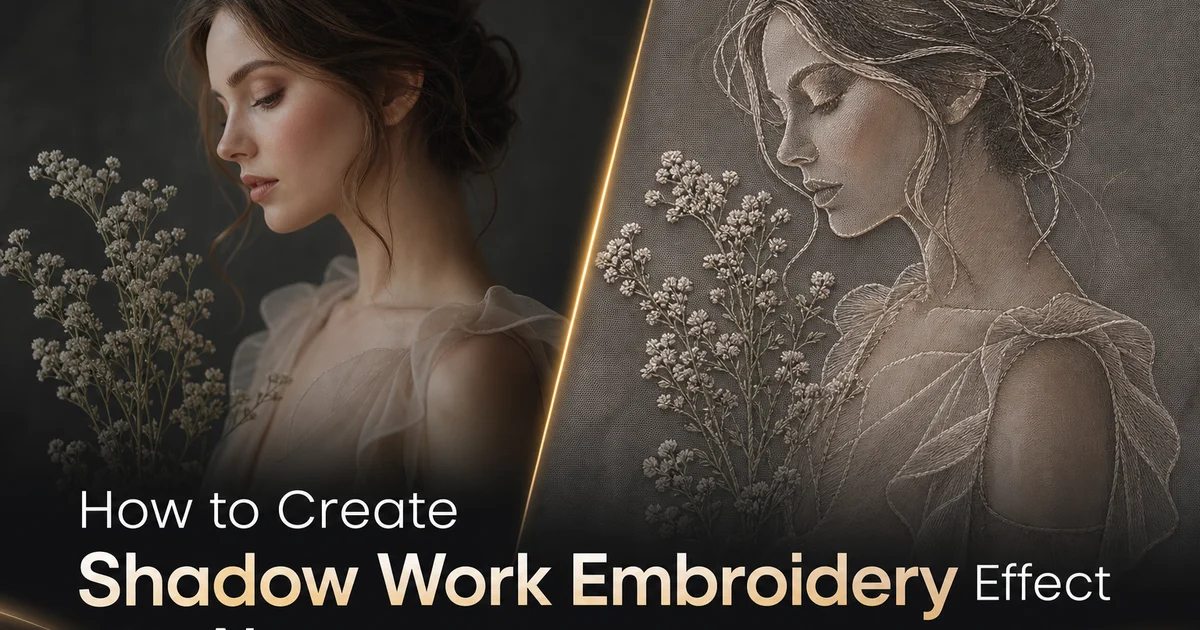
Shadow work embroidery is one of the most ethereal and visually distinctive forms of needlework, creating designs that appear to float within sheer fabric as softened color silhouettes rather than sitting on the surface like conventional embroidery. The technique works by stitching on the reverse side of translucent fabric. Organdy, voile, fine batiste, or other sheer materials — so that the thread color shows through to the front as a muted, diffused shadow whose edges are softened by the fabric layer between thread and viewer. The primary stitch is closed herringbone worked on the back, creating a dense criss-cross lattice that fills each design shape with overlapping diagonal thread lines. When viewed through the sheer fabric from the front, this lattice reads as a solid area of softened color, with the small backstitch lines where the herringbone crosses the design outline visible as fine defining marks on the fabric surface.
The visual effect is unlike any other embroidery technique. A watercolor-like softness where colors are muted by passage through translucent fabric, outlines are delicate rather than bold, and the overall impression is of color caught within the fabric rather than applied to it. Shadow work has been prized for centuries for christening gowns, bridal wear, fine table linens, and ecclesiastical vestments, where its ethereal quality suits occasions and settings that call for understated elegance rather than bold decoration. The technique reached its highest development in Indian chikan embroidery, where shadow work elements combine with surface stitching on muslin to create designs of extraordinary delicacy. In European whitework traditions where shadow effects in white thread on white organdy produce patterns visible only through the play of light and transparency.
AI-powered image editing tools can now simulate the distinctive visual character of shadow work embroidery with remarkable fidelity, recreating the translucent fabric ground, the diffused herringbone shadow fills, the fine surface outlines, and the muted color palette that define this technique. The challenge is at its core one of layered transparency. Creating the illusion of color seen through a semi-opaque surface rather than applied directly to it — which requires careful management of opacity, edge diffusion, color desaturation, and the subtle texture variations that distinguish thread-through-fabric shadow from simple transparent overlay. This tutorial covers the complete process from sheer fabric base preparation through motif design, shadow fill application, and final refinement, explaining the traditional embroidery principles that make shadow work visually distinctive and showing how AI tools replicate each element of the layered effect.
- AI tools simulate the layered transparency of shadow work where herringbone stitch on the fabric reverse shows through as muted color silhouettes on the front surface of sheer organdy, voile, or batiste.
- AI Enhance fine-tunes the critical shadow depth and fabric translucency balance — visible enough to define the design but soft enough to read as color through fabric rather than printed on it.
- Magic Eraser cleans design elements to establish the smooth flowing outlines that shadow work requires, as herringbone fill reads best in curved petal, leaf, and scroll shapes.
- The herringbone lattice simulation shows subtle density variations at thread crossing points, producing living textured shadow fills rather than flat uniform color tints.
- Batch export produces files for textile printing, wedding stationery, fine art reproduction, and digital applications that preserve the delicate shadow-through-fabric translucency effect.
Understanding shadow work: the herringbone stitch and translucency principle
The mechanics of shadow work embroidery are elegantly simple yet produce an effect that seems almost magical to viewers unfamiliar with the technique. The embroiderer works on the reverse side of a sheer fabric, stitching closed herringbone stitch between two parallel design outlines. The herringbone consists of diagonal stitches that alternate between the top and bottom design lines, crossing each other in the center to create a dense lattice of overlapping thread. Where each diagonal stitch reaches the design outline, it takes a tiny backstitch along the outline before crossing back to the opposite side. These backstitches, visible on the front of the fabric, create the fine outline that defines the motif edge. The body of the herringbone fill, stitched fully on the reverse, is visible through the translucent fabric only as a soft area of muted color. This is the shadow that gives the technique its name.
The fabric choice determines the entire character of the finished shadow work. Organdy — a crisp, sheer cotton fabric with a permanent stiffness — is the traditional ground for shadow work because its translucency allows thread color to show through while its crispness holds the fabric taut during stitching and maintains its form in the finished piece. Voile is a softer alternative with similar translucency but a more fluid drape. Fine batiste and muslin offer less translucency, producing subtler shadows that are elegant but less dramatic. The degree of fabric translucency directly controls the shadow intensity. More sheer fabric produces more vivid shadows, while denser fabric mutes the color further. In AI simulation, this translucency variable becomes the primary control for shadow effect intensity, managed through the opacity of the base fabric layer.
The color behavior of shadow work is distinctive and often surprising to those accustomed to surface embroidery. A thread that appears bright red on the back of the fabric shows through the front as a soft pink or rose. A medium blue becomes a pale, clouded blue-gray. Green threads produce sage or mint shadows. The fabric layer acts as a desaturating and lightening filter that transforms every thread color into a muted, pastel version of itself. This change is not uniform — it depends on the thread density in the herringbone fill, the fabric's specific translucency. The viewing angle as light passes through the layered structure. Areas where herringbone threads overlap more densely produce slightly deeper shadows. Areas with less thread coverage appear lighter, creating subtle tonal variation within each filled shape that gives the shadow a dimensionality impossible to achieve with flat color application.
- Closed herringbone stitched on the fabric reverse creates a criss-cross lattice visible through the front as muted color shadow, with backstitch outlines defining motif edges on the surface.
- Organdy is the traditional ground fabric — its sheer translucency allows shadow visibility while its permanent crispness maintains form during and after stitching.
- The fabric layer desaturates and lightens every thread color: bright red becomes soft pink, medium blue becomes pale blue-gray, and green becomes sage through the translucency filter.
- Herringbone overlap density creates subtle tonal variation within each shadow fill — denser crossing points produce deeper shadow, lighter areas produce paler tones for natural dimensionality.
Creating the sheer fabric base: translucency, texture, and ground preparation
Building a convincing sheer fabric base layer is the key first step in shadow work simulation because every subsequent element depends on the translucency effect this layer provides. The base must function both as a visible surface, with enough opacity to read as fabric rather than empty space, and as a filter that transforms elements behind it into softened shadows. In practical terms, this means creating a layer at about sixty to seventy-five percent opacity in pale white or cream with a subtle woven texture that suggests the fine thread structure of organdy or voile. Too much opacity and the shadows behind will be invisible. Too little and the fabric ground disappears fully, losing the key illusion of design embedded within textile rather than floating in space.
The texture of the sheer fabric base should suggest fine plain-weave construction without the visible individual threads trait of heavier even-weave embroidery fabrics. Organdy and voile are woven with very fine threads at high thread counts, producing a surface that appears smooth from normal viewing distances but shows a subtle woven texture under close examination. The AI-generated texture should include this fine weave character, just enough to read as fabric rather than paper or glass, along with the very slight irregularities and soft fiber haze that distinguish real textile from digital transparency. The crispness trait of organdy can be suggested through subtle fabric fold lines and the way the material holds gentle curves rather than draping in soft folds like silk or chiffon.
Color temperature and tonal range of the base fabric establish the palette constraints for the entire composition. Traditional shadow work uses white or very pale pastel ground fabrics, and the color temperature should lean warm. The natural cream-white of cotton organdy rather than the blue-white of bleached synthetic fabric. This warm base interacts with the shadow thread colors to produce the characteristically gentle color harmonies of shadow work. The tonal range available for shadows is determined by the fabric's opacity and the background behind it. Shadows can only be as dark as the fabric allows thread color to pass through and as light as the fabric's own surface tone. Establishing these boundaries early prevents the common simulation error of shadows that are too vivid or too dark for the fabric's actual translucency capacity.
- The base layer at sixty to seventy-five percent opacity provides enough surface visibility to read as fabric while allowing reverse-side thread color to show through as muted shadows.
- Fine plain-weave texture suggests organdy or voile construction — visible under close examination but appearing smooth from normal viewing distance, with subtle fiber haze for realism.
- Warm cream-white cotton color temperature rather than blue-white synthetic creates the gentle color harmonies characteristic of traditional shadow work on natural-fiber ground fabrics.
- Tonal range boundaries established by fabric translucency prevent simulation errors — shadows cannot exceed the darkness that the sheer fabric layer physically allows thread color to transmit.
Designing shadow motifs: shape selection, outline work, and fill application
Shadow work motifs succeed when they use smooth, flowing shapes that allow the herringbone fill to create even shadow coverage without the complications that angular or highly detailed forms introduce. The ideal shadow work motif has gently curved outlines: rounded flower petals, smooth leaf forms, flowing scrollwork, ribbon bows, and graceful letter shapes, because the herringbone stitch crosses between parallel design lines at consistent intervals and produces the most even shadow in shapes with consistent width and gradual directional changes. Narrow points where two design lines converge force the herringbone stitches into very tight spacing that creates visible dark spots in the shadow. Abrupt direction changes can leave small gaps in herringbone coverage that appear as light spots. AI tools should generate or adapt motifs with these considerations, ensuring smooth curvature and avoiding sharp angles.
The surface outline work that defines shadow motifs on the front of the fabric is a critical design element that balances the soft, diffused shadow fills with crisp, precise linear definition. In traditional shadow work, the outline is created automatically by the backstitch component of the herringbone stitch. Each time the herringbone crosses the design outline on the reverse, it takes a small backstitch on the front that collectively trace the complete motif outline in fine stitching. Extra surface detail can be added with stem stitch, chain stitch, or French knots for elements that benefit from more precise definition than the shadow fill alone provides. These include flower stamens, leaf veins, tendril details, and decorative accents. These surface stitches appear in full thread color against the fabric, contrasting with the muted shadow fills to create the layered depth that characterizes shadow work.
Applying the herringbone shadow fill requires understanding how thread density translates to shadow darkness through the fabric layer. In actual embroidery, the herringbone fill has fairly consistent density across a filled shape because the stitch spacing is regular. The shadow appears slightly darker along the center line where the most thread crossings occur and slightly lighter near the edges where the herringbone transitions to the outline backstitch. AI simulation should reproduce this center-to-edge gradient within each filled shape, creating a subtle dimensional quality where the shadow appears to have more depth at its center. As if the color is physically closer to the viewer's side of the fabric in the densest thread area. This gradient is gentle, not dramatic, but it is the detail that makes a shadow fill look like thread seen through fabric rather than a flat color wash.
- Smooth flowing shapes with consistent width and gradual curves produce the most even herringbone shadow coverage, avoiding dark spots at narrow convergence points and light gaps at abrupt angles.
- Surface backstitch outlines from the herringbone crossings provide crisp linear definition contrasting with soft shadow fills, supplemented by stem stitch, chain stitch, or French knots for fine detail.
- The herringbone center-to-edge gradient makes shadows appear slightly darker along the center crossing line and lighter near outline edges, creating dimensional depth within each filled shape.
- Additional surface stitching in full thread color for stamens, leaf veins, and decorative accents creates the layered depth where crisp surface details float above muted shadow fills.
Color management, finishing refinements, and advanced shadow work variations
Color selection for shadow work must account for the desaturation and lightening that the fabric layer imposes on every thread color. The general rule is to choose thread colors two to three values darker and one to two steps more saturated than the desired shadow look. The fabric's translucency filter will mute and lighten the color greatly. In AI simulation, this means working backward from the desired front-of-fabric shadow color to determine the reverse-side thread color, then rendering the thread layer at full color behind the translucent fabric layer so that the natural optical filtering produces the correct shadow tone. Warm colors — pinks, corals, peaches, soft yellows — produce the most pleasing shadow work results because they harmonize with the warm cream of natural organdy. Cool colors work but require careful management to avoid the clinical feel that cool tones on white can produce.
Advanced shadow work variations extend the basic herringbone technique into more complex layered effects that AI tools can simulate well. Double shadow work layers two herringbone fills in different colors behind overlapping shapes, creating color mixing where the shapes intersect, a technique that produces the effect of one shadow falling behind another as petals overlap in a floral design. Graduated shadow work varies the herringbone density across a shape to create color gradients, with the densest fill at one end fading to sparse fill at the other. Surface embroidery combined with shadow work, the hallmark of Indian chikan work, layers opaque surface stitches over and around shadow elements, creating a rich interplay between fully visible surface decoration and the ghostly shadow forms beneath. Each variation adds complexity to the AI simulation but follows the same fundamental principle of thread seen through translucent fabric.
Final refinements for a convincing shadow work simulation address the overall quality of light interaction with the layered composition. Real shadow work changes look under different lighting conditions. Direct light makes the shadows more visible by illuminating the thread through the fabric, while reflected light off the fabric surface can obscure the shadows beneath. Mimicking a specific lighting condition — often soft directional light that balances surface visibility with shadow depth — unifies the composition and gives it the luminous quality that makes shadow work so appealing. Edge treatment should show the subtle fabric edge behavior. The very slight change in opacity at the outer boundary of the composition where the fabric edge is visible. The overall impression should be of color suspended within cloth, glowing faintly through a gossamer veil of fine woven fiber.
- Thread colors are selected two to three values darker and more saturated than desired shadow appearance, accounting for the fabric translucency filter that mutes and lightens every hue.
- Double shadow work layers two herringbone fills in different colors behind overlapping shapes, creating color mixing at intersections for effects like overlapping flower petals.
- Indian chikan tradition combines opaque surface stitches with shadow elements, creating layered compositions where bold surface decoration contrasts with ghostly shadow forms beneath.
- Lighting simulation balances fabric surface visibility with shadow depth, producing the luminous quality where color appears suspended within the cloth rather than applied to its surface.
How to do it
- 1
Select a base image with sheer fabric qualities or prepare a translucent ground layer
Begin with an image that features sheer, semi-transparent fabric such as organdy, voile, batiste, or fine muslin. These are the fabrics traditionally used for shadow work embroidery. The key quality is translucency: the fabric must be opaque enough to be visible as a surface but transparent enough that stitching on the reverse side shows through as a softened shadow silhouette. If starting from scratch rather than a fabric photograph, create a base layer that mimics this sheer quality. Use a pale, very slightly textured surface with enough transparency that elements placed behind it appear as muted, soft-edged forms. The base color is often white or very pale pastel, because shadow work is historically a form of whitework.
- 2
Create the herringbone stitch shadow pattern on the reverse side of the fabric
Shadow work gets its name from the technique of stitching on the back of the sheer fabric so that the thread shows through to the front as a colored shadow. The primary stitch is closed herringbone stitch worked on the reverse, creating a criss-cross lattice of thread that fills a shape with overlapping diagonal lines. When viewed through the translucent fabric from the front, this dense herringbone filling appears as a solid-seeming area of muted, softened color. The small backstitch outlines where the herringbone crosses the design outline remain visible as fine defining lines on the fabric surface. Use AI tools to simulate this layered effect: the sharp herringbone pattern on the back diffused through the fabric into the soft shadow visible from the front.
- 3
Define motif shapes and outline details visible on the fabric surface
The motifs in shadow work are defined by two visual elements: the shadow fill seen through the fabric and the fine surface stitching that outlines and details each shape. Common shadow work motifs include floral designs with rounded petal shapes, leaf forms, butterflies, bows, and monogram letters. All characterized by smooth flowing outlines rather than angular geometric forms because the herringbone fill reads best in curved shapes. Use Magic Eraser to clean up any elements that conflict with the shadow work aesthetic, then use AI tools to establish the backstitch or stem stitch outlines that define each motif on the front fabric surface. These surface lines should be fine, precise, and slightly darker than the shadow fill they surround.
- 4
Refine the shadow depth, color diffusion, and fabric translucency balance
Use AI Enhance to fine-tune the critical visual balance that makes shadow work distinctive: the shadow must be visible enough to create the design but soft enough to look like color seen through fabric rather than color printed on fabric. Adjust the shadow opacity, edge softness, and color saturation to achieve the trait muted, dreamy quality where the thread color is transformed by its passage through the sheer ground. The herringbone crossings should create subtle variations in shadow density where threads overlap, producing slightly darker areas at crossing points and slightly lighter areas between them. This variation gives the shadow fill a living, textured quality rather than a flat uniform tint.
- 5
Export the shadow work design for textile applications, art prints, and digital use
Save the completed shadow work composition at high resolution for its intended application. Textile designers adapting shadow work patterns for fabric printing need files that capture the translucency effect at production scale. Invitation and stationery designers use shadow work effects for wedding and formal event designs where the delicate aesthetic suits the occasion. Fine art printmakers need color-accurate exports for giclée printing on translucent or white substrates. Digital applications including web design, app interfaces, and social media graphics need optimized versions that preserve the subtle shadow-through-fabric effect at screen resolution. Batch export handles all format needs from the master composition.
Sources
- Shadow Work Embroidery: Techniques and Design for Sheer Fabrics — Victoria and Albert Museum
- Historical Whitework Embroidery: Shadow Work and Transparent Techniques — The Metropolitan Museum of Art
- The Art of Shadow Work: Herringbone Stitch on Organdy and Voile — Needlework Traditions Archive