
How to Remove Power Lines from Photos with AI — Magic Eraser
Learn how to remove power lines, utility cables, and telephone wires from landscape, real estate, and travel photos with AI tools. Follow a step-by-step workflow for clean skies and clutter-free compositions.
SEO & Growth
Reviewed by Magic Eraser Editorial ·
Table of Contents
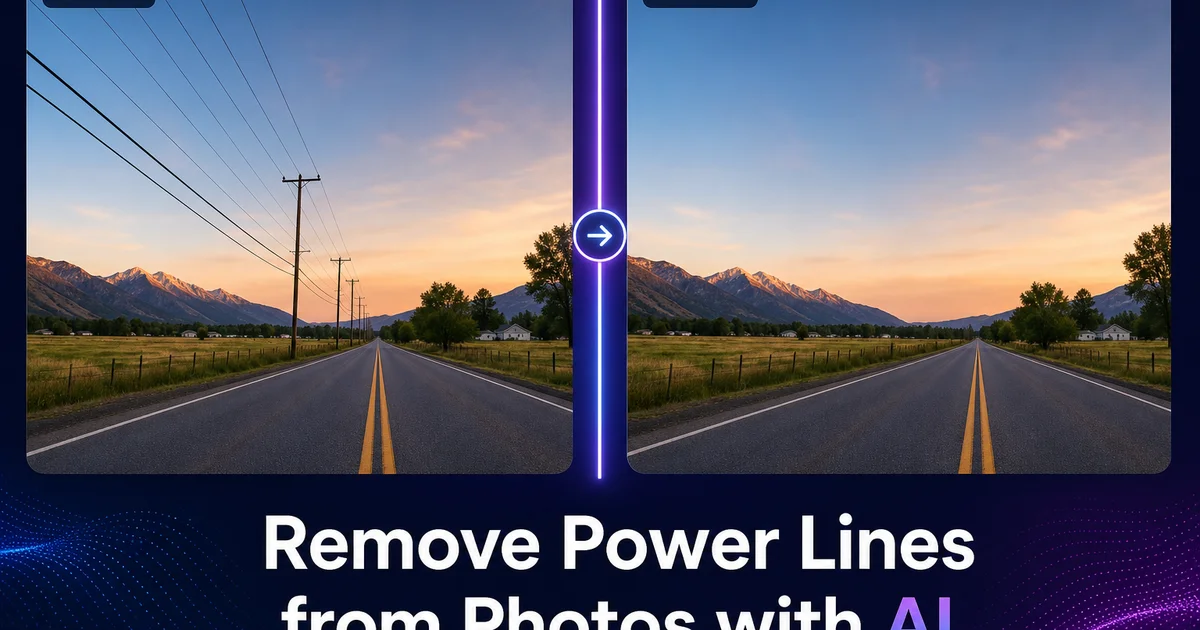
Power lines are the single most common unwanted element in outdoor photography. They slice across urban skylines, interrupt rural landscape compositions, and appear in nearly every real estate exterior shot as dark lines cutting through the sky above the property. Unlike a stray person who can be asked to move or a trash can that can be physically relocated before shooting, overhead wires are permanent infrastructure that the photographer cannot control. The only options are to frame around them, which limits composition to narrow windows between poles, or to remove them in post-processing.
Traditional wire removal in Photoshop is tedious work that scales linearly with the number of wires in the frame. Each wire must be selected with a thin, precise path, then filled using content-aware fill or the clone stamp tool. Where wires cross in front of complex backgrounds — tree canopies, building facades, or cloud formations — the manual fill requires careful color matching and texture blending to avoid visible patches. A single landscape photo with a dozen wires crossing through different background areas can take thirty to sixty minutes of meticulous editing. For real estate photographers processing dozens of exterior shots per week, this time cost is prohibitive.
AI-powered removal tools have fundamentally changed this workflow. Modern inpainting algorithms understand the difference between a thin linear artifact like a wire and the background content behind it. They can reconstruct the obscured background with remarkable accuracy even across complex textures like tree foliage and cloud gradients. Magic Eraser handles wire removal with a simple paint-over gesture. Trace along the wire, and the AI replaces it with the sky, clouds, trees, or building surface that should be visible behind it. This guide covers the complete technique for removing power lines, telephone cables, and utility poles from any type of outdoor photograph.
- Magic Eraser removes individual wires by painting over them with a brush slightly wider than the wire, letting the AI reconstruct the background behind each cable.
- Processing one wire at a time produces more accurate results than selecting all wires simultaneously, because the AI handles smaller reconstruction areas more precisely.
- Utility poles and transmission towers should be removed after the wires to avoid leaving illogical standing structures with no visible purpose.
- AI Enhance smooths subtle sky artifacts — tonal banding, pattern repetition, and color shifts — left by multiple overlapping wire removal operations.
- Wire-over-tree and wire-over-building intersections require the most careful review because complex background reconstruction is more prone to visible artifacts than clear sky reconstruction.
Why power lines are uniquely challenging to remove
Power lines present a specific technical challenge for image editing that differs from other object removal tasks. A wire is a very thin linear element. Often only one to five pixels wide in a standard photo — that extends across a large portion of the frame, often from edge to edge. This means the element being removed is narrow but long, requiring the inpainting algorithm to reconstruct a thin strip of background across many different texture regions in a single operation. A wire that starts against clear blue sky on the left side of the frame might cross through a cloud formation in the center and end against a tree canopy on the right. The algorithm must reconstruct three completely different background textures along the path of a single wire.
Bundled wires compound the difficulty exponentially. A typical residential power line run includes two to four high-voltage conductors, a neutral line, and often one or more communication cables running on the same or adjacent poles. These wires appear as parallel lines with small separations. Sometimes only ten to twenty pixels apart in the photo — and each wire must be removed one by one. When multiple parallel wires are removed from the same sky region, the inpainting algorithm must reconstruct the same background area multiple times in overlapping strips. If the reconstructions do not blend seamlessly with each other, the result shows visible banding or tonal inconsistency in the sky between where the wires used to be.
Intersection points where wires cross in front of other subjects — tree branches, building edges, roof lines, or signs — are the most failure-prone areas in wire removal. At these points, the algorithm must reconstruct not just sky but the actual foreground subject that the wire was obscuring. A wire crossing in front of a tree canopy requires the AI to generate plausible leaf and branch textures at the exact location where the wire hid the underlying detail. A wire crossing a building facade requires reconstruction of brick, stucco, or window detail. These complex reconstructions occasionally produce visible artifacts that require targeted touch-up. Being aware of this in advance allows the editor to plan a wire-by-wire removal strategy that minimizes problem areas.
- Wires are extremely thin but span the full frame width, requiring background reconstruction across multiple texture regions along a single linear path.
- Bundled parallel wires require multiple overlapping reconstruction strips in the same sky region, risking visible banding if the fills do not blend seamlessly.
- Intersection points where wires cross trees, buildings, and roof lines are the most failure-prone areas because the AI must reconstruct complex foreground textures rather than simple sky.
- A typical residential power line run includes four to six parallel wires including high-voltage, neutral, and communication cables, all requiring individual removal.
The wire-by-wire removal technique for clean results
The most reliable approach to power line removal is working one wire at a time, starting with the most isolated wires against clear sky and progressing to wires against complex backgrounds. This sequential approach gives the AI the simplest possible reconstruction task at each step and ensures that each reconstructed strip blends into a clean background rather than into the artifact of a previous removal. Start with the topmost wire in the frame, which often has the most unobstructed sky behind it. Work downward toward wires that run closer to rooftops, tree lines, and other foreground elements.
Brush width matters more for wire removal than for most Magic Eraser tasks. The brush should be just wide enough to cover the wire plus its visual halo. This includes the slight darkening or brightening immediately adjacent to the wire caused by contrast effects and lens diffraction. For most photos, this means a brush three to five pixels wider than the wire on each side. Too narrow a brush leaves halo remnants that appear as faint ghost lines after the wire is removed. Too wide a brush unnecessarily removes background detail that then must be reconstructed, increasing the chance of visible artifacts. The optimal width captures the wire and its halo without extending into the surrounding background any more than necessary.
For long wires that extend across the full frame, working in segments of roughly one third of the frame width often produces better results than a single edge-to-edge stroke. The AI processes each segment on its own and has more surrounding context from which to sample the background texture. Where the segments meet, the reconstructed areas blend naturally because each segment was processed with overlapping context from the adjacent already-cleaned area. This segmented approach is mainly important for wires that cross through multiple background types. A wire that runs from open sky through a cloud bank and into a tree canopy benefits from three separate removal segments, each optimized for its local background.
- Work top-to-bottom, starting with the most isolated wire against clear sky and progressing to wires near complex foreground elements.
- Set brush width to cover the wire plus its contrast halo — approximately three to five pixels wider than the wire on each side.
- Segment long edge-to-edge wires into thirds for more accurate background reconstruction across varying texture regions.
- Each removal step produces a cleaner background for subsequent removals, so the sequential order matters for final quality.
Removing utility poles and transmission infrastructure
Wires and poles are a visual system. Removing the wires while leaving the poles produces a strange result where wooden or metal structures stand in the landscape with no apparent purpose. Viewers right away sense something is wrong even if they cannot articulate that the wires are missing. A pole without wires is an illogical object. For expert real estate and landscape work, full removal means eliminating both the wires and the poles that support them. The exception is when a pole is partially hidden behind a building or tree and removing it would require reconstructing a large area of the foreground subject, in which case leaving the hidden pole is less disruptive than risking a visible reconstruction artifact.
Pole removal is a larger reconstruction task than wire removal because poles occupy more area in the frame. A wooden utility pole might be twenty to forty pixels wide and extend from the ground to a height well above the tree line, with crossarms extending horizontally at the top. The AI must reconstruct sky, trees, ground, and any other background elements that the pole obscured across this full extent. Sky reconstruction above the tree line is often seamless. Ground reconstruction at the pole base requires matching grass, pavement, or soil textures. The most challenging section is where the pole passes through the tree line. The AI must generate plausible tree canopy texture to fill the gap left by the pole and its crossarms.
Transmission towers and high-voltage pylons are substantially more complex than wooden utility poles due to their lattice structure. The open steelwork means the tower does not fully obscure its background. Sky, clouds, and landscape are visible through the gaps in the lattice. Removing a lattice tower requires the AI to distinguish between the steel members (which should be removed) and the background visible through the lattice (which should be preserved and extended to fill the gaps). Modern AI inpainting handles this distinction well in most cases. Very complex lattice patterns in front of detailed backgrounds may require two or three passes to achieve a clean result.
- Poles without wires look illogical — always remove both to avoid leaving unexplained vertical structures in the landscape.
- Sky reconstruction above the tree line is nearly always seamless, while ground-level pole base reconstruction requires careful texture matching.
- The tree-line intersection where the pole passes through canopy is the most challenging area, requiring plausible foliage generation to fill the gap.
- Lattice transmission towers require the AI to distinguish between steel members to remove and background visible through gaps to preserve.
Real estate and landscape photography applications
Real estate photography is the highest-volume commercial application of power line removal. Nearly every residential listing includes exterior photos where power lines, telephone cables, or cable TV wires are visible somewhere in the frame. Running along the street in front of the property, connecting from the pole to the house, or visible against the sky above the roof line. MLS guidelines and real estate photography best practices recommend removing power lines from listing photos because they distract from the property and create visual clutter that reduces the perceived quality of the neighborhood. Real estate photographers who process fifty to one hundred exterior shots per week save hours of editing time using AI wire removal compared to manual Photoshop techniques.
Landscape and travel photography benefits equally from wire removal, though the motivation is aesthetic rather than commercial. A dramatic mountain vista or a picturesque village scene loses its impact when power lines bisect the composition. Photographers who post to stock photo agencies have an extra incentive. Stock photos with visible power lines are either rejected or receive greatly lower licensing rates because commercial buyers want clean, versatile images. AI wire removal makes it practical to salvage photos that would otherwise be rejected from stock portfolios, expanding the photographer's salable catalog from locations where power lines could not be avoided during the shoot.
Architectural photography frequently requires wire removal for the same reasons as real estate. The building's design is the subject, and overhead infrastructure is a distraction. But architectural shoots often involve the extra challenge of wires that cross directly in front of the building facade, not just against the sky above it. These facade-crossing wires require the AI to reconstruct portions of the building surface. Brick patterns, window frames, facade details — which is more complex than sky reconstruction but well within the capability of modern inpainting algorithms when the wire is thin relative to the building texture scale.
- Real estate photographers process the highest volume of wire removal edits — fifty to one hundred exterior shots per week where power lines appear in nearly every frame.
- Stock photo agencies reject or lower-rate images with visible power lines, making AI wire removal a direct revenue tool for stock photographers.
- Architectural photos require facade reconstruction where wires cross building surfaces, which is more complex than sky reconstruction but well handled by modern AI.
- MLS guidelines recommend power line removal from listing photos to reduce visual clutter and improve the perceived quality of the property and neighborhood.
Post-removal cleanup and quality verification
After removing all wires and poles, the edited image needs a quality check at multiple zoom levels to catch artifacts that are invisible at the overview level but apparent when the image is printed at large sizes or viewed on high-resolution displays. The most common artifact from wire removal is tonal banding in the sky. Subtle horizontal or diagonal stripes where each removed wire left a slightly different tone in the reconstructed strip. These bands are nearly invisible on a phone screen but become apparent in large prints and on large-format displays where the sky region occupies substantial physical area.
AI Enhance resolves most banding artifacts by reprocessing the sky region as a steady gradient. The boost algorithm detects the tonal discontinuities and smooths them into the natural gradient that a clear sky or cloud formation should exhibit. This post-removal boost step is mainly important for sunset and sunrise photos where the sky gradient spans a wide range of warm colors. Orange, pink, purple, blue — because even slight tonal banding in a warm gradient is more perceptible to the human eye than the same banding in a uniform blue sky.
The final verification step is a side-by-side comparison of the original and edited images at both full frame and one hundred percent crop levels. At full frame, verify that no wires or poles were missed. It is remarkably easy to overlook a thin telephone wire or cable TV line that was not part of the main power line bundle. At one hundred percent crop, check each removal path for pattern repetition (where the AI filled the area with a repeating texture tile rather than a unique reconstruction), color temperature shifts. Edge artifacts where the reconstructed area meets the original background. Any visible artifact is addressed with a targeted Magic Eraser pass over just the affected area rather than reprocessing the entire image.
- Tonal banding — subtle stripes where each removed wire left a slightly different reconstructed tone — is the most common post-removal artifact.
- AI Enhance smooths banding artifacts by reprocessing the sky as a continuous gradient, blending the reconstructed strips into surrounding tones.
- Sunset and sunrise photos require extra attention because warm color gradients make even slight tonal banding more perceptible than the same banding in uniform blue sky.
- Final verification at one hundred percent crop catches pattern repetition, color temperature shifts, and edge artifacts that are invisible at the overview zoom level.
How to do it
- 1
Identify all power lines, cables, and poles visible in the frame before starting removal
Before making any edits, zoom to one hundred percent and trace every wire visible in the image from edge to edge. Power line removal fails most often when the editor misses thin secondary lines. The smaller distribution cables, telephone wires, and cable TV lines that run parallel to or slightly below the main high-voltage conductors. Also note where the wires intersect with or pass in front of other subjects like tree branches, building edges. Roof lines, as these intersection points require more careful reconstruction. Mark the utility poles as well, since removing wires while leaving the poles standing creates an illogical result where poles exist but serve no visible purpose.
- 2
Use Magic Eraser to paint over each wire segment individually from pole to pole
Select Magic Eraser and paint over each wire in a single steady stroke that follows the wire's path. Use a brush width slightly wider than the wire itself. About three to five pixels wider on each side — to ensure the full wire plus any halo or dark edge is captured in the selection. Work one wire at a time rather than selecting all wires at once. The AI produces more accurate sky and background reconstruction when it processes smaller, simpler selections. Start with wires against clear sky where the reconstruction is straightforward, then move to wires that cross in front of complex backgrounds like trees and buildings.
- 3
Remove utility poles and transmission towers after clearing the wires
With all wires removed, the poles and towers become the remaining visual disruption. Paint Magic Eraser over each pole from its base to its top, including crossarms and insulators. The AI reconstructs whatever the pole was standing in front of. Sky, trees, the face of a building, a hillside. Pole removal against sky is nearly always seamless. Poles against complex backgrounds like forested hillsides may require a second pass to blend the reconstructed area convincingly. For poles that are partially hidden behind foreground elements like fences or hedges, paint only the visible portion and leave the hidden section untouched.
- 4
Use AI Enhance to restore detail in sky regions where wire removal left subtle artifacts
After removing multiple wires from a sky region, examine the area at one hundred percent zoom for subtle artifacts. Slight tonal banding where each wire was removed, faint repeated patterns from the inpainting algorithm, or minor color shifts where the reconstructed sky does not perfectly match the surrounding gradient. AI Enhance smooths these artifacts by reprocessing the sky as a steady gradient, blending the reconstructed strips into the surrounding tones. The boost also recovers cloud detail that may have been simplified during the wire removal inpainting step.
- 5
Compare the edited image against the original at multiple zoom levels to verify natural results
Toggle between the original and edited versions at both full-frame and one hundred percent zoom levels. At full frame, verify that no wires or poles were missed and that the overall sky and landscape look natural without visible artifacts. At one hundred percent, check each wire removal path for banding, color shifts, or pattern repetition. Pay particular attention to areas where wires crossed in front of trees, buildings, or other complex backgrounds. These are the most likely locations for visible reconstruction artifacts. If any area looks unnatural, run Magic Eraser over that specific section again to regenerate the fill.
Sources
- Image Inpainting for Irregular Holes Using Partial Convolutions — arXiv — NVIDIA Research
- Thin Structure Removal and Reconstruction in Photographs — IEEE Transactions on Image Processing
- Real Estate Photography Standards: MLS Photo Guidelines and Best Practices — National Association of Realtors