
How to Create a Woodcut Effect with AI — Magic Eraser
Create a woodcut effect with AI from portraits, product shots, or illustrations. Learn wood grain texture, cross-hatching, ink thresholds, carving depth, export settings, and when the style works best.
SEO & Growth
Reviewed by Magic Eraser Editorial ·
Table of Contents
- How AI interprets photographic tone for woodcut conversion
- Cross-hatching techniques and how line density creates the illusion of tone
- Wood grain texture and the physical characteristics that define authentic woodcut aesthetics
- Creative applications: editorial illustration, packaging, and fine art prints
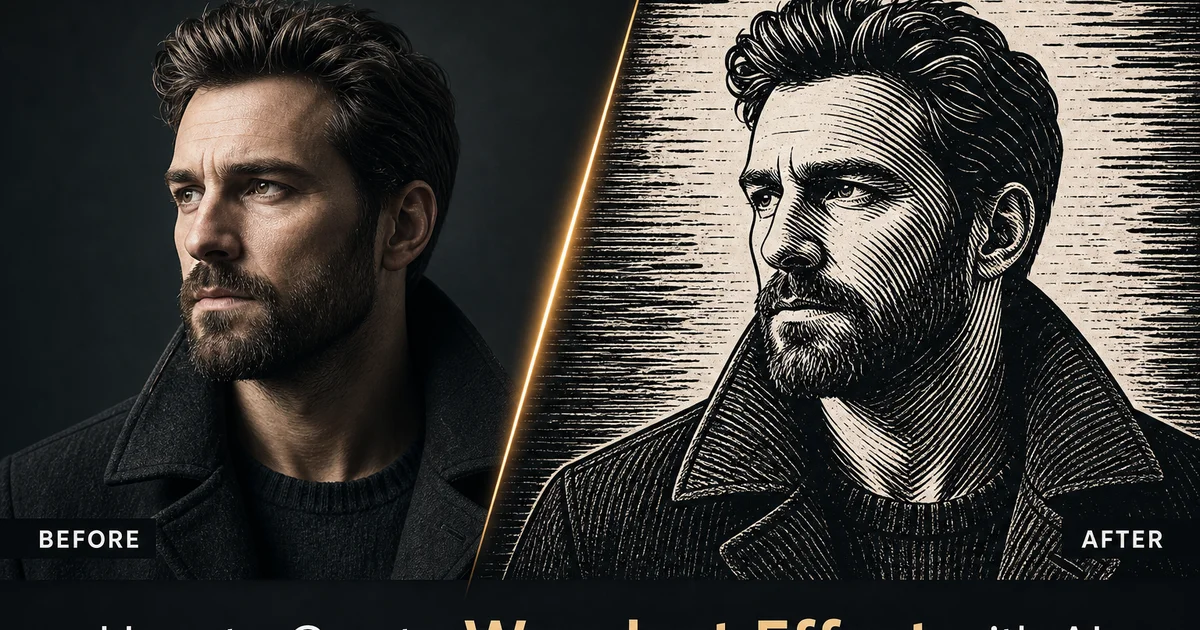
Woodcut printmaking is one of the oldest forms of graphic art, dating back to ninth-century China and reaching its European apex in the fifteenth and sixteenth centuries through the work of Albrecht Dürer, Hans Holbein, and the anonymous artisans who illustrated early printed books. The technique involves carving an image into the flat surface of a wood block, applying ink to the raised uncarved surfaces, and pressing paper against the block to transfer the image. The fundamental constraint of the medium — that every mark must be either inked surface or carved-away void — forces a radical simplification of photographic reality into bold binary compositions where form is communicated through the interplay of solid black shapes, white negative space, and the parallel-line hatching techniques that simulate tonal gradation within this two-value system.
Creating authentic woodcut-style artwork from photographs has in the past required either actual printmaking skills and equipment or laborious digital illustration work in Photoshop or Illustrator. The digital approach involves manually tracing contours, converting tonal regions into hatching patterns of right density, adding wood grain texture, and making hundreds of decisions about which details to preserve and which to sacrifice to the constraints of the medium. A skilled digital illustrator might spend four to eight hours converting a single photograph into a convincing woodcut interpretation, carefully balancing ink coverage, hatching direction, line weight, and the characteristic imperfections that distinguish handcrafted woodcut art from sterile digital posterization.
AI-powered woodcut conversion automates this entire process by understanding the visual language of relief printmaking and applying it intelligently to photographic source material. The AI analyzes tonal distribution, edge structure, and subject semantics to determine where solid ink areas should fall, where carved white space should open up, where cross-hatching should simulate mid-tone gradation, and how wood grain texture should interact with the printed surface. Rather than applying a simple threshold filter that produces flat high-contrast images, the AI replicates the specific techniques that woodcut artists use. Directional hatching that follows the form of the subject, grain texture that varies with ink coverage, and deliberate line weight variation that conveys the physical pressure of a gouge cutting through wood. This guide covers the complete workflow for creating authentic woodcut artwork using AI Filter.
- Two grain modes simulate different block types: end-grain for fine curved detail suitable for portraits, and side-grain for bold directional strokes with visible parallel fiber textures.
- Ink coverage threshold controls the balance between solid dark inked areas and carved-away white space, from heavy dramatic prints to light delicate compositions with extensive negative space.
- AI-generated cross-hatching mimics tonal gradation using parallel and intersecting cut lines of varying density, replicating the master printmaker technique for representing mid-tones in a binary medium.
- Wood grain texture overlay adds the natural fiber impression that distinguishes authentic woodcut aesthetics from simple posterization or high-contrast filters.
- Configurable carving depth controls line weight from fine hairline marks for detailed textures to wide bold gouges that read as confident graphic strokes at any viewing distance.
How AI interprets photographic tone for woodcut conversion
The fundamental challenge of woodcut conversion is translating the steady tonal range of a photograph. Possibly millions of distinct color and brightness values — into the binary vocabulary of ink and void. A naive approach applies a simple brightness threshold: pixels darker than the cutoff become black ink, pixels lighter become white carved space. This produces harsh posterized images that bear no resemblance to actual woodcut art because real woodcut prints never use a global threshold. Instead, master printmakers make local decisions about every region of the image, keeping dark shadows as solid ink, opening up highlights as clear carved space. Using hatching of varying density to represent the vast range of mid-tones between these extremes.
AI woodcut conversion replicates this local decision-making process by analyzing the image at multiple scales at once. At the global level, the AI evaluates the overall tonal distribution to determine the baseline ink-to-white ratio that will produce a balanced composition. At the regional level, it identifies distinct tonal zones. Deep shadows, mid-tones, highlights, and specular reflections — and assigns each zone an appropriate rendering strategy. At the detail level, it traces individual edges and contours to determine where crisp ink-to-void transitions should occur. This multi-scale analysis means that a face in shadow receives different treatment than a face in sunlight, even within the same image, just as a human printmaker would make different carving decisions for each lighting condition.
The AI also understands semantic context in ways that improve tonal assignment. It recognizes that eyes should retain detail even in shadowed faces, that the edges of a subject's silhouette against the background should remain crisp regardless of tonal similarity. That text or lettering in the scene should be preserved as solid forms rather than dissolved into hatching. This semantic awareness produces results that look like they were carved by a printmaker who understood the subject rather than processed by an algorithm that only saw brightness values. The combination of multi-scale tonal analysis and semantic understanding is what separates AI woodcut conversion from the threshold filters and posterize commands available in conventional image editors.
- Simple brightness thresholds produce harsh posterized images because real woodcut art uses local tonal decisions rather than a single global cutoff for the entire image.
- AI analyzes tone at global, regional, and detail scales simultaneously, assigning different rendering strategies to shadows, mid-tones, highlights, and specular reflections.
- Semantic awareness preserves important features like eyes in shadowed faces and subject silhouettes regardless of their tonal similarity to surrounding regions.
- Multi-scale analysis combined with subject understanding produces results that resemble prints carved by an artist who comprehended the scene rather than an algorithm processing brightness values.
Cross-hatching techniques and how line density creates the illusion of tone
Cross-hatching is the defining technique that transforms woodcut art from simple silhouettes into richly tonal imagery capable of representing form, depth, and lighting. In traditional printmaking, the artist carves parallel lines into the wood surface, removing material between the lines so that only thin ridges of wood remain to hold ink. Sparse widely-spaced parallel lines print as a light tone because the eye blends the narrow ink marks with the white gaps between them. Denser closely-spaced lines print as a darker tone because more ink surface area fills the visual field. When a second set of lines crosses the first at an angle, the intersecting grid creates an even denser ink pattern that reads as a still-darker tone. Through this technique of layered directional hatching at varying densities, a woodcut artist can represent a full range of tones from near-white to near-black using nothing but carved lines.
AI Filter replicates this technique by generating hatching patterns that follow the three-dimensional form of the subject. On a cylindrical form like an arm or tree trunk, the hatching lines curve around the surface to reinforce the perception of roundness, just as a skilled engraver would carve lines that follow the contour. On flat surfaces like walls or tabletops, the hatching runs in a consistent direction determined by the overall grain angle setting. In transition zones where form curvature changes — the bridge of a nose, the curve of a jawline, the bend of an elbow — the hatching direction shifts gradually to track the surface, creating the flowing organic quality that distinguishes expert woodcut work from mechanical line patterns. The density of hatching at any point is determined by the local tonal value, with smooth gradations from sparse single-direction lines in light areas to dense multi-directional cross-hatching in darker regions.
The hatching line weight also varies to simulate the physical traits of different cutting tools. Fine parallel lines simulate a V-gouge creating delicate marks for detailed areas like facial features, hair texture, and fabric weave. Broader lines simulate a U-gouge making bolder cuts for large shadow areas, architectural elements, and background textures. The AI mixes line weights within a single image to create the visual variety that makes woodcut art engaging. A portrait might use fine V-gouge hatching on the face, medium hatching on clothing, and bold U-gouge lines in the background, exactly as a printmaker would switch tools to match the needs of each region.
- Sparse widely-spaced parallel lines create light tones while dense closely-spaced lines produce dark tones, with crossed intersecting sets adding additional tonal depth.
- AI generates form-following hatching that curves around cylindrical surfaces and shifts direction at contour changes, replicating the organic quality of expert hand-carved lines.
- Tonal gradation transitions smoothly from single-direction sparse lines in highlights to multi-directional dense cross-hatching in shadows, representing continuous tone in a binary medium.
- Mixed line weights simulate different cutting tools — fine V-gouge marks for facial detail and delicate textures, broad U-gouge strokes for bold shadows and background elements.
Wood grain texture and the physical characteristics that define authentic woodcut aesthetics
The wood grain texture that appears in printed woodcuts is not merely decorative. It is a physical artifact of the printing process that serves as the most reliable visual indicator distinguishing actual woodcut prints from other forms of high-contrast art. When ink is applied to a carved wood block and pressed against paper, the natural grain pattern of the wood transfers alongside the intentionally carved image. In raised-grain areas where harder winter growth rings protrude slightly above softer summer wood, more ink contacts the paper, leaving subtle dark lines that follow the tree's growth pattern. In recessed areas between grain ridges, less ink transfers, creating barely perceptible light streaks. This grain impression appears in both the solid inked areas and, more subtly, in the nominally white carved regions where residual ink trapped in the grain pattern prints a ghostly echo of the wood's natural texture.
AI Filter mimics this grain transfer with physically-based accuracy by generating a procedural wood grain pattern and compositing it onto the converted image at the right opacity and interaction mode. The grain pattern follows the configured direction. Matching the side-grain or end-grain mode selected by the user — and varies in intensity based on the ink coverage of each region. Solid inked areas show the grain as subtle lightening where recessed grain channels hold less ink. Carved white areas show the grain as faint darkening where trapped ink in the grain ridges prints despite the area being nominally cut away. This bidirectional grain interaction — lightening darks and darkening lights — creates the distinctive visual quality that makes AI-generated woodcut art feel physically plausible rather than digitally synthetic.
The grain intensity control allows users to dial the texture from barely perceptible to prominently visible depending on the intended aesthetic. Minimal grain creates clean precise prints that suggest modern photopolymer or metal relief plates rather than traditional wood blocks. Moderate grain adds realism without distracting from the image content, suitable for most artistic and commercial applications. Heavy grain makes the wood medium itself a prominent visual element, creating the rustic handcrafted look associated with folk art traditions and artisanal printmaking. For maximum realism, the grain pattern includes the natural imperfections found in real wood. Knots, irregular fiber spacing, and slight curvature in the grain lines — rather than generating perfectly uniform parallel lines that would read as digital patterning.
- Real woodcut grain results from differential ink transfer between raised winter growth rings and recessed summer wood, creating subtle directional texture across the entire print surface.
- AI simulates bidirectional grain interaction — lightening solid inked areas and darkening carved white regions — replicating the physical ink behavior of actual block printing.
- Grain intensity ranges from barely perceptible clean modern prints to prominently textured rustic surfaces suitable for folk art and artisanal aesthetic applications.
- Natural imperfections including knots, irregular fiber spacing, and grain curvature prevent the texture from reading as digital patterning and add physical plausibility.
Creative applications: editorial illustration, packaging, and fine art prints
Woodcut-style imagery has experienced a major revival in editorial illustration because the bold graphic quality cuts through the visual noise of digital media. Magazine and newspaper art directors commission woodcut-style illustrations for cover stories, opinion pieces, and feature articles because the stark black-and-white aesthetic commands attention on newsstands and in social media previews. The visual weight of solid ink areas and the textural richness of cross-hatching convey seriousness and craft in ways that photographic or digitally-smooth illustrations cannot. AI woodcut conversion allows editorial teams to produce this aesthetic on tight publication deadlines by transforming relevant photographs into woodcut illustrations in minutes rather than commissioning custom artwork days in advance.
Product packaging and branding frequently employ woodcut aesthetics to convey heritage, craftsmanship, and artisanal quality. Craft beer labels, specialty food packaging, heritage brand identities. Premium spirits bottles use woodcut-style imagery to visually convey that the product is made with traditional care and attention. The carved-line texture and bold graphic composition signal authenticity in ways that modern digital graphics cannot replicate. AI woodcut conversion enables small producers to achieve this premium packaging aesthetic without the cost of commissioning original woodcut illustrations from specialist artists, democratizing access to a visual language that was before available only to brands with substantial design budgets.
Fine art printmakers use AI woodcut conversion as a starting point for actual physical printmaking, generating digital woodcut interpretations that serve as carving guides for real wood blocks. Rather than drawing the design freehand onto the block, the artist prints the AI-generated woodcut image at actual block size and transfers it onto the wood surface as a reference. The AI handles the complex tonal conversion and hatching decisions while the artist retains full control over the physical carving, inking, and printing processes that give each impression its unique character. This hybrid workflow combines the analytical precision of AI with the irreplaceable physical qualities of handmade prints. Variations in ink density, paper texture absorption, and the imprecisions of hand pressure that make each print in an edition subtly unique.
- Editorial teams use AI woodcut conversion to produce bold graphic illustrations on tight publication deadlines, transforming photographs into print-ready artwork in minutes.
- Craft and heritage brands employ woodcut aesthetics on packaging to communicate artisanal quality, making the style accessible to small producers through AI conversion.
- Fine art printmakers use AI-generated woodcut interpretations as carving guides, combining computational tonal analysis with the irreplaceable qualities of handmade physical prints.
- The bold high-contrast composition of woodcut imagery performs exceptionally well in social media previews and thumbnails where visual weight commands attention in crowded feeds.
How to do it
- 1
Upload your photo and assess its suitability for woodcut conversion
Open your image in AI Filter and evaluate whether it has strong tonal contrast, clear subject silhouettes, and well-defined edges. Woodcut art relies on the interplay between carved-away white areas and ink-retaining dark surfaces, so photographs with dramatic lighting, bold shapes, and minimal mid-tone ambiguity convert most successfully. Portraits with strong directional lighting, architectural photographs with crisp structural lines, and nature scenes with distinct foreground-background separation produce the most convincing woodcut results. Avoid images with flat even lighting, excessive fine detail in mid-tones, or subjects that lack a clear silhouette against their background, as these produce muddy results where the carved and inked regions blend together without visual clarity.
- 2
Select the woodcut style variant and configure the grain direction
Choose between end-grain and side-grain woodcut simulation, each producing distinctly different visual results. End-grain mode mimics boxwood blocks where the cutting tool moves freely in any direction, producing fine detail with smooth curved lines suitable for intricate portraits and detailed illustrations. Side-grain mode mimics plank-cut blocks where the wood fiber runs in a single direction, creating parallel line textures that follow the grain and produce bolder, more graphic results with visible directional strokes. Configure the grain angle to control the dominant line direction. Horizontal grain creates calm landscape-like textures, vertical grain adds height and drama to portraits, and diagonal grain introduces dynamic energy to action or nature scenes.
- 3
Adjust the ink coverage threshold and carving depth parameters
Set the threshold that determines which tonal values become solid ink areas and which become carved-away white space. A low threshold preserves more of the image as dark inked surface, creating heavy bold prints with minimal white space that read as dramatic and high-contrast. A high threshold carves away more material, leaving only the darkest shadows as ink and rendering mid-tones as white carved regions, producing lighter more delicate prints with extensive white space. The carving depth parameter controls the apparent depth of cut lines. Shallow depth creates fine hairline marks suitable for detailed textures and cross-hatching, while deep carving produces wide bold gouges that read as confident graphic strokes visible from a distance.
- 4
Apply wood grain texture overlay and cross-hatching for tonal depth
Enable the wood grain texture layer that mimics the natural fiber pattern of the printing block transferring subtly onto the printed surface. Real woodcut prints carry trace impressions of the wood grain in both inked and un-inked areas. This texture is what distinguishes authentic-looking woodcut art from simple high-contrast posterization. Adjust the grain intensity from subtle background texture to prominent surface pattern. Configure cross-hatching in mid-tone regions where the AI generates parallel cut lines of varying density to represent tonal gradations. Sparse parallel lines for light mid-tones, dense cross-hatched intersecting lines for darker mid-tones, and solid ink for the deepest shadows. This graduated hatching is the hallmark technique that master woodcut artists use to create the illusion of steady tone within a medium that only supports black and white.
- 5
Export the woodcut artwork and verify print-readiness at target dimensions
Save the finished woodcut image at your target resolution and inspect it at actual display or print size. The carved lines should be thick enough to remain visible and distinct at the intended viewing distance. Lines that appear as fine detail on screen may disappear fully when printed at poster size or viewed from across a room. Verify that the ink-to-white ratio creates a balanced composition where neither solid black nor carved white dominates excessively. Check that cross-hatching in mid-tone regions reads as intentional tonal graduation rather than digital noise. Export as PNG to preserve the crisp boundaries between inked and carved areas without JPEG compression artifacts that blur the sharp edges key to the woodcut aesthetic. For print applications, export at 300 DPI minimum to ensure that fine hatching lines and grain textures reproduce cleanly on paper.
Sources
- The History of Woodcut Printmaking and Its Influence on Modern Art — The Metropolitan Museum of Art
- Relief Printing Techniques: From Traditional Blocks to Digital Reproduction — Encyclopaedia Britannica
- Image Stylization Using Learned Line and Texture Representations — arXiv