
How to Create Vaporwave Aesthetic with AI — Magic Eraser
Step-by-step guide to creating vaporwave and retrowave aesthetic effects on photos using AI. Covers the signature pink-purple-cyan palette, scan line and VHS degradation effects, geometric overlays, and Japanese typography for authentic vaporwave art.

Product Marketing
Reviewed by Magic Eraser Editorial ·
Table of Contents
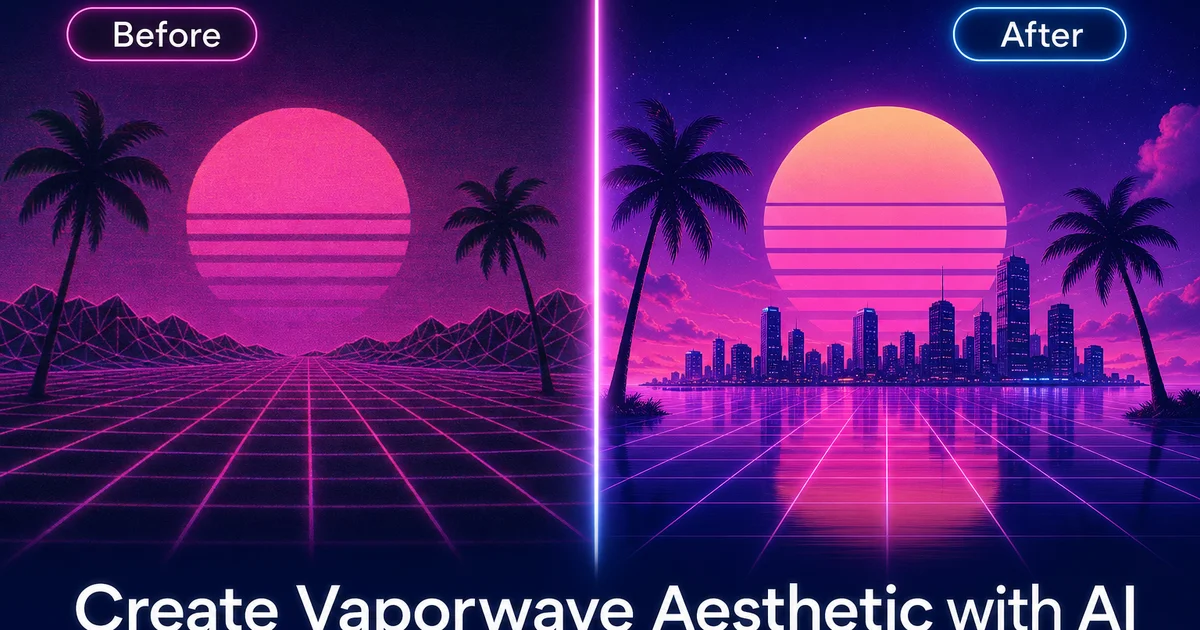
Vaporwave is an internet-born aesthetic movement that emerged in the early 2010s as both a music micro-genre and a visual art style, drawing its identity from a deeply ironic nostalgia for the consumer culture, corporate design. Technological optimism of the nineteen-eighties and nineteen-nineties. Visually, vaporwave is right away distinct: saturated pinks, purples, and cyans bathe every surface in synthetic neon light. Classical Greek and Roman sculptures appear alongside nineteen-nineties computer interfaces and Japanese consumer electronics. Palm trees silhouette against gradient sunsets rendered in colors no real sunset has ever produced. And the entire composition is overlaid with scan lines, VHS artifacts. Retro typography that reference a technological era when analog and digital were colliding. The aesthetic has transcended its niche internet origins to influence mainstream design, fashion, album art, and social media visual culture.
Creating authentic vaporwave imagery requires understanding the specific visual vocabulary that distinguishes it from generic retro filters or simple color shifts. The vaporwave palette is not merely warm or cool. It occupies a specific range of oversaturated pinks through cyans that references the color reproduction traits of cheap CRT monitors and VHS tape degradation. The subject matter carries cultural meaning: classical sculptures represent commodified high culture, Japanese text represents the exoticized consumer technology of nineteen-nineties Japan, geometric wireframes reference early three-dimensional computer graphics. Palm trees and swimming pools evoke the suburban leisure promised by consumer capitalism. Applying the visual style without understanding these references produces images that look vaguely retro but miss the specific cultural resonance that makes vaporwave strong.
AI-powered vaporwave effects analyze the photograph's composition and subject matter, apply the trait color changes with proper palette targeting, layer period-right degradation artifacts. Integrate graphic elements that complete the aesthetic. The AI understands that the pink-to-cyan gradient should map to the image's tonal range rather than being applied as a flat overlay, that scan lines should interact with the image brightness rather than floating uniformly on top. That chromatic aberration should affect edge contrast rather than uniform areas. This guide covers how to use Magic Eraser's creative filters to transform any photograph into authentic vaporwave art with the full visual vocabulary of the movement.
- Vaporwave uses a specific oversaturated pink-purple-cyan palette that references CRT monitor color reproduction and VHS tape degradation, not generic warm or cool color shifts.
- Authentic vaporwave imagery incorporates period-specific degradation: scan lines, chromatic aberration, VHS noise, and optional timestamp watermarks from analog video technology.
- Subject matter carries cultural meaning — classical sculptures, Japanese electronics, geometric wireframes, and palm trees each reference specific aspects of consumer culture nostalgia.
- Geometric overlays and retro typography transform a color-shifted photograph into a complete vaporwave composition rather than a simple filter application.
- The intentionally degraded aesthetic means moderate image compression enhances rather than detracts from the final result.
Understanding the vaporwave visual vocabulary and its cultural origins
Vaporwave originated on internet music forums around 2010 as a genre of electronic music that sampled and slowed down smooth jazz, corporate muzak, elevator music. Japanese city pop from the nineteen-eighties and nineteen-nineties. The music was at once a parody of and a sincere nostalgia for the era of peak consumer optimism. The period when shopping malls were cultural cathedrals, Japanese electronics brands represented the cutting edge of technological progress, and corporate aesthetics featured gradient sunsets, geometric shapes, and sans-serif typography in teal and magenta. The visual art that accompanied vaporwave music adopted the same source material, creating collages from nineteen-nineties operating system interfaces, early three-dimensional rendered graphics, classical sculpture, Japanese advertising, and tropical resort imagery.
The color palette is the most right away distinct element of vaporwave visual art. It draws from two related sources: the color reproduction traits of CRT monitors and VHS tape. The actual corporate design palettes of the era it references. CRT monitors displayed oversaturated colors with a trait warm glow, mainly in the pink-magenta range. VHS tape degradation shifted colors toward magenta and cyan as the magnetic coating deteriorated. Meanwhile, the corporate design of the nineteen-eighties and early nineteen-nineties favored teal, magenta, purple, and pink. Colors visible in everything from Trapper Keeper folder designs to early website backgrounds to the interior design of shopping malls. Vaporwave merges these influences into a palette that feels at once artificial, nostalgic, and strangely beautiful.
The cultural resonance of vaporwave extends far beyond retro nostalgia. By recontextualizing the visual language of consumer capitalism. The gleaming marble floors of empty shopping malls, the aspirational luxury of resort pool photography, the sleek surfaces of Japanese consumer electronics — vaporwave art creates an ambiguous emotional space that is at once critical and affectionate. The viewer feels the seductiveness of the consumer promises while also recognizing their hollowness. This emotional complexity is what gives vaporwave its lasting power as a visual movement and distinguishes it from simpler retro aesthetics that merely mimic period style without commentary.
- Vaporwave originated as internet music that sampled corporate muzak and Japanese city pop from the eighties and nineties.
- The palette merges CRT monitor color characteristics, VHS tape degradation shifts, and actual corporate design palettes of the era.
- Subject matter — malls, sculptures, Japanese electronics, resort pools — references specific artifacts of consumer culture and its promises.
- The aesthetic creates emotional ambiguity between criticism and affection for consumer capitalism, giving it lasting cultural resonance.
Mastering the pink-purple-cyan color transformation
The vaporwave color shift is the foundation of the entire aesthetic. Getting it right requires understanding how the palette maps to tonal ranges within the image. The change is not a simple hue rotation or a flat color overlay. It is a targeted remapping where different tonal zones receive different color treatments. Shadows and dark tones shift toward deep magenta and purple, creating the impression that dark areas are lit by hidden neon tubes. Midtones receive the warmest treatment, shifting toward hot pink and rose that bathes the primary subject matter in the signature vaporwave glow. Highlights shift toward cyan and teal, as if bright areas are reflecting a different, cooler light source. This split toning creates a color tension between warm and cool that is central to the vaporwave look.
Saturation must be pushed well beyond natural levels — the vaporwave palette is on purpose, aggressively artificial. Natural skin tones become pink-violet. Green vegetation turns teal or cyan. Blue skies become deep purple. White surfaces glow pink or cyan depending on their tonal value. The goal is complete departure from photographic reality into a synthetic color space that feels like the image was displayed on a malfunctioning CRT monitor bathed in neon light. If the colors still look like they could exist in nature, the saturation has not been pushed far enough.
The AI applies this color change with awareness of the image content, weighting the palette shift to preserve the structural legibility of the subject while pushing the color into vaporwave territory. Faces remain distinct as faces even when their color is completely unnatural. Architectural lines remain sharp and legible even when the building shifts from gray concrete to glowing magenta. This content-aware color mapping is what separates AI vaporwave effects from simple hue-saturation sliders. Can push colors into vaporwave range but lose structural clarity in the process.
- Shadows shift to deep magenta and purple, midtones to hot pink and rose, highlights to cyan and teal for proper split-toning.
- Saturation must be pushed aggressively beyond natural levels — if colors could exist in nature, the effect is not strong enough.
- Content-aware color mapping preserves structural legibility of faces and architecture even at extreme color departures.
- The warm-cool color tension between pink shadows and cyan highlights is central to the authentic vaporwave look.
Layering scan lines, VHS artifacts, and analog degradation effects
The degradation layer is what transforms a color-shifted photograph from a generic neon-palette image into a specifically vaporwave artwork. These artifacts reference the analog video technology of the era. CRT television displays, VHS tape playback, and early digital displays — and their inclusion signals the viewer that the image is engaging with the specific techno-nostalgic vocabulary of vaporwave rather than simply being an oversaturated photo. Each artifact type references a specific technology and should be applied with an understanding of how that technology actually produced the visual effect.
Scan lines are the horizontal lines visible on CRT (cathode ray tube) displays, caused by the electron beam scanning across the screen in discrete rows. In vaporwave art, scan lines are overlaid at subtle opacity. Often ten to twenty percent — so the image content remains fully visible through the line pattern. The lines should interact with image brightness: brighter areas of the image should show the scan lines less prominently because a bright CRT phosphor overwhelms the visible gap between scan lines. Darker areas show the lines more clearly. This brightness-responsive scan line rendering looks natural rather than like a flat pattern stamped on the image.
Chromatic aberration — the red-green-blue color channel offset visible in cheap analog lenses and video equipment — creates subtle color fringing along high-contrast edges. Applied to a vaporwave image, it enhances the synthetic, technological quality by making the image look as if it is being viewed through imperfect optical or electronic reproduction. VHS noise adds a fine grain pattern with occasional horizontal distortion bands that simulate tape tracking errors. Optional elements include a VHS timestamp in the corner, a tracking bar that partially obscures the bottom of the image. A subtle bloom or glow effect that mimics the way CRT phosphors bleed light into adjacent pixels.
- Scan lines at ten to twenty percent opacity should interact with image brightness — less visible in bright areas, more visible in dark areas.
- Chromatic aberration creates RGB channel offset along high-contrast edges, simulating cheap analog lens distortion.
- VHS noise, tracking distortion, and optional timestamps ground the image in the specific technological era vaporwave references.
- Brightness-responsive artifact rendering looks natural, while flat pattern overlays look like stamped filters.
Applications from social media to album art and brand design
Social media is the primary distribution channel for vaporwave visual art. The aesthetic has proven remarkably durable as a content style. Instagram, TikTok, Twitter, and Tumblr all have active vaporwave communities where artists share original compositions and stylized photographs. Profile pictures rendered in vaporwave palette create memorable personal branding that stands out in notification feeds and comment sections. Story content with vaporwave styling — mainly animated elements like pulsing scan lines and shifting gradient backgrounds — generates higher engagement than static filters because the movement and color intensity command attention in the vertical scrolling format.
Album art and music promotion are natural applications given vaporwave's origins as a music genre. Independent artists across electronic, lo-fi hip hop, synthwave. Adjacent genres use vaporwave visuals for album covers, single artwork, and promotional materials because the aesthetic right away shares a specific sonic territory to potential listeners. The visual vocabulary is so well-established that a vaporwave-styled album cover functions as genre signaling before the listener plays a single note. Magic Eraser's vaporwave filters allow musicians and designers to create expert-quality album art from existing photographs without commissioning custom illustration.
Brand design has increasingly adopted vaporwave elements, mainly in industries targeting millennial and Gen-Z consumers. Streetwear brands, gaming companies, music streaming services. Nightlife venues use vaporwave color palettes and geometric elements in their marketing materials, social media presence, and even physical interior design. The aesthetic shares digital fluency, cultural awareness. A specific kind of playful sophistication that resonates with audiences who grew up on the internet. Product photography rendered in vaporwave style transforms ordinary merchandise into culturally positioned lifestyle imagery that shares brand identity through visual association rather than explicit messaging.
- Vaporwave profile pictures and story content generate higher engagement through distinctive color intensity and animated effects.
- Album art in vaporwave style functions as immediate genre signaling for electronic, lo-fi, and synthwave music.
- Brands targeting millennial and Gen-Z consumers adopt vaporwave elements to communicate digital fluency and cultural awareness.
- Product photography in vaporwave style transforms merchandise into culturally positioned lifestyle imagery.
How to do it
- 1
Upload the photo and assess its suitability for vaporwave transformation
Open the image in Magic Eraser and evaluate its composition for vaporwave stylization. The aesthetic works best with subjects that evoke consumer culture, technology, architecture, or urban landscapes. Shopping malls, cityscapes, retro electronics, palm trees, swimming pools, classical sculptures, and neon signage are all iconic vaporwave subjects. Portraits work well when the subject has a contemplative or detached expression. Avoid images with very complex compositions or busy natural scenes that lack the geometric or architectural elements the vaporwave aesthetic relies on to create its distinctive atmosphere.
- 2
Apply the signature pink-purple-cyan color palette shift
The defining visual trait of vaporwave is its color palette: saturated pinks, purples, magentas, cyans. Teals layered over the image in place of natural color. Use the color grading controls to shift the entire image toward pink and purple in the shadows and midtones. Toward cyan and teal in the highlights. The result should feel like the image is bathed in neon light. Warm pinks dominate the darker areas while cool cyans glow in the brighter regions. Increase overall saturation greatly beyond natural levels. The vaporwave palette is on purpose artificial and oversaturated — subtlety is not the goal.
- 3
Add scan lines, chromatic aberration, and VHS-era degradation effects
Layer visual artifacts that reference analog video technology from the nineteen-eighties and nineteen-nineties. Add horizontal scan lines at a subtle opacity to simulate CRT monitor display. Apply chromatic aberration — the slight red-green-blue channel offset that occurs in cheap analog video equipment — to create color fringing along high-contrast edges. Introduce gentle VHS-style noise, subtle tracking distortion, and optional timestamp watermarks in the corner. These degradation effects ground the image in the specific technological era that vaporwave nostalgically references.
- 4
Incorporate geometric overlays and typographic elements
Vaporwave visual design frequently includes geometric wireframe elements, grid patterns, and Japanese or Greek text as decorative overlays. Add a perspective grid floor or horizon line in cyan or magenta wireframe. Overlay a translucent geometric shape — a triangle, circle, or diamond — that frames the subject. If right, add Japanese katakana or kanji characters as decorative typography, or English text rendered in a retro digital font. These graphic elements transform the image from a color-shifted photograph into a complete vaporwave composition that reads as intentional art rather than a simple filter application.
- 5
Export with appropriate compression and platform-specific formatting
Save the vaporwave image at web-optimized resolution for social media sharing. The intentionally degraded aesthetic means that moderate JPEG compression actually enhances the retro quality rather than degrading it. The compression artifacts blend with the intentional VHS noise and scan lines. For Instagram, export as a square crop. For desktop and phone wallpapers, export at the native device resolution. For animated vaporwave — looping scan lines, pulsing neon glows, or slowly shifting color gradients — export as a short video loop or animated GIF suitable for social media stories and profile backgrounds.
Sources
- Vaporwave: A Brief History of the Internet's Strangest Music Genre — Bandcamp Daily
- Nostalgia and Digital Aesthetics in Contemporary Visual Culture — European Journal of Cultural Studies