
How to Create a Takayama Woodcarving Effect with AI Photo Editing
Transform photos into Japanese Takayama ichii-ittobori yew wood carving effects using AI style transfer. Step-by-step guide covering single-knife faceting techniques, heartwood-sapwood color contrast, grain simulation, and authentic Hida mountain craft patina.
SEO & Growth
Reviewed by Magic Eraser Editorial ·
Table of Contents
- How AI faceted-surface rendering differs from standard texture overlays
- Ichii-ittobori carving traditions: netsuke, okimono, relief, and festival ornament
- Yew wood material properties: grain, color, and natural aging
- Creative applications: product design, cultural heritage, and artisan previsualization
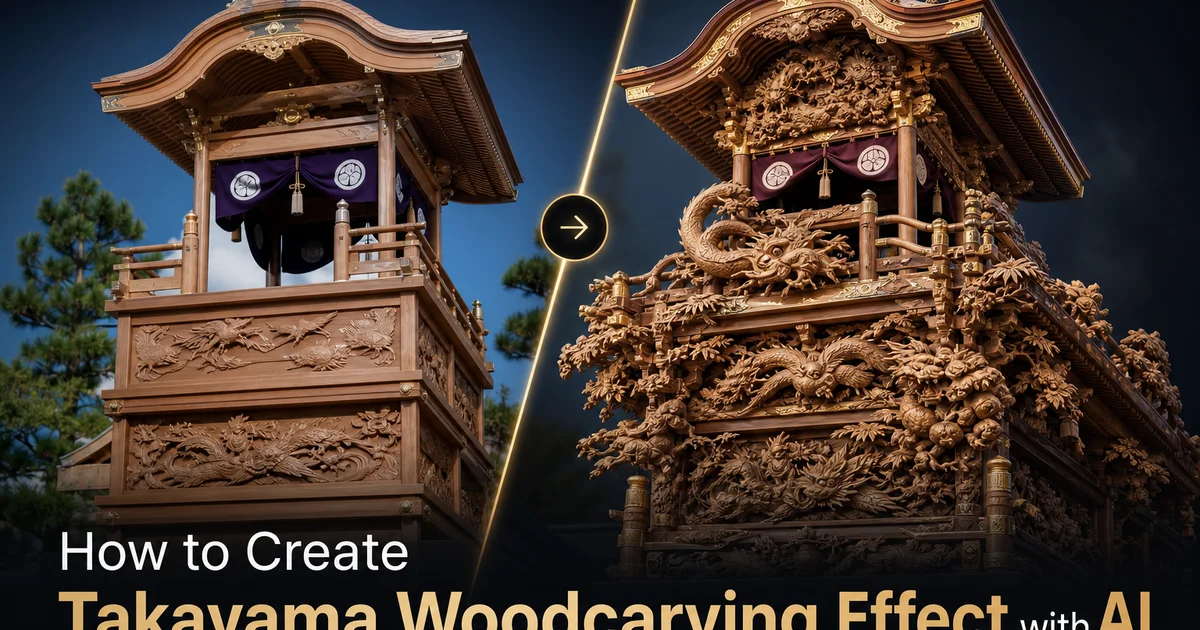
Takayama ichii-ittobori — one-knife yew wood carving from the Hida mountain region of central Japan — occupies a distinctive position among Japanese woodworking traditions because the finished surface is the carved surface itself, without lacquer, paint, or any applied finish obscuring the direct evidence of the carver's knife work. Where most Japanese decorative woodwork receives layers of urushi lacquer or pigment that transform and conceal the underlying wood, ichii-ittobori celebrates the raw interaction between a sharp blade and fine-grained yew heartwood, keeping every facet angle and tool mark as part of the aesthetic experience. The resulting surfaces display a faceted, crystalline quality that catches light differently across each knife-cut plane, creating complex visual texture from the simplest possible material. A single piece of wood shaped by a single tool.
The tradition emerged in the Hida region during the Edo period, drawing on centuries of accumulated woodworking expertise for which the Hida mountain province had been famous since the Nara period, when Hida carpenters were conscripted to build temples and palaces in the imperial capital. The specific choice of Japanese yew (Taxus cuspidata var. ichii) was deliberate and technically major. Yew grows very slowly at high altitude, producing exceptionally dense, fine-grained wood with annual rings sometimes spaced less than half a millimeter apart. This density allows the carver to cut clean facets at any angle without the wood tearing or splintering along the grain, and the natural two-tone color of yew. Pale cream sapwood grading into rich reddish-brown heartwood — provides built-in color contrast that the artisan includes into the design without needing any applied colorant.
AI-powered style transfer can simulate the visual properties of ichii-ittobori by learning from photographs of genuine pieces how knife-cut facets, exposed grain at different angles, unfinished wood patina. The natural sapwood-heartwood color transition create the distinctive look of this tradition. The simulation must model geometry that flat texture filters cannot replicate. The way adjacent facets cut at different angles to the grain display subtly different colors and reflective properties, how the tight grain of mountain yew creates a natural luster on clean-cut surfaces, and how decades of handling build a patina that deepens and enriches the wood's natural tones without hiding the facet structure. This guide covers the complete workflow from composition assessment through carving-style selection, material parameter tuning, and final refinement.
- AI simulates the faceted knife-cut surfaces of ichii-ittobori where each plane reveals different grain character and light reflection from the dense, slow-grown mountain yew.
- Multiple carving-style presets cover netsuke miniatures, okimono figures, relief panels, and Hida festival float ornaments with tradition-appropriate facet scale and undercutting.
- Yew heartwood-sapwood color contrast is modeled as a natural two-tone system that artisans deliberately exploit for design emphasis without any applied pigment or lacquer.
- Patina simulation follows the actual aging chemistry of unfinished yew — oxidation and absorbed handling oils deepening from pale cream through honey-gold to warm umber over decades.
- AI Enhance refines facet-edge crispness and the differential grain exposure that creates visual complexity from a single unfinished wood material shaped by a single knife.
How AI faceted-surface rendering differs from standard texture overlays
The most common digital wood-carving simulation applies a carved-wood texture as a displacement map or bump layer over the source image, treating the photograph's tonal values as a height field and adding uniform wood-grain texture across the entire surface. This approach produces a recognizably wood-like surface but at its core misrepresents how ichii-ittobori works. A real carver does not follow the photograph's tonal map. They make deliberate compositional decisions about which forms to render as raised volumes, which to carve as recessed planes, and where to place the bold facet transitions that give the piece its visual rhythm. The knife-cut facets are not texture; they are the sculptural language of the piece.
AI ichii-ittobori rendering begins by analyzing the image composition and identifying volumetric forms that can be translated into the planar vocabulary of knife-carved surfaces. A bird's rounded breast becomes a series of intersecting facets that approximate the curve through geometric planes. The same way a real ichii-ittobori carver builds up curved forms from flat knife cuts. The AI determines right facet scale based on the selected carving tradition: netsuke-scale work uses tiny, many facets creating almost smooth surfaces. Bold okimono carving uses larger, more expressive planes that make each knife stroke one by one visible. This compositional intelligence distinguishes the simulation from mechanical texture application.
The grain-facet interaction adds a second layer of realism that texture overlays miss fully. When a carver cuts through yew wood at different angles to the grain, each facet surface exposes a different grain pattern. Tangential cuts show broad, arcing grain lines while radial cuts show tight, parallel lines. The reflective properties also change: surfaces cut along the grain have a smooth, silky sheen while cross-grain cuts appear more matte. The AI models this directional dependency, assigning each simulated facet a grain orientation that produces the correct pattern and reflectance for its angle, creating the complex interplay of light and grain that makes genuine ichii-ittobori so visually rich from a single monochrome material.
- Standard texture overlays apply uniform wood-grain across tonal height maps, missing the deliberate compositional decisions that define ichii-ittobori facet placement.
- AI identifies volumetric forms and translates curves into intersecting geometric planes, matching how real carvers approximate organic shapes through flat knife cuts.
- Facet scale adjusts by tradition — tiny near-smooth netsuke facets versus bold expressive okimono planes where individual knife strokes are designed to be visible.
- Directional grain-facet interaction models different grain patterns and reflectance on each surface based on cut angle, creating authentic visual complexity from monochrome wood.
Ichii-ittobori carving traditions: netsuke, okimono, relief, and festival ornament
Netsuke-style ichii-ittobori represents the tradition at its most refined and miniature scale. Toggle pieces often three to five centimeters across where the carver must resolve distinct forms within an very compact volume using facets sometimes less than a millimeter wide. The yew wood's fine grain is key at this scale because coarser woods would splinter under such delicate cuts. Netsuke subjects favor compact natural forms. Frogs, turtles, cicadas, nuts, mushrooms, and coiled snakes — where the subject's natural form fits the rounded toggle shape required for functional use. The AI mimics this miniature precision, producing very fine faceting that reads as a carved surface at full view but reveals individual knife decisions when examined closely.
Okimono — decorative display figures — allows larger scale and more dramatic expression. Okimono ichii-ittobori carves standing figures, dynamic animal poses. Multi-element compositions where the bold planar faceting becomes the dominant visual feature. A hawk with spread wings might use large, flat facets on the wing surfaces to emphasize their broad planes while switching to fine, detailed faceting on the head and talons where precise form is needed. The interplay between large bold planes and small refined areas creates visual hierarchy within the piece. The same compositional principle that the AI applies when it varies facet scale across different regions of the source image based on the importance and complexity of each compositional element.
Relief panel carving and festival float ornaments represent ichii-ittobori at architectural scale, with panels sometimes exceeding a meter in width. The Hida region's spectacular spring festival floats. Designated as UNESCO Intangible Cultural Heritage — feature deeply undercut narrative scenes carved in ichii-ittobori technique, with multiple depth planes creating theatrical spatial depth. At this scale, the faceting serves both structural and aesthetic purposes. Bold planar cuts on background elements push them visually back while finely faceted foreground figures advance toward the viewer. The AI mimics this depth-dependent facet variation, producing convincing spatial layering within the two-dimensional image frame.
- Netsuke-scale carving resolves recognizable forms in three-to-five-centimeter volumes with sub-millimeter facets that demand the fine grain only slow-grown mountain yew provides.
- Okimono display figures use variable facet scale — bold wing planes versus fine head detail — creating the visual hierarchy the AI replicates across image regions.
- Festival float ornaments at architectural scale use deeply undercut multi-plane compositions where facet scale varies by depth to create theatrical spatial layering.
- The AI adjusts facet resolution, undercutting simulation, and depth-plane separation based on the selected tradition and the scale demands each style imposes.
Yew wood material properties: grain, color, and natural aging
Japanese yew's material properties are inseparable from ichii-ittobori's aesthetic identity. Accurate simulation requires modeling wood as a specific material rather than a generic surface. The species grows at elevations above 1,000 meters in the Hida mountains, reaching harvestable size only after 200 to 500 years of growth. This extreme slow growth produces wood with annual ring spacing averaging 0.3 to 0.7 millimeters. Dense enough that individual rings are difficult to see without magnification and the carved surface appears almost homogeneous from a normal viewing distance. The AI mimics this grain density as a function of the viewing scale, showing the fine ring structure only when the image resolution and viewing distance make it visible, matching the actual visual experience of examining genuine pieces.
The sapwood-heartwood color transition in Japanese yew is one of the most distinctive features that ichii-ittobori artisans exploit as a built-in two-tone palette. Fresh sapwood is cream to pale yellow; heartwood ranges from warm orange-brown to deep reddish-brown. The transition zone between them can be gradual or fairly abrupt depending on the individual tree. Skilled carvers orient the wood blank so that this natural color boundary falls across the design in a meaningful way. A bird might have a pale sapwood breast and dark heartwood wings, or a flower might emerge from dark wood into light. The AI identifies analogous tonal boundaries in the source image and maps the sapwood-heartwood transition to create the same kind of natural color emphasis that real carvers achieve through material selection and blank orientation.
Unfinished yew ages through a process at its core different from lacquered wood. Without any protective coating, the surface is exposed to air, light, and the oils from human hands. Ultraviolet exposure darkens the wood, mainly the sapwood, which shifts from cream toward golden-amber over years. Handling concentrates oil absorption on surfaces that contact hands and storage surfaces, deepening those areas preferentially. Over decades, the overall tone warms and darkens while developing a natural sheen from oil saturation of the surface fibers. A slow polish that cannot be rushed or faked with artificial finishes. The AI models this aging as a time-dependent process with spatially variable oil absorption based on the geometry of the carved form, producing patina that follows the logic of how a carved object would actually be handled and displayed.
- Mountain yew's 0.3–0.7 mm annual ring spacing creates an almost homogeneous carved surface at normal viewing distance, with fine grain visible only on close examination.
- Sapwood-heartwood color contrast provides a built-in two-tone palette that artisans exploit by orienting blanks to place the natural boundary meaningfully within the design.
- Unfinished yew ages through UV darkening and differential oil absorption from handling, producing warm golden-amber tones and natural sheen that lacquered finishes cannot replicate.
- The AI models patina as a time-dependent process with spatially variable oil absorption following the geometry of how carved objects are actually handled and displayed.
Creative applications: product design, cultural heritage, and artisan previsualization
Product designers working with Japanese craft aesthetics use ichii-ittobori effects to bring the materiality and handcraft presence of carved yew into digital design contexts. The faceted-surface quality shares handmade realism in a way that smooth renders cannot. Each visible knife facet signals that a human hand guided a blade through physical material, making this effect mainly effective for luxury brand applications, artisan marketplace imagery, and packaging design where the brand narrative centers on craft heritage and material honesty. Unlike lacquer effects that share refinement through surface perfection, ichii-ittobori effects share craft through visible process. The tool marks are the beauty.
Cultural heritage organizations in the Hida region and Japanese craft promotion agencies use these effects to create engaging visual materials that share the distinctive character of ichii-ittobori to international audiences who may never have encountered the tradition. Museum exhibition design, tourism collateral, and educational materials all benefit from the ability to transform familiar subjects into the visual language of Takayama yew carving, creating immediate visual understanding of the craft's character that text descriptions alone cannot achieve. The effect also serves archival purposes — documenting the visual character of historical pieces whose physical condition may be deteriorating.
Working ichii-ittobori artisans use the AI as a design exploration tool, testing how different compositions, facet approaches. Sapwood-heartwood orientations will appear in the final carving before making the first cut into an irreplaceable piece of centuries-old yew. Given that suitable carving blanks from slow-grown mountain yew are increasingly scarce and expensive. With large pieces sometimes requiring wood from trees 400 or more years old — the ability to preview multiple design approaches on the actual blank dimensions and grain photograph provides major economic and artistic value. Commission clients can approve designs with visual specificity that sketches and verbal descriptions cannot match.
- Luxury brand applications use visible knife-facet texture to communicate handmade authenticity and material honesty in packaging, marketplace, and collateral imagery.
- Cultural heritage organizations transform familiar subjects into ichii-ittobori visual language for international audiences through museum, tourism, and educational materials.
- Working artisans preview compositions and sapwood-heartwood orientations on actual blank photographs before cutting into irreplaceable centuries-old mountain yew.
- Commission clients approve designs with visual specificity that drawings and verbal descriptions cannot provide, reducing risk on expensive slow-grown yew blanks.
How to do it
- 1
Upload your photo and evaluate its composition for ichii-ittobori translation
Open your image in AI Filter and assess how its forms and tonal structure will translate into the visual language of Takayama ichii-ittobori. A wood carving tradition originating in the Hida region of Gifu Prefecture where artisans carve Japanese yew (ichii) wood using a single knife technique that produces distinctive faceted surfaces revealing the grain and color gradation of the heartwood. Images with strong volumetric forms, clear silhouettes, and natural subjects. Birds, fish, flowers, animals, and figure studies — work best because ichii-ittobori in the past focuses on representing organic forms through the geometric vocabulary of knife-cut facets rather than smooth sculptural surfaces.
- 2
Select a carving style preset and configure facet resolution parameters
Choose from presets representing the major ichii-ittobori approaches. Netsuke-style miniature carving with fine detailed facets, okimono decorative figure carving with bold planar surfaces, relief panel carving with graduated depth planes, and the distinctive Hida spring-festival float ornament style featuring dynamic compositions with deep undercutting. Each preset controls facet size, knife-angle simulation, the degree of surface smoothing versus retained tool marks, and how the two-tone color character of Japanese yew. Pale sapwood transitioning to rich reddish-brown heartwood — is incorporated into the design to create natural color contrast without applied pigment or lacquer.
- 3
Adjust wood grain visibility, patina depth, and tool-mark characteristics
Fine-tune the material simulation parameters that distinguish genuine ichii-ittobori from generic wood-carving effects. Authentic pieces display the tight, fine grain of slow-growing mountain yew. Annual rings spaced less than a millimeter apart — with a natural luster that develops over decades as handling oils penetrate the unfinished wood surface. The AI mimics grain density, the trait way yew grain interacts with knife-cut facets at different angles. The patina that transforms pale freshly-cut surfaces into the deep honey-gold and warm umber tones that collectors associate with aged ichii-ittobori. Tool-mark controls adjust the visibility of individual knife strokes from nearly invisible refined finishing to bold expressive faceting.
- 4
Use AI Enhance to refine facet edges, grain detail, and tonal transitions
Run AI Enhance to sharpen the three-dimensional reading of the carved surface, paying particular attention to the crisp edges between adjacent knife-cut facets and the way light breaks differently across surfaces cut at varying angles to the grain. Boost accentuates the subtle color difference between tangential and radial grain exposure on different facets. A phenomenon specific to the fine-grained yew wood that ichii-ittobori artisans on purpose exploit by orienting their cuts to reveal contrasting grain characters on adjacent surfaces, creating visual complexity from a single unfinished wood material.
- 5
Export and compare against documented Takayama ichii-ittobori examples
Save the completed image at full resolution and compare it with photographs of documented ichii-ittobori pieces from the Takayama Festival Exhibition Hall, the Hida Takayama Crafts Experience Center. Published catalogs of designated traditional craft products. Verify that the facet scale and knife-angle patterns are consistent with actual carving practice, that the yew grain character is accurately represented. That any patina or aging effects follow the natural oxidation and oil-absorption process of unfinished yew wood rather than mimicking lacquered or stained surface treatments that would be inappropriate for this tradition.
Sources
- Ichii-ittobori: Takayama's One-Knife Yew Wood Carving Tradition — Takayama City Tourism Board
- Traditional Japanese Wood Sculpture: Techniques, Materials, and Regional Traditions — Tokyo National Museum
- Hida Takayama Craft Culture: Living Traditions from the Mountain Province — Association for the Promotion of Traditional Craft Industries — Japan