
How to Create Quilling Effect with AI — Magic Eraser
Transform photos into stunning paper quilling art effects using AI. Step-by-step guide covering coil styles, paper strip parameters, dimensional shadows, and realistic quilled paper aesthetics.

Product Marketing
Reviewed by Magic Eraser Editorial ·
Table of Contents
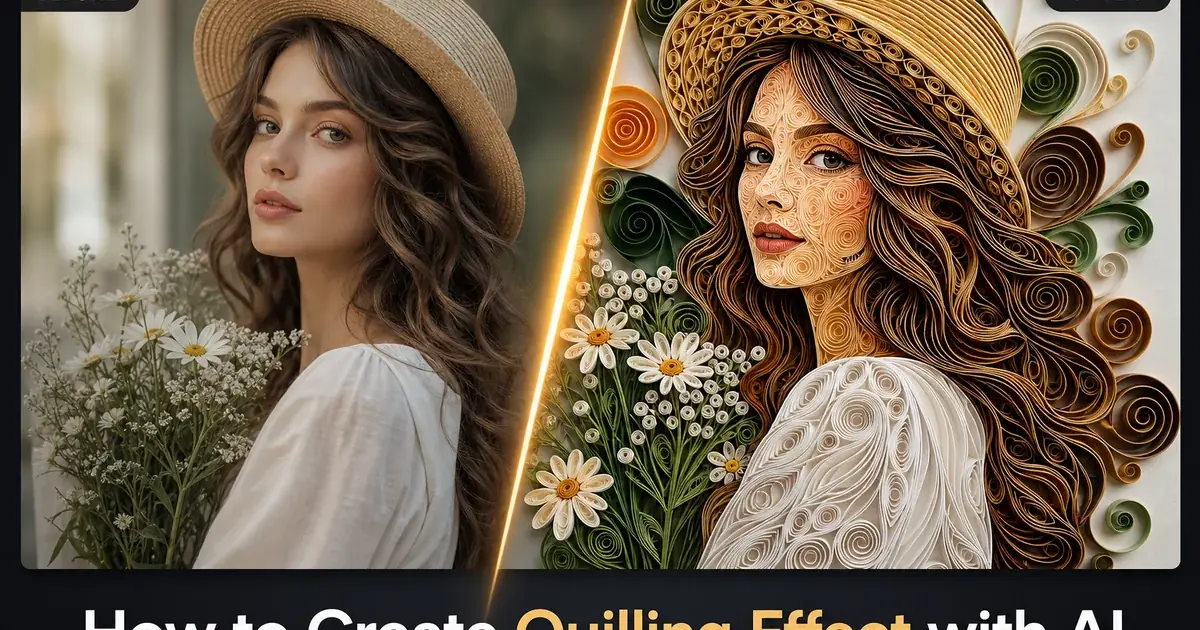
Paper quilling is a centuries-old decorative art form that transforms simple strips of paper into intricate three-dimensional designs by rolling, shaping, and arranging coiled elements into patterns and images. Originating in Renaissance-era monasteries where nuns and monks used gilded paper strips trimmed from books to create religious artwork, quilling evolved through the centuries into a refined craft practiced worldwide for both decorative and fine art purposes. The technique's appeal lies in its paradoxical nature. The raw material could not be humbler, yet the finished results can achieve remarkable complexity and beauty. A single photograph transformed into a quilling-style artwork gains a fully new material identity, appearing to exist as a tangible paper sculpture rather than a flat digital image.
Attempting to simulate paper quilling effects digitally has in the past required painstaking manual work in 3D modeling or illustration software. Each coiled element must be created, positioned, colored, lit, and shadowed one by one to produce a convincing result. A process that might require placing hundreds or thousands of individual coil objects for a single image. Even skilled digital artists report spending dozens of hours creating quilling simulations for commercial projects like greeting card designs, wedding invitation artwork, and advertising campaigns. No simple filter or one-click effect has been available because the quilling aesthetic is at its core volumetric: each paper strip occupies three-dimensional space, casts real shadows, and interacts with light based on its orientation and the viewing angle.
AI-powered quilling conversion changes this calculus greatly by understanding both the source photograph's content and the physical principles of paper coil construction. The AI decomposes the image into regions that correspond to distinct quilling elements, selects appropriate coil shapes for each region based on its color, size, and position in the composition, and then renders each element as a three-dimensional paper form complete with material properties, edge detail, and shadow casting. The system understands that tight coils fill solid areas, loose scrolls create flowing decorative borders, teardrops and marquise shapes follow directional elements like leaves and feathers. Open forms provide transparency and lightness in background areas. This guide covers how to use AI Filter to create quilling effects that capture the dimensional tactile beauty of real paper sculpture.
- AI decomposes photographs into regions mapped to distinct quilling elements. Tight coils for solid areas, loose scrolls for flowing forms, teardrops for directional elements, and open shapes for airy backgrounds.
- Three-dimensional rendering mimics the physical depth of paper strips standing on edge, with realistic cast shadows calculated from virtual lighting that creates the interplay of light key to quilling's visual richness.
- Paper material simulation includes strip edge visibility showing the white core between colored surfaces, surface finish options from matte to metallic. Color palettes mapped to commercially available quilling paper stocks.
- Multiple quilling technique presets cover tight coil filling, loose scrollwork, eccentric off-center coils, and geometric comb quilling, each suited to different subject matter and aesthetic goals.
- Configurable paper strip width ranges from delicate 1.5mm jewelry-weight strips for intricate detail to bold 10mm strips for chunky dimensional effects, with the AI automatically varying width by image region.
How AI quilling conversion understands paper coil geometry and image decomposition
The fundamental challenge of converting a photograph into a quilling-style artwork is decomposition. Breaking a steady-tone image into discrete regions that can each be represented by a single paper coil form. A human quilling artist approaches this intuitively, looking at a reference image and mentally segmenting it into areas that correspond to the shapes in their repertoire: tight circles for eyes and dots, teardrops for petals and leaves, marquise shapes for pointed elements, loose scrolls for decorative flourishes. Various open forms for transitional areas. The artist's experience with the medium informs this decomposition. They know which shapes are physically possible to form from paper strips and which sizes and densities produce readable results at the intended scale.
AI replicates this decomposition process by analyzing the image through multiple lenses at once. Color segmentation identifies regions of similar hue and brightness that will each become a single coiled element. Edge detection finds the boundaries between these regions, determining where one coil ends and the next begins. Semantic understanding identifies what each region represents. A petal, an eye, a background area — and selects the most appropriate coil form based on that spotting. Size analysis ensures that the decomposition produces elements within the physically plausible range for the configured paper strip width: elements too small to be realistically constructed from paper strips are merged with neighbors. Regions too large for a single coil are subdivided into groups of smaller elements.
The resulting decomposition map assigns a specific coil type, size, orientation, and color to every region in the image. Tight coils are packed densely to fill solid-colored areas like flower centers and solid backgrounds. Loose scrolls flow along curved boundaries where the composition needs graceful transitional elements. Teardrops align their pointed ends with the natural direction of leaves, feathers, and hair. The spaces between coils — intentional gaps that let the backing surface show through — are distributed carefully to create visual breathing room and suggest the characteristic lightness of paper quilling where the backing is on purpose visible as a design element. This full mapping ensures that every pixel in the original photograph is accounted for by a specific quilling element that is physically plausible for the medium.
- Color segmentation identifies regions of similar hue and brightness that become individual coiled elements, with edge detection determining precise boundaries between adjacent coils.
- Semantic understanding identifies what each region represents — petals, eyes, background — and selects the most appropriate coil form from tight circles, teardrops, marquise shapes, and scrolls.
- Size analysis ensures decomposition produces physically plausible elements — regions too small for paper construction merge with neighbors, while oversized regions subdivide into coil groups.
- Strategic gap distribution between coils lets the backing surface show through, replicating the characteristic visual lightness that distinguishes quilling from solid surface decoration.
Rendering dimensional paper strips with realistic material properties
Paper quilling's visual appeal depends fully on the three-dimensional quality of the coiled elements. Each strip of paper stands on its narrow edge, presenting a thin colored face to the viewer while its depth creates shadows, highlights, and the distinctive layered look that makes quilling immediately distinct. The AI rendering engine treats each coil element as a true three-dimensional object rather than a flat graphic shape, calculating how light interacts with the curved paper surface at every point. The outer curve of a tight coil catches light along its top edge and falls into shadow at its base where it meets the backing surface. Adjacent coils cast shadows on each other based on their relative heights and the light direction, creating the complex shadow patterns that give real quilling its visual depth and richness.
Paper material rendering goes beyond simple color fill to simulate the actual optical properties of paper strips. Real quilling paper has a visible fiber structure that affects how light scatters across its surface. Matte papers scatter light diffusely for a soft warm look, while glossy coated papers create specular highlights that add sparkle to the composition. The AI applies appropriate surface reflectance models for the selected paper type, generating highlights and mid-tones that match the physical behavior of actual paper under illumination. The edges of each strip — the narrow surfaces visible between the colored faces — show the paper's core color, often white or off-white, creating the distinctive edge lines that are one of the most distinctive traits of real paper quilling and right away distinguish it from any other art form.
Depth layering adds another dimension of realism by mimicking how quilling artists stack coils at different heights within a composition. Foreground elements rise higher from the backing surface than background elements, creating a genuine relief effect that reinforces the image's depth perception. The AI analyzes the original photograph's depth map to determine which elements should project more prominently, placing focal subjects like flower centers and eyes at maximum height while recessing backgrounds and peripheral areas to lower elevations. This depth variation strongly affects shadow casting. Tall foreground coils cast longer shadows across lower background elements, creating the kind of complex interplay between elements that makes photographs of real quilling so visually strong.
- Each coil element is rendered as a true three-dimensional object with light interaction calculated across curved paper surfaces, not as a flat graphic shape with applied shadow effects.
- Paper material rendering simulates fiber structure, surface reflectance, and the optical differences between matte, glossy, and metallic paper stocks for accurate material appearance.
- Strip edge visibility shows the paper core color between colored faces — a defining characteristic of real quilling that immediately identifies the art form.
- Depth layering analyzes the original photograph's depth map to stack foreground elements higher than background ones, creating relief effects with complex inter-element shadow casting.
Quilling techniques decoded: tight coils, loose scrolls, and specialty shapes
Tight coils form the foundational building blocks of most quilling compositions. Created by winding a paper strip tightly around a quilling tool and gluing the end to prevent unraveling, tight coils present as perfect circles when viewed from above and as short cylinders from the side. Their uniform density makes them ideal for filling solid areas. A cluster of tight coils in graduated colors can create smooth tonal transitions across a surface, while a single large tight coil serves as a bold graphic dot or flower center. The AI generates tight coils with physically accurate proportions: the diameter is determined by the paper strip length and width, with the characteristic spiral visible on the face where each wrap of paper is slightly larger than the one beneath it. This spiral face detail is visible under close inspection in real quilling and adds realism to the digital simulation.
Loose scrolls and S-curves are created by allowing a tightly wound coil to relax before shaping. The strip partially unwinds, creating flowing curves that can be pinched, bent, and arranged into decorative forms. These elements provide the flowing organic quality that distinguishes artistic quilling from simple coil packing. The AI uses loose scrolls along compositional curves, at transitions between color regions, and anywhere the image needs flowing movement rather than static density. Open teardrop shapes are formed by pinching one end of a loose coil to create a point, producing a versatile shape used for petals, leaves, flames, and any element with a directional emphasis. The AI orients teardrops to follow the natural direction of the photographic elements they represent. Leaf teardrops point in the direction of growth, petal teardrops radiate from flower centers, and hair teardrops follow the flow direction of the strands.
Specialty shapes extend the quilling vocabulary into more complex territory. Marquise shapes — pinched at both ends to create a pointed oval — serve as eyes, leaves, and elongated decorative elements. Squares and triangles, formed by pinching a loose coil at four or three equally spaced points respectively, provide geometric structure in architectural and pattern-based compositions. Husking, a technique where paper strips are looped around pins in a specific pattern rather than coiled, creates open lattice-like shapes used for delicate wing structures, ornamental borders, and areas where visual transparency is desired. The AI selects from this full vocabulary of shapes based on the semantic content of each image region, matching the quilling form to the photographic subject with the same intuition that an experienced quilling artist brings to their reference material.
- Tight coils present as perfect circles with visible spiral faces, filling solid areas with graduated color clusters that create smooth tonal transitions across surfaces.
- Loose scrolls and S-curves provide flowing organic movement at compositional curves and transitions. Teardrops are oriented to follow natural directional elements like leaf growth and petal radiation.
- Marquise shapes serve as eyes and elongated elements, geometric pinched shapes provide architectural structure, and husking creates open lattice forms for delicate transparent areas.
- The AI selects from the full shape vocabulary based on semantic content analysis, matching quilling forms to photographic subjects with craft-informed intuition.
Creative applications: greeting cards, wedding decor, and gallery art
Greeting card design represents one of the most natural applications for quilling-style photo effects. Traditional paper quilling has been used for handmade cards for centuries. The conversion of photographs to quilling-style artwork creates digital greeting cards that carry the warmth and craft aesthetic of handmade pieces. A family portrait converted to quilling style for a holiday card, a pet photograph transformed into a quilled birthday card design, or a flower arrangement rendered as a quilled sympathy card. Each application takes advantage of the association between paper quilling and personal care that has been culturally reinforced through generations of handcrafted card giving. The dimensional quality of the quilling effect translates well even to printed cards because the rendered shadows and depth cues share three-dimensionality on a flat surface.
Wedding and event decor increasingly includes quilling-style graphics as couples seek aesthetics that feel handcrafted and personal without the cost and time constraints of commissioning actual quilled artwork for every printed piece. Invitation suites, table numbers, seating charts, welcome signs. Social media graphics can all include quilling-style photography that ties the event's visual identity to a craft aesthetic. Converting engagement photographs into quilling-style artwork creates a unique visual signature that distinguishes the couple's materials from standard photography-based wedding stationery. The effect works especially well for floral compositions, which are already among the most popular subjects in traditional quilling, creating a natural visual connection between the crafted look and the botanical content.
Fine art and gallery applications push the quilling effect beyond decorative use into artistic statement. Large-format prints of photographs converted to quilling style create wall art that reads as records of intricate paper sculpture, challenging viewers' assumptions about the medium they are seeing. Viewers may wonder: is it a photograph of actual quilling or a digital transformation? The ambiguity itself becomes part of the artistic conversation. Artists working in mixed-media practices combine AI-generated quilling effects with actual paper elements, creating hybrid works where the boundary between physical craft and digital simulation is intentionally blurred. The quilling aesthetic also translates powerfully to commercial art contexts. Advertising campaigns for luxury brands, packaging design for artisanal products, and editorial spreads where the tactile handmade quality communicates realism and premium positioning.
- Greeting card design leverages quilling's centuries-old association with handcrafted personal care, converting photographs into dimensional artwork that communicates warmth even in printed format.
- Wedding and event materials use quilling-style photography across invitation suites, signage, and social media to create a distinctive handcrafted visual identity without commissioning actual quilled pieces.
- Fine art applications create large-format prints that challenge viewers' medium assumptions, while mixed-media artists blend AI quilling effects with actual paper elements for hybrid works.
- Commercial contexts from luxury advertising to artisanal packaging use the quilling aesthetic to communicate authenticity, craft heritage, and premium handmade positioning.
How to do it
- 1
Upload your photo and evaluate its composition for paper quilling conversion
Open your photograph in AI Filter and assess whether its subject matter will translate well into a paper quilling aesthetic. Quilling works best with subjects that have flowing organic curves, circular motifs, and layered depth. Floral compositions, portraits with expressive hair, animals with feathered or furred textures, and decorative patterns all convert beautifully. The art form builds images from narrow strips of paper that are rolled, shaped. Glued into coiled forms, meaning the AI needs to decompose your photograph into regions that can be represented by distinct rolled paper elements. Images with strong color areas and clear subject boundaries produce the most convincing results because each quilled element corresponds to a defined visual region.
- 2
Select the quilling style preset and configure paper strip parameters
Choose from quilling technique presets that simulate different approaches to the craft. Tight coil filling where densely packed spirals create solid color fields, loose scroll work with flowing S-curves and open teardrops, eccentric coil designs where the center of each roll is positioned off-center to create organic shapes, and comb quilling with geometric parallel strips formed using a quilling comb tool. Adjust the paper strip width to control the apparent thickness of the strips used, from delicate 1.5mm jewelry-weight strips to bold 10mm strips that create chunky dimensional effects. The AI maps these parameters to the image content, using tighter coils for detailed areas and looser scrollwork for backgrounds and negative space.
- 3
Configure depth, shadow, and dimensional paper rendering
Paper quilling is inherently three-dimensional — each rolled strip stands on its edge, creating a relief surface with real depth and shadow. Control the apparent depth of the quilled elements to determine how far they appear to project from the backing surface, from shallow low-relief designs where strips barely rise above the base to deep sculptural pieces where coils stack several layers high. The AI generates realistic cast shadows between adjacent elements based on the configured depth and a virtual light source, creating the interplay of light and shadow that makes real quilling visually rich. Adjust the shadow softness and direction to match your intended lighting scenario. Configure the backing surface material from plain cardstock to textured handmade paper.
- 4
Refine color palette and paper material appearance
Configure the color mapping to determine how the photograph's colors translate to quilling paper strips. Real quilling paper comes in specific color ranges. Solid colors, graduated tones, metallic foils, and vellum translucents — and the AI maps the steady photographic color space to a discrete palette that matches commercially available paper stocks. Enable the paper edge visibility setting to show the cut edges of individual strips. In real quilling display the white paper core between colored surface layers. This edge detail is one of the most telling indicators of authentic quilling and greatly increases the realism of the effect. Adjust the paper surface finish from matte craft paper to glossy cardstock or shimmer metallic to match the aesthetic you want.
- 5
Export the quilling artwork and compare against traditional paper quilling photography
Save the finished quilling effect at full resolution and evaluate it against photographs of actual paper quilling artwork from established quilling artists. Verify that each coil form reads as a physically plausible rolled paper shape. Tight coils should appear uniformly round, teardrops should have a clear point at one end with smooth curves, and marquise shapes should have symmetrical points. Check that the shadows between elements are consistent with a single light direction, that the paper edge detail is visible where strips meet. That the overall color palette falls within the range of commercially available quilling papers. The effect should evoke the tactile dimensional quality of paper sculpture, not a flat graphic pattern applied to the surface of the photograph.
Sources
- The Art of Quilling Paper Jewelry — Quarto Publishing Group
- 3D Object Stylization with Learned Neural Representations — arXiv — ACM SIGGRAPH Asia
- Paper Quilling for the First Time — All Things Quilling