
How to Create a Plique-a-Jour Effect with AI Photo Editing
Transform photos into luminous plique-a-jour enamel effects using AI style transfer. Step-by-step guide covering translucent enamel cells, metal wire frameworks, Art Nouveau aesthetics, and stained-glass-like jewelry rendering.
SEO & Growth
Reviewed by Magic Eraser Editorial ·
Table of Contents
- How AI plique-a-jour rendering differs from conventional stained glass filters
- Selecting source images that translate effectively into plique-a-jour compositions
- Configuring metal type, wire gauge, and framework aesthetics
- Mastering translucency depth, enamel color palette, and backlighting simulation
- Creative applications: jewelry mockups, Art Nouveau tributes, and decorative art prints
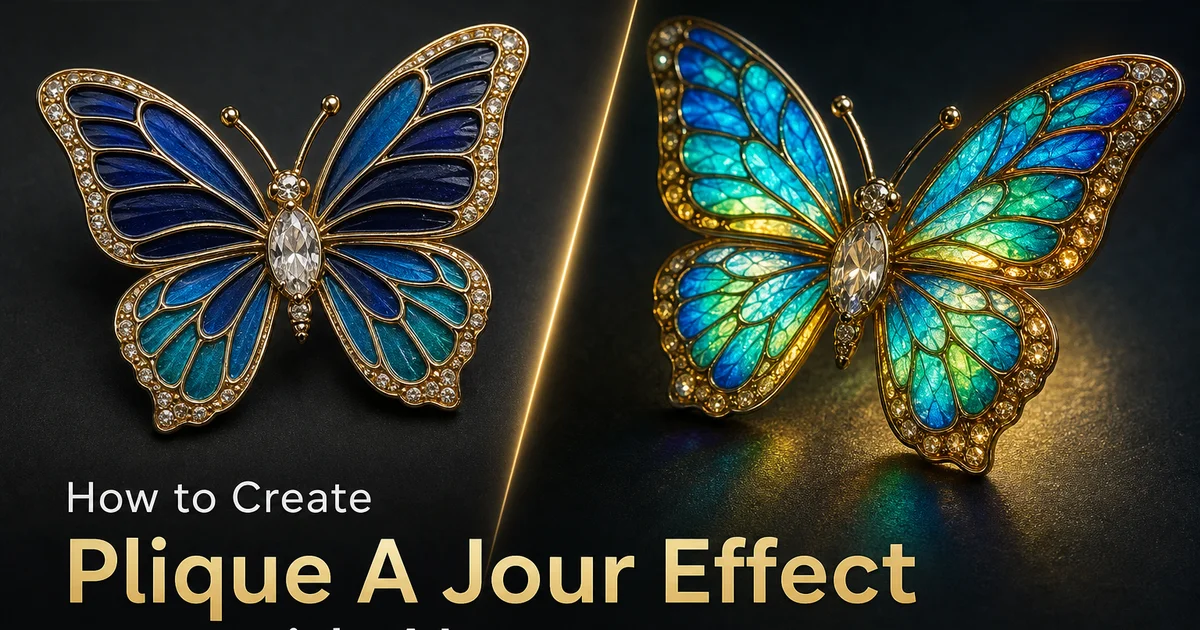
Plique-a-jour is among the rarest and most breathtaking techniques in the entire history of decorative metalwork, producing enamel jewelry and objects that glow like miniature stained glass windows when held to the light. Unlike cloisonne or champleve enamel where the vitreous glass rests on a metal backing plate, plique-a-jour suspends translucent enamel within a framework of fine metal wires with no support behind it. The finished piece transmits light directly through each colored cell, creating a luminous jewel-like quality that has captivated collectors since the Byzantine era. The technique reached its artistic zenith during the Art Nouveau period when master jewelers like Rene Lalique and Philippe Wolfers created extraordinary brooches, pendants. Hair ornaments featuring dragonfly wings, flower petals, and flowing organic forms rendered in translucent enamel of extraordinary delicacy.
Replicating the plique-a-jour aesthetic digitally has historically been one of the most challenging artistic filter effects because the technique depends on properties that conventional image processing handles poorly. The translucency of each enamel cell is not a simple transparency. It involves light passing through colored glass of varying thickness, scattering and saturating as it travels, with brightness concentrated where the glass is thinnest near the wire boundaries and deepest color where it pools thickest at the center of each cell. The metal wire framework must appear structurally coherent, following the kind of flowing curves that a goldsmith would actually solder, not arbitrary line patterns that would be impossible to fabricate. Previous filter approaches produced flat colored regions with black outlines that looked more like coloring book pages than precious enamelwork.
AI-powered style transfer changes this completely by understanding both the artistic tradition of plique-a-jour and the physical properties of translucent enamel before applying any change. The AI segments the image into regions that correspond to natural cell boundaries, generates wire frameworks that follow structurally plausible paths, and renders each enamel zone with physically accurate light transmission traits. Thicker glass producing deeper saturation, thinner areas near wires glowing brighter, and the overall luminosity responding to simulated backlighting angle and intensity. This guide walks through every step of creating plique-a-jour effects using AI Filter and AI Enhance, from choosing suitable source images to fine-tuning translucency, wire detail. The specific color palette of vitreous enamel.
- AI analyzes image content to create structurally plausible cell boundaries that follow natural edges, producing the flowing organic wire frameworks characteristic of master plique-a-jour jewelers.
- Translucency simulation renders each enamel cell with physically accurate light transmission. Deeper color at cell centers where glass is thickest and brighter glow near wire boundaries where it thins.
- Multiple style presets replicate different plique-a-jour traditions including Art Nouveau floral panels, Russian geometric patterns, and Scandinavian minimalist forms.
- Metal wire detailing includes specular highlights, consistent gauge, and smooth soldered curves that distinguish the effect from simple outline overlays or stained glass approximations.
- AI Enhance sharpens the metalwork framework to goldsmith precision while preserving the soft luminous quality of the translucent enamel fill between wires.
How AI plique-a-jour rendering differs from conventional stained glass filters
Most photo editing applications include a stained glass filter that divides the image into polygonal cells with dark borders, mapping average colors from the original into each cell. While this produces a superficially similar mosaic-like division of the image, it fails to capture the key qualities that distinguish plique-a-jour from ordinary stained glass. Plique-a-jour cells follow organic flowing curves dictated by goldsmith wire-bending techniques, not the random Voronoi tessellation that stained glass filters use. The wire boundaries in plique-a-jour are thin precious metal. Gold, silver, or platinum — with reflective properties completely different from the flat black lines of a digital filter. And the translucent enamel within each cell has depth-dependent color saturation that no flat color fill can replicate.
AI plique-a-jour rendering begins with understanding the source image as a three-dimensional scene before deciding where to place cell boundaries. The AI identifies natural edges — the outline of a flower petal, the boundary between sky and foliage, the contour of a face — and uses these as guides for wire placement, then smooths and refines the paths to follow the kind of flowing curves a jeweler would create when bending fine gold wire with pliers and mandrels. Structurally implausible configurations like unsupported wire spans exceeding what surface tension of molten enamel could bridge are automatically avoided, grounding the effect in physical reality.
The translucency simulation is where AI rendering makes the most dramatic departure from conventional filters. Each enamel cell is rendered as a volume of colored glass, not a flat color patch. Light entering the cell from behind scatters through the vitreous material, with color saturation increasing with glass thickness. Near the wire boundaries where the enamel meniscus is thinnest, the transmitted light is brightest and least saturated. At the center of each cell where the enamel pools deepest, the color reaches maximum richness. This physics-based rendering produces the trait luminous glow of genuine plique-a-jour that makes the technique so prized among collectors and art historians.
- Conventional stained glass filters use random Voronoi tessellation with flat black borders, producing geometric divisions unrelated to the organic flowing forms of plique-a-jour goldsmithing.
- AI wire placement follows natural image edges and refines paths to match the curves achievable with actual jeweler wire-bending techniques and tools.
- Structurally implausible wire configurations are automatically avoided, ensuring the enamel cell layout could theoretically be fabricated by a skilled goldsmith.
- Translucency rendering treats each cell as a volume of colored glass with depth-dependent saturation, replicating the luminous glow that distinguishes plique-a-jour from flat colored regions.
Selecting source images that translate effectively into plique-a-jour compositions
The most successful plique-a-jour changes begin with photographs that already contain visual properties sympathetic to the medium. Images with strong backlighting are ideal because plique-a-jour is at its core a transmitted-light technique. A backlit flower photograph, a sunset silhouette, or a stained glass window already shows the kind of luminous color-through-light quality that the effect enhances. Subjects with clearly defined regions of distinct color separated by natural boundaries convert most convincingly because the AI can place wire frameworks along existing edges rather than imposing artificial divisions that conflict with the image content.
Macro photography of natural subjects provides mainly strong source material because plique-a-jour has historically drawn its design vocabulary from the natural world. Art Nouveau plique-a-jour jewelry depicted dragonfly wings, butterfly wings, flower petals, peacock feathers, and marine organisms. All subjects where translucent membranes and thin structural veins already suggest the wire-and-enamel construction of the technique. A macro photograph of a leaf backlit by sunlight, with its veins forming a natural wire framework and its tissue glowing with translucent green light, is already halfway to plique-a-jour without any editing.
Portraits present a greater challenge but can produce striking results when the composition is carefully chosen. Profile silhouettes against bright backgrounds work well because the hair and facial outline provide natural wire framework paths while the background becomes luminous enamel. Three-quarter portraits with dramatic rim lighting allow the AI to use the light-edge boundary as the primary cell framework, creating a portrait that glows with the same ethereal quality as a Lalique brooch. Avoid flat-lit frontal portraits with busy backgrounds, as these force the AI to impose cell boundaries that compete with facial features rather than complementing them.
- Backlit photographs with luminous color fields are ideal source material because plique-a-jour is fundamentally a transmitted-light medium designed to glow when light passes through it.
- Macro shots of natural subjects like leaves, petals, butterfly wings, and feathers already suggest the wire-and-enamel construction vocabulary of the Art Nouveau plique-a-jour tradition.
- Profile silhouettes and rim-lit portraits translate effectively because the light-edge boundaries provide natural wire framework paths that complement rather than compete with facial features.
- Avoid flat-lit subjects with busy backgrounds, as these force artificial cell boundary placement that produces unconvincing results lacking structural coherence.
Configuring metal type, wire gauge, and framework aesthetics
The choice of simulated metal greatly affects the character of the plique-a-jour result. Gold wire produces warm reflective highlights that complement the rich saturated colors of vitreous enamel. This is the traditional choice for fine plique-a-jour jewelry and produces the most luxurious look. Silver wire creates cooler highlights that pair beautifully with blue, green. Violet enamel tones, producing a more modern aesthetic that references Scandinavian and Russian plique-a-jour traditions. The AI adjusts the specular highlight color, reflective intensity. Shadow warmth to match each metal type, ensuring the wire framework reads as polished precious metal rather than a generic neutral outline.
Wire gauge — the thickness of the simulated metal wires — controls the visual weight of the framework relative to the enamel fill. Fine gauge wire produces delicate lacework effects where the translucent enamel dominates and the metal framework is barely visible, replicating the extraordinary fineness of Lalique's best plique-a-jour work where wire nearly disappears into light. Heavier gauge produces bolder frameworks where the metal pattern becomes a prominent design element in its own right, closer to the robust construction of Russian tea glass holders or Scandinavian spoon bowls where the metalwork is meant to be admired as much as the enamel.
Framework pattern options extend beyond following image edges to include historically inspired decorative wire configurations. Art Nouveau flowing curves with whiplash tendrils produce the most organic naturalistic effects. Celtic interlace patterns create mesmerizing geometric wire compositions that transform any image into a decorative panel. Japanese shippo-style circular overlapping frames produce rhythmic cellular patterns suited to abstract and decorative applications. Each framework style interacts differently with the source image content. The AI previews how each pattern integrates with the specific photograph before committing to a final configuration.
- Gold wire simulation produces warm specular highlights suited to traditional plique-a-jour jewelry, while silver creates cooler highlights for contemporary Scandinavian and Russian aesthetics.
- Fine wire gauge creates delicate lacework where enamel dominates, replicating Lalique-era fineness, while heavier gauge emphasizes the metalwork pattern as a design element.
- Framework patterns include Art Nouveau organic curves, Celtic interlace geometry, and Japanese shippo circular overlaps, each producing distinctly different decorative effects.
- The AI previews how each framework style integrates with the specific source photograph before committing, ensuring wire placement enhances rather than conflicts with image content.
Mastering translucency depth, enamel color palette, and backlighting simulation
The translucency of plique-a-jour enamel is what elevates the technique above all other forms of decorative metalwork. Controlling this property accurately is the key to convincing digital simulation. Real vitreous enamel is glass — silicon dioxide fused with metallic oxide colorants at temperatures exceeding 800 degrees Celsius — and its optical properties follow the physics of colored glass rather than the behavior of paint or dye. When light passes through a thin layer of blue enamel, the cobalt oxide absorbs red and green wavelengths while transmitting blue, creating a saturated jewel tone that appears to glow from within. The AI replicates this wavelength-selective absorption for each enamel color, producing transmitted-light colors that look physically correct rather than simply tinted.
The enamel color palette available in vitreous work is constrained by chemistry. Not every color is achievable, and certain combinations that look natural in paint or digital color are impossible in glass. Transparent reds require gold chloride or selenium compounds and tend toward ruby rather than vermillion. Blues come from cobalt and range from pale azure to deep sapphire. Greens from chromium oxide can be vivid emerald but never the yellow-green of chartreuse. The AI constrains its color output to the physically achievable palette of vitreous enamel, preventing results that a knowledgeable viewer would right away recognize as impossible. This chemical accuracy is subtle but key for maintaining the illusion of genuine enamelwork.
Backlighting simulation controls determine how the viewer perceives the translucent enamel. Whether the piece appears to be held up to a bright window, displayed under museum gallery lighting, or photographed in a jeweler's light box. Strong directional backlighting produces the most dramatic effect, with enamel cells blazing with saturated color like cathedral windows. Diffuse ambient light creates a subtler glow where the translucency is visible but gentle, more like how most people experience plique-a-jour in a museum display case. The AI also mimics the slight color shift that occurs when translucent enamel is viewed at different angles, with oblique viewing producing slightly different hue traits than direct transmission.
- Vitreous enamel translucency follows glass physics with wavelength-selective absorption. The AI replicates this per-color to produce jewel tones that glow from within rather than appearing simply tinted.
- The color palette is constrained to chemically achievable vitreous enamel hues, preventing combinations that knowledgeable viewers would recognize as impossible in real glass enamel.
- Strong directional backlighting creates dramatic cathedral-window intensity, while diffuse ambient light produces the subtle museum-display glow most collectors experience.
- Angle-dependent color shift simulation replicates the slight hue variation that real translucent enamel exhibits when viewed from oblique angles versus straight-on transmission.
Creative applications: jewelry mockups, Art Nouveau tributes, and decorative art prints
Jewelry designers use the plique-a-jour filter to create concept visualizations before committing to the months of skilled labor required to produce genuine pieces. Converting a photograph of a butterfly wing into a plique-a-jour brooch mockup lets a designer evaluate how the natural pattern translates into enamel cells, which sections will glow most brilliantly. Where the wire framework needs reinforcement for structural integrity. This design-phase visualization saves enormous time and material cost compared to the traditional approach of sketching on paper and hoping the finished enamel matches the concept. Several modern enamelists have publicly credited AI mockup tools with improving their design success rate by letting them preview translucency effects before firing.
Art Nouveau tribute projects use the plique-a-jour effect to transform modern photography into images that evoke the aesthetic sensibility of the movement's greatest jewelers. A photograph of a dragonfly rendered in plique-a-jour style right away references Lalique. A peacock feather in translucent enamel cells recalls Tiffany. Flowing feminine hair in gold wire and luminous glass echoes Alphonse Mucha's poster designs. These tributes work as fine art prints, social media content for jewelry brands, museum gift shop merchandise. Educational illustrations that show the visual principles of Art Nouveau decorative arts without requiring access to actual museum collections.
Decorative art prints produced from plique-a-jour changes have found a growing market among interior designers and art collectors who appreciate the luminous stained-glass quality of the effect when printed on backlit display panels or translucent substrates. A landscape photograph transformed into plique-a-jour and printed on acrylic with LED edge lighting creates a room-scale artwork that genuinely transmits light through colored regions, achieving in large format what traditional plique-a-jour achieves at jewelry scale. This application bridges the gap between digital art and decorative craft, using AI to translate a centuries-old goldsmithing technique into a modern medium.
- Jewelry designers use plique-a-jour mockups to preview how natural patterns translate into enamel cells before committing to months of skilled fabrication labor.
- Art Nouveau tribute projects transform modern photographs into visual references to Lalique, Tiffany, and Mucha, serving as fine art prints, social content, and educational materials.
- Backlit acrylic prints of plique-a-jour transformations create room-scale artworks that genuinely transmit light through colored regions, scaling the jewelry technique to architectural dimensions.
- The effect bridges digital art and decorative craft traditions, making centuries-old goldsmithing aesthetics accessible to contemporary artists and designers without metalwork training.
How to do it
- 1
Upload your photo and assess its suitability for a plique-a-jour transformation
Open your image in AI Filter and evaluate how well its composition translates to translucent enamel panels separated by metal wire outlines. Plique-a-jour is a backless enamel technique where translucent colored glass fills cells formed by thin metal wires. Similar to miniature stained glass — so photographs with strong backlighting, distinct regions of color, and clear subject outlines convert most convincingly. Portraits with rim lighting, flower macro shots with translucent petals, and stained glass architectural images are ideal candidates. Low-contrast images with muddy color transitions produce unconvincing results because the effect depends on luminous color fields bounded by crisp metallic borders.
- 2
Select the plique-a-jour style preset and configure cell structure
Choose from presets that simulate different plique-a-jour traditions. Art Nouveau floral panels with flowing organic cell shapes, Russian kokoshnik pieces with geometric radial patterns, or Scandinavian spoon bowls with simple translucent basins. AI Filter analyzes the image content and proposes cell boundaries that follow natural edges in the photograph, dividing the scene into translucent enamel zones separated by thin gold or silver wire outlines. Adjust cell density to control whether the result resembles a finely detailed brooch with dozens of tiny translucent panels or a bold statement piece with large sweeping color fields.
- 3
Adjust translucency, color saturation, and light transmission
Control how much simulated light passes through each enamel cell by adjusting the translucency slider. Real plique-a-jour enamel transmits light like stained glass. When held up to a window, each cell glows with jewel-like color intensity that solid enamel cannot achieve. The AI mimics this by rendering each color zone as if backlit, with deeper saturation toward the center of each cell where the enamel is thickest and lighter transmission near the metal wire borders where the glass layer thins. Increase the backlighting intensity for a dramatic window-light effect or reduce it for the subtler ambient glow of enamel viewed under gallery lighting.
- 4
Refine metal wire detailing with AI Enhance for authentic goldsmith precision
Run AI Enhance on the transformed image to sharpen the simulated metal wire framework that separates each enamel cell. In genuine plique-a-jour, the metalwork is extraordinarily fine. Gold or silver wires soldered into intricate patterns that hold the vitreous enamel in place without any backing plate. The boost step tightens these wire edges, adds subtle specular highlights that simulate polished precious metal catching light. Ensures consistent wire thickness throughout the composition. This finishing pass transforms the effect from a color-segmentation overlay into a convincing representation of master jeweler craftsmanship.
- 5
Export the final image and compare against museum-quality plique-a-jour references
Save the completed image at full resolution and compare it with photographs of genuine plique-a-jour masterworks from collections like the Metropolitan Museum of Art or the Victoria and Albert Museum. Verify that the translucent color fields glow with right luminosity, that the metal wire framework appears structurally plausible with consistent gauge and smooth curves, and that the overall composition respects the material constraints of real enamelwork. No impossibly thin wires, no structurally unsupported spans, and no color combinations outside the palette achievable with vitreous enamel. Adjust any parameters that produce results a jeweler would recognize as physically impossible.
Sources
- Plique-a-Jour Enameling: History, Technique, and Conservation — The Metropolitan Museum of Art
- Image Style Transfer Using Convolutional Neural Networks — IEEE Conference on Computer Vision and Pattern Recognition
- Art Nouveau Jewelry: Makers, Marks, History — Lang Antiques & Estate Jewelry