
How to Create a Niello Inlay Effect with AI Photo Editing
Transform photos into niello metalwork inlay art using AI style transfer. Step-by-step guide covering engraved silver patterns, dark sulfide alloy fills, Russian, Thai, and Bidri traditions, and high-contrast metal decoration effects.
SEO & Growth
Reviewed by Magic Eraser Editorial ·
Table of Contents
- How AI niello conversion differs from manual contrast inversion and metallic overlay techniques
- Regional traditions: Russian narrative, Thai geometric, and Indian Bidri inversion
- Controlling engraving style: line weight, pattern fill, and compositional balance
- Creative applications: jewelry design, decorative art, and luxury branding
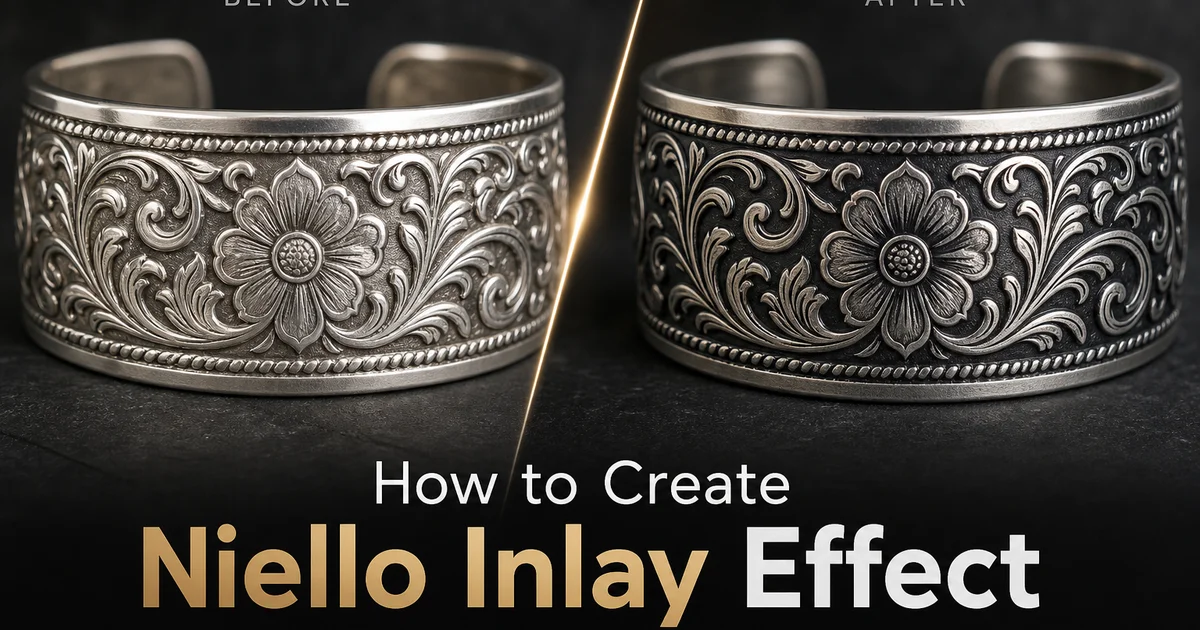
Niello is one of the oldest and most widespread metalwork decoration techniques, practiced across cultures from ancient Egypt and Rome through medieval Europe and the Islamic world to the living traditions of Russia, Thailand, and India. The technique involves engraving or chasing patterns into a metal surface. Often silver, occasionally gold — then filling the incised channels with a black sulfide alloy compound that fuses with the metal when heated. After firing and polishing, the result is a surface where bright, reflective metal and deep, matte black inlay create bold graphic patterns with extraordinary precision and durability. This high-contrast aesthetic — luminous metal traced with dark linear patterns or dark grounds revealed through bright metal lines — gives niello its timeless visual power and makes it one of the most strong decorative art effects to apply to photography through AI style transfer.
Recreating the niello look digitally has in the past been limited to manual Photoshop work: tracing subject outlines to create engraving paths, filling channels with dark tones. Overlaying metallic textures on the remaining surface. The results are time-consuming to produce and rarely convincing because the artist must make hundreds of decisions about where to place engraved lines, how dense the pattern fill should be. How to handle transitions between detailed and simplified areas. A skilled niello engraver develops these instincts over years of practice, knowing exactly which lines define a form well and which areas benefit from stippled fill versus open metal surface. These design decisions are what make the difference between niello that looks like intentional art and processing that looks like a posterized photograph with a metallic overlay.
AI-powered niello conversion brings genuine design intelligence to this process by analyzing the semantic content of the photograph before determining where to place engraved lines and pattern fills. The AI identifies subject boundaries, internal structures. Areas of visual importance, then generates an engraving pattern that follows natural contours while maintaining the graphic clarity that defines niello as an art form. Fine detail areas receive dense linework, broad surfaces receive open metal treatment or patterned fill depending on the selected tradition. The balance between dark inlay and bright metal is managed globally to achieve the desired visual weight. This guide walks through using AI Filter and AI Enhance to create niello effects that capture the precision and contrast of traditional metalwork inlay across Russian, Thai, and Bidri traditions.
- AI analyzes subject boundaries and internal structures to generate engraving patterns that follow natural contours, placing lines where a skilled metalworker would incise them rather than tracing arbitrary pixel edges.
- Multiple niello traditions are available including Russian Velikiy Ustyug fine narrative engraving, Thai bold geometric patterns. Indian Bidri ware with its inverted dark-ground silver-inlay aesthetic.
- Inlay density controls determine the balance between dark niello fill and bright exposed metal, from heavily inlaid surfaces with metallic highlights to mostly bright surfaces with fine dark linear accents.
- Line weight options simulate different engraving techniques — fine burin lines for detailed figurative work, broad chisel channels for bold patterns, and stippled point-work for textured fill areas.
- AI Enhance sharpens the engraved line boundaries to the razor-sharp precision characteristic of real niello inlay and adds directional polish marks to the metal surface for convincing reflectivity.
How AI niello conversion differs from manual contrast inversion and metallic overlay techniques
The simplest approach to a niello-like effect in photo editing is to convert the image to high-contrast black and white, invert it so that light areas become dark and dark areas become light, then overlay a metallic texture on the light regions. This produces something that vaguely resembles niello at a distance but falls apart under any scrutiny. The problem is that photographic tonal distribution bears no relationship to how a metalworker decides where to engrave. A photograph has steady tonal gradients. Every brightness value from pure white to pure black — while real niello has only two states: metal surface and niello fill. The conversion from steady tone to binary metal-or-inlay requires design decisions that a simple threshold cannot make.
AI niello conversion begins with subject recognition and structural analysis rather than tonal thresholding. The AI identifies the primary subject, its internal anatomy (facial features in a portrait, petal structure in a flower, window mullions in architecture). The relative importance of different contours. It then generates engraving lines that define these structures with the same hierarchical emphasis a skilled engraver would apply. Primary contours with heavier, more confident lines, secondary details with finer linework, and fill areas with right pattern density. The dark niello areas are not simply inverted highlights. They are intentionally designed fill regions that create decorative richness while supporting the legibility of the primary design.
The metal surface treatment is equally important to the realism of the effect. Real polished silver does not look like flat gray or white. It is a mirror-like surface that reflects its setting with a specific warm-cool color character that depends on the alloy composition. The AI renders bright metal areas with directional reflectivity, subtle surface variation. The trait warm tone of sterling silver or the cooler tone of fine silver. This material rendering means the non-inlaid areas of the image look like actual metal rather than simply the lighter portions of a high-contrast photograph. Is what creates the illusion that the viewer is looking at a decorated metal object rather than a processed digital image.
- Simple threshold-based contrast inversion treats tonal values as design decisions, producing results that look like posterized photographs rather than intentionally designed metalwork.
- AI generates engraving patterns through subject recognition, placing heavier lines on primary contours and finer detail on secondary structures with design intelligence matching skilled engravers.
- Dark niello regions are intentionally designed fill areas that create decorative richness, not simply inverted highlight zones from the original photograph's tonal distribution.
- Metal surface rendering includes directional reflectivity and alloy-specific color character, making bright areas look like actual polished silver rather than the light portions of a high-contrast image.
Regional traditions: Russian narrative, Thai geometric, and Indian Bidri inversion
Russian niello, mainly from the Velikiy Ustyug tradition that flourished from the 17th century onward, is characterized by intricate narrative scenes rendered with fine engraving on silver surfaces. Architectural views, hunting scenes, floral scrollwork, and figural compositions are rendered with the detail of miniature engravings. The niello-filled lines build up complex pictorial imagery against the bright silver ground. The Russian tradition treats niello as a drawing medium. The dark lines create images in the same way that ink on paper creates prints or engravings. The AI mimics this tradition by converting the image subject into fine engraved linework with crosshatched shading for tonal variation, producing results that resemble the elaborate silver boxes, goblets. Decorative panels that made Ustyug niello famous across Europe.
Thai niello (kruang thom) from the Nakhon Si Thammarat tradition takes a bolder approach, covering large areas of the silver surface with dense niello fill and leaving the exposed metal as the design element. Where Russian niello uses dark lines on bright ground, Thai niello often uses bright metal patterns on mostly dark ground. The patterns are often geometric and botanical. Interlocking lotus scrolls, kanok flame motifs, and tessellated geometric grids — creating surfaces with rich overall texture rather than pictorial imagery. The AI mimics this tradition by converting the image into bold pattern regions with heavy niello coverage, producing results that emphasize decorative surface treatment over narrative representation.
Bidri ware from the Indian Deccan represents a unique inversion of the typical niello relationship. Instead of dark inlay in bright metal, Bidri uses a zinc-copper alloy base that is chemically treated with a soil paste to turn the base metal deep black while leaving inlaid silver and gold wire patterns bright. The result is a dark object with gleaming metallic decoration. Visually similar to other niello traditions but achieved through the opposite material relationship. The AI mimics Bidri by rendering the ground as deep matte black with inlaid silver or gold patterns that follow the image's highlighted areas, producing the distinctive Bidri aesthetic where bright metallic designs float on a velvety dark surface. Bidri mode works mainly well with subjects that have isolated bright elements against dark backgrounds.
- Russian Velikiy Ustyug niello uses fine narrative engraving with crosshatched tonal variation, converting subjects into detailed pictorial linework on bright silver. Ideal for complex figurative and architectural subjects.
- Thai Nakhon Si Thammarat niello covers large areas with dense dark fill, leaving exposed metal as bold geometric and botanical patterns that emphasize decorative surface texture over pictorial representation.
- Indian Bidri ware inverts the typical relationship with bright silver or gold wire inlaid into chemically blackened zinc-copper alloy, producing gleaming metallic patterns on a velvety dark ground.
- Each tradition can be applied to any subject, but Russian works best for detailed scenes, Thai for pattern-rich compositions, and Bidri for subjects with bright focal elements against dark surrounds.
Controlling engraving style: line weight, pattern fill, and compositional balance
The engraving line weight determines the fundamental character of the niello design and should be chosen based on both the subject matter and the intended viewing distance. Fine burin lines — the kind produced by a pointed engraving tool pushed through the metal — create delicate detail suited to small-scale work viewed at close range, such as jewelry, snuffboxes, and decorative panels. The AI renders these as thin, precise lines with slight natural variation in width where the burin encounters grain boundaries in the metal, producing the hand-cut quality that distinguishes real engraving from mechanical precision. Medium chisel lines suggest the broader cuts of a flat graving tool, suitable for medium-scale work like serving ware, plaques, and architectural ornament. Heavy chased lines simulate the bold marks of a chasing tool struck with a hammer, creating deep broad channels suited to large-scale work viewed from a distance.
Pattern fill behavior determines what happens in areas between the primary engraving lines. In the simplest mode, these areas remain as open metal surface, producing a clean line-drawing aesthetic where the niello pattern consists only of the engraved design lines. Adding background fill introduces stippled or crosshatched texture to selected regions, creating darker areas that increase the overall niello coverage and add decorative richness. The AI intelligently selects which areas receive background fill based on the image's tonal structure. Shadow regions in the original photograph receive denser fill while highlight regions remain as open metal, creating a tonal mapping that preserves the image's depth cues within the binary niello medium. The fill pattern itself can be configured from fine stippling (individual punched dots) to regular crosshatching to organic random texture.
Compositional balance between niello-covered and metal-exposed areas is the most important aesthetic decision in the entire process. A design that is too heavily inlaid becomes a dark mass with thin metallic lines that looks oppressive and loses the luminous contrast that defines niello's appeal. A design that is too lightly inlaid appears as a polished metal surface with barely visible dark accents that fails to deliver the graphic impact the technique promises. The ideal balance depends on the tradition. Russian narrative niello tends toward moderate coverage with equal weight given to dark and light, Thai decorative niello tends toward heavy coverage with the metal as accent, and Bidri tends toward heavy ground darkness with bright metal as the featured element. The AI sets default density based on the selected tradition but provides manual override for precise control.
- Fine burin lines create delicate detail with natural width variation for close-viewing work, while heavy chased lines produce bold channels suited to large-scale compositions viewed at distance.
- Pattern fill adds stippled or crosshatched texture to areas between primary engraving lines, with AI mapping fill density to the original image's tonal structure for preserved depth cues.
- Compositional balance between niello coverage and exposed metal determines the overall visual weight — too heavy becomes oppressive, too light loses graphic impact.
- Default density presets match the selected tradition's typical coverage ratios, with manual override available for precise control over the dark-to-bright balance.
Creative applications: jewelry design, decorative art, and luxury branding
Jewelry designers use niello effects to visualize how proposed designs would look as finished metalwork before committing to the time-intensive engraving process. A photograph of a ring, bracelet, or pendant can be converted to a niello rendering that shows how the engraved pattern would interact with the form of the piece. Which areas would receive inlay, how the pattern would wrap around curved surfaces, and what the overall visual weight would be. This visualization capability saves major time in the design process because changes can be evaluated digitally rather than requiring new metalwork for each iteration. Independent jewelers who offer custom niello work can show clients realistic previews of commissioned pieces based on photographs of their plain metal blanks.
Decorative art and interior design applications use niello effects to create visual assets with the gravitas of traditional metalwork. A portrait rendered as Russian niello becomes a striking wall art piece that shares heritage and craftsmanship. A botanical illustration rendered as Thai niello produces a decorative panel with rich surface texture suitable for luxury interior applications. Architectural details rendered as Bidri ware create dramatic dark-and-bright graphic compositions that work as statement pieces in modern interiors. The niello aesthetic shares age, permanence, and skilled handwork. Values that resonate strongly in luxury residential and hospitality design contexts where visual materials need to convey substance rather than ephemerality.
Luxury brand marketing benefits from the niello aesthetic because it right away shares the values of craftsmanship, heritage. Material quality that luxury positioning requires. A product photograph rendered as niello inlay transforms a consumer good into an object that appears to have been crafted by artisan metalworkers, elevating its perceived value through association with traditional decorative art. The high-contrast graphic quality of niello also reproduces well across media. It reads clearly at small sizes on mobile screens, prints cleanly in high resolution for catalogs and packaging, and creates distinctive social media content that stands out from the standard photography that dominates luxury brand feeds. The effect is mainly effective for watches, jewelry, leather goods. Spirits brands where the product category already has associations with traditional craftsmanship.
- Jewelry designers visualize engraving patterns on photographed metal blanks before committing to physical work, showing clients realistic previews of custom niello commissions.
- Interior designers use niello-styled portraits, botanicals, and architectural details as wall art and decorative panels that communicate heritage and craftsmanship in luxury spaces.
- Luxury brand marketing uses niello rendering to transform product photos into objects that appear artisan-crafted, elevating perceived value through association with traditional metalwork.
- The high-contrast graphic quality of niello reproduces clearly across all media — mobile screens, print catalogs, packaging, and social media — making it versatile for multi-channel luxury branding.
How to do it
- 1
Upload your photo and assess its suitability for niello inlay conversion
Open your image in AI Filter and evaluate it for the niello aesthetic. Depends on strong contrast between a bright metal surface and dark inlaid patterns. Photographs with clear subject boundaries, well-defined edges, and distinct tonal regions convert most well because niello is at its core a high-contrast medium. Dark sulfide alloy fills engraved channels in polished silver or gold, creating designs defined by the interplay of bright metal and black pattern. Portraits with strong lighting, botanical close-ups with clear vein and petal structure. Architectural details with geometric patterns all work well. Low-contrast images with subtle tonal variations produce less strong results because niello demands bold separation between light and dark.
- 2
Select the niello tradition and configure metal base and inlay parameters
Choose from niello presets that simulate different historical and regional traditions. Russian niello (Velikiy Ustyug tradition) features fine narrative scenes with architectural and figurative detail engraved into silver with delicate line work. Thai niello (Nakhon Si Thammarat tradition) uses bold geometric and floral patterns with heavier inlay coverage on a bright silver ground. Bidri ware from the Indian Deccan uses a zinc-copper alloy base that is treated to turn deep black, with silver or gold wire inlaid to create the bright pattern. An inversion of the typical niello relationship where the ground is dark and the design is bright. Select the tradition that matches your desired aesthetic, then adjust the base metal from polished silver to oxidized silver, gold, or Bidri black.
- 3
Adjust inlay density, line weight, and pattern fill behavior
Control the density of the niello pattern to determine how much of the metal surface is covered by dark inlay versus how much remains as bright exposed metal. High density produces surfaces where the dark niello dominates and the bright metal appears as fine lines and small reserved areas, creating an overall dark look with metallic highlights. Low density produces surfaces where the bright metal dominates and the niello appears as fine engraved lines and accent patterns, creating an overall bright look with dark linear detail. Adjust line weight to simulate different engraving techniques. Fine burin lines for detailed figurative work, broader chisel-cut channels for bold decorative patterns, and stippled point-work for textured fill areas.
- 4
Use AI Enhance to sharpen engraved line detail and polish the metal surface
After the initial niello conversion, run AI Enhance to sharpen the engraved line detail and ensure the boundary between dark niello fill and bright metal is crisp and precise. Real niello inlay has razor-sharp edges where the sulfide alloy meets the polished metal surface. This precision is one of the technique's defining traits and any blurring at these boundaries right away compromises the effect. The boost step also refines the metal surface quality, adding the subtle directional polish marks visible on real silver and gold surfaces and ensuring the bright metal areas display convincing metallic reflectivity rather than flat light color.
- 5
Export the final image and compare against museum-quality niello references
Save the finished niello effect at full resolution and compare it with photographs of authentic niello metalwork from museum collections and artisan workshops. Check that the dark inlay areas display the deep, slightly warm black of real niello sulfide rather than pure cool black, that the metal surface areas show convincing reflective quality with right polish marks. That the engraved pattern follows the natural contours of the subject in a way that a metalworker would design. Verify that the line weight is consistent where it should be and that the inlay density creates the desired balance between dark pattern and bright metal ground. Adjust settings until the result reads as a photograph of an engraved metal object rather than a processed photograph.
Sources
- Niello: The Art of Black Metalwork Inlay — The Metropolitan Museum of Art
- Image Style Transfer Using Convolutional Neural Networks — IEEE Conference on Computer Vision and Pattern Recognition
- Bidri Ware: Indian Metalwork from the Deccan — Victoria and Albert Museum