
How to Create a Niello Effect with AI — Magic Eraser
Transform photos into niello-style metalwork art with AI. Learn engraving pattern styles, metal surface choices, niello fill, dimensional relief, aging effects, and historical regional traditions.

SEO & Growth
Reviewed by Magic Eraser Editorial ·
Table of Contents
- How AI niello conversion creates convincing metalwork aesthetics beyond simple threshold filters
- Regional niello traditions and their distinctive visual vocabularies
- Metal surface rendering and the physics of reflective materials
- Aging effects and the patina of historical niello objects
- Creative applications: jewelry design, luxury branding, and decorative art prints
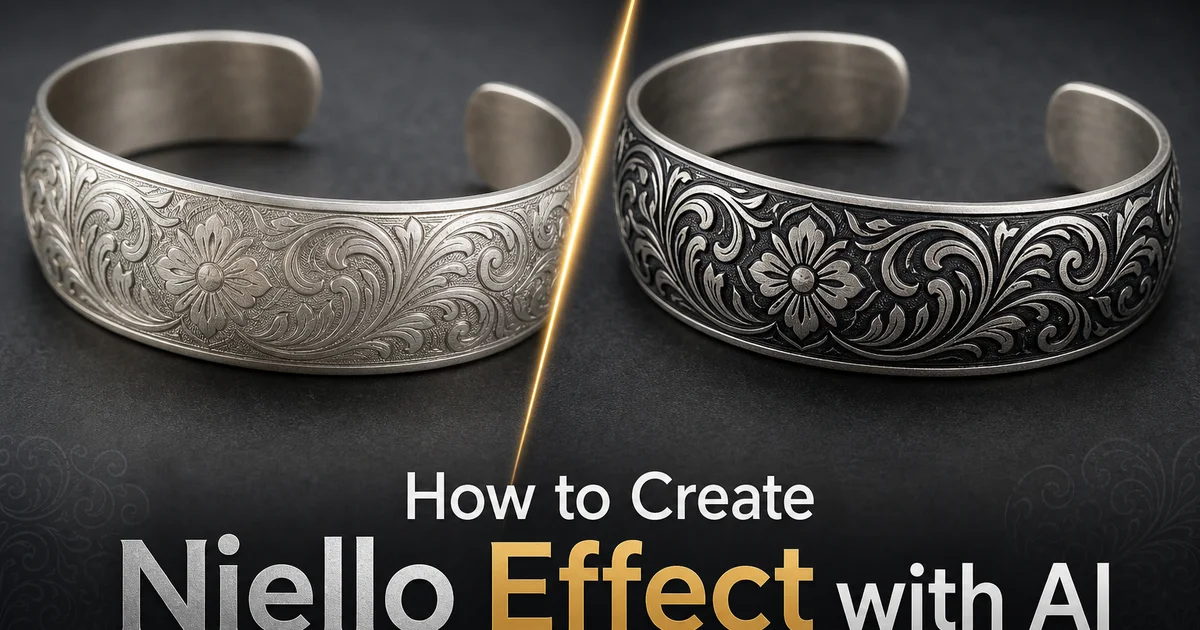
Niello is the ancient decorative metalworking technique of filling engraved designs in silver, gold, or other metals with a dark alloy compound. Often a mixture of silver, copper, lead, and sulfur that melts into the incised lines and hardens into a jet-black inlay contrasting greatly with the polished metal surface. The technique has been practiced for at least four thousand years, with niello-decorated objects found in Mycenaean shaft graves, Egyptian tombs, Roman jewelry hoards, Byzantine reliquaries. The treasuries of cultures spanning from India to Scandinavia. The dramatic visual contrast between gleaming metal and deep black engraving makes niello one of the most striking decorative metalwork techniques ever developed, producing objects that combine the precision of engraving with the bold graphic impact of high-contrast two-tone design.
Recreating the niello aesthetic digitally has been challenging because the effect depends on material qualities. Metallic reflectivity, dimensional depth of engraved lines, the particular matte-black quality of the sulfide compound, and the tactile contrast between raised metal and recessed fill — that flat digital filters cannot adequately represent. A simple threshold filter can produce high-contrast black-and-white images. An emboss filter can add apparent depth, but combining these with convincing metallic surface quality and historically right engraving patterns requires understanding both the material properties of metalwork and the decorative conventions of specific niello traditions. Generic metallic texture overlays produce results that look like chrome text effects rather than handcrafted silverwork.
AI-powered niello conversion addresses these challenges by learning the visual traits of actual niello objects from museum collections and craft records, understanding how polished metal surfaces reflect light, how engraved lines create shadows and highlights at their edges, how niello compound sits within incisions with a specific matte-black quality distinct from painted black. How different regional traditions employ different engraving vocabularies. This guide walks through using AI Filter to transform photographs into niello metalwork artwork, covering regional style selection, metal surface configuration, engraving pattern control, dimensional relief simulation. The finishing details that distinguish convincing metalwork art from flat graphic effects.
- AI learns the visual traits of actual niello from museum collections. Metallic reflectivity, engraved line depth, matte-black sulfide compound quality, and tactile contrast between raised and recessed surfaces.
- Regional style presets reference specific traditions including Russian scrollwork, Islamic geometric interlace, Italian Renaissance figurative scenes, and Thai bold graphic patterns.
- Metal surface options include polished sterling silver, oxidized silver, yellow gold, and rose gold, each fundamentally changing the color relationship in the high-contrast composition.
- Dimensional relief simulation adds depth to engraved areas through edge highlights and shadows, replicating the tactile quality where incised lines sit physically below the polished metal surface.
- Niello fill density controls simulate conditions from freshly applied complete fill to aged worn niello where dark compound has partially been lost from incisions, revealing metal beneath.
How AI niello conversion creates convincing metalwork aesthetics beyond simple threshold filters
The simplest approximation of niello in digital editing is a threshold filter that converts a photograph to pure black and white. Pixels above a brightness value become white (representing bare metal) and pixels below become black (representing niello-filled engraving). This produces a high-contrast two-tone image that shares niello's fundamental dark-on-light structure but lacks every quality that makes niello visually distinctive. The white areas are flat and uniform rather than showing the reflective quality of polished metal. The black areas are flat ink rather than the specific matte-black of sulfide compound sitting within recessed engraving. There is no dimensional depth, no engraving pattern structure, and no relationship to any historical niello tradition.
AI niello conversion builds the effect from material simulation upward. The base metal surface is generated with physically based rendering that mimics how polished silver, gold, or other metals reflect light. Including the trait broad specular highlights, the subtle color variation across curved surfaces, and the way reflections stretch and compress across the metal's geometry. The engraved areas are then rendered as physically incised into this metal surface, with the edges of each engraved line showing the sharp bright highlight where the burin cut reveals fresh metal and the shadow on the opposite side where the line drops below the surface plane. The niello compound within the engraving is rendered with its specific optical properties. Matte rather than reflective, slightly granular in texture, and with the trait blue-black tone of silver sulfide.
The engraving patterns themselves are generated according to the decorative conventions of the selected regional tradition rather than simply tracing the photograph's edges. Russian niello uses flowing scrollwork with foliate motifs. Acanthus leaves, flower heads, and spiraling tendrils — that fill background areas while leaving figural subjects as bare polished metal. Islamic niello uses geometric interlace patterns based on mathematical constructions similar to zellige tilework. Italian Renaissance niello uses fine crosshatching to build tonal gradations, allowing figurative scenes with modeled three-dimensional form. The AI selects and applies the right decorative vocabulary, using the photograph's tonal structure as a guide for which areas receive dense engraving and which remain as polished metal. Expressing that tonal mapping through historically authentic pattern language.
- Simple threshold filters produce flat two-tone images without metallic reflectivity, dimensional depth, or any relationship to historical niello engraving traditions.
- AI builds niello from material simulation upward — physically rendered metal surfaces with specular highlights, engraved line depth with edge highlights and shadows, and matte sulfide compound fill.
- Russian scrollwork, Islamic geometric interlace, Italian Renaissance crosshatching, and Thai graphic patterns each represent distinct decorative vocabularies with centuries of tradition.
- Tonal mapping uses the photograph's brightness structure as a guide but expresses it through historically authentic engraving patterns rather than simple pixel-level black-and-white conversion.
Regional niello traditions and their distinctive visual vocabularies
Russian niello reached its highest artistic development in the workshops of Tula and Veliky Ustyug during the eighteenth and nineteenth centuries, producing silverwork renowned for its fine scrollwork backgrounds and crisp figural designs. Tula niello is characterized by densely packed foliate scrollwork. Spiraling acanthus leaves, flower heads, and intertwined stems — that fills every background area with intricate dark pattern while leaving architectural views, portraits, and decorative cartouches as bright polished silver. The contrast between the intensely detailed dark background and the clean bright subject areas creates a dramatic visual hierarchy that draws the eye to the reserved metal subjects. Veliky Ustyug work tends toward finer, more delicate engraving with greater tonal range achieved through varying the density of the scrollwork pattern.
Islamic niello traditions from the Middle East and Central Asia employ geometric interlace patterns that reflect the same mathematical principles found in zellige tilework and architectural decoration. These patterns use interlocking geometric shapes. Stars, hexagons, and flowing arabesques — to create all-over designs of extraordinary complexity built from simple repeated elements. The niello-filled geometric framework creates a dark lattice that reveals bright metal in the spaces between interlocking shapes, producing patterns that can be read as either dark design on light ground or light shapes emerging from dark framework depending on the viewer's perceptual focus. This figure-ground ambiguity is a defining trait of Islamic geometric art that niello renders with particular clarity due to the absolute contrast between black fill and polished metal.
Thai niello, known as kruang thom, represents a Southeast Asian tradition where bold graphic designs. Mythological figures, floral motifs, and narrative scenes from Buddhist and Hindu texts — are rendered in a larger scale and bolder line weight than most European or Middle Eastern niello work. Thai silversmiths favor strong graphic impact over delicate detail, producing objects where the niello designs read clearly from a distance and carry the visual weight of graphic illustration rather than the fine jewelry-scale engraving of European traditions. This bold approach makes Thai niello mainly effective for converting photographs because the heavier line weight and larger pattern scale maintain legibility even when applied to complex photographic content with diverse tonal values.
- Russian niello from Tula and Veliky Ustyug features dense foliate scrollwork backgrounds with bright polished silver reserved for figural subjects and architectural views.
- Islamic traditions employ geometric interlace creating figure-ground ambiguity. Dark lattice revealing bright shapes or bright shapes emerging from dark framework — reflecting mathematical principles shared with zellige.
- Thai kruang thom uses bold graphic designs at larger scale than European traditions, favoring strong visual impact over delicate detail with clear legibility from viewing distance.
- Italian Renaissance niello pioneered fine crosshatch tonal modeling that allowed figurative scenes with three-dimensional form, distinct from the flat two-tone approach of other traditions.
Metal surface rendering and the physics of reflective materials
The visual quality that most right away distinguishes niello art from simple black-and-white graphic design is the metallic reflectivity of the bright areas. Polished silver does not appear as flat white. It shows specular highlights where light sources are reflected, subtle tonal gradation across curved surfaces as the reflection angle changes, and a particular luminous quality that results from the high reflectivity of the metal surface. These optical properties share the material's nature to the viewer and establish the context that transforms the dark pattern areas from printed ink into engraved and filled metalwork. Without convincing metallic surface rendering, the niello effect reads as a graphic design exercise rather than a simulation of a three-dimensional crafted object.
AI Filter renders metal surfaces using principles derived from physically based rendering in computer graphics, adapted for the specific optical properties of precious metals. Sterling silver reflects about ninety-five percent of visible light with a slight warm bias that gives it a different character from chromium's cooler tone. Yellow gold reflects strongly in the red and green portions of the spectrum while absorbing blue, producing its trait warm color. Rose gold's copper content shifts the reflection further toward red. Oxidized silver has reduced reflectivity with a warm gray-brown tone that results from surface tarnishing. The AI applies these specific optical properties to the bright metal areas of the image, generating surface reflections that respond to the geometry of the underlying photograph. Curved surfaces show stretched reflections while flat areas show more uniform brightness.
The interaction between metal surface and dimensional relief is where the rendering achieves its most convincing quality. At every boundary between polished metal and niello-filled engraving, the AI generates the specific light behavior that occurs at an incised edge in real metalwork. The wall of the engraving where the burin first enters the metal creates a bright highlight line. The sharp cut exposes fresh metal at an angle that catches light efficiently. The opposite side of the engraving casts a subtle shadow. The niello compound within the incision sits slightly below the metal surface plane, creating a shadow line along its edge where it meets the raised metal. These micro-scale lighting effects accumulate across thousands of engraved lines to produce the dimensional richness that distinguishes fine niello from flat printing.
- Polished silver reflects approximately ninety-five percent of visible light with a warm bias, while gold and rose gold shift reflections toward red-green wavelengths per their metal composition.
- Physically based rendering generates surface reflections that respond to underlying geometry — curved surfaces show stretched reflections while flat areas display uniform brightness.
- Engraved line edges produce bright highlight lines where fresh metal is exposed at an angle, with opposing shadows where the incision drops below the surface plane.
- These micro-scale lighting effects across thousands of engraved lines create the dimensional richness that distinguishes niello metalwork simulation from flat two-tone graphic design.
Aging effects and the patina of historical niello objects
Niello objects accumulate distinctive aging traits that reveal their history and add visual complexity beyond the original design. The polished metal surfaces gradually develop tarnish. Silver oxidizes to produce a warm gray-brown patina that reduces the bright contrast with the niello fill, creating a more subtle tonal relationship. Gold surfaces are more resistant to tarnishing but accumulate fine scratches from handling and wear that scatter reflections and soften the mirror-like polish. The niello compound itself can deteriorate over centuries, cracking or partially falling out of the engraved lines to reveal the bare metal beneath. Creating a textured, incomplete fill that shows the history of the object's use.
AI Filter offers aging controls that simulate these deterioration processes to produce results that evoke specific historical periods rather than pristine new metalwork. Light aging adds a subtle patina to the metal surfaces and introduces minor wear to the niello fill, producing the look of a well-maintained piece that is perhaps a few decades old. Medium aging darkens the tarnish, introduces more major niello loss in high-wear areas like edges and corners. Adds the fine scratch network visible on frequently handled silver. Heavy aging mimics centuries of deterioration with pronounced tarnish, major niello loss that reveals the engraved line structure beneath. The overall softening of visual contrast that characterizes museum pieces in their unrestored state.
The strategic use of aging effects can serve specific artistic purposes beyond simple historical simulation. Applying aging to a niello conversion of a modern portrait or landscape creates a temporal dislocation. The viewer sees a recognizably modern subject rendered in a medium that implies centuries of age, producing a visual tension between content and display that can be artistically strong. The aging effects also add visual complexity and warmth to compositions that might appear too stark in their pristine high-contrast form, softening the graphic impact into something that feels more organic and less digitally precise.
- Silver tarnish reduces bright contrast with niello fill over time, while gold accumulates handling scratches that scatter reflections and soften mirror polish.
- Niello compound deterioration over centuries produces cracking and partial loss from engraved lines, revealing bare metal beneath and showing the object's history of use.
- Aging controls range from subtle decades-old patina to heavy centuries-old deterioration with pronounced tarnish, significant niello loss, and overall contrast softening.
- Strategic aging creates temporal dislocation when applied to modern subjects. Modern content in an apparently ancient medium produces strong visual tension between subject and display.
Creative applications: jewelry design, luxury branding, and decorative art prints
Jewelry designers use niello conversion to visualize how photographic designs would appear as engraved metalwork before committing to the labor-intensive process of actual metal engraving. Converting a floral photograph, a geometric pattern, or a portrait into a niello-style image provides an immediate preview of how the subject would translate into the two-tone engraving medium, revealing which details survive the conversion and which are lost. This visualization step saves major time in the design process because it identifies problematic source images early. Subjects with insufficient contrast, overly complex detail that would become illegible at engraving scale, or tonal structures that do not map cleanly to the dark-fill-versus-bright-metal binary of niello work.
Luxury brands in the jewelry, watchmaking, and accessories sectors use niello-style imagery to evoke the heritage of traditional metalcrafting in their marketing materials. Converting product photographs or brand imagery into niello creates visual assets that share craftsmanship, historical depth, and material luxury. Values central to luxury brand positioning. A watch brand can convert dial macro photographs into niello-style imagery for advertising campaigns, a jewelry brand can render its collections as niello illustrations for catalogs and social media. An accessories brand can use niello-converted imagery as distinctive packaging design elements that reference artisanal metalworking traditions.
Decorative art prints created through niello conversion offer a unique aesthetic that bridges photography and metalwork illustration. The dramatic contrast, dimensional quality, and historical resonance of niello-style imagery produces wall art that reads as both modern and traditional. The photographic subject is modern but the rendering technique evokes centuries of metalworking craft. These prints work mainly well when produced on metallic or pearlescent papers that add actual reflective quality to the simulated metal surfaces, creating a viewing experience where the paper itself contributes to the metalwork illusion by catching and reflecting light in ways that flat matte paper cannot replicate.
- Jewelry designers preview how photographic designs translate to engraved metalwork, identifying subjects with insufficient contrast or excessive complexity before committing to actual engraving.
- Luxury brands use niello imagery to communicate heritage craftsmanship in marketing materials — watch dials as niello for advertising, jewelry collections as niello for catalogs and social media.
- Decorative art prints on metallic or pearlescent papers combine AI-generated niello patterns with actual reflective paper surfaces, enhancing the metalwork illusion through physical light interaction.
- The niello aesthetic bridges contemporary photography and traditional metalwork illustration, producing imagery that reads as both modern in subject and historically resonant in rendering technique.
How to do it
- 1
Upload your photo and evaluate its suitability for niello metalwork conversion
Open your photograph in AI Filter and assess how the image's tonal structure will translate into the high-contrast vocabulary of niello. Dark engraved designs filled with black alloy set against polished silver or gold surfaces. Niello art is at its core a two-tone medium where intricate designs are incised into metal and filled with a dark sulfide compound, creating dramatic black-on-silver or black-on-gold contrast. Photographs with strong tonal contrast, clear subject outlines. Well-defined features convert most well because the technique maps dark image areas to niello-filled engraving and light areas to polished bare metal. Low-contrast or heavily mid-toned images produce less successful results because niello demands clear commitment to either dark fill or bright metal with minimal ambiguous middle tones.
- 2
Select the niello style and configure engraving pattern parameters
Choose from niello sub-styles that reference different historical traditions. The fine scrollwork and foliate patterns of Russian niello from Tula and Veliky Ustyug, the geometric interlace designs of Islamic niello from the Middle East and Central Asia, the figural narrative scenes of Italian Renaissance niello from Florence and Rome, or the bold graphic patterns of Thai niello (kruang thom) from Southeast Asian silversmithing traditions. AI Filter analyzes the image content and suggests the most right engraving pattern based on the subject matter, mapping the photograph's tonal information onto the selected decorative vocabulary. Adjust the engraving fineness slider to control the detail density of the incised lines.
- 3
Configure the metal surface and niello fill characteristics
Select the base metal that the niello designs will appear against. Polished sterling silver with its bright white reflectivity, oxidized silver with a warmer gray tone, yellow gold with its warm rich luster, or rose gold with its distinctive pink hue. Each metal choice at its core changes the color relationship between the light and dark areas of the composition. Then adjust the niello fill density to control how completely the dark compound fills the engraved lines. Fully filled produces crisp sharp lines while partially filled creates an aged or worn look where some of the dark compound has been lost from the incisions over time, revealing the metal beneath.
- 4
Add dimensional relief and surface finish details for metalwork authenticity
Enable the dimensional relief simulation that adds subtle depth to the engraved areas, showing the incised lines as slightly recessed below the polished metal surface. Real niello work has a tactile dimensional quality. You can feel the engraved lines with your fingertip because the metal is physically carved away before the niello compound is applied. The AI mimics this depth through carefully placed highlights and shadows along the edges of engraved lines. Then configure the surface finish of the metal areas: mirror polish for the brightest most reflective look, satin brush for a softer directional sheen, or hammered texture for a more rustic handcrafted quality that complements bold graphic niello designs.
- 5
Export the final metalwork artwork and verify engraving consistency
Save the completed niello image at full resolution and examine the engraving patterns for the consistency and intentionality that characterize genuine metalwork. In real niello, every line is on purpose cut by a skilled engraver using burins and gravers. The lines have consistent depth, controlled width that may vary intentionally for emphasis but never accidentally, and smooth steady curves without hesitation marks or wavering. Verify that the AI-generated engraving patterns show this same deliberate quality, that the niello fill is consistent within engraved areas. That the transitions between filled engraving and bare metal are clean and precise. Compare against museum photographs of actual niello work to verify that the overall density, pattern style. Surface quality match the traditions of the selected regional style.
Sources
- Niello: The Art of Inlaid Metal Design — The British Museum
- Image-Based Rendering of Metallic Surfaces and Engraving Effects — ACM Transactions on Graphics
- Medieval and Renaissance Metalwork Techniques — The Metropolitan Museum of Art