
How to Create Kolam Effect with AI — Magic Eraser
Transform photos into South Indian kolam geometric floor art using AI pattern generation. Step-by-step guide covering dot-grid structures, sikku loops, rangoli colors, and traditional design principles.

Visual Arts Editor
Reviewed by Magic Eraser Editorial ·
Table of Contents
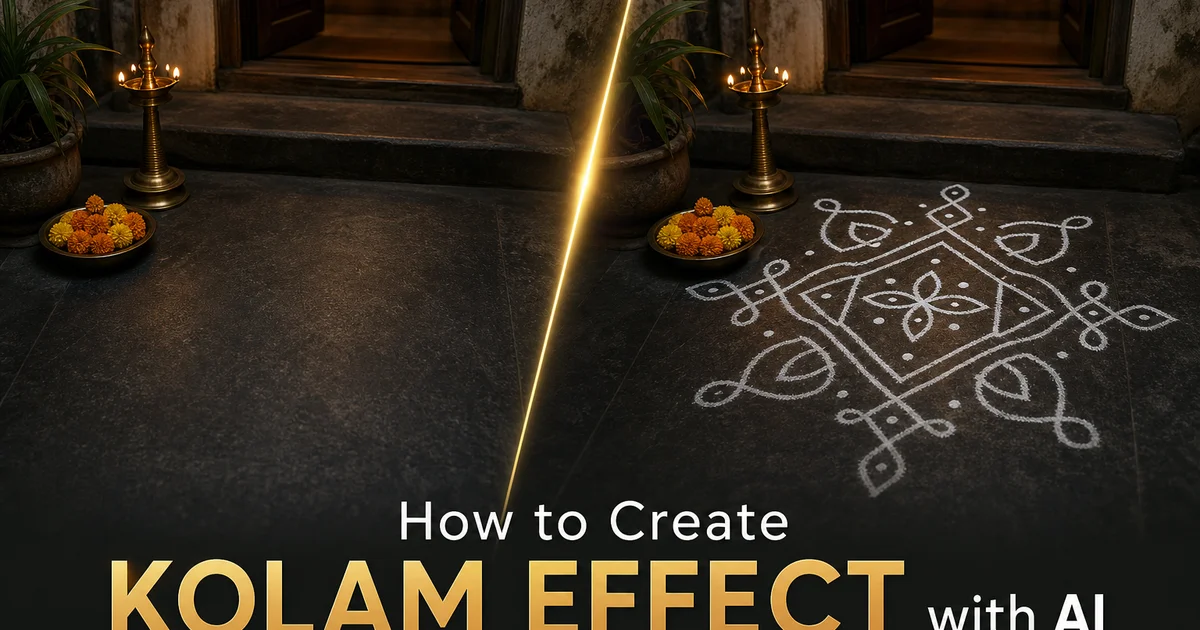
Kolam is a living art tradition practiced daily by millions of women across South India, mainly in Tamil Nadu, Karnataka, Andhra Pradesh, and Kerala. Each morning before dawn, the threshold of the home is swept clean and decorated with an intricate geometric pattern drawn freehand using rice flour, chalk powder, or colored rangoli powder on the ground. The designs range from simple dot-connected curves that take minutes to draw to extraordinarily complex interlocking loop patterns that can take hours and cover entire courtyards. Kolam serves at once as a spiritual practice marking the threshold between domestic and public space, an aesthetic expression of mathematical beauty, and a practical offering. The rice flour feeds ants and small creatures, embodying the Hindu principle of living in harmony with all beings. The geometric precision and visual complexity of kolam have attracted the attention of mathematicians, computer scientists, and artists worldwide.
Digital recreation of kolam patterns has in the past relied on algorithmic generation rather than photographic conversion. The designs are abstract geometric constructions rather than representations of natural scenes. Software that generates kolam often starts with a dot grid and applies formal grammar rules to draw curves connecting and encircling the dots according to traditional design principles. Converting a photograph into kolam-style art is a fundamentally different challenge. It requires mapping the distinct content of an image onto the abstract geometric vocabulary of kolam while maintaining both the legibility of the original subject and the mathematical elegance of the traditional art form. Simple overlays of kolam patterns onto photographs look artificial because there is no meaningful relationship between the photograph's content and the geometric structure.
AI-powered kolam conversion bridges this gap by analyzing the structural geometry of the photograph and using it as the organizing framework for generating authentic kolam patterns. The AI identifies symmetry axes, repeating elements, dominant curves, and focal points in the image, then constructs a dot grid aligned to these structural features and generates kolam curves that both follow traditional design rules and trace the meaningful contours of the subject. The result is a kolam pattern that reads as a distinct version of the original photograph while embodying the mathematical structure, steady-line discipline, and aesthetic sensibility of genuine South Indian floor art. This guide covers the complete process from subject selection through style configuration, color choices, and the finishing details that make the difference between a pattern overlay and a convincing kolam transformation.
- AI maps the structural geometry of photographs onto traditional kolam dot-grid frameworks, generating curves that follow both design rules and meaningful subject contours simultaneously.
- Multiple kolam styles are available including simple pulli dot-connected curves, complex sikku interlocking loops, and angular kambi straight-line patterns, each suited to different subject types.
- Color modes range from traditional white rice flour on dark ground to vibrant festival rangoli palettes that map the original photograph's colors onto geometric pattern sections.
- Symmetry controls include four-fold mirroring for traditional kolam appearance and radial rotation for subjects with natural circular structure like flowers and architectural details.
- Ground surface simulation replicates the texture of terracotta, stone, or concrete with visible granular rice flour or smooth paste medium along the drawn curves.
The cultural significance and mathematical structure of kolam art
Kolam occupies a unique position at the intersection of domestic ritual, visual art, and mathematics. In Tamil Hindu tradition, drawing kolam each morning is an auspicious act that invites Lakshmi, the goddess of prosperity, into the home. The threshold where kolam is drawn represents a liminal space between the interior domestic world and the exterior public world. The geometric pattern serves as both decoration and symbolic protection. The practice is passed from mother to daughter through direct observation and imitation, with young girls learning simple patterns and gradually mastering more complex designs over years of daily practice. The transience of kolam — drawn fresh each morning and erased by foot traffic throughout the day — embodies philosophical principles about the impermanence of beauty and the value of creative practice for its own sake rather than for keeping.
Mathematically, kolam patterns have been analyzed through the lenses of knot theory, formal language theory, and fractal geometry. The sikku kolam style, where a single steady line weaves over and under itself to create a complete pattern without the line ever crossing or breaking, has been shown to be equivalent to certain classes of mathematical knots. Researchers have shown that the rules governing kolam construction can be expressed as formal grammars, specifically array grammars and picture languages that generate two-dimensional patterns through recursive rule application. This mathematical structure means that kolam patterns can be systematically generated by algorithms that apply the same rules traditional artists follow intuitively, producing results that are both mathematically valid and aesthetically consistent with hand-drawn designs.
The dot grid that serves as the scaffold for most kolam designs is itself a mathematical object with specific properties. The grid determines the pattern's symmetry group, its maximum complexity, and the set of valid curves that can be drawn through it. Square grids with dots at regular intersections support four-fold symmetry and right-angle curves. Hexagonal dot arrangements support six-fold symmetry and 60-degree angles. The number of dots and their arrangement define the design space. A five-by-five pulli grid supports a finite but large number of valid kolam patterns, each following the rules of single-line continuity and dot enclosure. The AI uses these mathematical constraints as the generative framework for converting photographs into kolam, ensuring that every generated pattern is valid according to traditional design rules rather than being an arbitrary collection of decorative curves.
- Kolam is drawn fresh each morning as an auspicious threshold decoration in Tamil Hindu tradition, passed from mother to daughter through direct observation over years of daily practice.
- Sikku kolam patterns where a single continuous line weaves over and under itself have been mathematically analyzed as equivalent to specific classes of knots in knot theory.
- Kolam construction rules can be expressed as formal grammars that generate valid two-dimensional patterns through recursive rule application, enabling algorithmic generation.
- Dot grid arrangements define the symmetry group and design space of valid patterns, with square grids supporting four-fold symmetry and hexagonal grids supporting six-fold symmetry.
How AI maps photographic content onto kolam geometric frameworks
The central technical challenge in converting a photograph to kolam art is establishing a meaningful correspondence between the steady-tone image content and the discrete geometric vocabulary of kolam patterns. The AI approaches this through a multi-stage pipeline that first extracts structural information from the photograph, then generates a kolam-appropriate dot grid aligned to that structure, and finally draws curves through the grid that both follow kolam design rules and trace the important features of the original image. The structural extraction phase identifies edges, symmetry axes, and regions of consistent texture or color, creating a map of the image's geometric skeleton that will serve as the organizational framework for the kolam pattern.
Dot grid placement is the critical translation step where photographic content becomes kolam structure. Rather than placing dots on a uniform regular grid, the AI varies dot density based on the image content. Placing dots closer together in areas of fine detail and further apart in areas of uniform tone. The grid is aligned to the image's dominant symmetry axis and rotated to match the angular orientation of major structural features. Important subject contours like the outline of a face or the edge of a building influence the grid layout so that kolam curves will naturally follow these contours as they connect and encircle the dots. This content-aware dot placement ensures that the resulting kolam pattern is not merely overlaid on the image but is generated from the image's own geometry.
Curve generation follows the formal rules of the selected kolam style while being guided by the content-aware dot grid. In sikku style, a single steady line must pass through every grid cell, weaving over and under at each crossing in an alternating pattern. The AI routes this line so that the path preferentially follows the contours identified in the structural extraction phase, meaning the steady loop traces the outlines of faces, objects, and major features as it winds through the grid. In pulli style, individual curves connect nearby dots in smooth arcs, and the AI assigns curve density and weight based on the image's tonal values. Darker image areas receive denser curve clusters while lighter areas have sparse curves with more visible ground surface. The result is a kolam pattern where the traditional geometric vocabulary represents the image content.
- Multi-stage pipeline extracts structural information from photographs, generates content-aware dot grids, then draws kolam curves that follow both design rules and image features.
- Content-aware dot placement varies grid density based on image detail levels and aligns to dominant symmetry axes, ensuring patterns emerge from the image's own geometry.
- Sikku continuous-line routing preferentially follows subject contours identified during structural extraction, tracing outlines of faces and objects as the loop winds through the grid.
- Pulli style assigns curve density and weight based on tonal values — darker areas receive denser clusters while lighter areas show sparse curves with visible ground surface.
Color palettes: from traditional rice flour to festival rangoli
The simplest and most distinct kolam aesthetic is white rice flour on a dark ground surface. Traditional kolam is drawn on swept earth, stone, or concrete that has been dampened to help the powder adhere. The contrast between bright white powder and dark ground creates bold geometric patterns visible from a distance. The AI mimics this by rendering the kolam curves in off-white tones with subtle granular texture that suggests the physical properties of rice flour. Slightly uneven edges where individual grains scatter beyond the drawn line, variations in opacity where the powder sits thicker or thinner, and the warm yellow-white color of raw rice rather than pure digital white. The ground surface is rendered with the texture of swept terracotta, polished stone, or rough concrete depending on the selected substrate.
Festival kolam and rangoli use vibrant colored powders to create designs that celebrate special occasions like Pongal, Diwali, and Navaratri. The traditional palette includes turmeric yellow, vermillion red, indigo blue, rice flour white, and charcoal black, with modern additions of synthetic powder colors in bright pinks, greens, and purples. The AI's polychrome mode maps the original photograph's color regions onto different sections of the kolam pattern, with each geometric segment receiving a color derived from the corresponding image area. The colors are rendered with the matte, opaque quality of powder pigments rather than the translucency of paint or the smoothness of digital color fills, maintaining the handmade material quality that distinguishes rangoli from digital pattern art.
Flower petal kolam represents a special category where the geometric pattern is filled with actual flower petals, leaves, and other natural materials rather than powder. This style, common during festivals and weddings, produces lush organic textures within the rigid geometric framework of the kolam design. The AI can simulate this by generating the kolam structure from the photograph's content, then filling each geometric section with textures derived from the natural materials in the image. If the photograph contains flowers, the petals become the fill material within the kolam curves. This creates a distinctive hybrid effect that combines the geometric precision of traditional kolam with the organic visual richness of floral arrangement, producing results that feel celebratory and abundant.
- Traditional white rice flour on dark ground is simulated with granular texture, uneven powder edges, and warm off-white coloring that replicates the physical properties of raw rice.
- Festival rangoli uses vibrant powder colors including turmeric yellow, vermillion red, and indigo blue, rendered with the matte opaque quality of pigment powder.
- Polychrome mode maps the original photograph's color regions onto kolam pattern sections, deriving each geometric segment's color from the corresponding image area.
- Flower petal kolam fills geometric structures with organic textures from the source photograph, combining rigid kolam frameworks with lush natural material richness.
How to do it
- 1
Upload your photo and evaluate its geometric structure for kolam conversion
Open your image in AI Filter and assess whether the subject has symmetrical elements, repeating patterns, or strong geometric structure that will translate well into kolam-style art. Kolam designs are traditionally drawn each morning with rice flour on the ground in front of South Indian homes, using a grid of dots as scaffolding for intricate looping curves that weave over and under in steady paths. Photographs with central subjects, symmetrical compositions, or regular repeating elements convert best because the AI can map these structural features onto the dot-grid framework that underlies kolam patterns. Portraits with frontal symmetry, architectural details with geometric repetition, and nature photographs with radial patterns like flowers and starfish produce especially striking results.
- 2
Select the kolam style and configure pattern complexity
Choose from kolam style presets that range from simple pulli kolam with straightforward dot-connected curves to complex sikku kolam with elaborate interlocking loops that weave over and under each other in steady single-line paths. The complexity slider controls how many dot-grid intersections the AI uses as anchor points for the looping curves. Low complexity produces bold, open designs with large curves and ample negative space, while high complexity generates dense intricate patterns where thin lines create detailed geometric textures. Kambi kolam style uses straight lines connecting dots in angular geometric patterns rather than curves, producing a more architectural aesthetic. The AI analyzes the subject's dominant features to determine which elements become the primary pattern structure and which become secondary fill patterns.
- 3
Configure the color palette and ground surface simulation
Select the rendering medium that determines the visual character of the kolam. Traditional white rice flour on a dark ground produces the most authentic look. Bright white geometric curves against a dark brown or terracotta surface, with the slightly granular texture of rice powder visible along the line edges. Colored kolam powder mode uses the vibrant pinks, yellows, blues, and greens of festival rangoli designs, mapping the original photograph's color regions onto different sections of the geometric pattern. Wet paste kolam mimics the smoother, more defined lines drawn with rice paste rather than dry powder, producing cleaner edges with subtle dimensional relief where the paste sits above the ground surface.
- 4
Adjust symmetry, dot grid density, and line weight parameters
Control the symmetry mode to determine how the kolam pattern relates to the original image's composition. Four-fold symmetry creates patterns that mirror across both horizontal and vertical axes, producing the most traditional kolam look. Radial symmetry generates patterns that rotate around a central point, ideal for subjects with natural radial structure like flowers or circular architectural details. The dot grid density determines the spacing between anchor points. Tighter grids allow finer detail but can produce patterns that feel cluttered, while wider grids create bolder designs with stronger individual curves. Line weight controls the thickness of the drawn curves, from delicate single-pixel lines that suggest fingertip-drawn rice flour to bold strokes that evoke thick paste application.
- 5
Export the kolam design and enhance details with AI post-processing
Save the kolam effect at full resolution and use AI Enhance to sharpen the curve intersections and crossing points where lines weave over and under each other. These are the most visually complex and important areas of any kolam design. Compare the result against photographs of real hand-drawn kolam to verify that line weight is consistent, curves flow smoothly through dot intersections without kinking, and the over-under weaving pattern at crossing points is clearly legible. The ground surface texture should remain visible between the lines. The powder or paste medium should show the correct granular or smooth texture depending on the selected rendering mode. Adjust any parameters that produce results inconsistent with the physical traits of actual kolam art.
Sources
- Kolam: A Mathematical and Cultural Analysis of South Indian Floor Art — Leonardo — MIT Press
- Computational Generation of Kolam Patterns Using Formal Grammars — ACM SIGGRAPH
- The Mathematics of Kolam: Knot Theory and Ethnomathematics — Springer — Axiomathes