
How to Create a Jacobean Crewel Tree Effect with AI — Magic Eraser
Step-by-step tutorial for creating the Jacobean crewel tree of life motif with AI tools. Transform photographs into elaborate branching tree designs with exotic flora, fantastical fauna, and authentic wool embroidery stitch textures.

SEO & Growth
Reviewed by Magic Eraser Editorial ·
Table of Contents
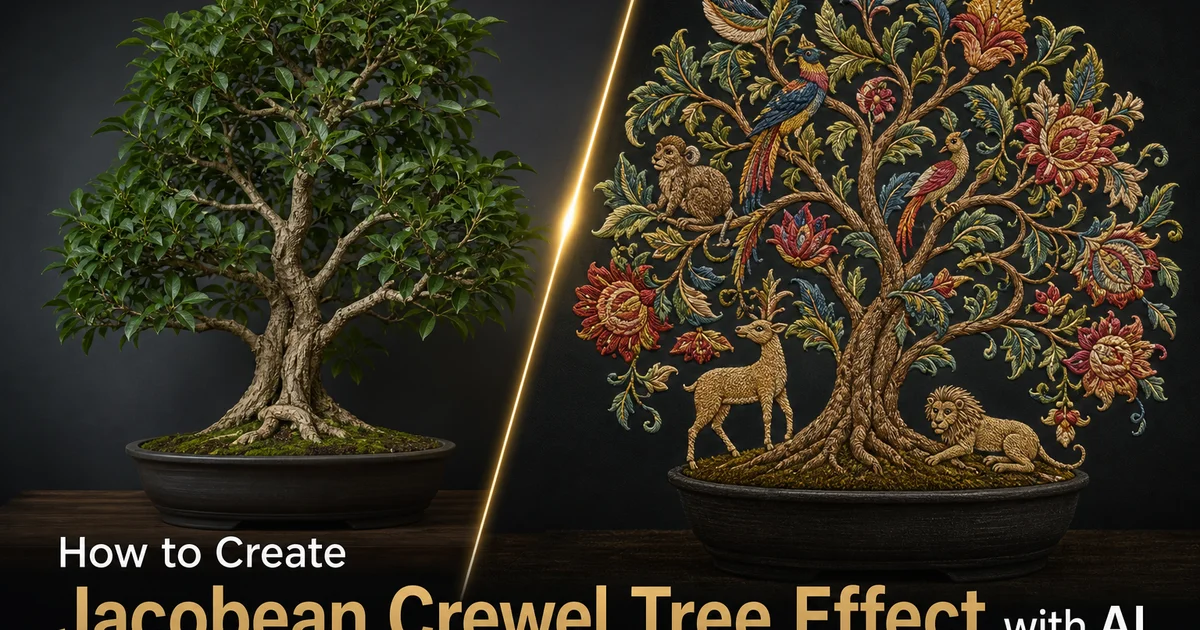
The Jacobean crewel tree of life is one of the most distinct and enduring motifs in the history of decorative embroidery, originating in seventeenth-century England when crewel wool work on linen twill became the dominant form of domestic textile decoration. The design centers on a fantastical tree rising from a stylized ground mound, its sinuous trunk splitting into sweeping branches laden with an impossible abundance of oversized flowers, exotic fruits, birds, and other creatures drawn from a blend of Eastern textile traditions, European herbals, and pure imagination. This elaborate composition — where pomegranates grow beside tulips and artichokes while parrots perch among squirrels — has fascinated textile artists for over four hundred years and continues to inspire modern fabric designers, wallpaper creators, and surface pattern artists who adapt its principles to modern aesthetics.
Recreating the Jacobean crewel tree in the past required months of skilled hand embroidery, mastery of dozens of filling stitches, and the ability to compose a balanced design where botanical exuberance never tips into visual chaos. The tree must feel abundant yet structured, fantastical yet grounded in distinct natural forms, densely filled yet allowing the linen ground fabric to breathe through the design. Each element — from the twisted trunk worked in stem stitch to the pomegranate filled with trellis couching to the bird worked in long-and-short shading — demands a different technical approach and a deep understanding of how wool thread behaves on woven linen. This complexity has historically limited the Jacobean crewel tree to dedicated embroiderers willing to invest hundreds of hours in a single piece.
AI-powered image editing tools now make it possible to create convincing Jacobean crewel tree compositions starting from photographs, botanical illustrations, or even rough sketches, greatly reducing the time and technical skill required while producing results that capture the key character of the historical style. By combining AI Enhance for stitch texture simulation, intelligent object placement for the flora and fauna elements, and careful color palette management, artists and designers can produce tree of life designs suitable for fabric printing, wallpaper, wall art, greeting cards, and digital applications. This tutorial walks through the complete process from source image selection through final export, explaining the historical design principles that make the Jacobean crewel tree work as a composition and showing how AI tools replicate the specific visual qualities of wool embroidery on linen.
- AI Enhance mimics authentic crewel wool stitch textures including long-and-short shading, chain stitch outlines, trellis couching fillings. French knot centers on tree, flower, and fauna elements.
- Magic Eraser removes conflicting photographic elements and enables replacement with the fantastical flora and fauna. Oversized pomegranates, artichokes, tulips, exotic birds — that define Jacobean design.
- Background Eraser isolates tree structures for recomposition against natural linen-toned grounds with historically accurate muted greens, warm blues, golds, russets, and coral accents.
- The AI handles the most technically demanding aspect of crewel simulation. Making stitch directions follow the natural contours of each element, with stem stitch along branches and shading stitches filling leaves.
- Batch export produces print-ready files for fabric repeats, wallpaper panels, giclée art prints, and web-optimized versions that preserve stitch texture at screen viewing distances.
Understanding the Jacobean crewel tree: historical principles and design anatomy
The Jacobean crewel tree of life draws from a confluence of design traditions that arrived in England during the late sixteenth and early seventeenth centuries. Indian palampores — hand-painted and block-printed cotton textiles — introduced English embroiderers to the concept of a single fantastical tree bearing multiple species of flowers and fruits, a motif with ancient roots in Persian and Mughal textile art. European herbals and botanical illustrations contributed distinct flower forms. The tulip from Ottoman trade, the carnation from Mediterranean gardens, the pomegranate from classical symbolism — that English needleworkers combined with native plants like the oak leaf and acorn. The result was a uniquely English hybrid that borrowed Eastern compositional extravagance while grounding it in the familiar vocabulary of European decorative arts, all executed in the robust medium of wool thread on linen twill.
The compositional structure of the Jacobean crewel tree follows consistent principles that distinguish it from other tree-of-life traditions. The trunk rises from a gently rounded hillock. Sometimes populated with rabbits, insects, or small flowering plants — and either remains as a single column or splits into two or three main branches that curve outward to fill the rectangular format of a bed hanging, curtain panel, or cushion cover. The branches undulate in smooth S-curves and C-curves rather than branching at sharp angles, creating a flowing rhythm that carries the eye through the composition. Flowers, fruits, and leaves attach to the branches at regular intervals, graduating in size from large focal-point blooms at the center and top of the design to smaller supporting elements along lower branches. Birds perch on branches or fly between them, often in pairs, while ground-level animals complete the ecosystem.
The visual texture of crewel embroidery is perhaps its most distinctive quality and the element that most strongly separates an authentic-looking Jacobean design from a flat graphic interpretation. Crewel wool has a matte, slightly fuzzy surface that catches light differently from silk or cotton thread, creating a soft dimensional quality visible even in photographs. Each filling stitch pattern creates a unique surface texture. The diagonal ridges of long-and-short stitch, the chain-link pattern of chain stitch outlines, the grid-over-thread structure of trellis couching, the bumpy dots of French knots, the smooth parallel lines of laid work. A well-designed Jacobean tree uses this variety of textures as a compositional tool, contrasting smooth areas against textured ones and using stitch direction to create visual movement within individual elements.
- The motif blends Indian palampore tree compositions, Ottoman tulip forms, Mediterranean pomegranates, and English native plants into a uniquely hybrid decorative tradition.
- Compositional structure follows S-curve and C-curve branching from a central trunk rising from a hillock, with graduated flower sizes creating focal hierarchy.
- Crewel wool's matte fuzzy surface and varied filling stitches — long-and-short, chain, trellis couching, French knots — create the dimensional texture that defines the style.
- Historical pieces use texture contrast as a design tool, with different stitch patterns assigned to different botanical and fauna elements for visual variety and rhythm.
Building the tree structure: trunk, branches, and compositional flow
The foundation of any successful Jacobean crewel tree composition is the trunk and branch structure, which must be established before any decorative elements are added. Start with a source image that provides a strong vertical trunk. This can be an actual tree photograph, a hand-drawn sketch, or an AI-generated base form. The trunk should be substantial enough to feel like it could support the weight of abundant decoration but not so thick that it dominates the composition. In historical examples, the trunk often occupies about one-eighth to one-sixth of the total composition width, rising from the lower quarter of the design and splitting into major branches within the central third. Use AI Enhance to apply a bark texture that suggests stem stitch worked in parallel lines following the trunk's vertical axis, with subtle color variations in browns and dark greens that imply multiple thread shades blended together.
Branch architecture determines the overall flow and balance of the finished tree. The primary branches should sweep outward in generous curves, creating open spaces between them that will be filled with flowers, fruits, and leaves without feeling crowded. Asymmetrical balance — where the left and right sides of the tree have similar visual weight but different specific arrangements — is more authentic to the Jacobean tradition than perfect mirror symmetry. Use AI tools to adjust branch positions, extend or shorten individual limbs. refine the curvature to achieve the characteristic flowing rhythm. Secondary branches split from the primary ones at gentle angles, creating smaller curved forms that carry individual flower clusters or bird perches. The total branch structure should create a framework that fills the rectangular composition format with an even distribution of structural lines and open spaces.
The ground mound at the base of the tree anchors the composition and provides a transition between the trunk and the lower border of the design. In historical crewel work, this hillock is often a gentle dome shape filled with rows of stem stitch or chain stitch in graduated greens, with small plants, insects. Sometimes rabbits or other animals emerging from its surface. Use AI tools to create this ground element with correct proportions. Wide enough to visually support the tree canopy above and tall enough to give the trunk a convincing rooting point. The ground surface should show stitch texture in horizontal or gently curved rows that follow the contour of the mound, with small flowering plants rendered in scaled-down versions of the same stitch patterns used in the main tree canopy.
- The trunk should occupy one-eighth to one-sixth of composition width, rising from the lower quarter and splitting into major branches within the central third of the design.
- AI Enhance applies stem stitch bark texture with parallel lines following the trunk axis and subtle color variations suggesting multiple blended wool thread shades.
- Asymmetrical balance with similar visual weight but different specific arrangements on each side is more authentic to Jacobean tradition than perfect mirror symmetry.
- The ground mound anchors the design with graduated green stitch rows following its contour, populated with small plants, insects, and optional animal figures at appropriate scale.
Populating the tree: exotic flora, fantastical fauna, and stitch variety
The decorative abundance of the Jacobean crewel tree is what transforms a simple tree structure into the spectacular composition that has captivated textile artists for centuries. Begin populating the branches with the largest focal-point flowers at the most visually prominent positions, often at the apex of the tree and at the terminals of the main branches. These primary blooms should be the most elaborate elements in the design, combining multiple stitch patterns within a single flower: long-and-short shading for curved petals, trellis couching with contrasting couching threads for open centers, French knots for stamens and pollen details, and chain stitch outlines defining the edge of each petal. The pomegranate is perhaps the most characteristic Jacobean flower form: split open to reveal seeds inside, rendered with the exterior in laid work and the interior seeds as clusters of French knots in contrasting colors.
Fauna elements add narrative life to the tree and break up the botanical pattern with different shapes and textures. Birds are the most common animal motif in Jacobean crewel work, often rendered in profile with detailed wing feathers worked in long-and-short stitch showing color gradients from body to wing tip. Exotic species — parrots, peacocks, and fantastical hybrids — appear more frequently than English garden birds, reflecting the Eastern textile influences that shaped the tradition. Position birds on branches where they create visual interest without competing with major flower elements, often in pairs facing each other across the tree's central axis. Squirrels, deer, rabbits at the ground level, and insects including butterflies and caterpillars add secondary fauna interest. Each creature should display a different combination of filling stitches to maintain the texture variety that keeps the eye moving through the composition.
The spaces between major elements need careful attention to avoid the two extremes that undermine Jacobean design. Overcrowding suffocates the composition, while emptiness breaks its rhythm. Small leaves, buds, tendrils, and minor flowers fill intermediate spaces along branches and between major blooms. These supporting elements use simpler stitch treatments: single-color satin stitch for small leaves, outline-only chain stitch for tendrils, simple detached chain stitches for tiny buds. The background linen ground should remain visible between all elements, creating a consistent neutral space that unifies the composition. In AI simulation, this means maintaining the linen texture base layer and ensuring that decorative elements are placed with consistent spacing that allows the ground to breathe through the design rather than covering it completely.
- Primary focal flowers combine multiple stitch patterns. Long-and-short petals, trellis-couched centers, French knot stamens, and chain stitch outlines — positioned at tree apex and main branch terminals.
- The split pomegranate with laid-work exterior and French knot seed clusters is the signature Jacobean flower form, appearing in virtually every historical tree of life design.
- Birds in profile with long-and-short wing feather shading appear as pairs across the central axis, with exotic species like parrots and peacocks preferred over common garden birds.
- Supporting elements — small leaves in satin stitch, chain stitch tendrils, detached chain buds — fill spaces while preserving visible linen ground that unifies the composition.
Color palette and finishing: achieving the authentic Jacobean crewel character
The color palette of Jacobean crewel work is one of its most immediately recognizable features and getting it right is key for an authentic result. Historical crewel pieces were worked in naturally dyed wool, producing a characteristic range of muted, harmonious colors quite different from the bright saturated hues of modern synthetic dyes. The dominant color family is green, ranging from pale sage through olive and forest to deep blue-green — which fills the majority of leaf, stem, and ground elements. Blues span from soft teal through medium indigo to deep navy, often used for large flower petals and bird bodies. Warm tones include antique gold, russet, burnt orange, and cinnamon brown for fruits, secondary flowers, and animal fur. Accent colors are used sparingly — coral pink, soft red, and cream white appear in small amounts to create focal points without disrupting the overall muted harmony.
Achieving these historical colors in an AI-generated composition requires careful adjustment away from the vivid saturated palette that AI tools tend to default toward. Reduce saturation globally by fifteen to twenty-five percent from photographic levels, then warm the overall color temperature slightly to suggest aged wool on yellowed linen. Individual color channels may need specific adjustment. Greens should shift toward yellow-green and olive rather than the blue-green that digital tools favor, blues should lean toward indigo rather than royal or electric blue, and reds should warm toward coral and rust rather than crimson. The linen ground color itself should be a warm cream with slight yellow-tan variation suggesting the natural fiber, not pure white or cool gray. These subtle color adjustments make the difference between a composition that reads as authentic crewel work and one that looks like a digitally colored drawing.
Final refinements address the overall surface quality that makes the composition convincing as a crewel embroidery simulation. The entire image should have a slight textural grain that suggests the woven linen ground fabric showing through and around the stitched areas. Edges of embroidered elements should show the slight irregularity of hand-placed stitches rather than the perfect smoothness of vector graphics — a controlled imperfection that reads as handcraft realism. The surface should appear slightly raised in heavily stitched areas and flatter in areas of simple outline work, creating the subtle dimensional variation that is visible in real crewel embroidery when viewed at an angle. These finishing touches transform a well-composed design with correct colors and elements into a convincing simulation of historical needlework that serves textile designers, surface pattern artists, and decorative art enthusiasts.
- The historical palette centers on muted greens from sage to blue-green, indigo blues, antique golds and russets, with sparing coral and cream accents on warm linen ground.
- Reduce AI default saturation by fifteen to twenty-five percent and warm color temperature to simulate aged wool on naturally yellowed linen twill.
- Shift digital greens toward olive and yellow-green, blues toward indigo, and reds toward coral and rust to match the character of natural dye chemistry.
- Final surface refinements add linen weave grain, slight stitch edge irregularity, and subtle dimensional variation in heavily worked versus lightly stitched areas.
How to do it
- 1
Select a base image with strong vertical trunk and branching structure
Begin with a photograph or illustration that features a prominent central tree with visible branching architecture. The Jacobean crewel tree of life motif depends on a strong vertical trunk that rises from a stylized ground mound and splits into sweeping branches that fill the composition. Choose images where the branches extend outward in graceful curves rather than straight lines. The organic flowing quality of the branches is what distinguishes the Jacobean tree from botanical illustration. Images with clear separation between branches and sky or background provide the best starting point because AI tools can identify and transform each element on its own.
- 2
Apply the crewel wool texture and stitch pattern overlay using AI Enhance
Use AI Enhance to transform the smooth photographic surfaces into the characteristic texture of crewel wool embroidery. The Jacobean style uses long-and-short stitch, chain stitch, stem stitch, and laid-work fillings that create distinctive surface textures visible even from a distance. AI Enhance can simulate these stitch directions following the natural contours of branches, leaves, and flowers: stem stitch running along branch lines, long-and-short shading filling leaf shapes, and French knots creating flower centers. The goal is a surface that reads as hand-stitched wool on linen rather than a flat digital filter.
- 3
Populate branches with exotic flora and fantastical fauna elements
The hallmark of Jacobean crewel design is the improbable abundance of its tree. Oversized pomegranates, artichokes, tulips, carnations, and fantastical flowers bloom at once on branches that also host exotic birds, squirrels, deer, and occasionally insects. Use Magic Eraser to remove any realistic botanical elements that conflict with the Jacobean aesthetic, then use AI generation to add the characteristic oversized fruits and flowers at branch terminals. Each flower species should display a different filling stitch pattern. Brick stitch for solid petals, trellis couching for open centers, and seed stitch for textured backgrounds.
- 4
Refine the ground mound, border elements, and color palette
The base of the Jacobean tree often rises from a gently curved hillock populated with smaller plants, rabbits, and insects. Use AI tools to construct this ground element at the correct scale relative to the tree, adding stylized grass tufts, small flowering plants, and optional animal figures. Adjust the color palette to match historical crewel conventions. Muted greens ranging from sage to forest, warm blues from teal to indigo, rich golds and russets, with occasional touches of coral pink and cream on a natural linen-colored background. The restrained palette is key to the authentic Jacobean character.
- 5
Export the finished Jacobean crewel tree composition for print and digital use
Save the completed tree of life design at high resolution for its intended application. Textile designers and surface pattern creators need files large enough to tile or scale for fabric printing, wallpaper repeats, or cushion panels. Digital artists creating wall art prints need color-accurate exports suitable for giclée printing on canvas or fine art paper. Social media sharing requires optimized web-resolution versions that preserve the stitch texture detail at screen viewing distances. Batch export handles all format and resolution needs from a single master composition.
Sources
- Jacobean Embroidery: Its Forms and Fillings Including Late Tudor — Victoria and Albert Museum
- Crewel Embroidery: A Practical Guide — The Metropolitan Museum of Art
- Historic Needlework Techniques and Pattern Traditions — Needlework Traditions Archive