
How to Create Filigree Effect with AI — Magic Eraser
Transform photos into intricate wire filigree metalwork art using AI style transfer. Step-by-step guide covering wire styles, metal finishes, scrollwork patterns, and expert jewelry-inspired decorative effects.
SEO & Growth
Reviewed by Magic Eraser Editorial ·
Table of Contents
- How AI filigree conversion differs from traditional vector pattern construction
- Choosing the right filigree tradition for your subject matter
- Controlling wire gauge, pattern density, and fill complexity
- Metal finish simulation and lighting for three-dimensional realism
- Creative applications: jewelry visualization, decorative art, and mixed-media composition
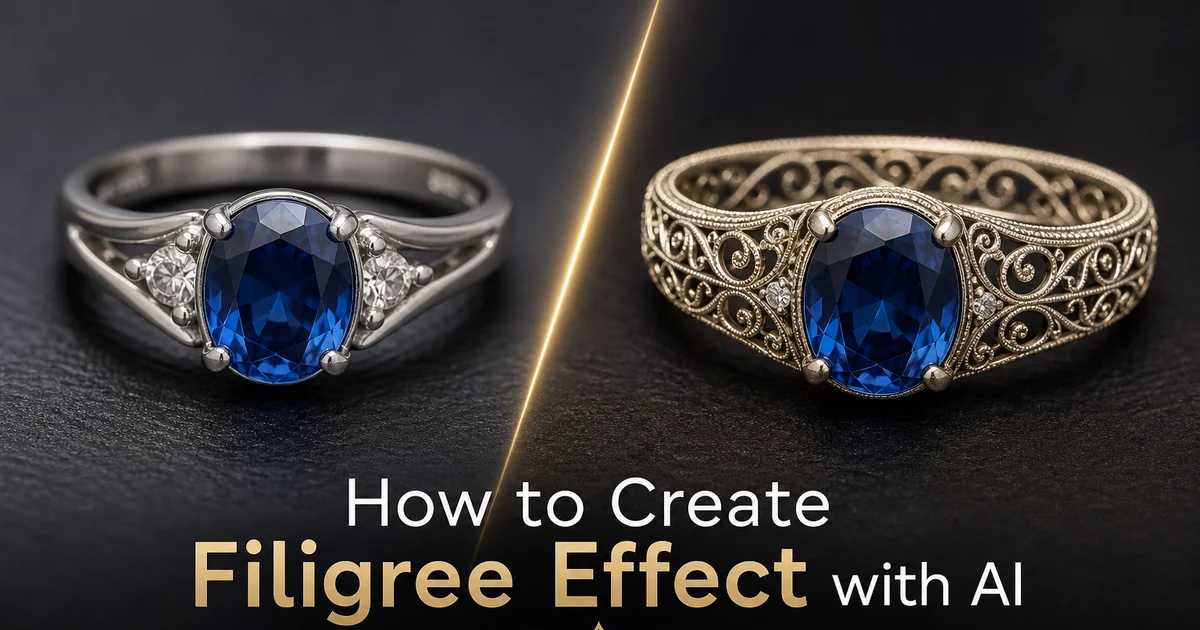
Filigree is one of the most exquisite and technically demanding forms of decorative metalwork, involving the shaping of fine metal wire into intricate scrolls, spirals and lattice patterns that have adorned jewelry, religious artifacts, and architectural ornamentation for over five thousand years. From the gold filigree of ancient Mesopotamia to the silver wire traditions of Portuguese and Scandinavian craftspeople, the art form transforms rigid metal into designs that appear impossibly delicate: lace-like patterns of curling tendrils and tiny granulated spheres soldered together with extraordinary precision. The desire to capture this aesthetic digitally has grown alongside interest in decorative arts, jewelry design visualization, and ornamental illustration.
Traditional digital approaches to mimicking filigree have relied on vector tracing and manual pattern construction. A designer would painstakingly draw each scroll, duplicate and mirror elements, then apply metallic gradients and shadow effects to suggest three-dimensional wire. This process could take hours for even a simple brooch-sized design and required both artistic skill and deep familiarity with how real wire behaves when shaped by hand. The results were often either too perfect and mechanical, lacking the organic flow of hand-twisted wire, or too loose and random, failing to capture the disciplined symmetry that characterizes master filigree work.
AI-powered filigree conversion changes this creative landscape by analyzing the structural content of any photograph and generating wire-pattern interpretations that follow the natural contours of the subject. The AI understands which areas should receive dense scrollwork filling, where primary wire outlines should define form, and how decorative tendrils should branch and curl to create the characteristic visual density of authentic filigree. This guide walks through using AI Filter and AI Enhance to transform photographs into filigree artwork that captures the ornamental richness and three-dimensional quality of traditional metalwork, covering wire style selection, metal finish configuration, pattern density control, and the finishing touches that make the result look like genuine handcrafted filigree.
- AI analyzes the subject's contours and tonal structure to generate wire scrollwork patterns that follow natural forms. Facial profiles, petal curves, architectural arches — rather than applying arbitrary decorative overlays.
- Multiple filigree traditions are available including fine silver scrollwork, bold gold with granulation, oxidized copper with verdigris. Geometric Moorish lattice patterns suited to different subject matter.
- Metal finish simulation replicates how light interacts with different wire surfaces. High polish for mirror brightness, satin for soft luster, brushed for directional texture, and antiqued for dimensional depth.
- Wire gauge control adjusts the apparent thickness of simulated metal wire from hairline delicacy to heavy gauge boldness, matching the visual weight to the subject and intended presentation scale.
- AI Enhance sharpens individual wire strands and granulation details after conversion, ensuring the finest tendrils and solder points remain distinct within dense scrollwork compositions.
How AI filigree conversion differs from traditional vector pattern construction
Traditional filigree simulation in graphic design software follows a construction approach borrowed from actual metalwork: the designer creates individual scroll elements — C-scrolls, S-scrolls, rosettes, and straight wire segments — then arranges them manually within an outline shape, duplicating, rotating, and mirroring elements to fill the design space. Each scroll must connect logically to its neighbors, wire paths must flow smoothly without dead ends. The overall density must be even enough to read as a unified pattern rather than scattered decoration. This manual construction accurately models how real filigree is built. It demands hours of skilled labor for even a moderately complex design.
AI filigree conversion begins with content analysis rather than manual construction. The AI identifies the subject's primary contours, secondary internal features and tonal regions, then generates wire patterns that are informed by this structural understanding. Major contour lines become thick primary wire outlines. Interior areas of consistent tone receive scrollwork fill patterns whose density corresponds to the tonal darkness of the original. Shadows get dense tightly wound spirals while highlights receive sparse open scrollwork. Transition zones between tonal regions get connecting tendrils that bridge the density change gradually, mimicking how traditional filigree artisans manage the visual flow between densely and sparsely filled areas.
The difference is most apparent in organic subjects like faces, flowers, and animals where the relationship between wire pattern and subject form determines whether the result reads as portraiture or mere decoration. A manually constructed filigree portrait requires the designer to make thousands of individual decisions about where each scroll should curve and how each tendril should follow facial contours. The AI generates these decisions from its understanding of the face's three-dimensional structure. Wire follows the curve of a cheek, spirals tighten in the shadow under a brow, tendrils trace the direction of hair growth — producing portraits that maintain distinct likeness while transforming completely into decorative metalwork.
- Traditional filigree simulation requires manual placement of individual scroll elements with hours of skilled labor even for moderately complex designs.
- AI begins with content analysis, mapping primary contours to thick wire outlines and filling tonal regions with density-matched scrollwork patterns.
- Shadow areas receive dense tightly wound spirals while highlights get sparse open scrollwork, creating tonal variation through pattern density rather than color.
- Organic subjects like faces maintain recognizable likeness because wire paths follow three-dimensional facial structure — cheek curves, brow shadows, and hair direction.
Choosing the right filigree tradition for your subject matter
Different filigree traditions evolved in different cultures to serve different aesthetic purposes. The AI converter offers presets that simulate each major style. Fine silver filigree in the Portuguese and Scandinavian tradition uses very thin wire shaped into tight, disciplined scrolls with minimal open space. The result is dense, lace-like patterns that read as textile rather than metalwork from a distance. This style excels for portraits and detailed subjects because the fine wire gauge preserves subtle features while the tight scrollwork creates smooth tonal gradients. It is the most photorealistic filigree style because the pattern density allows for the most tonal nuance.
Bold gold filigree inspired by Byzantine and Ottoman traditions uses thicker wire with more open space between scrolls, accented by granulation. Tiny gold spheres soldered at wire junctions and along outlines. This style is more overtly decorative and less photorealistic, creating images that read right away as ornamental metalwork rather than fine art illustration. It works beautifully for architectural subjects, heraldic designs, and images where the goal is decorative impact rather than subtle portraiture. The granulation accents add visual texture and catch simulated light differently from the wire itself, creating a rich interplay of reflective surfaces.
Geometric Moorish filigree replaces curvilinear scrolls with interlocking angular patterns. Hexagons, stars, and tessellating geometric shapes formed from straight wire segments with precise angular bends. This tradition emerged from Islamic decorative arts where geometric pattern was elevated to extraordinary complexity and mathematical precision. The AI applies this style best to architectural subjects, abstract compositions, and geometric still-life arrangements where the angular wire patterns harmonize with the subject's own geometry. Organic subjects like faces and flowers receive a stylized treatment that transforms curves into faceted approximations, creating a distinctive angular portrait aesthetic.
- Fine silver filigree uses thin wire in tight scrolls for dense lace-like patterns that preserve subtle detail and create smooth tonal gradients ideal for portraits.
- Bold gold filigree with granulation accents creates overtly decorative metalwork effects suited to architectural subjects and heraldic designs.
- Geometric Moorish filigree replaces curves with interlocking angular patterns inspired by Islamic decorative arts, best for architectural and abstract subjects.
- Each tradition creates a fundamentally different aesthetic — photorealistic density, decorative impact, or geometric stylization — matched to different creative intentions.
Controlling wire gauge, pattern density, and fill complexity
Wire gauge determines the visual weight and character of the filigree effect more than any other single parameter. At the finest setting, the simulated wire is barely visible: a gossamer web of scrollwork that creates the impression of metallic lace draped over the image. This extreme delicacy works for large-format prints and close-up viewing where the viewer can appreciate the intricacy. It disappears at small sizes or low resolution. At the heaviest gauge, the wire is bold and immediately readable. Thick scrolls and prominent outlines that work at any viewing distance but sacrifice fine detail in favor of graphic impact. Most subjects look best in the middle range. Individual wire elements are clearly visible but do not overpower the subject they describe.
Pattern density controls how much of the image area is filled with scrollwork versus left as open space. High density produces the trait look of completed traditional filigree where every area within the wire outline is packed with decorative elements. Rosettes, petals, spiraling tendrils filling every gap. Low density creates a more skeletal effect where primary outlines and major features are traced in wire but interior areas remain largely open, suggesting an unfinished or intentionally minimal filigree design. The density setting interacts with wire gauge: fine wire at high density creates intricate lacework. Heavy wire at high density creates bold patterns with strong visual weight.
Fill complexity determines how many levels of decorative subdivision appear within each scrollwork region. At minimum complexity, areas are filled with simple uniform spirals. At maximum complexity, each spiral contains smaller spirals within it, and the spaces between scrolls are filled with even smaller decorative elements. Granulation dots, tiny leaf shapes, hair-thin connecting tendrils — creating the fractal-like quality of the most elaborate traditional filigree masterworks. High fill complexity greatly increases the visual richness of the result but requires enough image resolution to remain legible. For web-sized images, moderate complexity produces the best results; for large prints, maximum complexity rewards close viewing.
- Fine wire gauge creates gossamer metallic lace suited to large prints and close viewing, while heavy gauge produces bold graphic patterns readable at any size.
- High pattern density fills every area with decorative scrollwork matching completed traditional filigree, while low density creates a minimal skeletal wire outline effect.
- Fill complexity adds nested decorative subdivision within scrollwork regions — spirals within spirals, granulation, and tiny connecting tendrils for fractal-like richness.
- Wire gauge, density, and complexity interact multiplicatively — fine wire at high density and complexity creates the most intricate results but demands high image resolution.
Metal finish simulation and lighting for three-dimensional realism
The metal finish applied to the simulated wire is what transforms a flat line drawing into a convincing representation of three-dimensional metalwork. High polish finish generates bright specular highlights along the top surface of each wire element and deep reflections in the curves of scrollwork, creating the mirror-bright look of polished sterling silver or high-karat gold. The AI calculates highlight placement based on the wire path direction and a simulated overhead light source. Highlights move naturally along curved elements and intensify at the apex of each scroll where the wire surface faces most directly toward the light.
Satin and brushed finishes soften the specular highlights into broader, more diffuse reflections that follow the length of the wire. Satin finish produces a gentle sheen that is visible but not glaring. It creates the look of silver that has been lightly buffed rather than mirror-polished. Brushed finish adds visible directional texture lines along the wire surface, creating the look of wire that has been drawn through a drawplate and retains the fine parallel scratches of the manufacturing process. Both finishes reduce the visual contrast between highlight and shadow areas, producing a subtler metallic quality that some viewers find more sophisticated than high polish.
Antiqued and oxidized finishes darken the recessed areas between wire elements while leaving the raised wire surfaces brighter, exaggerating the three-dimensional depth of the filigree pattern. Oxidized silver fills the spaces between scrolls with dark tarnish that makes the pattern stand out strongly against the shadowed background. Verdigris copper adds blue-green patina in the recesses with warm copper tones on the wire crests. These aged finishes are especially effective for subjects with historical or romantic themes because they suggest metalwork that has acquired character through time, connecting the digital artwork to the long tradition of handcrafted filigree art.
- High polish generates mirror-bright specular highlights that move naturally along wire paths based on simulated light direction and scroll curvature.
- Satin and brushed finishes soften highlights into diffuse reflections, with brushed adding visible directional texture from the simulated drawplate manufacturing process.
- Antiqued and oxidized finishes darken recessed areas between wire elements, dramatically exaggerating the three-dimensional depth and visual contrast of the pattern.
- Verdigris copper patina and oxidized silver tarnish suggest aged metalwork that connects the digital artwork to handcrafted filigree traditions spanning millennia.
Creative applications: jewelry visualization, decorative art, and mixed-media composition
Filigree portrait conversion creates striking decorative artwork where familiar faces are fully reimagined in wire and scrollwork. Wedding portraits transformed into gold filigree become unique anniversary gifts that elevate a photograph into an art object. Pet portraits rendered in fine silver filigree capture beloved animals in a medium that suggests permanence and preciousness. These filigree portraits work especially well as large-format prints on dark backgrounds. The metallic rendering catches light and the dark surround echoes the velvet display cases used for actual filigree jewelry.
Jewelry designers use filigree conversion as a visualization tool to explore how photographic subjects might translate into actual metalwork pieces. A photograph of a flower converted to filigree reveals how its petal shapes would work as scrollwork elements, whether the stem provides a natural bail attachment point, and how the overall proportions would function as a brooch or pendant. While the AI output is artistic interpretation rather than manufacturing specification, it provides a rapid conceptual starting point that would take hours to sketch by hand, accelerating the design exploration phase of jewelry creation.
Mixed-media compositions combine filigree conversion with selective original photo retention to create images where part of the scene appears as metalwork while the rest remains photographic. A portrait where the hair transforms into flowing silver filigree scrollwork while the face retains its photographic detail, or a landscape where trees become copper filigree against a photographic sky. These compositions use the contrast between metallic decoration and photographic realism to create surreal, visually strong artwork. AI Filter enables this through selective masking, with the AI handling the transition between filigree and photographic regions so the boundary feels organic rather than cut-and-pasted.
- Filigree portraits transform wedding photos and pet portraits into decorative art objects that suggest permanence and preciousness, ideal as large-format prints on dark backgrounds.
- Jewelry designers use filigree conversion to rapidly visualize how photographic subjects might translate into actual wire metalwork pieces, accelerating design exploration.
- Mixed-media compositions selectively convert portions of an image to filigree while retaining photographic detail elsewhere, creating surreal contrasts between metalwork and realism.
- The AI handles transition zones between filigree and photographic regions organically, preventing the hard mask boundaries that reveal digital compositing.
How to do it
- 1
Upload your photo and assess its suitability for filigree conversion
Open your image in AI Filter and examine it for clear subject outlines and well-defined tonal regions. Filigree effects work by tracing delicate wire-like patterns along edges and filling areas with ornamental scrollwork. Photos with strong silhouettes, distinct subject-background separation, and moderate complexity convert most convincingly. Portraits with clean profiles, architectural details with repeating geometric motifs, and floral compositions with clear petal outlines produce the most striking filigree results. Overly busy images with dense overlapping textures tend to produce tangled wire patterns that lose readability.
- 2
Select the filigree style and configure wire parameters
Choose from filigree presets that simulate different metalwork traditions. Fine silver filigree with delicate spiraling tendrils, bold gold filigree with thicker wire and granulation accents, oxidized copper filigree with verdigris patina, or geometric Moorish filigree with interlocking angular patterns. AI Filter analyzes the image content and suggests the most suitable tradition based on subject geometry: curvilinear subjects default to scrollwork filigree, architectural subjects default to geometric lattice patterns. Organic subjects default to flowing botanical wire motifs. Adjust the wire gauge slider to control the apparent thickness of the simulated metal wire from hairline fine to heavy gauge.
- 3
Adjust metal finish and background treatment for authentic metalwork appearance
Select a metal surface finish that determines how light reflects off the simulated wire. High polish for mirror-bright silver or gold, satin finish for a softer luster, brushed finish for visible directional texture, or antiqued finish for darkened recesses that emphasize the three-dimensional quality of the wirework. Then configure the background treatment: solid dark velvet for a jewelry display, transparent for overlay compositions, or matching metal mesh for a unified metalwork aesthetic. The metal finish is most visible on the thicker wire elements and the fill areas between scrollwork patterns.
- 4
Use AI Enhance to sharpen intricate wire details and refine scroll definition
After the initial filigree conversion, apply AI Enhance to tighten the definition of individual wire strands and ensure that the finest scrollwork tendrils remain distinct rather than blurring into adjacent elements. The boost step also improves the clarity of granulation details — the tiny metal spheres that traditional filigree artisans solder along wire junctions — and sharpens the contrast between raised wire and recessed shadow areas that give the pattern its three-dimensional depth.
- 5
Export the final filigree artwork and evaluate against traditional metalwork references
Save the finished piece at full resolution and compare it with photographs of real filigree jewelry and metalwork from museum collections. Check that wire paths flow smoothly without abrupt direction changes, that scroll patterns maintain consistent proportions, that filled areas show the characteristic density of traditional filigree rosettes and petals, and that the overall composition reads as an intentional decorative design rather than a random tangle of lines. Adjust wire gauge, pattern density, or metal finish if any aspect falls outside the authentic range of handcrafted filigree metalwork.
Sources
- The Art and Craft of Wire Filigree: Historical Techniques and Modern Applications — The Metropolitan Museum of Art
- Neural Style Transfer for Decorative Metalwork Patterns — arXiv — Computer Vision and Pattern Recognition
- Digital Simulation of Traditional Filigree Craftsmanship — ACM SIGGRAPH