
How to Create Felting Effect with AI — Magic Eraser
Transform photos into needle felted and wet felted fiber art with AI style transfer. Step-by-step guide covering felting textures, fiber color blending, wool surface simulation, and sculptural felted effects.
SEO & Growth
Reviewed by Magic Eraser Editorial ·
Table of Contents
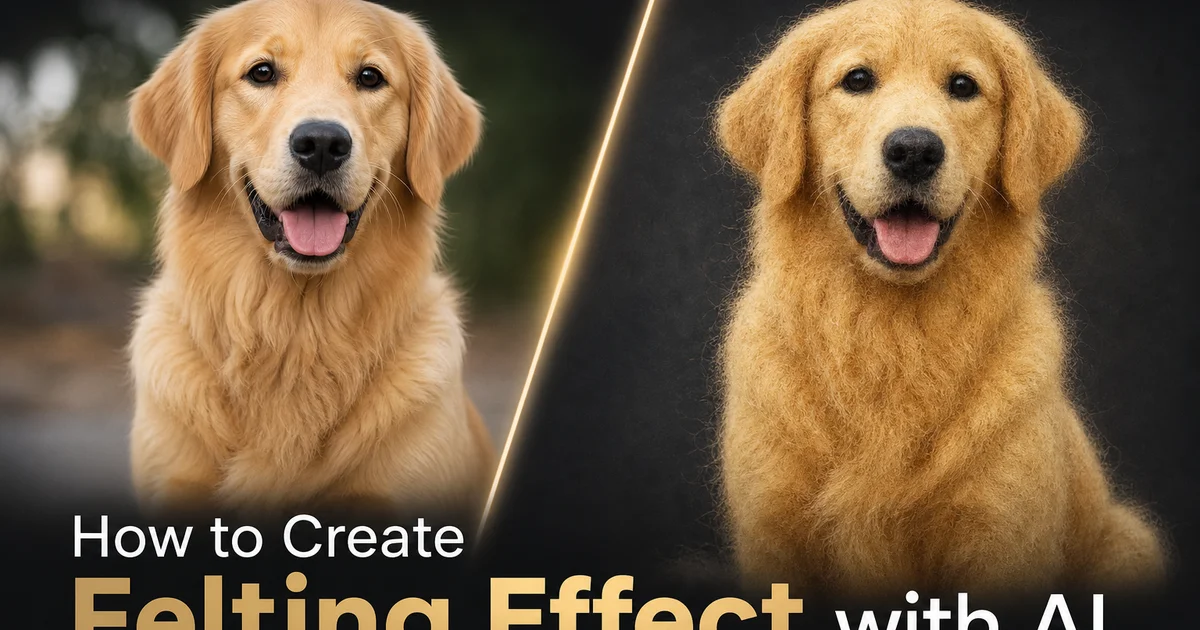
Felting is one of humanity's oldest textile techniques. The process of transforming loose animal fibers into a dense interlocking fabric through the application of moisture, heat, and mechanical agitation, or in the case of needle felting, through repeated puncturing with barbed needles that tangle fibers together at a microscopic level. The resulting material has a distinctive visual character that is right away distinct: soft rounded forms with gently blended edges, surfaces covered in visible fiber texture, colors that mix through physical intermingling of one by one dyed fibers rather than paint blending. An overall quality of warmth and handcraft that digital media struggles to replicate. Felted sculpture has exploded in popularity as a modern art form, with needle felted animals, characters. Portraits achieving viral recognition for their charm and the extraordinary skill required to create them.
Digital attempts to simulate felting effects have in the past relied on Gaussian blur combined with noise textures. Softening edges to suggest fiber construction and adding surface grain to suggest fiber texture. These approaches fail because they treat felting as an aesthetic of softness when it is actually an aesthetic of fiber structure. A felted surface is not blurry. It is composed of thousands of visible individual fibers that create a complex micro-texture. A felted edge is not simply soft. It is defined by fibers that project outward from the form, creating a fuzzy boundary that has physical dimension. A felted color transition is not a gradient. It is an intermingling zone where one by one colored fibers from adjacent areas overlap and mix optically. None of these qualities can be achieved by blurring and adding noise.
AI-powered felting style transfer approaches the problem by understanding the physical structure of felted material and generating imagery that replicates fiber-level construction rather than simply softening the source image. The AI identifies subjects, estimates their three-dimensional form. Then re-renders surfaces as tangled fiber masses with visible individual fiber texture, edge boundaries as fuzzy fiber projections, and color transitions as zones of fiber intermingling. The result looks like a photograph of an actual felted sculpture rather than a filtered photograph. The forms have the rounded soft quality of fiber construction, the surfaces have tangible fiber texture, and the overall aesthetic shares warmth and handcraft. This guide covers using AI Filter and AI Enhance to create felting effects that capture the extraordinary material quality of this ancient and newly popular art form.
- AI generates visible individual fiber texture across surfaces rather than applying generic blur, capturing the complex micro-texture that defines felted material.
- Multiple felting presets simulate needle felted sculpture, wet felted flat work, nuno felted translucency, and wool painting layered color techniques.
- Color transitions render as zones of intermingling individually colored fibers rather than smooth gradients, matching the optical color mixing of real dyed wool roving.
- Edge rendering creates fuzzy fiber projections with physical dimension rather than simply softening boundaries, distinguishing felted forms from blurred photographs.
- AI Enhance sharpens fiber-level detail including individual strands, surface loops, and density variations that sell the illusion of actual physical fiber construction.
How AI felting simulation captures fiber structure rather than just softness
The fundamental failure of traditional digital felting effects is the conflation of softness with fiber character. A Gaussian blur makes an image soft. Adding noise makes a surface grainy, but neither operation produces anything that looks like felted fiber. Real felted surfaces are composed of thousands of individual wool fibers, each about 20 to 40 micrometers in diameter, that are randomly entangled in three-dimensional space. When you look at a felted surface, you see the collective effect of these fibers. Some lying flat on the surface, some looping outward, some catching light at bright angles while adjacent fibers absorb it. This creates a complex luminance texture that is neither smooth nor uniformly noisy but has the specific statistical pattern of randomly oriented reflective cylinders.
AI felting simulation generates this fiber-level texture by synthesizing individual fiber suggestions across every surface in the image. Rather than applying a uniform texture overlay, the AI varies fiber orientation, density. Visibility based on the surface properties of the underlying subject. Flat surfaces facing the viewer show fibers lying mostly parallel to the surface plane, creating a dense compact look. Curved surfaces show fibers at varying angles as the surface turns away from the viewer, with more fiber ends and loops becoming visible on surfaces approaching perpendicular to the viewing angle. Edges and silhouette boundaries show fibers projecting outward into space, creating the trait fuzzy outline that distinguishes a felted form from any other material.
This fiber-aware rendering extends to how the AI handles fine detail and sharp features in the source image. Real felting cannot produce razor-sharp edges, fine points, or perfectly flat surfaces because the medium is inherently soft and organic. When the AI encounters sharp corners in the source, it rounds them into the gentle curves that fiber construction naturally creates. When it encounters fine linear features, it renders them as slightly irregular fiber pathways rather than crisp lines. When it encounters flat uniform surfaces, it adds the subtle undulation that comes from fiber density variations across a handworked surface. These material-accurate translations are what make the result look like a photograph of a felted object rather than a softened photograph.
- Real felted surfaces show the specific luminance pattern of randomly oriented reflective wool fibers, not generic softness or noise.
- AI varies fiber orientation and visibility based on surface angle — flat surfaces show compact parallel fibers while curved surfaces reveal more fiber ends and projecting loops.
- Silhouette edges render as fuzzy fiber projections with physical dimension, creating the distinctive felted boundary that separates this effect from simple blur.
- Sharp features in source images are translated into the gentle rounded forms that fiber construction naturally produces, maintaining material accuracy throughout.
Needle felting versus wet felting: choosing the right technique
Needle felting and wet felting produce visually distinct results. The AI offers separate presets that capture the specific traits of each technique. Needle felting uses barbed needles to repeatedly puncture and entangle fibers, building up three-dimensional sculptural forms one layer at a time. The surface of needle felted work shows the trait marks of this process. Tiny indentations where the needle entered the fiber mass, creating a subtly pockmarked texture that is smooth from a distance but reveals the construction method upon close inspection. Needle felted sculptures tend toward compact, fairly firm forms with well-defined edges and the ability to hold detail in features like animal ears, noses, and paws.
Wet felting uses hot water, soap, and mechanical agitation. Rolling, rubbing, kneading — to cause wool fibers to swell, open their scales, and interlock for good. The resulting material is a flat or gently curved sheet rather than a sculptural form. Its surface has a smoother, more compressed quality than needle felted work because the agitation presses fibers together under pressure. Wet felted surfaces show a flowing quality where fibers merge into a steady fabric rather than maintaining individual fiber visibility. Colors in wet felted work blend more smoothly than in needle felting because the agitation process physically mixes adjacent colored fibers at their boundaries. The AI mimics wet felting with smoother surface texture, more compressed forms. Gentler color transitions than the needle felting preset.
Nuno felting — a hybrid technique where loose fibers are felted through a woven fabric base — produces yet another distinctive aesthetic. The fibers migrate through the fabric during the felting process, creating areas where the base fabric is visible through gaps in the fiber coverage and areas where dense fiber buildup obscures the fabric fully. This creates a translucent, textural quality that is unique among felting techniques — part fiber art, part textile design. The AI mimics nuno felting by varying fiber coverage across the image, allowing the source photograph to show through in lighter areas while building up dense fiber texture in areas of color and shadow, producing the trait peek-through translucency of this technique.
- Needle felting produces compact sculptural forms with visible needle puncture marks, well-defined edges, and the ability to hold fine detail in features.
- Wet felting creates smoother compressed surfaces with flowing fiber character and gentler color transitions from mechanical agitation that merges adjacent fibers.
- Nuno felting varies fiber coverage to create translucent areas where the source image shows through gaps in fiber buildup, producing a unique textile-art hybrid aesthetic.
- Each technique preset adjusts surface texture, edge character, and color blending behavior to match the specific physical properties of that felting method.
Color rendering and the optical properties of dyed wool fiber
Color in felted art behaves at its core differently from color in painting, printing, or digital display. Capturing this difference is key for convincing felting simulation. When a painter mixes red and blue pigments, the result is a chemical blend that produces purple. When a felter places red and blue wool fibers next to each other, the result is an optical mix that the eye averages into purple from a distance but resolves into individual red and blue fibers upon closer inspection. This is the same phenomenon as Pointillist painting but with fiber-diameter color dots rather than paintbrush dots. The AI replicates this by rendering color transitions not as smooth gradients but as zones where one by one colored fiber suggestions intermingle, maintaining their distinct hues while producing an averaged color impression from normal viewing distance.
The saturation and color temperature of dyed wool also differs from digital color. Natural wool fibers have a warm base tone even when bleached white. Wool dyes interact with this base to produce colors that are slightly warmer and less saturated than their synthetic or digital equivalents. Bright blue wool is warmer and softer than bright blue in RGB. Red wool has a depth and warmth that is difficult to achieve with flat digital red. The AI applies a subtle color change that shifts the source image's colors toward the warmer, slightly muted palette of dyed wool, avoiding the oversaturation that would right away betray a digital origin to anyone familiar with actual fiber art materials.
Highlights and shadows in felted surfaces also show distinctive color behavior. When light hits felted wool at a steep angle, the fibers reflect a mixture of the dye color and the natural warm white of the underlying keratin protein, creating highlights that are warmer and lighter than the base color rather than simply brighter. Shadows in felted surfaces deepen toward warm brown-black rather than cool blue-black because the fiber mass absorbs light through warm-toned keratin pathways. The AI renders highlights and shadows with this warm fiber-optic quality, ensuring the tonal range of the felted image reads as illuminated wool rather than illuminated digital color.
- Color transitions render as zones of intermingling distinct fiber colors that average optically from distance but resolve into individual hues on close inspection.
- Dyed wool color is shifted warmer and slightly less saturated than digital equivalents, matching the natural warm base tone of keratin fiber that influences all wool dye colors.
- Highlights mix dye color with warm white keratin reflection rather than simply brightening, while shadows deepen toward warm brown-black rather than cool blue-black.
- These fiber-optical color properties distinguish the felting effect from simple desaturation or warm color grading, producing material-accurate wool rendering.
Creative applications: pet portraits, characters, and mixed media
Felted animal portraits have become one of the most popular applications of fiber art style transfer, driven by the viral popularity of needle felted animal sculptures on social media. Converting a photograph of a pet into a felted version produces an image that looks like a custom needle felted portrait sculpture. The kind of handcrafted keepsake that costs hundreds of dollars and weeks of skilled labor to produce physically. The AI handles animal subjects mainly well because the soft rounded forms and fiber textures of felting align naturally with fur-covered animal bodies. Dog and cat portraits gain an irresistible quality of warmth and charm. The fiber texture provides a convincing approximation of felted wool that fiber art enthusiasts right away recognize.
Character design and illustration benefit from felting style transfer by producing artwork that looks like it was created using stop-motion animation puppets or handcrafted fiber art figures. Converting illustrated characters into felted versions creates a material quality that animation studios spend enormous effort achieving in physical puppet construction for films. Game designers, children's book illustrators, and social media content creators use felted character versions for merchandise mockups, promotional images, and distinctive visual branding that shares handcraft and warmth in a marketplace saturated with digital slickness.
Mixed-media compositions combine felted rendering with photographic or other artistic elements to create images that play with material reality. A photograph of a real garden where all the flowers have been converted to felted fiber sculptures, a portrait where the subject's clothing transforms from photographic fabric to felted wool, or a cityscape where buildings retain their photographic structure while the sky becomes a flowing wet-felted wool landscape. These compositions use the contrast between photographic and felted elements to create whimsical artwork that delights through material impossibility. The AI handles the transition between felted and photographic regions with carefully blended boundaries that prevent hard mask edges.
- Pet portraits in felted style resemble custom needle felted sculpture commissions, producing the warmth and charm that has made fiber art animal portraits a viral social media genre.
- Character illustrations converted to felted versions create stop-motion puppet aesthetics used for merchandise mockups, promotional images, and handcraft-oriented brand identity.
- Mixed-media compositions contrast felted and photographic elements to create whimsical artwork where material impossibility drives visual delight.
- The AI handles animal fur and soft organic forms with particular effectiveness because felting's inherent softness naturally aligns with these subject properties.
How to do it
- 1
Upload your photo and assess its suitability for felting transformation
Open your image in AI Filter and evaluate whether the subject will translate well into a felted aesthetic. Subjects with rounded soft forms — animals, plush characters, rounded objects, portraits — work exceptionally well because felted sculptures naturally tend toward soft rounded shapes with gently blended edges. The AI needs clear subject-background separation to establish the felted form. Images with well-defined subjects against uncluttered backgrounds produce the most convincing results. High-contrast images with sharp angular subjects require more interpretation by the AI to translate into the inherently soft vocabulary of felted fiber art.
- 2
Select the felting style and configure fiber texture density
Choose from felting presets that simulate different fiber art techniques. Needle felted sculpture with visible individual fiber puncture marks, wet felted flat work with smooth compressed surfaces, nuno felted translucency where fibers bond through fabric, or wool painting with layered color blending achieved by arranging colored fibers like brush strokes. Adjust the fiber density slider to control the surface texture character: low density shows individual visible fibers creating a loose handmade quality. High density produces the smooth tightly compressed surface of expert finished felted work.
- 3
Adjust color saturation and fiber color blending for authentic wool appearance
Control how colors are rendered to match the properties of dyed wool roving. Real felted art shows colors as blended fiber masses rather than smooth gradients. Where red meets blue, individual red and blue fibers intermingle visually rather than producing a smooth purple transition. The AI mimics this fiber-level color mixing by rendering color transitions as visible clusters of one by one colored fibers. Reduce saturation slightly from photographic levels to match the muted warmth of natural dyed wool. Rarely reaches the vivid saturation of digital color.
- 4
Use AI Enhance to refine fiber texture detail and surface character
After the initial felting conversion, apply AI Enhance to sharpen fiber-level detail and increase the tactile quality of the surface texture. Real felted surfaces have extraordinary micro-texture. Individual fibers catching light at different angles, tiny loops and loose ends projecting from the surface, slight variations in fiber density creating subtle undulations. Boost brings out these details that sell the illusion of an actual physical fiber object rather than a soft-focus filter applied to a photograph.
- 5
Export the final felted artwork and compare against reference fiber art
Save the finished image at full resolution and compare it with photographs of actual needle felted sculptures and wet felted artwork. Verify that the surface texture is consistent with felted fiber rather than smooth digital blurring. You should see individual fiber suggestions throughout, not just soft edges. Check that color transitions show the trait fiber-mixing quality where adjacent colors intermingle rather than blending smoothly. That the overall form has the soft rounded quality of wool fiber construction rather than maintaining the sharp edges of the original photograph.
Sources
- The Structural Mechanics of Felted Wool: Fiber Entanglement and Material Properties — Journal of Materials Science — Springer
- Needle Felting Techniques and Sculptural Applications in Contemporary Fiber Art — Fiber Arts Magazine
- Neural Texture Synthesis for Non-Photorealistic Rendering of Fiber-Based Materials — arXiv — Computer Graphics