
How to Create Cyberpunk Effects with AI — Magic Eraser
Transform photos into cyberpunk and synthwave artwork using AI. Step-by-step guide covering neon color palettes, surface reflections, volumetric atmosphere, rain effects, and export for social media and print.
SEO & Growth
Reviewed by Magic Eraser Editorial ·
Table of Contents
- The visual DNA of cyberpunk: neon, rain, and urban density
- Neon palette selection: classic cyberpunk versus synthwave variants
- Surface reflections: making neon light interact with the environment
- Atmospheric effects: haze, rain, and volumetric neon light
- Social media and print applications for cyberpunk photography
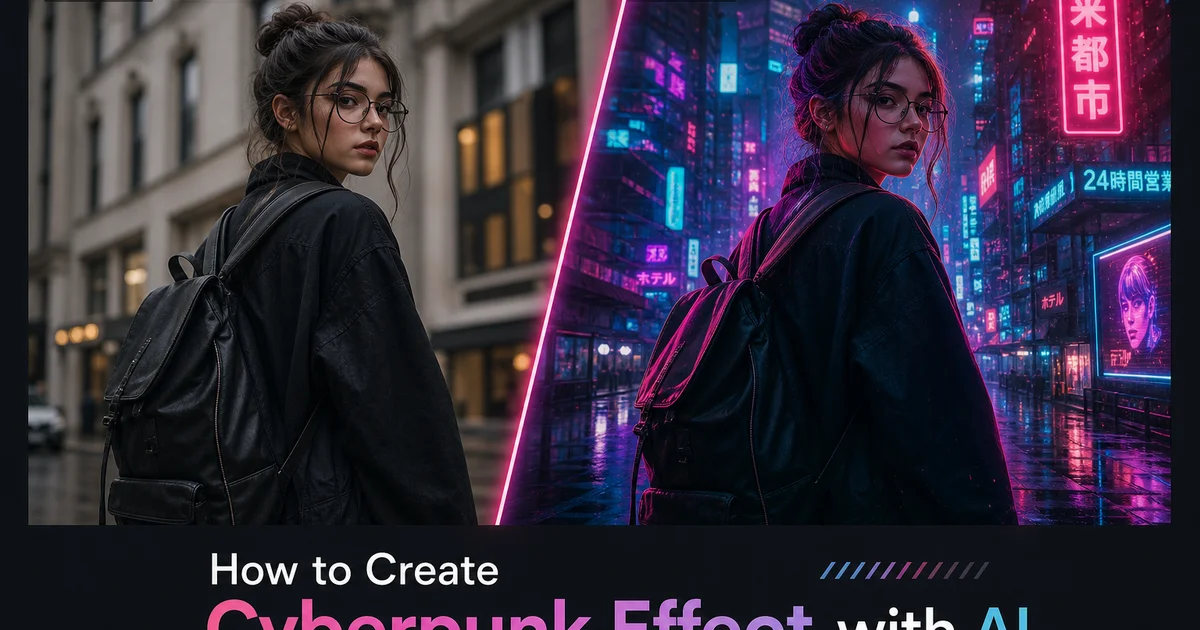
The cyberpunk aesthetic emerged from the science fiction literary movement of the early 1980s. William Gibson's Neuromancer, Ridley Scott's Blade Runner, and the manga of Katsuhiro Otomo — and has become one of the most distinct and enduring visual styles in popular culture. Its visual language is defined by the collision of advanced technology with urban decay: neon signs illuminating rain-soaked streets, holographic advertisements towering over cramped alleyways, the cold blue glow of computer screens reflected in mirrored sunglasses. The perpetual twilight of cities so dense with artificial light that the sky is never truly dark. This aesthetic has transcended its science fiction origins to influence fashion, music, gaming, graphic design, and photography worldwide.
Creating the cyberpunk look in photography has in the past required either shooting in settings that naturally exhibit these qualities. The neon-drenched streets of Shinjuku, Hong Kong's Kowloon district, Seoul's Gangnam — or extensive post-processing in Photoshop involving dozens of adjustment layers, hand-painted light effects, color grading curves, and composited mood elements. A skilled photo editor might spend two to four hours transforming a single urban photograph into a convincing cyberpunk scene, carefully adding neon color casts, amplifying reflections, introducing mood haze. Adjusting every surface to respond to the imagined neon light sources. The synthwave variant, with its distinctive pink-and-purple sunset grids and chrome lettering, requires extra compositing of graphic elements.
AI-powered cyberpunk filters make this change accessible by understanding the visual rules of the aesthetic. Where neon light would fall, how surfaces would reflect it, where mood haze would accumulate, and which colors belong to the cyberpunk palette — and applying these rules intelligently to any photograph. The AI has been trained on thousands of cyberpunk artworks, synthwave compositions. Neon-noir cinematography frames, learning not just the colors but the lighting logic that makes the aesthetic convincing. This guide covers the complete workflow for creating cyberpunk effects using Magic Eraser's AI Filter, from source selection through palette choice, reflection boost, mood effects, and export improvement.
- The cyberpunk aesthetic combines neon color palettes, rain-soaked reflective surfaces, atmospheric haze, and the contrast of advanced technology with urban density.
- AI cyberpunk filters understand the lighting logic of the aesthetic — where neon light would fall and how surfaces would respond — rather than applying flat color overlays.
- Neon reflections on wet pavement, glass facades, and metallic surfaces are a defining element that transforms ordinary urban photography into cyberpunk scenes.
- Atmospheric depth from haze, rain, and volumetric light creates the feeling of a dense, light-polluted urban environment essential to the cyberpunk mood.
- Export as PNG with embedded sRGB to preserve saturated neon colors that sit at the edge of the color gamut and can appear muted without proper color management.
The visual DNA of cyberpunk: neon, rain, and urban density
The cyberpunk aesthetic is not a random collection of visual effects. It is a coherent visual language with specific rules that govern color, light, atmosphere, and spatial composition. The primary color palette is dominated by neon pink, electric blue. Deep purple, with secondary accents of acid green, warm amber, and cold white. These colors appear not as surface colors of objects but as environmental light. They emanate from signs, screens, vehicles, and advertisements, casting colored illumination across every surface in the scene. The result is an setting where nothing has its natural color because everything is bathed in competing artificial light sources, creating the chromatic complexity that makes cyberpunk imagery visually rich and right away identifiable.
Rain is not merely a weather detail in cyberpunk aesthetics. It is a fundamental compositional element because wet surfaces transform the urban setting into a mirror that doubles every light source. A dry street absorbs most of the neon light that falls on it, reflecting a dim fraction. A rain-soaked street becomes a near-perfect reflector, creating elongated streaks of pink, blue. Purple light that extend the visual presence of every sign and lamp across the entire ground plane. This is why canonical cyberpunk imagery. Blade Runner, Ghost in the Shell, Akira, Cyberpunk 2077 — almost universally features rain or recent rain. The wet surfaces create the light multiplication effect that saturates the setting with color.
Spatial density is the third pillar. Cyberpunk settings are vertically compressed and horizontally cluttered. Narrow streets with buildings rising on all sides, signs and cables crossing overhead, vehicles and pedestrians filling the ground level. This density concentrates the neon light into a confined volume where it bounces between surfaces, compounds through reflections, and mixes through mood scattering. An open, spacious setting cannot achieve the cyberpunk aesthetic even with neon colors because the light dissipates rather than accumulating. The AI filter mimics this light accumulation by analyzing the spatial structure of the image and concentrating color intensity in enclosed areas while allowing it to fade in open spaces.
- Cyberpunk colors appear as environmental light from signs and screens, not surface colors — everything is bathed in competing artificial neon sources.
- Rain transforms streets into mirrors that double every light source, creating the elongated color reflections that saturate canonical cyberpunk environments.
- Spatial density concentrates neon light into confined volumes where it bounces, compounds, and mixes — open environments cannot achieve the same effect.
- The AI analyzes spatial structure to concentrate color intensity in enclosed areas and fade it in open spaces, simulating realistic neon light accumulation.
Neon palette selection: classic cyberpunk versus synthwave variants
The classic cyberpunk palette — neon pink and electric blue as dominant hues, with deep purple shadows and occasional acid green accents — draws directly from the cinematography of Blade Runner and its successors. This palette works by exploiting the matching relationship between warm pink-magenta and cool blue-cyan: the two hues create maximum chromatic contrast when placed adjacent to each other. Their mixture in overlap zones produces the deep purple that fills the shadows of every cyberpunk scene. The pink often represents commercial signage and entertainment lighting, while the blue represents technology, screens, and institutional illumination. A color coding that subconsciously reinforces the genre's themes of commerce and technology competing for visual dominance.
The synthwave variant shifts the palette toward warmer tones inspired by 1980s retro-futurism: hot magenta and vivid purple replace the cooler pinks and blues, warm amber and chrome yellow appear as accent colors. The overall mood is more nostalgic and romantic than the classic cyberpunk palette's cold intensity. Synthwave imagery often includes graphic elements that are not present in photographs. Grid-lined horizons, chrome text, geometric sun shapes — but the photographic synthwave aesthetic focuses on the color grading and mood qualities without these graphic overlays. The AI filter's synthwave preset applies the warmer palette with slightly more halation and bloom to match the style's softer, more idealized visual treatment.
For custom palettes, the most effective approach is to select two dominant neon hues that are matching or split-matching on the color wheel, plus one accent hue that appears sparingly. Teal and magenta, green and purple, orange and blue — all produce the chromatic tension that the cyberpunk aesthetic requires. Avoid palettes where all colors are from the same region of the color wheel, as this produces a monochromatic result that lacks the competing-light-sources quality that defines the genre. The accent color should be reserved for specific highlight moments. A single sign, a pair of glasses, a distant window — to create visual focal points in the neon-saturated setting.
- Classic cyberpunk pink-and-blue exploits complementary color contrast, with pink representing commerce and blue representing technology — a subconscious thematic reinforcement.
- Synthwave shifts toward warmer magenta-and-purple with amber accents, producing a more nostalgic and romantic mood than the classic palette's cold intensity.
- Custom palettes work best with two complementary dominant hues plus one sparingly used accent — monochromatic palettes lack the competing-light-sources quality.
- The accent color should mark specific focal points: a single sign, a pair of glasses, a distant window that draws the eye through the neon-saturated scene.
Surface reflections: making neon light interact with the environment
The difference between a cyberpunk filter and convincing cyberpunk photography is surface interaction. Whether the neon light simply tints the image or actually appears to illuminate and reflect from the physical surfaces in the scene. A flat color overlay changes the overall mood but looks applied. Convincing cyberpunk lighting shows neon colors arriving at surfaces from specific directions, creating highlights on the sides of objects facing the light source and leaving the opposite sides in relative shadow. It shows reflections in glass that match the color and position of the implied neon sources. It shows wet pavement reflecting these sources with right perspective foreshortening.
The AI filter achieves this by performing a depth and material analysis of the image before applying color. It identifies which surfaces are glass and therefore highly reflective, which are wet and therefore specularly reflective, which are matte surfaces like concrete and brick that absorb most light but show a soft color cast. Which are metal surfaces that produce bright specular highlights. It then applies the neon palette as directional lighting rather than flat tinting, with each surface type responding to the light according to its reflective properties. The result is that a single neon color source casts different-looking light on different materials, just as it would in a real neon-lit urban setting.
For images that lack naturally reflective surfaces, the reflection boost can add simulated wet-surface reflections to pavement and road surfaces. This feature analyzes the ground plane geometry, applies a subtle wet-surface texture. Then generates neon reflections that are perspective-correct and color-consistent with the applied palette. The effect is most convincing on asphalt and concrete surfaces, less so on irregular surfaces like gravel or grass. Used judiciously, wet-surface simulation can transform a dry daytime street into a rain-soaked cyberpunk scene, but overuse creates an obviously artificial result. Apply it to the main foreground ground plane and let the effect diminish naturally toward the edges of the frame.
- Convincing cyberpunk lighting shows neon colors arriving from specific directions, creating directional highlights and shadows rather than flat tinting.
- The AI identifies surface materials — glass, wet pavement, matte concrete, metal — and applies neon light with appropriate reflective properties for each.
- Simulated wet-surface reflections can transform dry pavement into a rain-soaked scene with perspective-correct neon color reflections.
- Wet-surface simulation works best on asphalt and concrete foreground planes — apply it judiciously and let the effect diminish toward frame edges to avoid artificiality.
Atmospheric effects: haze, rain, and volumetric neon light
Atmosphere is what transforms a neon-colored photograph into a cyberpunk setting. Without mood effects, neon light travels in straight lines from source to surface with nothing visible in between. With atmosphere — haze, rain, fog, steam — the light becomes visible as volumetric beams, cones. Diffuse glows that fill the space between surfaces and create the sense of a dense, saturated, almost tactile setting. This is the quality that makes cyberpunk scenes feel immersive rather than decorated: the light is not just on things, it is in the air between things.
The haze control adds a subtle scattering medium to the scene that catches and diffuses neon light. At low levels, this creates soft color gradients in the air around intense light sources. A pink glow extending into the space around a neon sign, a blue haze filling a corridor lit by screen light. At higher levels, the haze thickens until distant objects are partially obscured, creating mood depth where the background dissolves into a colored murk of competing neon sources. This depth-based haze effect is a hallmark of cyberpunk cinematography. Close subjects are sharp and clearly lit while the background becomes an impressionistic wash of neon color.
Rain effects add motion, reflective surfaces, and temporal energy to the scene. The AI generates rain streaks with realistic motion blur, perspective-correct angle across the frame. Neon illumination where the streaks pass through regions of colored light. Rain drops catching neon pink light glow briefly as luminous pink streaks. Drops passing through blue-lit areas appear as blue-tinted motion lines. The density and angle of the rain are adjustable, from a light drizzle that adds texture to a downpour that partially obscures the scene and greatly increases the amount of reflective surface area. Combined with wet-surface reflections, the rain effect creates a complete mood system that integrates light, surface. Weather into a cohesive cyberpunk setting.
- Atmospheric effects make neon light visible in the air between surfaces — volumetric beams, diffuse glows, and color gradients that create immersive depth.
- Haze at low levels produces soft colored auras around light sources; at higher levels it creates cinematic depth where backgrounds dissolve into colored neon murk.
- AI-generated rain streaks glow with neon color as they pass through lit regions, adding motion energy and multiplying reflective surfaces.
- Combined haze, rain, and wet-surface reflections create a complete atmospheric system integrating light, surface, and weather into a cohesive cyberpunk scene.
Social media and print applications for cyberpunk photography
Cyberpunk-styled photography performs exceptionally well on visual social media platforms because its neon color palette and high contrast are engineered to command attention in a scroll-driven feed. Instagram, TikTok, and Pinterest algorithms favor content that generates high engagement signals. Stops, saves, shares — and the cyberpunk aesthetic always delivers these because its visual intensity breaks the pattern of natural-light photography that dominates most feeds. For Instagram, cyberpunk images work as both standalone posts and as cohesive grid themes. A feed composed fully of cyberpunk-styled urban photography creates a striking, instantly distinct visual brand. For TikTok, before-and-after change videos showing a normal photograph becoming a cyberpunk scene generate strong engagement because viewers are fascinated by the magnitude of the visual change.
Print applications for cyberpunk photography are growing rapidly as the aesthetic has moved from screen-native subculture to mainstream visual culture. Event posters, album covers, book covers, merchandise. Gaming-related promotional materials frequently use cyberpunk styling because it connotes technological sophistication, urban edge, and futuristic energy. The neon color palette presents specific print challenges because the most saturated pinks, blues. Purples are outside the standard CMYK gamut. Spot colors, metallic inks, and fluorescent inks can reproduce neon vibrancy that standard CMYK cannot. Discuss these options with your printer if the budget allows. For standard CMYK printing, the soft-proof feature shows which areas will lose saturation and allows you to adjust the palette toward printable options before committing to production.
For maximum impact across both screen and print, create a hero image at the highest available resolution and then generate platform-specific exports from that master file. The master should be in Adobe RGB color space to preserve the widest gamut for print conversion, with sRGB exports generated for each social media platform at their optimal dimensions. This workflow ensures that the cyberpunk effect is created once at maximum quality and then adapted for each channel rather than being recreated multiple times at different settings. Risks inconsistency across the brand's visual presence.
- Cyberpunk imagery breaks the natural-light photography pattern in social feeds, generating the stops, saves, and shares that platform algorithms reward.
- Neon palette colors are often outside standard CMYK gamut — spot colors, metallic inks, and fluorescent inks can reproduce vibrancy that process printing cannot.
- Before-and-after transformation content on TikTok generates strong engagement because viewers are fascinated by the magnitude of the visual transformation.
- Create one master file in Adobe RGB at maximum resolution, then generate platform-specific sRGB exports to ensure consistency across social media and print channels.
How to do it
- 1
Choose an urban or portrait photograph with strong geometric lines and light sources
The cyberpunk aesthetic is rooted in the visual language of dense, technology-saturated urban settings. Rain-slicked streets reflecting neon signs, towering buildings with illuminated windows, rooftop vantage points overlooking city grids, and figures silhouetted against artificial light. Select a source image that contains architectural geometry, visible light sources such as street lamps or signs, or a portrait with directional lighting that can serve as the foundation for the neon color treatment. Night and low-light photographs work best because the cyberpunk palette depends on neon colors emerging from darkness. Daytime urban shots can also be transformed if they have strong structural content.
- 2
Apply the cyberpunk filter preset and select a neon color palette
Navigate to AI Filter and select the cyberpunk aesthetic preset. Choose from several signature color palettes: the classic neon pink and electric blue combination inspired by Blade Runner and synthwave art. The green-and-magenta matrix palette. The warm amber-and-teal combination that references noir science fiction. Or a custom palette where you select two or three dominant neon hues. The AI applies these colors as environmental lighting that appears to emanate from signs, screens. Reflective surfaces in the scene, not as a flat color overlay. Set the neon intensity to medium initially to evaluate the base change before pushing the effect further.
- 3
Enhance neon reflections on wet surfaces, glass, and metal
A defining element of the cyberpunk aesthetic is the way neon light interacts with urban surfaces. Rain puddles reflecting pink and blue signs, glass facades mirroring the glow of LED billboards, chrome and metal surfaces catching colored light in bright specular highlights. The reflection intensity slider amplifies these surface interactions, making existing reflective surfaces in the image glow more intensely with the neon palette. If your source image has wet pavement, glass buildings, or metallic objects, increasing the reflection slider greatly enhances the cyberpunk atmosphere. The AI identifies reflective surface types and applies color-consistent reflections rather than uniform glow.
- 4
Add atmospheric depth with haze, rain, and volumetric light effects
Cyberpunk settings are rarely clean and clear. They are characterized by mood density from rain, fog, steam, neon-lit haze, and the visual pollution of too much artificial light competing in a confined space. Use the atmosphere controls to add volumetric light rays emanating from neon sources, subtle haze that catches and diffuses the colored light through the scene. Optional rain streaks that add motion and reflective surfaces at once. These mood elements transform a static photograph into something that feels like a frame from a cyberpunk film, with the colored light interacting with the atmosphere to create depth and mood that flat lighting cannot achieve.
- 5
Export at high resolution with the neon color gamut preserved
The saturated neon colors that define the cyberpunk aesthetic are at the edge of the sRGB color gamut, meaning they can appear slightly muted on some screens and in some formats. Export as PNG with the full sRGB profile embedded to ensure the neon colors display as intended across devices. For social media platforms that compress uploaded images, export at the maximum resolution the platform accepts so that compression has more data to work with and the neon gradients survive without visible banding. For print applications such as posters, album covers, and event flyers, export as TIFF at 300 DPI and verify with a soft proof that the neon colors translate to the CMYK gamut. Some electric blues and vivid magentas may need slight adjustment for print reproduction.