
How to Create a Crewelwork Effect with AI — Magic Eraser
Create a Jacobean crewelwork effect with AI: turn photos into wool-stitched tree-of-life artwork with linen texture, stitch detail, and artifact cleanup.

SEO & Growth
Reviewed by Magic Eraser Editorial ·
Table of Contents
- The visual vocabulary of Jacobean crewelwork and its translation to digital media
- Stitch texture generation: long-and-short, French knots, couching, and satin stitch
- Color palette calibration for historical and contemporary crewelwork aesthetics
- Creative applications: home textiles, wall art, and digital pattern design
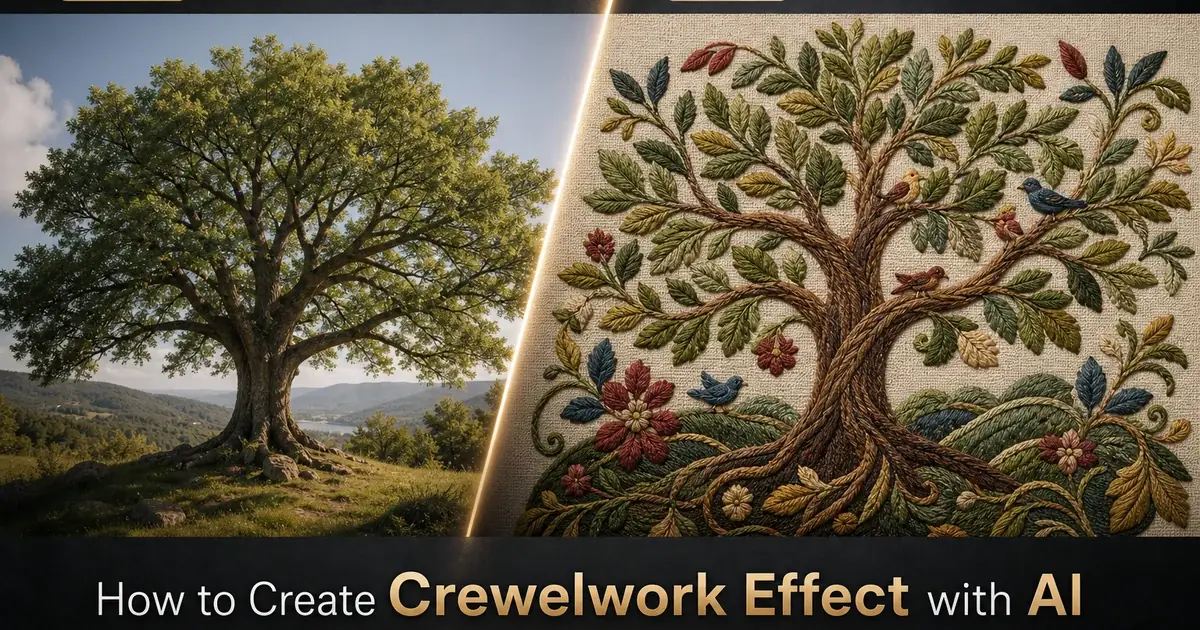
Crewelwork — embroidery worked in wool yarn on a linen or linen-cotton ground fabric — is one of the great traditions of English decorative needlework, reaching its peak of popularity during the Jacobean period of the seventeenth century when elaborate tree of life designs adorned bed hangings, curtains. Furnishing textiles in homes across England. The style draws its visual vocabulary from a rich synthesis of sources: Indian chintz textile patterns imported by the East India Company, European botanical illustrations, Persian garden imagery. The native English tradition of stylized floral embroidery. The result is a distinctive aesthetic characterized by oversized, fantastical botanical forms. Enormous exotic flowers, curving branches heavy with imaginary fruit, and stylized leaves worked in a palette of wool colors that time has mellowed into the warm, muted tones that define the antique crewelwork look.
What distinguishes crewelwork from other embroidery traditions is both its material and its technique. Crewel wool — a fine, tightly twisted two-ply yarn — creates a surface texture that is at its core different from silk or cotton embroidery. The wool has body and dimension, building up on the fabric surface to create a tactile relief that catches light and shadow differently across the stitch directions. The stitch vocabulary of crewelwork is exceptionally rich: long-and-short shading creates smooth tonal gradients within leaves and petals, stem stitch and chain stitch define sinuous outlines and veins, French knots build textured clusters for flower centers and fruit surfaces, laid work and couching create geometric fill patterns for backgrounds and large areas. Padded satin stitch produces raised, gleaming surfaces for small motifs and berries.
AI photo editing tools make it possible to translate photographic images into the crewelwork aesthetic by automating the most technically demanding steps of the conversion. Simplifying organic forms into bold embroidery shapes, generating authentic stitch textures for each element, calibrating colors to period-right wool-dyed ranges, and compositing the finished work onto realistic linen ground fabrics. The process preserves the key character of crewelwork: the flowing organic forms, the rich surface texture that comes from multiple stitch types working together, the warm muted color palette. The fundamental quality of handmade textile art that connects to centuries of English embroidery tradition. This tutorial guides you through each step from source image selection to final export, producing crewelwork-effect images suitable for wall art, textile design, digital illustration, and creative portfolio work.
- AI style transfer replaces photographic surfaces with authentic crewel wool stitch textures including long-and-short shading, French knots, laid-work couching, and padded satin stitch fills.
- Form simplification converts photographic complexity into the bold contoured shapes and discrete fill zones that characterize Jacobean crewelwork design vocabulary.
- Period-appropriate color palette adjustment maps modern photograph colors to historically accurate crewel wool tones — indigo blues, madder reds, weld yellows, and walnut browns.
- Magic Eraser removes style transfer artifacts including texture seams, unnatural stitch breaks, and digital noise that contradict the hand-stitched aesthetic of authentic crewelwork.
- Background Eraser composites finished crewelwork onto linen twill ground fabric with visible diagonal weave texture for presentation that captures the material character of wool-on-linen embroidery.
The visual vocabulary of Jacobean crewelwork and its translation to digital media
Jacobean crewelwork operates within a visual vocabulary that is at once highly stylized and richly organic. Understanding this vocabulary is key for creating convincing digital interpretations. The foundational compositional structure is the tree of life. A central undulating trunk from which branches extend outward and upward, bearing oversized flowers, exotic fruits, elongated leaves, and sometimes birds or small animals perched among the branches. This tree grows from a ground line that may include a small hillscape with extra botanical elements. The tree of life structure is not meant to depict any real plant species but rather creates a fantasy garden that combines elements from multiple botanical sources into a single exuberant composition. AI conversion of photographic sources should map the organic elements of the photograph into this compositional logic even when the source is not literally a tree.
The individual motif elements in crewelwork have trait forms that distinguish them from naturalistic botanical illustration. Leaves are large and prominently veined, often with serrated or deeply lobed edges, and they curve and twist to show both their front and back surfaces. A device that allows the embroiderer to use different stitch directions and colors on each side for visual variety. Flowers combine features from multiple real species into fantasy blooms with layered petals, prominent stamens, and complex centers. Fruits appear as oversized berries, pomegranates, or fully imaginary forms with textured surfaces suited to French knot or seed stitch treatment. These stylized forms translate well from photographic sources because the AI simplification process naturally reduces botanical complexity into the bold, trait shapes that define the crewelwork aesthetic.
Scale relationships in crewelwork are on purpose unrealistic. A single flower may be as large as a bird, a leaf may dwarf a fruit, and a small animal may perch on a branch that could not physically support it. This disregard for natural scale proportions is a fundamental feature of the style, not an error. AI conversion should preserve or even exaggerate scale relationships rather than correcting them toward botanical accuracy. The fantasy scale creates the visual impact that made crewelwork such effective large-format decoration for bed hangings and curtains. Bold forms needed to read clearly from across a room. When converting photographs, allowing AI to interpret the relative sizes of elements freely rather than maintaining photographic proportions produces results that feel more authentically crewelwork in character.
- Tree of life composition structures the design with a central undulating trunk, extending branches, and fantasy botanical elements that combine features from multiple real species.
- Characteristic leaf forms are large, prominently veined, and shown twisting to reveal front and back surfaces for stitch direction variety and visual complexity.
- Deliberate scale distortion makes flowers as large as birds and leaves dwarf fruits — a decorative feature, not an error, that creates the bold visual impact of the tradition.
- AI conversion should map photographic elements into crewelwork compositional logic rather than preserving naturalistic proportions or botanical accuracy.
Stitch texture generation: long-and-short, French knots, couching, and satin stitch
The surface texture of crewelwork is its most distinctive visual quality. AI style transfer must generate convincing stitch textures that capture the dimensional, tactile character of wool embroidery on linen. Long-and-short shading — the primary technique for filling leaves, petals. Other large organic shapes — creates smooth tonal gradients through overlapping rows of stitches that alternate between long and short lengths. The individual stitches follow the natural contour of the shape they fill, creating directional flow lines that give each element a sense of three-dimensional form. AI generation of this texture must produce visible individual stitch marks running in right directions for each element, with the stitch length variation and slight irregularity that characterize handwork rather than the mechanical uniformity of machine embroidery.
French knots are the signature texture for raised, bumpy surfaces in crewelwork. Flower centers, berry clusters, fruit surfaces, and decorative fillings. Each French knot is a small, tight coil of wool that sits on the fabric surface as a distinct raised dot. Clusters of French knots create a dense, pebbly texture unlike any other stitch. AI generation of French knot texture needs to produce individual visible knots at right scale, with the slight size variation and spacing irregularity of hand placement. The knots should catch light on their upper surfaces and cast tiny shadows between them, creating the dimensional texture that makes French knot areas visually distinct from the smoother long-and-short filled areas surrounding them. Color variation within French knot clusters. Mixing two or three shades of the same hue — adds the richness that skilled embroiderers achieve by threading different-toned wools alternately.
Couching and laid work create the geometric fill patterns used for backgrounds, large flat areas, and decorative grids in crewelwork. In laid work, long parallel threads span across an area and are secured by small couching stitches at regular intervals, creating a lattice or grid pattern with a smooth, flat surface texture very different from the raised textures of long-and-short or French knot work. Trellis couching adds a second layer of threads crossing the first at angles to create diamond, square, or hexagonal grid patterns with small securing stitches at each intersection. AI texture generation for couching areas must show the underlying parallel threads, the crossing grid threads. The small holding stitches at intersections, with the trait flatness that contrasts with the raised textures in adjacent areas. Padded satin stitch, used for small raised motifs like berries and buds, requires texture that shows smooth, closely parallel stitches over a visibly raised surface.
- Long-and-short shading follows element contours with directional stitch flow, requiring visible individual stitch marks with the length variation and irregularity of handwork.
- French knot clusters show individually visible raised dots with light-catching upper surfaces and inter-knot shadows, plus color variation from alternating wool tones.
- Trellis couching displays parallel laid threads, crossing grid threads, and small intersection securing stitches with the characteristic flatness contrasting raised adjacent textures.
- Padded satin stitch produces smooth, closely parallel stitches over visibly raised surfaces for small motifs, berries, and buds that stand out dimensionally from the ground.
Color palette calibration for historical and contemporary crewelwork aesthetics
The color palette of crewelwork is one of its most right away distinct features. Calibrating AI-processed colors to match historical or modern wool-dyed ranges is key for authentic results. Historical Jacobean crewelwork used colors produced by natural dyes available in seventeenth-century England: indigo produced the blues from pale sky to deep navy, madder root created the reds from salmon pink to deep crimson, weld and fustic yielded yellows from pale lemon to golden ochre, walnut husks and oak gall produced browns from tan to near-black. Iron-gall ink created the blacks used for outlines. These natural dye colors have a warmth and depth that synthetic dyes rarely replicate. Centuries of age and light exposure have further mellowed them into the distinctively soft, harmonious palette that art historians call the Jacobean color sense.
AI color processing for the crewelwork effect should apply a palette mapping that shifts modern photographic colors toward their nearest natural-dye equivalents. Bright photographic greens — which have no direct natural-dye source in historical crewelwork — should map to the blue-green achieved by over-dyeing weld yellow with indigo blue, a distinctively cool, slightly muted green quite different from modern synthetic greens. Photographic reds should shift toward the warm, slightly orange-leaning tones of madder rather than the cool, blue-leaning crimsons of modern red dyes. Blues should adopt the trait slightly greenish undertone of natural indigo rather than the pure spectral blue of synthetic dyes. The overall effect should be a palette where no single color dominates and all colors exist in the same muted tonal range, creating the visual harmony that characterizes period textiles.
Modern crewelwork artists work with a broader color palette that includes modern wool dyes not available historically. Some AI crewelwork effects may intentionally target this modern aesthetic rather than strict historical accuracy. Modern crewel palettes retain the warm, wool-softened quality of the tradition but may include brighter accents, wider color ranges. Combinations that historical dyers could not achieve. The key principle that applies to both historical and modern palettes is that crewel wool absorbs and softens color compared to silk or synthetic fibers. Even bright colors in wool have a matte warmth that differs from the crisp, saturated colors of other textile media. AI color calibration should apply this wool-softening effect regardless of whether the target palette is historical or modern, maintaining the material character that defines crewelwork across all periods.
- Historical natural dye colors — indigo blues, madder reds, weld yellows, walnut browns — have characteristic warmth and muted harmony that centuries of light exposure further softens.
- Green in crewelwork comes from indigo-over-weld overdyeing, producing a cool blue-green distinct from modern synthetic greens that AI color mapping must replicate.
- All crewel wool colors share a matte warmth from fiber absorption that softens even bright tones — AI calibration applies this wool-softening effect across both historical and contemporary palettes.
- Contemporary crewel palettes extend the color range beyond historical dye limitations while retaining the warm, harmonious character that defines wool embroidery aesthetics.
Creative applications: home textiles, wall art, and digital pattern design
The crewelwork effect produced through AI conversion has immediate applications in home textile design. The Jacobean aesthetic has maintained steady popularity since the seventeenth century. Converted photographs can serve as original patterns for actual crewelwork embroidery projects, providing embroiderers with design templates that combine photographic composition with traditional stitch-texture visualization. For the home furnishing industry, crewelwork-effect images translate into printed fabric designs, wallpaper patterns, cushion cover artwork. Lampshade decorations that capture the handmade textile aesthetic at production scale. The AI conversion bridges the gap between the labor-intensive reality of hand embroidery. A large crewelwork hanging can take months or years to complete — and the market demand for the aesthetic at accessible price points and production timescales.
Wall art is perhaps the most natural application for crewelwork-effect photography because the tradition has always been associated with large-scale decorative display. A photographic landscape or garden scene converted to the crewelwork aesthetic and printed on quality canvas or fine art paper creates wall art that combines the composition and subject recognition of photography with the warmth and handcraft character of textile art. The texture of crewel stitches adds visual interest that rewards close inspection. Viewers drawn in by the overall composition discover the individual stitch textures, the French knot details, and the couching patterns at close range. Series of related images — four seasons of the same garden scene, for example — create mainly strong sets that reference the tradition of matching crewelwork panels in historical interior decoration.
Digital pattern design using the crewelwork effect opens creative possibilities that extend beyond the traditional rectangular panel format. Crewelwork-style motifs extracted from AI-converted photographs can be arranged into repeating patterns for fabric printing, organized into border designs for stationery and invitation suites, combined into modular layouts for quilting designs, or adapted as vector elements for brand identity projects in the heritage craft, garden, and home decor sectors. The AI conversion process creates these motifs from photographic sources that provide originality and variety beyond what traditional pattern libraries offer. The crewelwork style treatment gives them the handcrafted character and historical resonance that connects them to centuries of English decorative tradition.
- AI-converted designs serve as embroidery project templates that combine photographic composition with traditional stitch visualization for working crewelwork patterns.
- Home textile applications include printed fabric, wallpaper, cushion covers, and lampshade decoration that deliver the crewelwork aesthetic at production scale and accessible pricing.
- Wall art on canvas or fine art paper combines photographic composition and recognition with the warm, handcraft character that rewards close inspection of stitch-level detail.
- Extracted crewelwork motifs organize into repeating fabric patterns, border designs, quilting layouts, and brand identity elements for heritage and home decor applications.
How to do it
- 1
Select a source image with organic forms suited to Jacobean crewelwork interpretation
Choose a photograph featuring botanical subjects, animals, or landscape elements that translate naturally into the Jacobean crewelwork vocabulary of stylized organic forms. The ideal source contains flowing curves, layered leaf and petal shapes. A sense of upward organic growth that echoes the traditional tree of life compositional structure. Garden photographs with climbing plants, flowering branches, and perching birds work exceptionally well. Avoid photographs dominated by straight geometric lines or architectural subjects, as crewelwork's visual language is at its core organic. Even when depicting man-made objects, historical crewel embroiderers interpreted them through curving, botanical forms.
- 2
Simplify forms into the bold outlines and filled shapes characteristic of crewel design
Use AI processing to reduce photographic complexity into the bold, clearly defined shapes that characterize crewelwork design. Each element in the composition — a leaf, flower, fruit, bird, or branch — needs a strong contour outline that defines its shape unambiguously, just as a crewel embroiderer would draw the design onto linen before stitching. Internal detail within each shape should be simplified to areas that will receive different stitch treatments rather than photographic gradients. AI Enhance sharpens the contour lines to consistent weight while the conversion process flattens internal tonal variation into discrete zones suited to different crewel stitch fills.
- 3
Apply wool embroidery stitch textures using AI style transfer
Apply crewelwork stitch textures through AI style processing that replaces flat color fills with the trait surface textures of crewel wool stitches. The directional ridges of long-and-short shading, the raised bumps of French knots, the latticed geometry of laid-work couching, the smooth satin sheen of padded satin stitch, and the knotted texture of stem stitch outlines. Each element in the composition receives stitch textures right to its subject: leaves use long-and-short shading with visible directional stitch lines following the vein structure, flower centers use French knot clusters, stems use twisted stem stitch or chain stitch textures. Backgrounds use seeding or trellis couching patterns.
- 4
Refine color palette to period-appropriate crewel wool tones and clean artifacts
Adjust the color palette to match the trait crewel wool color range. The indigo blues, madder reds, weld yellows, walnut browns, and iron-gall blacks that defined historical wool-dyed embroidery, softened by age and use into the muted, harmonious palette that makes antique crewelwork instantly distinct. Magic Eraser removes any artifacts from the style transfer process including unnatural stitch pattern breaks, texture seams between adjacent elements. Digital noise that contradicts the hand-stitched aesthetic. The color adjustment should maintain enough saturation for visual impact while staying within the range achievable with natural wool dyes on linen ground.
- 5
Export the crewelwork effect on linen twill background for authentic presentation
Composite the finished crewelwork design onto a linen twill ground fabric using Background Eraser to remove the working background and place the design on a realistic textile surface. Traditional crewelwork uses a linen-cotton twill weave that provides the structure needed to support heavy wool embroidery. The diagonal weave pattern should be subtly visible beneath the stitched areas. Export at high resolution for print applications including fabric design, wall art, cushion covers. Portfolio display, with extra versions sized for social media platforms and web galleries.
Sources
- Jacobean Crewelwork: The Tree of Life and English Embroidery Traditions — Victoria and Albert Museum
- Crewel Embroidery Stitch Techniques: A Comprehensive Guide to Wool on Linen — Royal School of Needlework
- The History of English Domestic Embroidery: Bed Hangings and Furnishing Textiles — The Metropolitan Museum of Art