
How to Create a Cosmati Effect with AI Photo Editing — Magic Eraser
Transform photos into medieval Cosmati marble inlay geometric patterns using AI style transfer. Step-by-step guide covering porphyry, serpentine, and gilded glass tessellation, quincunx layouts, and guilloche borders.

Product Marketing
Reviewed by Magic Eraser Editorial ·
Table of Contents
- How AI Cosmati conversion creates authentic tessellation rather than generic mosaic effects
- The historical Cosmati material palette and how to replicate it digitally
- Pattern types: quincunx, guilloche, opus alexandrinum, and micro-tessellation
- Creative applications: architecture, portraits, and decorative art
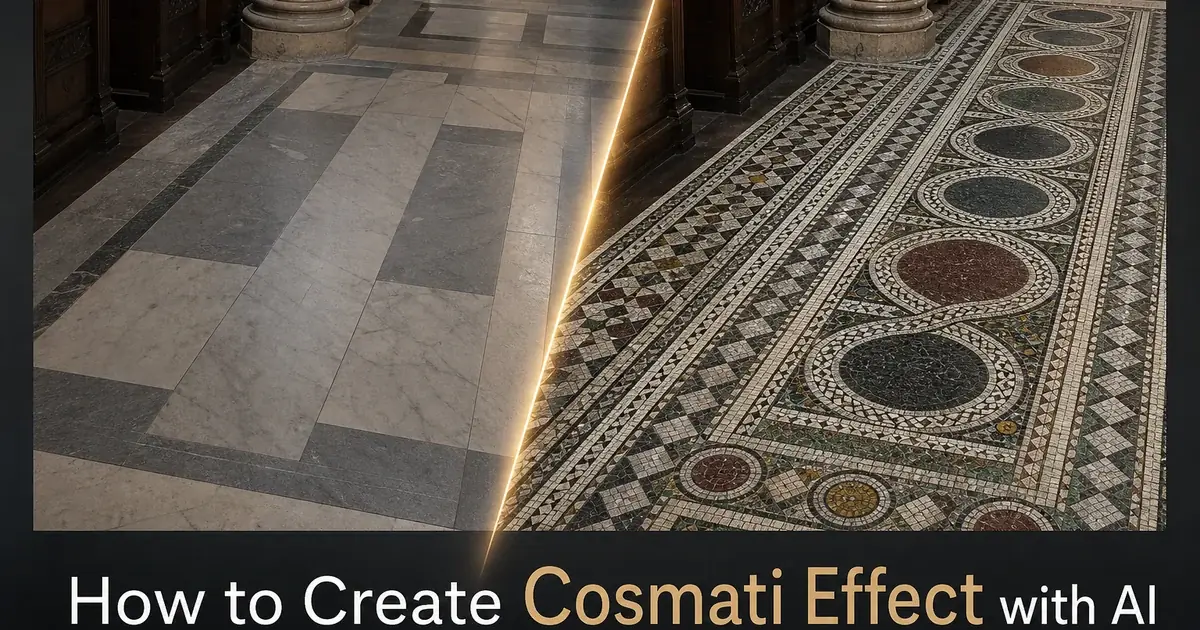
Cosmati work — the geometric marble, porphyry. Glass tessellation that decorates the floors, walls, and liturgical furniture of medieval Roman churches — represents one of the most sophisticated traditions of geometric decorative art in Western history. Named after the Cosmati family of Roman marble workers who perfected the technique across generations spanning the twelfth and thirteenth centuries, Cosmatesque design assembles precisely cut pieces of colored stone and gilded glass into geometric patterns of extraordinary mathematical complexity and visual richness. The Westminster Abbey pavement, the floors of Santa Maria in Cosmedin, the cloister columns of San Giovanni in Laterano. These works combine the imperial grandeur of their porphyry and serpentine materials with geometric precision that anticipates mathematical concepts not formally described until centuries later. Applying this aesthetic to photographs creates images that carry the visual weight and historical authority of medieval Roman architecture.
Traditional digital approaches to mimicking Cosmati tessellation have treated it as a geometric overlay problem. Dividing the image into geometric cells, filling each cell with a color sampled from the underlying photograph, and adding border lines to suggest the mortar joints between pieces. The results resemble simplified mosaic filters rather than Cosmati work because they miss the key material qualities that make real Cosmatesque decoration so visually strong. In actual Cosmati pavements, each piece of stone is a real material with its own veining, crystalline structure, color variation, and surface quality. Porphyry has a distinctive granular texture with visible feldspar crystals. Serpentine shows flowing dark green patterns with lighter mineral inclusions. White marble has subtle gray veining. Gold glass tesserae catch light differently than the surrounding stone. None of these material qualities survive a simple geometric-fill approach.
AI-powered Cosmati conversion solves this by understanding both the geometric structure of Cosmatesque design and the material properties of the stones and glasses it employs. The AI generates tessellation patterns that follow the authentic compositional rules of Cosmati work. Quincunx arrangements of roundels, guilloche interlocking borders, opus alexandrinum large-scale geometric fields — and fills each geometric zone with stone textures that replicate the actual visual traits of porphyry, serpentine, marble, and gilded glass. The composition respects the photograph's subject by mapping the Cosmati geometry onto the image's existing spatial structure, placing focal patterns over the image's natural center of interest and border patterns along compositional edges. This guide walks through creating Cosmati-style images using AI Filter and AI Enhance, covering historical pattern selection, material palette control, surface finish adjustment. The details that make the result read as plausible Cosmatesque decoration rather than a digital geometric filter.
- AI generates tessellation patterns following authentic Cosmati compositional rules. Quincunx roundels, guilloche borders, opus alexandrinum fields — rather than applying generic geometric subdivision to the image.
- Stone material simulation replicates the visual traits of historical Cosmati materials including porphyry granular texture, serpentine mineral patterns, marble veining. The warm luminance of gilded glass tesserae.
- Composition mapping places focal Cosmati patterns over the image's natural center of interest with border patterns along edges, creating designs that respect the photograph's subject rather than tiling mechanically.
- Surface finish controls range from freshly conserved polished stone to centuries-worn medieval pavements with authentic chips, wear patterns, and mortar gaps that communicate historical materiality.
- AI Enhance sharpens inter-piece boundaries and clarifies the internal texture of each stone type, ensuring the result reads as cut-stone assemblage rather than geometric color fill.
How AI Cosmati conversion creates authentic tessellation rather than generic mosaic effects
The fundamental difference between a Cosmati tessellation and a generic mosaic filter lies in the geometric logic that organizes the composition. Mosaic filters divide an image into uniform cells. Square grids, hexagonal grids, or Voronoi cells — and fill each cell with a single sampled color. The result is a pixelated version of the original image that reads as a low-resolution representation rather than a decorative design. Cosmati work, by contrast, uses hierarchical geometric compositions where large-scale design elements contain smaller-scale pattern fills. In turn contain individual tessellation pieces. A quincunx floor features large roundels that contain rotating geometric patterns made of smaller triangles and diamonds, surrounded by border bands filled with micro-tessellation, all set within a field of yet another geometric pattern. This hierarchy of scales is what gives Cosmati work its visual richness. It rewards viewing from both across the nave and on hands and knees.
AI Cosmati conversion replicates this hierarchical structure by first analyzing the photograph's composition to determine the large-scale geometric layout, then generating the intermediate-scale pattern fills within each geometric zone. Finally populating those patterns with individual tessellation pieces at the finest scale. The large-scale layout responds to the photograph's subject. The primary subject maps to the central design element, secondary subjects to satellite elements, and background to border and field patterns. The intermediate patterns are chosen from the historical vocabulary of Cosmati geometry. Rotating triangles, interlocking circles, chevron bands, diamond fields — with each zone receiving a pattern right to its role in the composition. The individual tessellation pieces are then generated with material textures and inter-piece boundaries that sell the illusion of cut stone assembly.
The result is qualitatively different from any generic geometric filter because it applies the same multi-level design thinking that the Cosmati marble workers used. Where a mosaic filter produces a single-scale subdivision that flattens the image into uniform cells, the Cosmati conversion creates a composition with visual depth. Large patterns that organize the overall design, medium patterns that create textural variety within each zone, and fine tessellation details that reward close inspection. This matches the experience of viewing actual Cosmati pavements, where the overall design is legible from thirty feet, the pattern variations become apparent at ten feet. The individual stone pieces with their unique veining and texture are appreciable only from directly above. The AI replicates this multi-scale visual experience in a single image.
- Generic mosaic filters divide images into uniform cells with sampled colors, producing pixelated representations that lack the hierarchical geometric structure of real Cosmati design.
- AI generates multi-level compositions — large-scale geometric layout, intermediate pattern fills. Individual tessellation pieces — matching the three-scale visual hierarchy of actual Cosmati pavements.
- Composition analysis maps the photograph's subject structure onto the Cosmati geometric framework, placing focal elements in central roundels and supporting elements in border and field patterns.
- The multi-scale approach creates visual depth where large patterns organize the design, medium patterns add textural variety, and fine details reward close inspection. Matching the real pavement viewing experience.
The historical Cosmati material palette and how to replicate it digitally
The materials used in Cosmati work were not chosen arbitrarily. They were specific stones and glasses with imperial Roman associations that the medieval Cosmati workers salvaged from ancient ruins and repurposed into church decoration. Understanding these materials is key for creating authentic-looking Cosmati effects because the specific colors, textures. Optical qualities of each stone type are as distinct to informed viewers as the geometric patterns themselves. Imperial porphyry — the deep red-purple stone quarried exclusively at Mons Porphyrites in the Egyptian eastern desert — was the most valued material because of its association with Roman emperors, who reserved its use for imperial monuments. The quarry was lost and forgotten after antiquity, making the existing supply of porphyry finite and irreplaceable. Elevated its value in medieval Roman eyes to something approaching sacred status.
Serpentine — the dark green stone quarried in Greece and found throughout ancient Roman buildings — provided the primary contrasting color to porphyry's red-purple. Its flowing dark green patterns with lighter mineral inclusions create a visual texture that is right away distinct and impossible to replicate with flat green fill. White marble, primarily from the quarries at Carrara and Luna, served as the bright ground against which the dark porphyry and serpentine patterns were set, with its subtle gray veining adding textural interest to what might otherwise be blank white fields. Gilded glass tesserae — small pieces of glass with gold leaf fused between layers — added points of warm luminous reflection that caught candlelight in the dim church interiors, creating sparkling accents within the otherwise matte stone surfaces. The AI mimics each of these materials with texture generation that matches their real optical and structural traits.
The relative proportions of these materials in a Cosmati composition share different historical and regional styles. The Westminster Abbey pavement uses a porphyry-dominant scheme with fairly little serpentine, creating a regal austere look that emphasizes the imperial associations of the purple stone. Roman basilica floors often balance porphyry and serpentine more equally, with generous white marble fields that keep the composition from becoming visually heavy. Liturgical furniture and smaller decorative panels often feature more gold glass tesserae proportionally, as the smaller viewing distance rewards the luminous sparkle that gold glass provides. The AI's material palette controls let you weight each material on its own, shifting between these historical approaches or creating custom palettes that serve your creative vision while maintaining the material realism that makes the Cosmati effect convincing.
- Imperial porphyry provides the signature red-purple with visible feldspar crystal texture — the most valued Cosmati material due to its exclusive association with Roman imperial power.
- Greek serpentine contributes dark green patterns with lighter mineral inclusions, creating flowing texture that is immediately recognizable and impossible to simulate with flat color fill.
- White Carrara marble serves as the bright ground with subtle gray veining that adds textural interest, preventing the light areas from appearing as blank flat fields.
- Gilded glass tesserae add warm luminous highlights that caught candlelight in medieval churches, with the AI simulating their distinctive light-catching quality distinct from surrounding matte stone.
Pattern types: quincunx, guilloche, opus alexandrinum, and micro-tessellation
The quincunx is the signature compositional pattern of Cosmati pavement design. Five roundels arranged with one at the center and four at the corners of a surrounding square, all connected by bands of geometric border patterns. This arrangement creates a self-similar design that can tile infinitely while maintaining clear focal hierarchy: the central roundel is always the visual anchor, the four satellite roundels create secondary focal points. The connecting bands provide visual pathways between them. In the greatest Cosmati pavements, each roundel contains its own internal geometric pattern. Rotating triangles, concentric circles, interlocking stars — creating a composition where every element rewards close examination. The AI maps this quincunx structure onto photographs by placing the central roundel over the image's primary subject and arranging the satellites and connectors to follow the secondary compositional elements.
Guilloche borders are the intricate interlocking circular arc patterns that form the connecting bands between major design elements and frame the edges of Cosmati compositions. The guilloche is constructed from pairs of sinuous lines that weave around each other, creating almond-shaped openings between the intersections that are filled with small-scale tessellation. Tiny triangles, diamonds, and circles of porphyry, serpentine, and gilded glass. The visual effect is at once structured and flowing. The mathematical precision of the interlocking arcs combined with the organic warmth of the stone materials creates borders that are ornamental without being rigid. AI generation of guilloche borders follows the mathematical rules of the pattern while introducing the subtle irregularities of hand execution. Slightly varying arc radii, marginal misalignments at intersection points — that prevent the border from looking mechanically computer-generated.
Opus alexandrinum refers to the large-scale geometric field patterns that fill the areas between major design elements. The background texture of a Cosmati composition. These fields often feature bold geometric forms. Large triangles, diamonds, hexagons, and square panels — filled with alternating colors of stone to create dramatic graphic patterns visible from across a church nave. Micro-tessellation, by contrast, packs the highest density of individual pieces into the smallest space, creating zones of intense visual detail that reward examination from inches away. A complete Cosmati composition uses all four pattern types in a hierarchical arrangement: quincunx structure at the largest scale, guilloche borders at the intermediate scale, opus alexandrinum in field areas. Micro-tessellation as detailed fill within borders and roundels. The AI replicates this full hierarchy in its conversion, distributing pattern types properly across the image.
- Quincunx patterns arrange five roundels with a central focal point and four satellites connected by border bands, creating the signature Cosmati composition that maps naturally onto photograph subject hierarchies.
- Guilloche borders use mathematically precise interlocking circular arcs with small-scale tessellation fills, combining structural precision with the organic warmth of hand-cut stone materials.
- Opus alexandrinum large-scale geometric fields fill background areas with bold alternating stone colors visible from a distance, providing the graphic backbone of the overall composition.
- The AI distributes all four pattern types hierarchically. Quincunx structure, guilloche borders, alexandrinum fields, and micro-tessellation details — matching how real Cosmati workshops composed their pavements.
Creative applications: architecture, portraits, and decorative art
Architectural photographs converted to Cosmati tessellation create images that transform modern buildings into what appears to be medieval Roman church decoration. An anachronistic contrast that is visually striking and conceptually rich. The geometric structure of architecture translates naturally into Cosmati composition because buildings share the mathematical regularity that the Cosmati tradition celebrates. Windows become roundels, columns become border bands, and floor plans become quincunx arrangements. The AI maps the architectural geometry onto the Cosmati vocabulary with sensitivity to the building's actual structure. The tessellation patterns feel integrated with the architectural forms rather than arbitrarily overlaid. These images work as art prints, architectural concept illustrations. Creative social media content that connects modern design to historical craft traditions.
Portrait Cosmati creates a powerful visual effect where a human face becomes the central element of a geometric composition that evokes medieval sacred art. The face occupies the central roundel of a quincunx arrangement, with the features rendered in tessellated stone. Porphyry shadows, marble highlights, serpentine in the middle tones — while the surrounding geometric borders frame the face with the same ornamental vocabulary used to frame sacred images in Roman churches. The effect gives portraits an iconic, devotional quality that is impossible to achieve with conventional photographic filters. The restrained palette of the Cosmati materials. Red-purple, green, white, and gold — removes the distraction of skin tone and hair color, focusing attention on the geometric structure of the face rendered in permanent stone rather than fleeting flesh.
Decorative and commercial applications use the Cosmati effect to create surface designs, packaging concepts. Branding elements that carry the visual authority of medieval craft tradition. Fashion brands reference Cosmati tessellation for textile patterns and jewelry designs that evoke the geometric precision and material richness of Roman church decoration. Interior designers use Cosmati-style images as mood board elements that share the specific aesthetic of polychrome geometric stone inlay. The AI conversion makes it possible to transform any photograph into a Cosmati-inspired design that maintains connection to the photographic source while translating it into the language of cut stone and geometric precision. A unique creative tool for designers who want to evoke historical craft without commissioning actual stone cutting.
- Architectural subjects translate naturally into Cosmati compositions where windows become roundels, columns become border bands, and building geometry maps onto the tessellation vocabulary.
- Portrait Cosmati renders faces in tessellated porphyry, serpentine. Marble within quincunx compositions, creating iconic devotional-quality images with the permanence of stone rather than photographic impermanence.
- Fashion and interior design applications use Cosmati conversions for textile patterns, jewelry concepts. Mood boards that share the geometric precision and material richness of historical stone inlay.
- The AI maintains a connection between the photographic source and the Cosmati design, ensuring the tessellation patterns serve the image's subject rather than obscuring it beneath arbitrary geometric overlay.
How to do it
- 1
Upload your photo and evaluate its geometric structure for Cosmati conversion
Open your photograph in AI Filter and assess the image for the geometric regularity and tonal organization that translate well into Cosmati-style tessellation. Cosmati work is at its core geometric. Circles inscribed within squares, triangles arranged in rotational symmetry, bands of repeating diamond and chevron patterns, all assembled from precisely cut pieces of colored stone and glass. Photographs with clear geometric structure, strong symmetry, or well-defined spatial zones convert most convincingly because the AI can map the tessellation patterns onto a logical compositional framework. Architectural photographs, portraits with centered symmetry, mandala-like natural forms. Any image with a clear focal point surrounded by organized peripheral elements provide ideal source material. Images with chaotic composition, undefined focal areas, or purely random textures produce Cosmati effects that lack the intentional geometric order of real Cosmatesque design.
- 2
Select the Cosmati style and configure tessellation pattern parameters
Choose from Cosmati presets that simulate different historical expressions of the technique. The quincunx pattern — a large central roundel surrounded by four smaller roundels connected by bands of geometric borders — is the signature Cosmati composition found on church floors throughout medieval Rome. The guilloche border uses interlocking circular arcs filled with small tessellation pieces to create ornamental frames around major design elements. The opus alexandrinum style features bold geometric fields of contrasting stone colors arranged in large-scale patterns that read from a distance. The micro-tessellation style packs thousands of tiny stone and glass pieces into intricate patterns that reveal their complexity only at close range. Adjust the tessellation density to control how many individual pieces fill the composition. Sparse settings produce bold graphic patterns while dense settings create the jewel-like intricacy of the finest Cosmati floors.
- 3
Adjust stone material palette and surface finish for authentic medieval appearance
Control the material palette to replicate the specific stones and glasses used in historical Cosmati work. The traditional Cosmati palette is dominated by four materials: white marble from Carrara or Luna providing the bright ground, deep red-purple porphyry from ancient Egyptian quarries contributing the most valued dark accent, green serpentine from Greece offering the primary contrasting color. Gold glass tesserae adding luminous highlights. The AI lets you weight these materials differently. Emphasizing the austere porphyry-and-white of Westminster Abbey, the green-dominant compositions of Roman basilica floors, or the gilt-glass-rich ornamentation of liturgical furniture. Surface finish ranges from the polished mirror-smooth look of freshly conserved Cosmati pavements to the worn matte surface of medieval floors that have been walked on for eight centuries, with chips, wear patterns. Mortar gaps that share authentic age.
- 4
Use AI Enhance to sharpen tessellation edges and refine stone texture detail
After the initial Cosmati conversion, apply AI Enhance to sharpen the boundaries between individual stone pieces and clarify the material texture within each tessera. Real Cosmati work has a specific visual quality at the piece boundaries. A thin line of mortar or direct stone-to-stone contact that defines each element as a discrete cut piece rather than a painted area. Boost tightens these inter-piece boundaries, sharpens the natural veining and crystalline structure visible within each marble and porphyry piece. Adds the subtle color variation within a single stone type that prevents the tessellation from looking like flat colored fill. The result reads as an assemblage of real stone pieces with individual material character rather than a geometric pattern applied as a uniform overlay.
- 5
Export the finished Cosmati image and compare against historical pavement references
Save the completed Cosmati effect at full resolution and compare it against photographs of actual Cosmati pavements from Roman basilicas, Westminster Abbey, and other historical installations. Check that the geometric relationships are correct. Roundels that are truly circular, borders that maintain consistent width, and tessellation pieces that are plausibly sized for hand-cutting from real stone. Verify that the color relationships match the historical palette. Porphyry should read as deep red-purple rather than bright red, serpentine should be dark green rather than emerald, and the gold glass should have the warm amber tone of real gilded glass tesserae rather than metallic yellow. Evaluate the surface finish for the right level of stone materiality. Each piece should show the trait texture of its stone type rather than appearing as flat uniform color fills.
Sources
- The Cosmati Pavements in Westminster Abbey — Westminster Abbey
- Image Style Transfer Using Convolutional Neural Networks — IEEE Conference on Computer Vision and Pattern Recognition
- Cosmatesque Ornament: Flat Polychrome Geometric Patterns in Architecture — The Metropolitan Museum of Art