
How to Create Chalk Art Effect with AI — Magic Eraser
Step-by-step guide to transforming photos into chalkboard and sidewalk chalk art using AI. Covers chalk dust textures, blackboard and concrete backgrounds, colored chalk palettes, stroke rendering, pigment blending simulation, and pastel chalk styles.

Product Marketing
Reviewed by Magic Eraser Editorial ·
Table of Contents
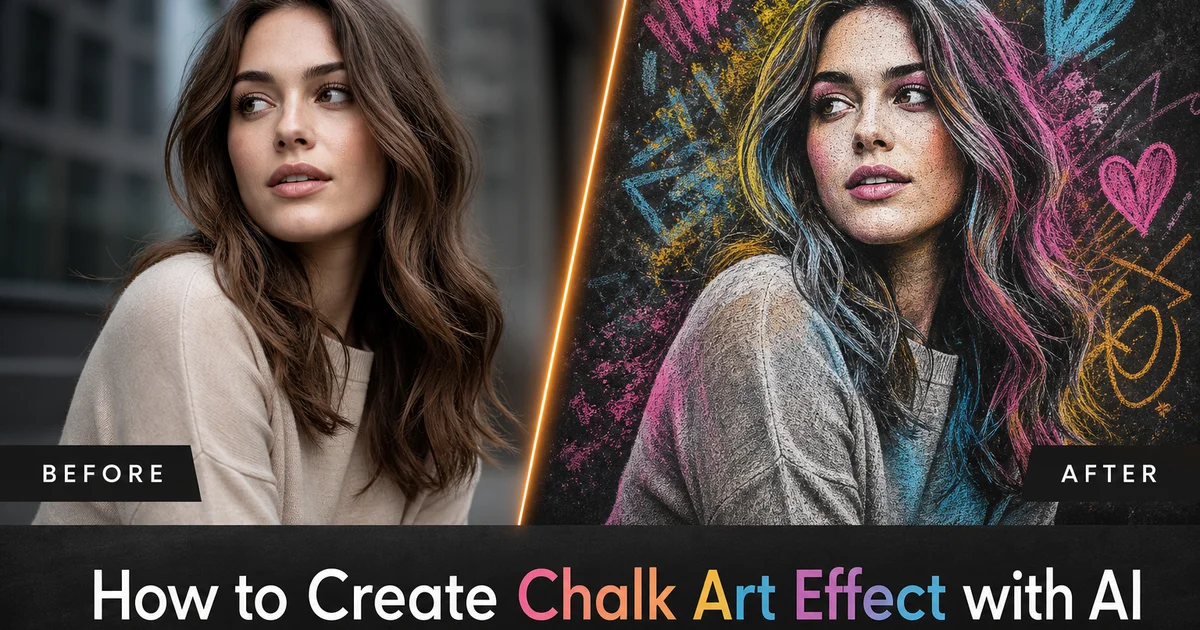
Chalk art holds a distinctive place in visual culture as a medium that is at once nostalgic and modern, ephemeral and enduring in its aesthetic appeal. From the chalkboard menus that define the visual identity of cafes worldwide to the massive sidewalk murals that transform urban pavement into temporary galleries, the chalk aesthetic communicates warmth, authenticity, and handcrafted care.
Creating convincing chalk art from photographs requires understanding what makes the chalk medium visually unique. Chalk is a dry pigment that sits on the surface rather than soaking into it, meaning the surface texture always shows through — the slate grain of a chalkboard, the aggregate pattern of concrete, the tooth of toned paper.
AI chalk conversion analyzes the photograph's composition, color, and tonal structure, then re-renders it using simulated chalk behavior. The AI generates individual stroke marks that follow the subject's contours, applies pigment density that varies with simulated pressure, creates blending zones at color boundaries, and deposits dust particles around drawn elements.
- Chalk art relies on dry pigment sitting on the surface rather than absorbing into it — the substrate texture always shows through, defining the visual character.
- Three chalk medium styles produce distinct aesthetics: chalkboard for dark-surface lettering, sidewalk chalk for vibrant street art, and pastel chalk for fine art softness.
- Stroke rendering simulates pressure-dependent pigment density from scratchy textured marks at light pressure to dense opaque coverage at heavy pressure.
- Color blending at boundaries simulates physical chalk smudging with feathered transition zones rather than the hard edges of digital illustration.
- Dust particle simulation adds loose pigment accumulation around drawn elements, contributing the authentic imperfect quality of real chalk work.
How AI simulates the physics of chalk pigment on textured surfaces
The visual behavior of chalk on a surface is governed by the interaction between a soft, friable pigment stick and a textured substrate. Heavier pressure compresses chalk into surface valleys producing denser coverage; lighter pressure deposits pigment only on the highest points, creating the signature scratchy quality of chalk drawing.
AI chalk rendering generates a surface texture map for the selected substrate — slate grain, concrete aggregate, paper tooth — and modulates pigment density according to surface height at every point. This per-pixel interaction produces physically convincing marks.
The stroke generation layer adds directional quality by generating individual stroke paths that follow subject contours, each with variable pressure from light start through firm middle to lifted tail, creating the hand-drawn quality that distinguishes AI chalk rendering from simple texture overlays.
- Surface texture maps modulate pigment density at every point — chalk deposits on raised grain but skips over surface valleys.
- Pressure simulation varies coverage from scratchy textured marks at light pressure to dense opaque coverage at heavy pressure.
- Stroke generation creates directional marks following subject contours with variable pressure throughout each stroke.
- Layered stroke accumulation builds the image through overlapping passes rather than flat color fills.
Chalkboard, sidewalk, and pastel: three distinct chalk art aesthetics
Chalkboard chalk art renders the photograph primarily in white chalk on a dark surface with colored accents, reducing the full color range to the limited palette of standard chalk — white, yellow, pink, blue, green, and orange.
Sidewalk chalk art uses vibrant saturated colors at heavy pigment density with coarse concrete texture for the festive energy of street festival art.
Pastel chalk produces fine art softness with delicate layering, controlled blending, and luminous pigment-on-toned-paper interaction.
- Chalkboard style constrains output to a classic limited palette on dark matte board.
- Sidewalk chalk delivers vibrant saturated colors with coarse concrete texture.
- Pastel chalk produces fine art softness with delicate layering and controlled blending.
- Each chalk style applies different stroke qualities and pigment densities for distinct results.
Color blending, smudging simulation, and dust particle effects
Chalk blending interleaves separate pigment particles rather than mixing colors chemically, producing the granular shimmer unique to dry media. The AI mimics this by generating individual pigment particles at color transitions rather than smooth mathematical gradients.
Smudge simulation spreads pigment along natural form directions with density reduction matching real chalk distribution behavior.
Dust particles accumulate below and around drawn elements proportional to nearby pigment intensity, and ghost marks from erased areas add the faint pigment residue of the impermanent chalk medium.
- Chalk blending interleaves separate pigment particles, producing the granular shimmer unique to dry media.
- Smudge simulation spreads pigment along natural form directions with density reduction.
- Dust particles accumulate proportional to nearby pigment intensity.
- Ghost marks from simulated erased areas add impermanent medium character.
Applications from restaurant branding to education and social media content
Restaurant and cafe branding represents the largest commercial application — the chalkboard aesthetic communicates artisanal quality and personal craftsmanship.
Educational content benefits from chalk's association with teaching, making materials feel approachable and personal rather than clinical.
Social media content in chalk effect performs well on dark mode interfaces where the dark background integrates seamlessly with the UI.
- Restaurant chalk art communicates artisanal quality for emotionally resonant brand content.
- Educational content in chalk style leverages cultural associations with teaching for improved engagement.
- Dark chalkboard backgrounds integrate naturally with dark mode social media interfaces.
- Seasonal content in chalk carries handcrafted warmth with minimal processing time.
How to do it
- 1
Upload the photo and evaluate its suitability for chalk art conversion
Open your image in Magic Eraser and assess whether the photograph will translate well into chalk art. Images with strong tonal contrast, clear outlines, and bold color areas convert most successfully.
- 2
Select the chalk medium style and background surface
Choose between chalkboard chalk, sidewalk chalk, or pastel chalk styles that determine the overall visual character. Each style applies a different background surface — dark matte board, gray concrete, or toned art paper.
- 3
Configure chalk stroke rendering and dust texture parameters
Adjust stroke pressure, direction, and the dust parameter that adds loose pigment accumulating around chalk marks — smudges, hand prints, and particles that settle below drawn elements.
- 4
Apply the colored chalk palette with blending and layering simulation
Map the photograph's colors to a chalk palette and apply medium-specific blending. For chalkboard style, enable limited palette mode constraining output to classic chalk colors.
- 5
Export the chalk artwork with optional print and display formats
Export as a high-resolution image. For chalkboard-style outputs, enable the board edge frame. For sidewalk chalk, use wider aspect ratios for street festival photography.
Sources
- The History of Chalkboard Art and Lettering in Visual Communication — AIGA Eye on Design
- Texture Synthesis and Transfer for Non-Photorealistic Rendering — ACM SIGGRAPH
- Sidewalk Chalk Art: Techniques for Large-Scale Temporary Public Art — Smithsonian Magazine