
AI Photo Editing for Watchmakers: Showcase Precision Craftsmanship
Expert product photography editing for watchmakers using AI tools. Cover dial macro detail, movement finishing, crystal reflections, case materials, and multi-angle display for e-commerce and social media.

Product Marketing
Reviewed by Magic Eraser Editorial ·
Table of Contents
- Why watch photography demands higher editing standards than most product categories
- Background removal and replacement for professional watch presentation
- Sharpening dial details and movement finishing for maximum visual impact
- Metal accuracy, crystal reflections, and color fidelity for buyer confidence
- Multi-platform export: e-commerce listings, social media, and collector marketplaces
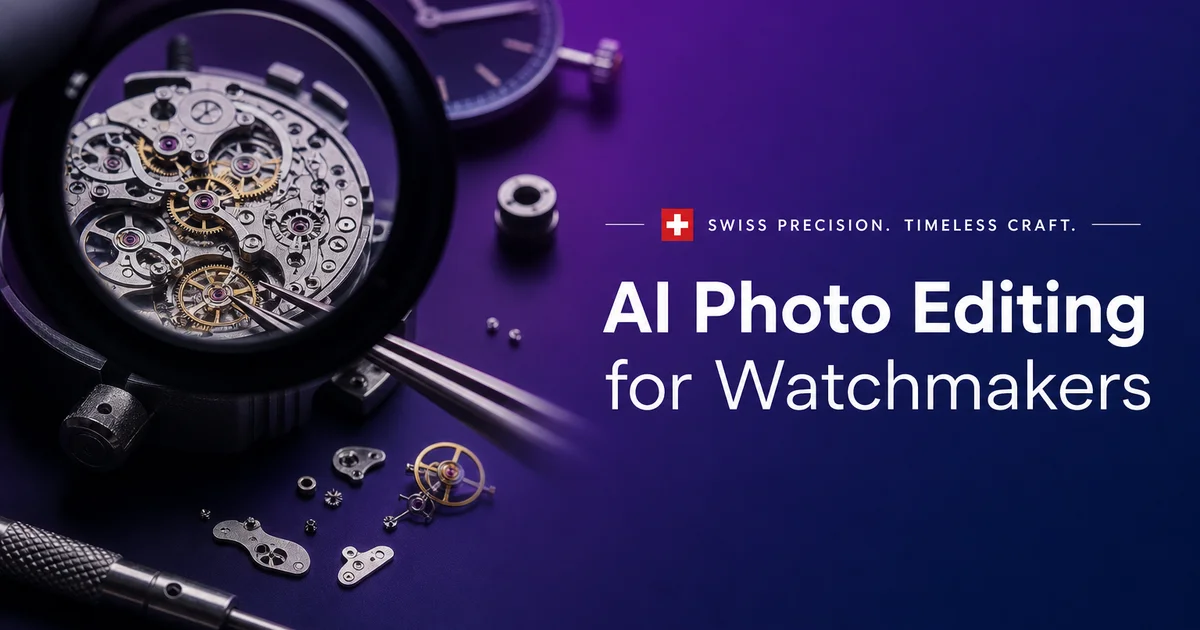
Watchmaking is a craft where the product's value is communicated almost entirely through visual detail. The precision of a dial layout, the polish of a case surface, the finishing quality of a movement visible through a sapphire caseback. Unlike many products where a decent photo is enough to drive a purchase decision, watches demand photography that reveals the micro-level craftsmanship that justifies their price. A blurry photo that obscures the straightness of Geneva stripes or the crispness of dial printing tells the buyer nothing about the quality of the work. In a market where buyers routinely spend thousands of dollars based on online images, the difference between adequate and excellent product photography directly impacts sales conversion. This reality makes photo editing a key part of any watchmaker's or watch dealer's workflow.
The challenge for independent watchmakers and small watch dealers is that expert watch photography has historically required expensive equipment and major expertise. Macro lenses, focus stacking rigs, light painting setups. Hours of post-processing in Photoshop have been the standard for producing the kind of product images that appear in watch magazines and brand marketing materials. Independent watchmakers who spend their days at the bench perfecting movements and finishing components rarely have the time or budget to also master advanced photography techniques. Their livelihood depends on presenting their work compellingly online. The gap between the quality of the craftsmanship and the quality of its photographic representation is one of the biggest challenges facing independent watchmakers in the digital marketplace.
AI photo editing tools close this gap by automating the most technically demanding aspects of watch photography post-processing. Background removal and replacement, selective sharpening of dial details, color accuracy correction for different metal types, and the subtle shadow and reflection work that grounds a watch convincingly on its display surface. Tasks that once required hours of skilled Photoshop work can now be accomplished in minutes. This guide walks through a complete AI-powered photo editing workflow for watchmakers, covering everything from initial macro photography setup through final export for e-commerce listings, social media, and marketplace platforms. The goal is to help watchmakers present their craftsmanship with the visual impact it deserves, without requiring them to become expert photographers.
- AI background removal cleanly isolates watches from studio backgrounds including transparent crystal areas, with intelligent replacement that adds natural reflections and shadows for convincing surface placement.
- Selective AI boost sharpens the micro-details watch buyers evaluate. Dial text crispness, index faceting, Geneva stripes, anglage mirror polish — without introducing artifacts on smooth polished surfaces.
- Metal color correction ensures stainless steel, rose gold, yellow gold, and titanium each display their correct real-world tones without color cast drift that undermines buyer confidence.
- Multi-angle presentation workflows produce consistent editing across hero, dial detail, caseback, and wrist shots for cohesive product listings across e-commerce and social platforms.
- AI tools reduce watch photography post-processing from hours of expert Photoshop work to minutes, letting independent watchmakers focus on their craft rather than learning advanced photo editing.
Why watch photography demands higher editing standards than most product categories
Watch buyers are among the most visually literate consumers in any product category. Enthusiast communities spend hours examining macro photographs of dials, movements. Case finishing, comparing the quality of different pieces based on photographic evidence of craftsmanship details that are barely visible to the naked eye. The straightness of a Geneva stripe, the depth and consistency of a sunburst dial pattern, the mirror polish quality on the edge of a bridge. These micro-details are scrutinized in high-resolution photos and form the basis of purchasing decisions for watches that can cost anywhere from hundreds to hundreds of thousands of dollars. Photography that fails to clearly reveal these details puts the watchmaker at a competitive disadvantage regardless of the actual quality of their work.
The materials used in watchmaking present unique photographic challenges. Polished stainless steel and precious metals are highly reflective, producing mirror-like surfaces that reflect the studio setting, the photographer, and the camera itself. Sapphire crystals add another layer of reflective complexity, with both the outer surface and the inner surface producing reflections and distortions. Anti-reflective coatings on crystals create color-shifted reflections. Often blue or purple — that can contaminate the perceived dial color in photographs. Managing these reflective surfaces during both shooting and editing requires specialized techniques that go beyond standard product photography workflows.
Movement photography through exhibition casebacks introduces extra challenges. The depth of field required to keep an entire movement in focus at macro magnification is very narrow, often requiring focus stacking. Capturing multiple images focused at different depths and combining them computationally. The variety of finishing surfaces within a single movement. Mirror polish, circular graining, Geneva stripes, sandblasting, bluing — each respond differently to light, meaning a lighting setup that reveals the beauty of one finishing technique may obscure another. AI boost tools help resolve these competing demands by selectively processing different areas of the image to bring out the best in each finishing type.
- Watch enthusiasts evaluate purchases based on macro-level detail in product photos. Geneva stripes, dial texture, index faceting — making sharp, revealing photography a direct driver of sales conversion.
- Highly reflective case materials, sapphire crystals, and anti-reflective coatings create multiple layers of optical complexity that standard product photography techniques cannot adequately address.
- Movement photography requires extreme depth of field at macro magnification, often demanding focus stacking to keep all finishing details from bridges to wheels simultaneously sharp.
- AI editing tools address these challenges by selectively enhancing different surface types and finishing techniques within a single image, optimizing each area independently.
Background removal and replacement for professional watch presentation
Clean background removal is the foundation of expert watch product photography because the background establishes the visual context that positions the watch in the buyer's mind. A watch floating on pure white communicates e-commerce efficiency and lets the product speak for itself. This is the standard for marketplace listings and catalog-style displays. A watch resting on dark leather suggests luxury and heritage, suitable for brands that emphasize traditional craftsmanship. A watch on a textured concrete surface communicates modern industrial design. The background is not merely decorative. It is a branding statement that influences how the buyer perceives the watch's market position and value.
AI background removal handles the specific challenges of watch silhouettes that trip up manual masking. The junction between the case and crystal creates a subtle edge change where the highly reflective metal meets the transparent sapphire. Getting this transition clean requires detecting material boundaries rather than just color boundaries. Lugs that extend behind the strap or bracelet create complex overlap geometry. Exhibition casebacks are partially transparent, revealing movement detail that should remain visible against the new background rather than being masked away. The AI recognizes these material types and handles each properly, maintaining crystal transparency, keeping caseback visibility. Creating clean edges along the precise geometric lines of the case.
Shadow and reflection generation on the replacement background is equally important. A watch presented on a surface without a shadow or reflection appears to float unnaturally, right away breaking the illusion of a real product photograph. The AI generates appropriate shadows based on the lighting direction evident in the watch image. Soft diffused shadows for flat surface displays, sharper directional shadows for more dramatic lighting setups. For reflective surfaces like glass or polished stone, the AI adds a subtle mirror reflection below the watch that extends the visual weight of the object and creates the luxurious display associated with high-end watch advertising photography.
- Background choice communicates brand positioning — pure white for e-commerce, dark leather for luxury heritage, textured surfaces for modern design — making replacement a branding decision beyond simple aesthetics.
- AI handles watch-specific masking challenges including crystal-to-case transitions, lug-behind-strap overlap, and exhibition caseback transparency that should preserve movement visibility.
- Shadow generation matches the lighting direction of the watch image, with options from soft diffused shadows for neutral presentation to dramatic directional shadows for editorial impact.
- Reflective surface mode adds mirror reflections below the watch for the luxurious glass-surface presentation style used in high-end watch advertising and brand marketing.
Sharpening dial details and movement finishing for maximum visual impact
The dial is the face of the watch. The element buyers see most and the surface that communicates design intent, brand identity, and manufacturing quality. AI boost selectively sharpens dial elements without introducing the noise and artifacts that global sharpening produces on smooth metal surfaces. Applied indices become crisper at their faceted edges while their polished faces remain smooth. Printed text — the brand name, model designation, depth rating. Other dial text — becomes more legible, which is especially important because text clarity is one of the first quality indicators buyers examine. Subdial registers, date windows, and minute markers all benefit from targeted sharpening that makes them pop against the dial surface without over-processing the dial texture itself.
Movement finishing details require a different boost approach than dial elements because they are often viewed through the caseback crystal with extra optical complexity. Geneva stripes (Cotes de Geneve) should show clean parallel lines with consistent spacing and smooth light-to-shadow gradients across each stripe. Circular graining (perlage) should reveal individual overlapping circles with subtle radial texture. Mirror polish on bridge edges (anglage) needs to show the absolute smoothness that distinguishes hand-polished from machine-polished finishing. The AI recognizes these different finishing patterns and applies appropriate sharpening. Enhancing the linear quality of Geneva stripes, the circular pattern of perlage, and the reflective smoothness of anglage — rather than applying one-size-fits-all sharpening that might help one technique while harming another.
Lume visibility presents a special challenge in watch photography. Watch dials often have luminous material applied to hands and hour markers, and this material has a different surface quality than the surrounding dial. It is often slightly raised, has a matte or semi-matte texture, and may appear white, green, or blue depending on the lume type and lighting conditions. In daylight photography, lume should appear as a clean, uniform material with crisp edges where it meets the metal of the hand or index. In dark or UV-lit photography that shows the lume's glow, the luminous areas should appear bright and evenly charged without blotchy spots. AI color correction ensures lume displays its correct color under the specific lighting conditions of the photograph.
- Dial text, applied indices, and subdial registers receive targeted sharpening that enhances legibility and edge crispness without introducing artifacts on smooth polished dial surfaces.
- Movement finishing — Geneva stripes, circular graining, mirror polish anglage — each receives finishing-type-specific enhancement that preserves the distinctive visual character of each technique.
- Lume material appearance is corrected for consistent color and uniform application quality under both daylight and dark/UV photography conditions.
- Selective boost processes different areas independently, optimizing each for its specific material and surface type rather than applying global adjustments that compromise some areas to benefit others.
Metal accuracy, crystal reflections, and color fidelity for buyer confidence
Color accuracy in watch photography is not merely an aesthetic preference — it is a trust requirement. Watch buyers making purchasing decisions based on product photos need to know that the stainless steel case they see on screen will look like stainless steel in person, not the slightly warmer tone that could indicate titanium or the cooler tone that might suggest a rhodium-plated surface. Rose gold must display its specific pink-copper warmth without drifting toward orange (which suggests gold plating) or toward red (which looks unnatural). Yellow gold should appear rich and warm without the brassy cast that artificial lighting often introduces. Getting these metal tones precisely right builds buyer confidence, while getting them wrong creates expectations that the physical product cannot meet. Leading to returns, negative reviews, and damaged reputation.
Crystal reflections are one of the most complex aspects of watch photography color management. Modern watch crystals are often sapphire with anti-reflective coatings. These coatings produce color-shifted reflections that can contaminate the perceived dial color. A blue AR coating produces blue-purple reflections on the crystal surface that, in photographs, can make a black dial appear slightly blue or a silver dial appear slightly purple. The AI recognizes these coating reflections and can either preserve them accurately (many watch enthusiasts actually appreciate visible AR coating as a sign of quality) or reduce them to show the true dial color underneath. The choice depends on the purpose of the photo. Marketing images often reduce AR to show clean dial color, while enthusiast community photos preserve it as part of the watch's character.
Bracelet and strap color accuracy completes the overall color fidelity picture. Metal bracelets should match the case material precisely. Center links in polished finish and outer links in brushed finish should both display the correct metal color for stainless steel, gold, or titanium. Leather straps must show their true color without the shift that different lighting temperatures introduce. A brown alligator strap should look brown in the product photo regardless of whether it was shot under warm tungsten studio lights or cool LED panels. Rubber and textile straps need accurate rendering of their matte surface quality and specific colorways. AI color correction normalizes these materials to their true look, compensating for whatever lighting conditions were present during the original photography.
- Metal tone accuracy — distinguishing stainless steel from titanium, rose gold from gold plate, yellow gold from brass cast — is a trust requirement that directly affects buyer confidence and return rates.
- Crystal AR coating reflections can be preserved for authenticity or reduced for clean dial color visibility, depending on whether the image targets marketing use or enthusiast communities.
- Bracelet material should match case color precisely with correct distinction between polished and brushed finishing treatments on the same metal.
- AI color correction normalizes all materials to their true appearance regardless of original lighting conditions, ensuring consistency across an entire product photography set.
Multi-platform export: e-commerce listings, social media, and collector marketplaces
Watch product photography needs to serve multiple platforms that have different technical requirements and viewing contexts. Your primary e-commerce listing needs high-resolution images that support zoom features. Watch buyers routinely zoom in to 200-400% to examine finishing detail, so your hero image must remain sharp at these magnification levels. This often means exporting at 2000 pixels or higher on the long edge with careful compression settings that preserve fine detail without creating files too large for fast web loading. The AI boost step is especially valuable here because it ensures that the micro-details buyers zoom into. Dial text, finishing patterns, index edges — remain crisp even at extreme magnification rather than dissolving into blur or compression artifacts.
Social media platforms need different formatting and editing priorities. Instagram product posts work best as square crops that center the watch with minimal negative space. Story and reel formats need vertical orientation with the watch positioned to leave room for text overlays and engagement elements. The key difference from e-commerce imagery is that social media images are viewed at phone screen resolution, usually without zoom capability, so the editing priority shifts from fine detail preservation to overall visual impact. Stronger contrast, more dramatic shadows, and bolder color that reads well on small screens. AI Filter's style presets can apply social-media-optimized processing that enhances visual punch without compromising the accuracy needed for e-commerce versions of the same image.
Collector marketplace platforms like Chrono24, WatchBox, and eBay's watch category have specific needs and conventions that influence how images should be edited. Most require a minimum number of angles. Often dial, caseback, profile, lug detail, and wrist shot — and buyers on these platforms are experienced enough to notice and question inconsistencies between images in a listing. Consistent editing across all angles is critical: the same white balance, the same metal color accuracy, the same shadow behavior. The same level of boost must apply to every image in the set. AI batch processing ensures this consistency by applying identical correction parameters across all images in a shoot, producing a cohesive listing that communicates professionalism and attention to detail.
- E-commerce images need 2000+ pixel resolution to support 200-400% zoom that watch buyers routinely use to evaluate finishing quality and dial detail.
- Social media formatting prioritizes visual impact on small screens with stronger contrast and bolder color, using square crops for posts and vertical orientation for stories and reels.
- Collector marketplace listings require consistent editing across minimum angle sets — dial, caseback, profile, lug, wrist — with matching color, shadow, and enhancement across all images.
- AI batch processing applies identical correction parameters across an entire shoot, ensuring the cohesive consistency that communicates professionalism to experienced watch buyers.
How to do it
- 1
Photograph the watch with proper macro lighting to capture dial and movement detail
Set up your watch photography with diffused lighting that minimizes harsh reflections on the crystal and case while revealing the fine detail of the dial. Use a macro lens or macro mode to capture the intricate elements that define watchmaking craftsmanship. Applied indices, printed text, subdial registers, and hand finishing. Position the watch at a slight angle rather than perfectly flat to show dimensionality in the case profile and create natural shadow that defines the lug shape. Shoot against a neutral background that you plan to remove or replace later, as AI background removal works best when the original background provides clear contrast against the watch case edges.
- 2
Remove the background and replace it with a clean surface that suits the brand positioning
Use Background Eraser to isolate the watch from its original background, paying attention to the crystal edges and any transparent areas where the background shows through the watch face. Replace the background with a surface that matches your brand's market position. Pure white for clean e-commerce display, dark textured leather for luxury positioning, brushed metal for a technical aesthetic, or a lifestyle scene for editorial marketing. AI background replacement handles the subtle reflections and shadows needed to ground the watch on its new surface, preventing the floating-object look that undermines product photography credibility.
- 3
Use AI Enhance to sharpen dial text, indices, and movement finishing details
Run AI Enhance on the watch image to bring maximum sharpness to the elements that matter most to watch buyers: the crispness of dial text and logo printing, the faceted edges of applied indices, the polished surfaces of hands. The fine finishing details visible through exhibition casebacks. Watch enthusiasts evaluate pieces based on finishing quality. The straightness of Geneva stripes, the mirror polish of anglage, the grain of circular graining — and these micro-details must be sharp and clearly defined in your product photos. The AI selectively enhances fine detail without introducing artifacts in smooth polished surfaces that should remain clean.
- 4
Correct color accuracy for metals, dial colors, and lume consistency
Use AI Filter's color correction tools to ensure that the metals in your watch photo match their real-world look precisely. Stainless steel should appear neutral without yellow or blue color cast, rose gold should show its characteristic warm pink-copper tone without orange drift, yellow gold should look rich without appearing brassy. Titanium should display its slightly darker, warmer gray compared to steel. Dial colors are equally critical — a sunburst blue dial must display the correct hue and gradient behavior. Lume plots should show their correct color whether the shot represents daylight or darkness. Inaccurate metal or dial color is the fastest way to lose credibility with watch buyers.
- 5
Create multiple presentation angles and export for web, social, and marketplace listings
Prepare a complete set of product images from your edited watch photos. Create a hero image with the watch at three-quarter angle showing both the dial and case profile, a straight-on dial shot for detail viewing, a caseback shot highlighting the movement or engravings, and a wrist shot if available. Export each at multiple resolutions — high resolution for zoom features on your website, optimized mid-resolution for product listing galleries, and social-media-formatted versions for Instagram product posts and story features. Consistent editing across all angles reinforces the expert display that watch buyers expect from serious dealers and independent watchmakers.
Sources
- Product Photography Best Practices for E-Commerce — Shopify
- Macro Photography Techniques for Small Object Detail — Digital Photography School
- The Psychology of Product Images in Online Luxury Sales — Harvard Business Review