
AI Photo Editing for Toxicologists — Magic Eraser
How toxicologists use AI photo editing for histopathology records, dose-response imaging, forensic toxicology reports, and regulatory study submissions. Enhance tissue detail, standardize staining color, and create publication-ready figure plates.

SEO & Growth
Reviewed by Magic Eraser Editorial ·
Table of Contents
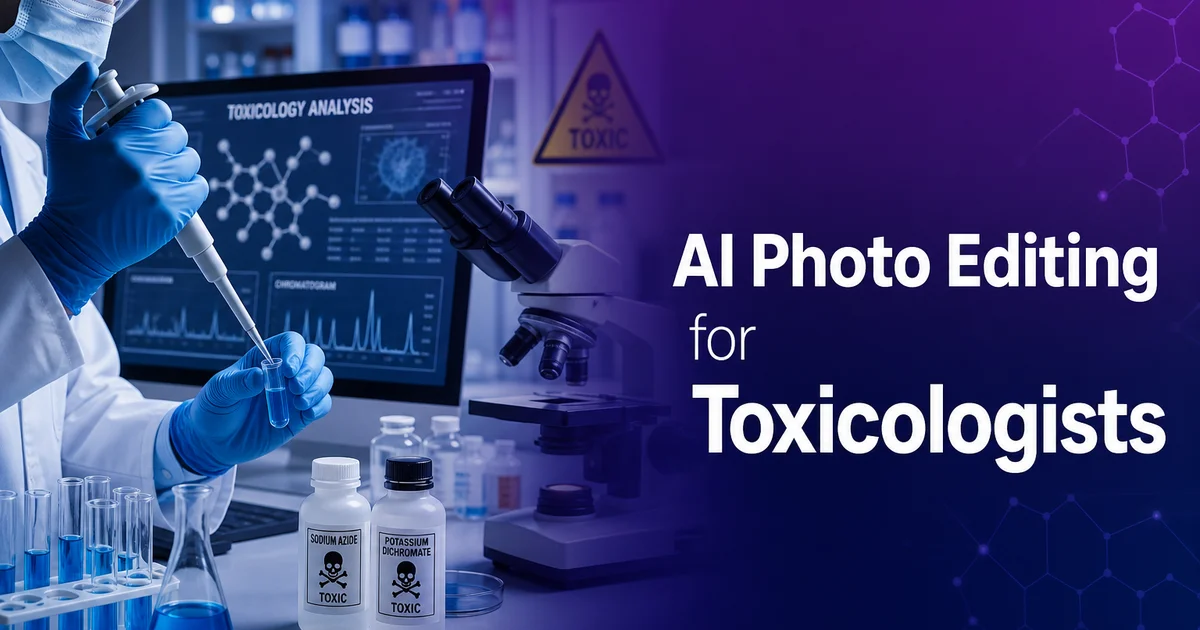
Toxicology — the study of the adverse effects of chemical, physical, and biological agents on living organisms — relies on photographic records at every stage of investigation, from documenting gross pathological findings at necropsy through recording histopathological changes under the microscope to presenting dose-response image series in regulatory submissions. Whether the context is pharmaceutical safety assessment, environmental toxicology, forensic death investigation, or clinical poisoning management, the ability to produce clear, standardized, and accurately color-rendered images is key for sharing findings to regulatory agencies, juries, peer reviewers, and clinical colleagues.
The photographic challenges in toxicology are driven by the field's dual scientific and legal character. Images must be scientifically accurate — faithfully representing the tissue morphology, staining traits, and pathological features as they appear under the microscope — while also meeting evidentiary standards for regulatory submissions and legal proceedings, where the chain of custody, realism, and standardization of photographic evidence may be scrutinized. Histopathological photomicrographs serve as primary evidence in pharmaceutical toxicity studies that determine whether a drug candidate progresses to human trials. In forensic cases, photographic records of tissue damage may influence criminal sentencing. The stakes demand both technical quality and documentary integrity.
AI photo editing tools address the post-processing challenges that toxicologists face without compromising the documentary realism of the images. Boost sharpens the morphological detail that communicates the nature and severity of toxic effects. Color normalization corrects the inevitable variation in staining intensity and microscope color temperature across multi-session imaging campaigns. Artifact removal eliminates preparation damage and laboratory clutter that obscure pathological findings. Critically, all these adjustments operate on the display quality of the image while keeping the underlying biological information, making genuine findings more visible without creating, enhancing, or altering pathological features that are not present in the original specimen.
- AI enhancement sharpens histopathological detail — cellular changes, inflammatory infiltrates, necrosis, fibrosis — that communicates the nature and severity of toxicological effects.
- Color normalization across staining batches and microscopes ensures dose-dependent tissue changes reflect genuine toxicological effects rather than staining or photographic artifacts.
- Artifact removal eliminates mounting bubbles, section folds, coverslip debris, and bench clutter without altering the biological features that carry diagnostic information.
- Batch processing standardizes photomicrographs from multi-organ, multi-dose study protocols into visually consistent regulatory submission packages.
- Dose-response figure plates arrange control and treated tissue images at identical magnification and color balance to demonstrate toxicological progression clearly.
Histopathological photomicrography and dose-dependent finding documentation
The core visual records challenge in regulatory toxicology is showing dose-dependent changes across treatment groups. A typical nonclinical toxicity study examines dozens of tissues from animals in control, low-dose, mid-dose, and high-dose groups, and the pathologist must document the findings with photomicrographs that clearly show the progression from normal morphology through minimal, mild, moderate, and marked severity grades. The photographic challenge is that many toxicologically major changes are subtle. Early hepatocyte hypertrophy may manifest as a modest increase in cell size barely distinguishable from normal variation, minimal tubular basophilia in the kidney may involve a slight color shift in a small population of cells, and early fibrosis appears as delicate strands of collagen that are difficult to distinguish from normal stromal architecture at low magnification.
AI boost increases the visibility of these subtle dose-dependent changes by sharpening cellular boundaries, increasing local contrast between affected and normal tissue regions, and accentuating the staining differences that pathologists use to grade lesion severity. For hepatocyte hypertrophy, boost sharpens cell membrane boundaries to make the size comparison between treated and control hepatocytes more apparent in the photomicrograph. For tubular basophilia, boost increases the color contrast between the basophilic (blue-staining) tubules and the normal eosinophilic (pink-staining) adjacent tissue. For early fibrosis, boost brings out the reticular collagen network that Masson's trichrome stain colors blue against the red muscle and pink cytoplasm background.
The dose-response comparison need means that images from different treatment groups must be photographically comparable. When the pathologist presents a figure plate with control, low-, mid-, and high-dose images side by side, the viewer must be able to attribute any visible differences to genuine biological effects rather than photographic variables. AI batch normalization ensures that the illumination intensity, color temperature, exposure level, and white balance are identical across all images in the comparison set, removing the photographic variables that could confound the visual assessment of dose-dependent toxicological progression.
- Dose-dependent change documentation requires distinguishing subtle morphological differences — early hypertrophy, minimal basophilia, delicate fibrosis — from normal anatomical variation.
- AI enhancement sharpens cell boundaries, increases stain-specific color contrast, and accentuates the tissue differences that pathologists use to grade lesion severity.
- Batch normalization ensures illumination, color temperature, and exposure are identical across treatment group comparison sets, removing photographic confounds from dose-response assessment.
- Regulatory figure plates presenting side-by-side treatment group comparisons require pixel-level consistency so visual differences reflect genuine biological effects only.
Forensic toxicology and evidentiary image standards
Forensic toxicologists document their findings for legal proceedings where photographic evidence may be challenged by opposing counsel, scrutinized by expert witnesses, and presented to jurors who are not trained in toxicological pathology. The images must be at once scientifically accurate, legally defensible, and comprehensible to lay audiences. Gross pathology photographs from forensic autopsies document external findings (skin discoloration, injection marks, chemical burns), internal organ appearances (hepatic congestion, pulmonary edema, gastric mucosal damage), and the collection of specimens for analytical testing. These images become part of the permanent case file and may be presented in court years after the original examination.
AI photo editing in the forensic toxicology context operates under strict constraints that distinguish it from other scientific imaging applications. Enhancement of existing features — sharpening the boundary of a skin lesion, increasing the contrast between congested and normal liver tissue, or clarifying the morphology of a gastric ulceration — is appropriate because it improves the visibility of features that genuinely exist in the specimen. However, any processing that could be construed as creating, adding, or substantially altering features could compromise the evidentiary value of the image. Forensic toxicologists using AI tools must maintain complete processing logs documenting every adjustment applied, and the unprocessed original images must be preserved alongside the enhanced versions in the case file.
Background removal serves a specific function in forensic toxicology displays: isolating pathological findings from the visually unwanted and possibly distressing context of the autopsy suite. Court displays of toxicological findings benefit from clean, focused images where the relevant finding (a specific organ abnormality, injection site, or tissue change) is clearly visible against a neutral background rather than surrounded by the steel autopsy table, other organs, and surgical instrumentation. This clinical display approach helps jurors focus on the scientific evidence while reducing the emotional distraction of the autopsy setting. Magic Eraser handles this isolation while maintaining the feature integrity that legal defensibility requires.
- Forensic toxicology images must be simultaneously scientifically accurate, legally defensible, and comprehensible to lay audiences including jurors and non-specialist attorneys.
- Enhancement of existing features is appropriate; any processing that could create or substantially alter features compromises evidentiary value and legal defensibility.
- Complete processing logs and preserved unprocessed originals are mandatory for forensic applications to maintain chain-of-evidence integrity.
- Background removal isolates pathological findings from the autopsy environment, helping courtroom audiences focus on scientific evidence rather than visually distressing context.
Environmental and ecological toxicology field documentation
Environmental toxicologists investigating contamination events, ecological damage assessments, and wildlife toxicosis outbreaks work in field conditions where photographic quality is limited by weather, terrain, lighting, and the urgency of the investigation. Documenting a fish kill along a contaminated waterway, a vegetation die-off downwind of an industrial emission source, or abnormal development in amphibian populations near an agricultural operation requires photographs taken rapidly in variable outdoor conditions with whatever camera equipment is available. These field photographs become critical evidence in regulatory enforcement actions, environmental litigation, and ecological damage assessments where the financial stakes may reach millions of dollars.
AI post-processing transforms variable-quality field records into consistent, clear image sets suitable for expert reports and legal proceedings. Color correction normalizes images taken under overcast, direct sun, and mixed lighting conditions into a consistent photographic record. Boost brings out the morphological details of environmental toxicity. Gill damage in fish, shell thinning in bird eggs, limb deformities in amphibians, chlorosis patterns in vegetation — that may be photographically subtle in rapidly captured field images. Background cleanup removes the visual clutter of the field setting to focus attention on the specific biological damage being documented.
Ecotoxicological dose-response records often compare organisms or tissues from contaminated sites with reference populations from clean control sites photographed during separate field visits under different conditions. The same AI normalization tools used for laboratory dose-response photomicrographs apply to field ecological records. Batch processing ensures that organisms from contaminated and reference sites are photographed with identical color rendering, exposure, and contrast so that visible differences reflect genuine toxicological effects rather than differences in field photography conditions. This photographic consistency strengthens the evidentiary weight of comparative ecological assessments in regulatory and legal contexts.
- Field documentation of contamination events occurs under variable conditions — weather, lighting, urgency — producing inconsistent images that serve as critical evidence in enforcement actions.
- AI color correction normalizes field photographs taken under diverse outdoor lighting into consistent records suitable for expert reports and litigation.
- Enhancement recovers morphological toxicity indicators — gill damage, shell thinning, limb deformities, vegetation chlorosis — from rapidly captured field images.
- Batch normalization ensures contaminated-site and reference-site organism photographs are visually comparable, strengthening comparative ecological assessments.
In vitro assay documentation and high-content screening image management
Modern toxicology increasingly relies on in vitro assay systems — cell cultures, organoids, organ-on-chip devices, and high-content screening plates — that generate enormous volumes of photographic data requiring consistent processing for quantitative analysis. A single high-content screening campaign testing a chemical library for cytotoxicity might generate tens of thousands of fluorescence microscopy images across multiple cell lines, exposure concentrations, and time points. While automated image analysis software performs the primary quantitative assessment, the toxicologist must review representative images visually to verify that the automated results reflect genuine biological responses rather than imaging artifacts.
AI boost assists this quality control review by sharpening the cellular features that indicate toxicity. Nuclear morphology changes (condensation, fragmentation, enlargement), cytoplasmic vacuolation, membrane blebbing, and changes in the spatial distribution of fluorescent markers for organelle integrity. In plate-based screening, well-to-well variation in illumination intensity, focus quality, and background fluorescence can obscure genuine toxicological signals at screening concentrations. AI normalization across a plate image set reduces this technical variation, making it easier to distinguish genuine dose-dependent cytotoxicity from imaging noise in the rapid visual review that complements automated analysis.
Organoid and organ-on-chip toxicology models generate especially challenging photographic records because these three-dimensional culture systems require imaging through multiple focal planes, producing z-stack image sets that must be projected or sectioned for two-dimensional display. AI processing helps select and enhance the most informative focal planes from these z-stacks, producing representative images that clearly show the toxicological effects. Organoid structural disruption, barrier integrity loss in organ-on-chip models, or changes in tissue-like architecture — while managing the depth-of-field limitations inherent in three-dimensional culture imaging. The resulting images communicate complex three-dimensional toxicological effects in the two-dimensional format required for publications and regulatory submissions.
- High-content screening generates tens of thousands of images per campaign — AI enhancement supports quality control review by sharpening indicators of cellular toxicity responses.
- Plate-based well-to-well normalization reduces illumination and focus variation, distinguishing genuine dose-dependent cytotoxicity from technical imaging noise.
- Organoid and organ-on-chip z-stack processing selects and enhances the most informative focal planes for clear two-dimensional presentation of three-dimensional toxicological effects.
- AI-processed representative images from automated screening campaigns communicate complex toxicological findings to regulatory reviewers who assess them alongside quantitative data.
How to do it
- 1
Photograph tissue samples and test results with standardized microscopy and imaging setups
Establish a photography protocol appropriate to the toxicological analysis being documented. Histopathological examination requires photomicrography through calibrated microscopes with consistent Koehler illumination, color temperature, and exposure settings. In vivo toxicity study records need standardized gross pathology photography with consistent backgrounds, lighting, and specimen positioning. Analytical chemistry results — chromatograms, spectra, and plate images — require screen captures or direct instrument exports at native resolution. Include magnification scales, color calibration cards, and specimen orientation markers in every frame.
- 2
Remove visual distractions and isolate toxicological findings
Use Background Eraser and Magic Eraser to isolate the toxicologically relevant features from their photographic context. Remove dissection board surfaces, glove-covered hands holding specimens, surgical instruments, and bench clutter from gross pathology photographs. In photomicrographs, eliminate mounting medium bubbles, coverslip debris, section folds, and staining artifacts that distract from the histopathological finding being documented. For analytical images, remove instrument interface elements, watermarks, and adjacent data panels that are not relevant to the specific result being presented.
- 3
Enhance tissue detail and pathological findings for clear documentation
Use AI Enhance to sharpen the histological features that show toxicological effects. Cellular vacuolation, nuclear changes, inflammatory infiltrates, fibrosis, necrosis, and neoplastic change. Boost increases the visibility of subtle dose-dependent changes that may be diagnostically critical but photographically inconspicuous, such as early hepatocyte hypertrophy, minimal tubular basophilia in kidney, or slight increases in mitotic figures. For gross pathology, boost brings out surface texture, color variations, and lesion boundaries that communicate the nature and extent of toxic injury.
- 4
Standardize color across study documentation for consistent pathological assessment
Use batch color correction to normalize photomicrographs taken across different microscopes, staining batches and imaging sessions into a visually consistent study record. H&E stain color varies between batches and laboratories. These variations can affect the perceived severity of findings when images from different study time points are compared side by side. Consistent color rendering ensures that dose-dependent changes in tissue look reflect genuine toxicological effects rather than staining or photographic artifacts, supporting accurate pathological assessment in regulatory submissions.
- 5
Prepare regulatory-compliant figure plates and study report images
Assemble standardized images into figure plates suitable for regulatory toxicology study reports, peer-reviewed publications, and expert testimony materials. Arrange dose-response image series showing control tissue alongside low-, mid-, and high-dose groups at identical magnification and color balance to show dose-dependent progression of toxicological findings. Export at resolution meeting regulatory agency requirements for electronic submission while maintaining file sizes appropriate for large study reports that may contain hundreds of photomicrographs documenting findings across multiple organs and dose groups.
Sources
- Photomicrography Standards in Toxicologic Pathology: Best Practice Guidelines — Toxicologic Pathology — Society of Toxicologic Pathology
- Image Documentation in Forensic Toxicology Case Reports — The International Association of Forensic Toxicologists
- Regulatory Submission Standards for Nonclinical Study Photomicrographs — U.S. Food and Drug Administration — Center for Drug Evaluation and Research