
AI Photo Editing for Sphragists — Magic Eraser
How sphragists and sigillographers use AI photo editing for seal records, wax impression photography, and scholarly publication. Enhance inscriptions, clean backgrounds, and prepare comparative plates.

Product Marketing
Reviewed by Magic Eraser Editorial ·
Table of Contents
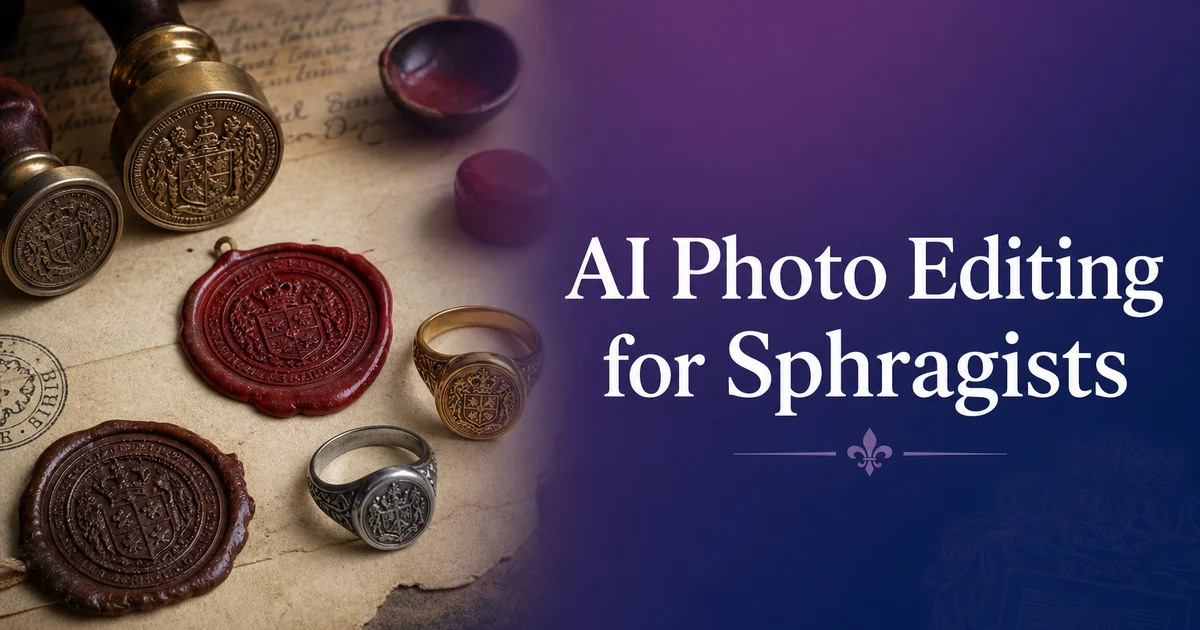
Sphragistics — the scholarly study of seals and seal impressions — relies on photography as the primary record for documenting, analyzing, and publishing the thousands of medieval and early modern seals preserved in archives, museums, and private collections worldwide. Every seal matrix and every wax, lead, or paper impression carries iconographic, heraldic, and textual information that serves as primary historical evidence for legal transactions, administrative authority, personal identity, and institutional relationships. The quality of the photographic record directly determines how much of this evidence scholars can use, because the original objects are often too fragile, too geographically dispersed, or too restricted in access for researchers to examine every seal in person.
The challenge for sphragists is that seals are among the most photographically demanding objects in material culture studies. Their information is carried in three-dimensional surface relief. Carved intaglio on the matrix, raised impression in the wax — that must be translated into two-dimensional photographs without losing the depth information that distinguishes a letter from a mere line, a heraldic charge from a shapeless lump, or a legible inscription from an illegible one. Lighting angle, image resolution, background treatment, and post-processing all critically affect whether a seal photograph serves as a useful scholarly document or merely proves that the seal exists.
AI photo editing tools address the specific challenges of sigillographic photography by enhancing the relief details that carry scholarly information, removing visual clutter from museum mounts and archival labels, and creating consistent display standards across images photographed under very different institutional conditions. For sphragists working with collections spread across dozens of archives and libraries, each with different photography policies, lighting conditions, and equipment access, AI post-processing provides a practical path to publication-quality imagery that would otherwise require expensive expert studio setups at every collection visited.
- AI Enhance recovers inscription text and heraldic detail from wax impressions degraded by centuries of handling, compression, and environmental exposure.
- Background Eraser creates clean scholarly presentation by isolating seals from museum mounts, display cases, and photographing surfaces.
- Magic Eraser removes accession labels, mounting hardware, and conservation materials that distract from seal iconography in publication plates.
- Consistent post-processing across images from different archives creates uniform comparative plates despite vastly different original photography conditions.
- Non-contact photographic enhancement reduces the need for physical handling of fragile wax impressions, supporting conservation goals alongside scholarly documentation.
Why photographic quality determines scholarly value in sphragistics
In sphragistic research, the photograph is not an illustration of the argument — it is the argument. When a sigillographer proposes that two seal impressions were made from the same matrix, the evidence is the photographic comparison showing identical iconographic details, matching inscription letter forms, and corresponding damage patterns. When a researcher attributes a seal to a specific workshop based on stylistic analysis, the evidence is the photograph revealing the distinctive carving technique, composition preferences. Heraldic conventions that characterize that workshop's production. Poor photography that obscures these details does not merely weaken the argument. It prevents the argument from being made at all, because the evidence cannot be presented to the scholarly community for verification.
The International Committee of Sigillography has established records standards that call for high-resolution imagery captured under controlled lighting with calibrated color reproduction and standardized scale references. These standards exist because sigillographic analysis operates at the intersection of art history, paleography, heraldry. Legal history, with each discipline requiring different information from the same seal image. Art historians need to see carving technique and compositional style. Paleographers need to read inscription letter forms. Heraldists need to identify charges and tinctures. Legal historians need to verify the seal's authority indicators. A single photograph must serve all these analytical purposes at once.
Digital seal databases — the Sigillum project, the Archives nationales' SIGILLA database, the British Museum's seal collection — have raised the visibility of sigillographic photography by making thousands of seal images publicly accessible online. This democratization of access has increased scholarly productivity enormously. It has also exposed the quality gap between seals photographed with expert equipment under optimal conditions and those captured hastily with available light during brief archive visits. AI boost helps bridge this gap by recovering detail from suboptimal photographs, making viable scholarly images from source material that would otherwise be useful only as existence records.
- Sigillographic photographs are primary evidence — workshop attribution, matrix identification, and inscription reading all depend on image quality that reveals carved and impressed detail.
- International records standards require imagery serving multiple disciplines at once: art history, paleography, heraldry. Legal history each extract different information from the same seal.
- Digital seal databases have exposed the quality gap between professional studio photographs and hastily captured archive visit images that AI enhancement can help bridge.
- Poor photography does not merely weaken scholarly arguments — it prevents them from being made at all by rendering the evidence unpresentable for peer verification.
Lighting challenges and AI solutions for three-dimensional relief documentation
The fundamental photographic challenge in sphragistics is translating three-dimensional relief into a two-dimensional image that preserves depth information. A seal matrix is carved in intaglio. The design is cut into the metal surface so that when pressed into warm wax, the impression rises in relief. Both the matrix and the impression carry their information in surface height variation: letters are raised ridges, heraldic charges are shaped plateaus, decorative borders are stepped profiles. Flat overhead lighting — the default in most photography scenarios — suppresses this height information by illuminating the surface uniformly, making raised and recessed areas appear similar in brightness. The result is a photograph where the seal looks like a flat disk with vague markings rather than a three-dimensional document with legible text and identifiable imagery.
Raking light solves this problem by casting shadows from the relief elements, making their three-dimensional structure visible in the two-dimensional photograph. But achieving optimal raking light in archive and museum settings is often impractical. Available lighting may be fixed overhead fluorescent, photography may be restricted to a reading room without adjustable lighting equipment, or time constraints during a research visit may limit the photographer to whatever conditions exist. AI boost compensates by analyzing the subtle shadow and highlight variations present even in flat-lit photographs and amplifying them to reveal the relief structure that the original lighting conditions suppressed.
The AI approach is mainly valuable for damaged and degraded wax impressions where physical relief has been partially lost through compression, breakage, or environmental exposure. A wax seal that has been stored under weight for centuries may be partially flattened, reducing the original bold relief to subtle surface undulations that are invisible under flat lighting. AI Enhance can detect and amplify these faint relief traces, recovering inscription fragments and iconographic details that would require sophisticated photogrammetric equipment to document by traditional optical means. This capability transforms routine collection photographs into scholarly resources without requiring the specialized raking-light setups that were before the only way to document degraded impressions.
- Three-dimensional relief information in seals is suppressed by flat overhead lighting that makes raised and recessed areas appear uniformly bright in photographs.
- Raking light reveals relief through shadow casting but is often impractical in archives and museums with fixed lighting and restricted photography conditions.
- AI enhancement amplifies subtle shadow and highlight variations from suboptimal lighting to reveal the relief structure that the original photography conditions suppressed.
- Partially flattened wax impressions with reduced relief can yield readable inscriptions through AI enhancement without specialized photogrammetric equipment.
Background removal and consistent presentation for comparative sigillographic plates
Comparative analysis is the core method of sphragistic research. Researchers compare seals across collections, time periods, and geographic regions to establish workshop provenance, trace administrative relationships, and document the evolution of heraldic and iconographic conventions. This comparative work requires consistent visual display: when six seal impressions are placed side by side on a publication plate, differences in background color, lighting direction. Image framing must not distract from the substantive differences in the seals themselves. Every visual inconsistency between photographs introduces a potential false signal that the analyst must consciously discount, reducing the efficiency and reliability of the comparison.
Background Eraser addresses this by isolating each seal from its photographing setting. Whether that was a museum display mount with fabric backing, an archival reading room table, a glass display case with reflections, or a makeshift photography surface in a church archive. Once isolated, all seals in a comparative set can be placed on an identical neutral background at standardized scale, creating the visual consistency that comparative analysis requires. This is not merely a cosmetic improvement. It is a methodological need for rigorous sphragistic scholarship, analogous to the standardized scales and color charts used in archaeological photography.
Magic Eraser contributes to clean display by removing the modern additions that accumulate on seal photographs taken in collection settings. Typed or handwritten accession numbers on adhesive labels, thin cotton ties securing seals to their parent documents, tissue paper conservation overlays partially covering the impression, pencil annotations on the wax surface made by earlier researchers, and reference scale rulers placed in the frame. These elements are key for collection management records but irrelevant and unwanted in scholarly publication. Removing them creates images that present the medieval or early modern artifact without the visual interference of its modern curatorial context.
- Comparative sigillographic analysis requires consistent visual presentation — background and lighting differences between photographs introduce false signals that compromise comparison reliability.
- Background Eraser isolates seals from varied photographing environments to create standardized plates where only the substantive seal differences remain visible.
- Magic Eraser removes accession labels, cotton ties, tissue overlays, and pencil annotations that serve collection management but distract from scholarly analysis.
- Consistent post-processing is a methodological requirement for rigorous sphragistic research, not merely a cosmetic preference for publication aesthetics.
Scaling sigillographic documentation across dispersed collections
A typical sigillographic research project involves examining seals in multiple institutions. National archives, cathedral chapter archives, municipal repositories, university libraries, and private collections — each with different photography policies, equipment availability, and access conditions. A researcher studying the seals of a thirteenth-century English episcopal chancery might need to photograph impressions in the National Archives at Kew, the British Library, Canterbury Cathedral Archives, the Bodleian Library at Oxford. Several county record offices, all within the time and budget constraints of a research grant. The resulting photographs in time vary in quality, lighting, background, color accuracy. Resolution despite the researcher's best efforts at consistency.
AI batch processing normalizes these heterogeneous photograph sets into consistent publication-quality imagery. Background removal eliminates the different surfaces and mounts. Boost brings detail quality to a uniform standard regardless of original lighting conditions. Color correction neutralizes the different color casts from fluorescent, tungsten, and daylight sources in different reading rooms. The result is a corpus of seal images that appears to have been photographed under identical studio conditions even though the originals were captured over months of travel across dozens of institutions. A practical necessity for publishing comparative catalogs that may include hundreds of seal images.
For digital humanities projects building full seal databases, AI processing at scale transforms the economics of sigillographic records. The traditional approach required either expert photographers visiting each collection. Expensive and slow — or accepting highly variable image quality from research photographs taken under field conditions. AI post-processing offers a middle path: researchers capture the best images they can under available conditions. Batch AI boost brings the entire set to a publishable standard. This approach has made viable the large-scale digitization projects that are transforming sphragistic research from a discipline dependent on physical archive visits to one with growing online access to comparative material.
- Research projects spanning multiple archives produce heterogeneous photograph sets that AI batch processing normalizes into consistent publication-quality imagery.
- Background removal, detail enhancement, and color correction eliminate the visual inconsistencies from different institutions' photography conditions and equipment.
- AI processing transforms the economics of large-scale seal documentation by making field-condition photographs viable for publication without professional studio reshoots.
- Digital humanities seal databases benefit from batch AI enhancement that enables comprehensive online access to comparative material previously requiring physical archive visits.
How to do it
- 1
Photograph seals and impressions under controlled raking light to reveal surface relief
Set up a photography station with adjustable directional lighting positioned at a low angle to the seal surface. Raking light — light directed nearly parallel to the surface — reveals the three-dimensional relief of carved seal matrices and wax impressions that flat overhead lighting suppresses. Capture each seal from directly above using a copy stand or tripod to maintain consistent framing and eliminate perspective distortion that compromises measurement accuracy in scholarly records.
- 2
Remove background clutter to isolate the seal for scholarly presentation
Use Background Eraser to isolate the seal or impression from the photographing surface, storage mount, or museum display case. Sphragistic publications require clean display that focuses viewer attention on the seal's iconography, legend text, and heraldic devices. A neutral background eliminates visual competition and creates consistency across comparative plates showing multiple seals from different collections photographed under different conditions.
- 3
Enhance fine detail to make legend text and heraldic devices legible
Use AI Enhance to sharpen the carved or impressed details that carry the seal's scholarly information. The Latin or vernacular inscription running around the legend border, the heraldic charges within the central field, personal devices or ecclesiastical symbols, and any counterseals on the reverse. Wax impressions degrade over centuries, and enhanced photography that recovers faded details can make partially legible inscriptions readable without physical contact that risks further damage.
- 4
Remove modern labels, mounting hardware, and conservation materials from documentary images
Use Magic Eraser to remove accession number labels, archival mounting tabs, conservation tissue overlays. Reference rulers that appear in raw collection photographs but distract from the seal image in publication plates. Preserve a separate unedited archival image for collection records while creating a clean display version for scholarly articles, catalogs, and digital humanities databases.
- 5
Prepare consistent image sets for comparative sigillographic analysis and publication
Export edited seal photographs at standardized dimensions and resolution for publication in sigillographic catalogs, journal articles, and digital seal databases. Consistent background color, lighting quality, and image framing across all seals in a comparative set allows readers to evaluate iconographic relationships, stylistic development, and workshop attribution without visual inconsistencies introducing false differences between specimens.
Sources
- Sigillography: The Study of Seals as Historical Evidence — Medieval Academy of America
- Digital Imaging Standards for Cultural Heritage Documentation — Federal Agencies Digital Guidelines Initiative
- Photographic Documentation of Museum Collections: Best Practices — American Alliance of Museums