
AI Cave Photography Editing for Speleologists — Magic Eraser
How speleologists use AI cave photography editing for field records, geological survey images, and subterranean research publications. Enhance formation detail, correct mixed cave lighting, remove survey gear, and create publication-ready imagery.
SEO & Growth
Reviewed by Magic Eraser Editorial ·
Table of Contents
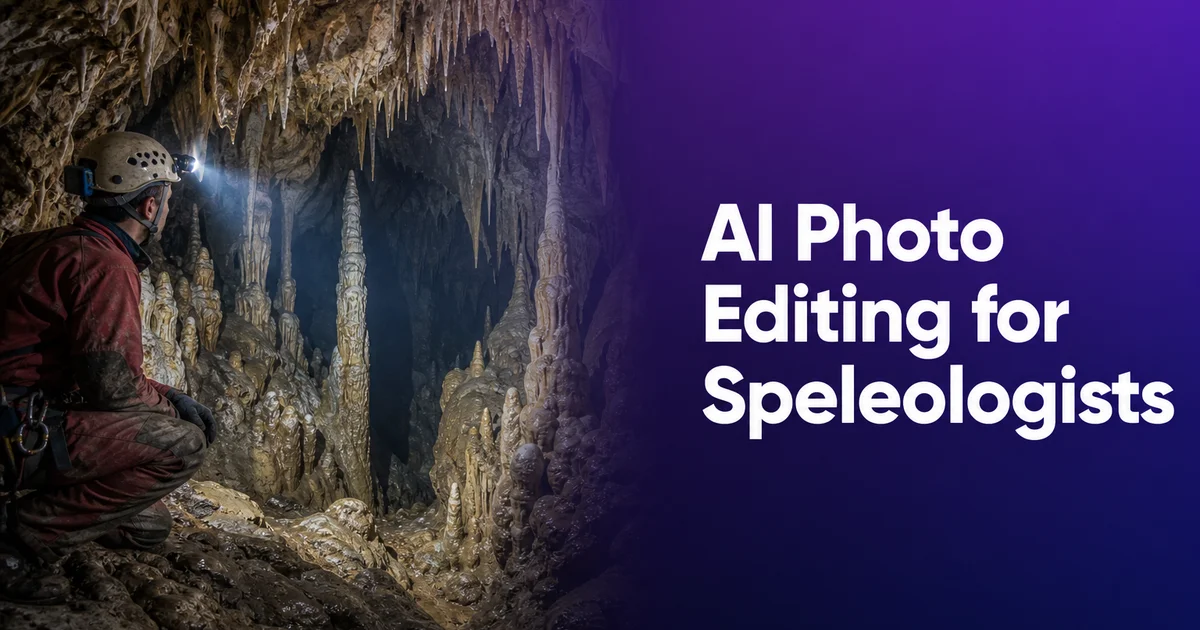
Speleology — the scientific study of caves, their formation, physical properties, geology, biology. Human history — depends on photographic records more than almost any other field science. Caves cannot be brought to the laboratory. Their formations develop over millennia and cannot be reproduced experimentally. Many caves are fragile settings where repeated human visits cause measurable degradation, making full photographic records during limited survey visits key for ongoing research without continued physical disturbance. From the crystallographic structure of a helictite cluster to the broad architecture of a cathedral-sized chamber, photography is the primary medium through which speleological observations are recorded, communicated, and preserved.
Cave photography is among the most technically demanding forms of scientific records. The total absence of natural light means every photon in the image must come from equipment the photographer carries into the cave. The extreme contrast between illuminated formations and surrounding absolute darkness exceeds the dynamic range of most camera sensors. Humidity levels near or at one hundred percent fog lenses within minutes. Surfaces range from brilliant white calcite to light-absorbing black manganese oxide coatings, often within the same frame. Cave formations are three-dimensional, complex, and fragile. The photographer cannot rearrange the subject, cannot add a backdrop, and in many cases cannot even reposition to find a better angle because passage geometry dictates the only available camera positions.
AI photo editing tools offer speleologists practical solutions to these persistent records challenges. Boost algorithms recover formation detail from the extreme dynamic range of cave exposures. Color correction normalizes the mixed-source lighting that is unavoidable when illuminating large formations with multiple portable light sources. Object removal cleanly eliminates lighting equipment, cables, and human artifacts from images without disturbing the geological features. For speleologists producing survey reports, journal publications, conservation assessments. Educational materials, AI-assisted image processing transforms the raw captures from challenging underground conditions into clear, accurate records of some of Earth's most remarkable hidden settings.
- AI enhancement recovers formation detail from extreme-contrast cave exposures where illuminated features and total darkness coexist in the same frame.
- Color correction normalizes mixed lighting from LED panels, flash units, and headlamps that create inconsistent color casts across cave formations.
- Magic Eraser removes lighting equipment, cables, reflective gear, and team artifacts from images without disturbing geological features.
- Detail enhancement reveals growth banding, crystal structure, mineral coloration, and micro-features invisible in raw low-light cave captures.
- Publication-ready exports at 300 DPI meet journal standards for geological survey reports, conservation assessments, and speleological monographs.
Mastering the extreme lighting challenges of underground photography
The fundamental obstacle in cave photography is that caves are dark. Not dim, not shadowy, but completely devoid of light in all zones beyond the entrance twilight area. This means the photographer must create the entire lighting setting from portable equipment. The result is always a compromise between coverage, color accuracy, equipment weight, and the time available in the cave. A large chamber that would require dozens of studio lights for even illumination must be photographed with perhaps three or four portable flash units or LED panels. The standard technique — painting with light during a long exposure — involves setting the camera to a multi-second or multi-minute exposure and manually firing flash units from different positions, walking through the cave to illuminate sections sequentially. This produces dramatic images but creates challenges: uneven illumination, color temperature shifts between light positions. Shadow patterns that depend on the photographer's movement path.
AI boost specifically addresses the dynamic range problem that plagues cave photography. A typical cave image contains formations lit to near-white brightness adjacent to areas of absolute black where no light reached. This range exceeds what even the best camera sensors can capture in a single exposure, resulting in images with either blown-out highlights on lit formations or crushed shadows where unilluminated areas are rendered as featureless black. AI boost recovers detail at both extremes. Pulling texture and color back from highlight-clipped formations and revealing structural detail in deeply shadowed passages. This dynamic range recovery well gives the speleologist a multi-exposure HDR result from a single capture. Is critical in situations where only one exposure opportunity exists.
Color management in cave photography is complicated by the fact that different artificial light sources produce different color temperatures. LED panels often emit cool, slightly blue-white light. Xenon flash units produce daylight-balanced light. Older carbide lamps and some warm LED headlamps produce strongly warm, yellow-orange light. When these sources illuminate different sections of the same formation during a light-painting exposure, the resulting image shows color shifts across the formation that do not reflect real mineral coloration. AI color normalization identifies these artificial color zones and neutralizes them, revealing the true mineral colors of the cave. The iron reds, calcite whites, manganese blacks, and copper greens that carry geological information about the formation history.
- Light painting with portable flash creates dramatic coverage of large chambers but produces uneven illumination and color temperature inconsistencies.
- AI dynamic range recovery extracts formation detail from both blown highlights and crushed shadows in extreme-contrast single-exposure cave captures.
- Mixed-source color casts from LEDs, xenon flash, and headlamps mask genuine mineral coloration that carries geological information about formation history.
- Humidity at near one hundred percent fogs lenses within minutes — rapid shooting followed by AI post-processing compensates for degraded image quality.
Documenting speleothems and geological formations with enhanced detail
Speleothems — the mineral deposits formed by water in caves — are the primary objects of speleological photographic records. Stalactites, stalagmites, flowstone, draperies, rimstone pools, cave pearls, helictites. Gypsum flowers each present specific photographic challenges related to their size, shape, translucency, and surface texture. Stalactites and stalagmites require side lighting to reveal their cylindrical form and surface texture. Many are clustered in tight groups where positioning a light between formations is physically impossible. Flowstone requires backlighting or transmitted light to show the internal banding that records thousands of years of deposition history. Helictites — tiny, gravity-defying crystal formations that grow in seemingly random directions — demand macro photography in humid, confined spaces where tripod placement is severely limited.
AI detail boost serves these records needs by maximizing the geological information extractable from images captured under the inevitable compromises of cave photography conditions. Growth banding in stalactite cross-sections reveals annual or seasonal deposition rates that are proxies for climate history. These bands may be fractions of a millimeter wide and require high-resolution, high-clarity imagery to count and measure. Crystal structure in gypsum flowers shows the growth direction and environmental conditions under which they formed. Mineral coloration variations — iron-rich red zones alternating with pure white calcite bands — indicate changes in the water chemistry over the formation's growth history. Each of these details carries scientific data. AI boost's ability to sharpen and clarify them directly increases the information value of every photograph.
Cave biology records presents extra photographic challenges. Many caves harbor unique ecosystems of cave-adapted organisms — troglobites — that are often pale, translucent, eyeless, and very small. Cave spiders, crickets, fish, salamanders, and invertebrates that have evolved in complete darkness for millions of years are frequently the subjects of speleological photography for biodiversity inventories and conservation assessments. These organisms are often found on dark substrates, move slowly but unpredictably, and cannot tolerate prolonged light exposure. AI boost recovers the morphological detail of these small, translucent organisms from the brief, carefully limited exposures that conservation-minded speleologists use to minimize disturbance to light-sensitive cave fauna.
- Growth banding in speleothem cross-sections records climate history — AI sharpening makes sub-millimeter bands countable for proxy data extraction.
- Gypsum flowers and helictites require macro documentation in humid, confined spaces where AI compensates for the inevitable quality compromises.
- Mineral coloration variations indicate water chemistry changes over centuries — accurate color reproduction after AI correction preserves this geological data.
- Cave-adapted organisms are pale, translucent, and light-sensitive — AI enhancement recovers morphological detail from brief, minimally disruptive exposures.
Removing survey equipment and human artifacts from cave documentation
Scientific cave photography frequently includes equipment that should not appear in final records images. Survey teams bring ropes, ladders, lighting rigs, survey stations with reflective markers, and personnel in high-visibility caving gear. All of which may be visible in photographs of the formations being documented. For journal publications, these artifacts must be removed because they distract from the geological subject and can introduce scale confusion. For conservation advocacy, images that show pristine cave settings without human intrusion are more effective at sharing the value of protection. For tourism and educational materials, clean images of formations without visible cables and equipment create a more strong display.
Magic Eraser handles cave artifact removal with particular effectiveness because the surrounding context. Cave walls, rock surfaces, formation textures — provides strong reference material for the AI to use when reconstructing the areas behind removed objects. A rope hanging in front of a stalactite can be removed with the AI filling in the stalactite texture behind it. A flash unit sitting on a ledge can be removed with the rock surface reconstructed seamlessly. Reflective survey markers on cave walls can be eliminated without disturbing the surrounding rock texture. The key advantage over manual Photoshop work is speed. A survey set of fifty images with equipment artifacts in each can be batch-processed in minutes rather than the hours that manual retouching would require.
One area requiring careful judgment is the removal of scale references. Geological rulers, known-size objects, and team members included for scale should generally remain in survey records images because scale is scientifically key. However, for publication or public-facing use, it is common practice to process two versions. One with scale references for the scientific record and one cleaned version for publication plates or educational materials. AI tools make this dual-version workflow efficient, producing both the annotated survey image and the clean display image from the same source capture with minimal extra effort.
- Ropes, lighting rigs, survey markers, and high-visibility gear all require removal from publication and conservation documentation images.
- Cave walls and formation textures provide strong context for AI reconstruction — artifact removal produces seamless results on rock and mineral surfaces.
- Batch processing fifty-image survey sets takes minutes versus hours of manual retouching for equipment artifact removal.
- Scale references should remain in survey documentation but can be removed for a separate clean version for publication and public-facing materials.
Conservation advocacy, public education, and cave survey publications
Cave conservation depends heavily on visual communication. Most people will never enter a wild cave. Their understanding of why caves deserve protection comes almost fully from photographs, films, and educational materials. The quality of these images directly affects their persuasive power. A properly enhanced photograph of a helictite formation. Tiny crystal structures that took tens of thousands of years to grow and can be destroyed by a single careless touch — shares the value and fragility of these settings more well than any written description. AI boost that brings out the delicate crystal structure, the translucent mineral quality. The sheer improbability of these formations strengthens every piece of conservation advocacy that uses those images.
Speleological survey reports and journal publications require standardized imagery that meets specific quality needs. The Union Internationale de Spéléologie and national speleological societies publish guidelines for cave survey photography that specify scale references, lighting standards, and image resolution needs. AI post-processing helps meet these standards always across large image sets from multi-day cave surveys where conditions varied between passages. Color normalization ensures that the same formation appears the same color across images taken with different lighting. Exposure normalization ensures that images from well-lit chambers and cramped, poorly lit crawlways achieve comparable brightness and detail levels in the final publication.
Educational materials for schools, museums, and nature centers benefit from cave photography that is both scientifically accurate and visually strong. The challenge is that raw cave photographs. With their extreme contrast, equipment clutter, and color cast issues — rarely share the wonder of cave settings to audiences unfamiliar with underground landscapes. AI-processed images that correct these technical issues while keeping the genuine geological features create visual materials that are at once scientifically defensible and aesthetically engaging. Museum displays, educational websites, and interpretive signage at show caves all benefit from imagery that makes the science accessible without sacrificing accuracy for visual appeal.
- Conservation advocacy depends on photographs that communicate the beauty and fragility of formations that most people will never see in person.
- Survey report standardization requires consistent color, exposure, and scale reference quality across multi-day image sets — AI batch processing delivers this.
- Educational materials need imagery that is both scientifically accurate and visually compelling — AI processing achieves both without sacrificing one for the other.
- Museum displays, interpretive signage, and educational websites all benefit from cave imagery that makes geological science accessible to general audiences.
How to do it
- 1
Photograph cave features with portable lighting and stabilization equipment
Cave photography operates in complete or near-complete darkness, making artificial lighting the sole light source. Set up portable LED panels or flash units at multiple positions to illuminate formations from angles that reveal three-dimensional structure. Side lighting for stalactites and stalagmites, backlighting for translucent flowstone, and direct lighting for wall textures and fossil impressions. Use a sturdy tripod on uneven cave floors and long exposures where possible to capture maximum detail. Include scale references — geological rulers, known-size carabiners, or team members — in records shots to establish feature dimensions.
- 2
Remove lighting equipment and human artifacts from scientific cave images
Use Magic Eraser to remove flash units, light stands, cables, headlamp beams, reflective gear. Other equipment visible in cave photographs. Speleological records images should show the cave setting as it naturally appears, without the visual intrusion of the survey team's equipment. This is mainly important for publication images, conservation reports. Environmental impact assessments where the pristine quality of the cave setting needs to be visually established.
- 3
Enhance geological formations and mineral detail in low-light captures
Use AI Enhance to recover formation detail from images captured in challenging cave lighting. The delicate banding patterns in flowstone cross-sections, the crystal structure of gypsum flowers and helictites, the layered growth rings in stalactites, and the subtle color variations in mineral deposits that indicate different geological periods. Cave photography frequently produces images with limited dynamic range due to the extreme contrast between illuminated formations and surrounding darkness. AI boost recovers detail in both highlight and shadow regions that single exposures struggle to capture.
- 4
Correct color casts from mixed artificial lighting sources
Cave photographers often use multiple light sources. LED panels, xenon flash units, carbide lamps, and headlamps — each with different color temperatures. This creates mixed color casts across the image where different light sources illuminate different areas of the formation. Use AI color correction to normalize these mixed-source color casts while keeping the genuine mineral colors of the formations. The iron-oxide reds and yellows of ochre deposits, the whites and creams of calcium carbonate formations, and the rare blues and greens of copper-bearing mineral deposits.
- 5
Prepare survey documentation and publication-ready cave imagery
Compile processed cave images into survey records packages with consistent exposure, color balance, and scale reference visibility. Export at 300 DPI for geological journal submissions and cave survey reports. For conservation advocacy and public education materials, prepare web-optimized versions that share the beauty and scientific importance of cave settings to audiences who may never visit a cave in person.
Sources
- Guidelines for Cave and Karst Photography in Scientific Documentation — National Speleological Society
- Photography Standards for Speleological Survey and Documentation — Union Internationale de Spéléologie
- Image Processing Techniques for Subterranean Geological Surveys — Geomorphology