
AI Photo Editing for Pest Control Companies: Documentation, Marketing, and Inspection Reports
How pest control businesses use AI photo editing for professional before/after documentation, inspection reports, customer-facing marketing, and technician training materials.

Product Marketing
Reviewed by Magic Eraser Editorial ·
Table of Contents
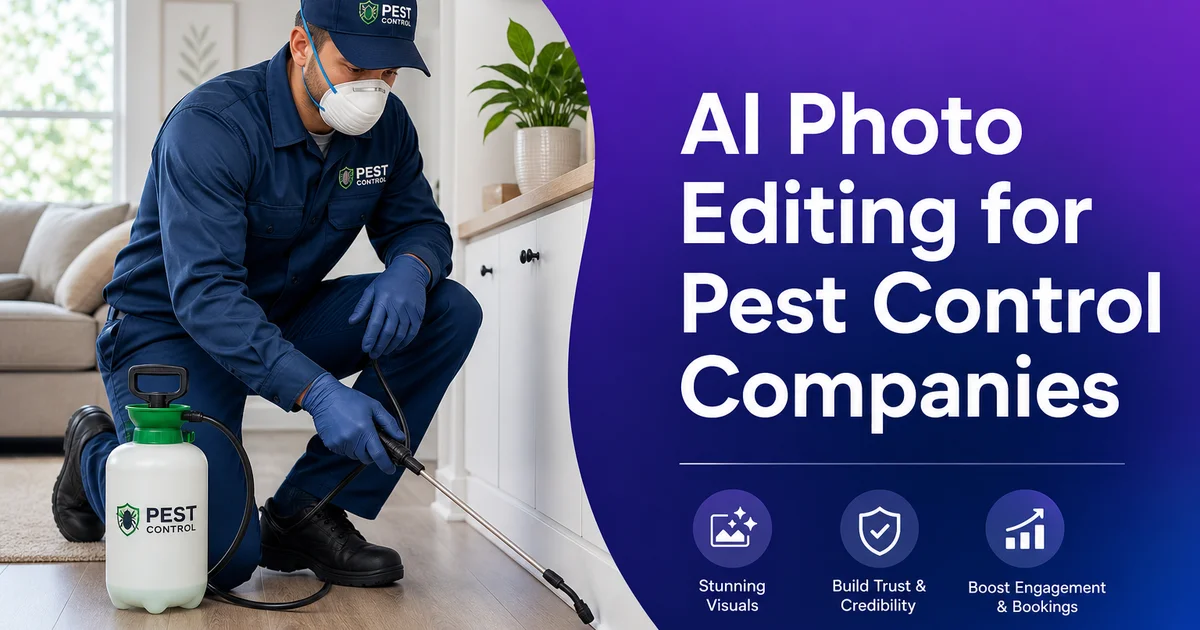
Pest control is a documentation-heavy business. Every job involves evidence that needs to be recorded. The droppings that confirm a rodent species, the frass that indicates active termite feeding, the entry points that explain how the pests are getting in. This documentation serves multiple purposes: it proves to the customer that the problem is real and justifies the treatment plan, it creates a record for regulatory compliance, it shows treatment effectiveness over time. It provides the before/after evidence that drives marketing for new customer acquisition.
The problem is that pest control documentation happens in the worst photographic conditions any service industry faces. You are photographing evidence in dark crawl spaces, unlit attics, behind appliances, inside wall cavities. Under structures where your phone camera's auto settings produce images that barely show what you found. The droppings are there, the damage is visible in person with a flashlight. The photo looks like a dark rectangle with vague shapes that could be anything. You know what it shows because you were there. Your customer, their property manager, or your marketing audience sees an unclear dark photo that shares nothing.
AI photo editing solves the documentation quality problem and the marketing privacy problem at once. AI Enhance recovers the detail in dark inspection photos so the evidence is as clear on screen as it was in person with a flashlight. Magic Eraser removes personal belongings, identifying information, and background clutter from customers' properties so you can use the photos for marketing without compromising anyone's privacy. Together, these tools turn the photos every technician already takes on every job into professional documentation and strong marketing content.
- Pest control documentation serves compliance, customer communication, marketing, and training purposes simultaneously.
- Inspection photos taken in dark crawl spaces and attics lose critical evidence detail that AI Enhance recovers.
- Magic Eraser removes customers' personal belongings and identifying information for privacy-safe marketing use.
- Before/after photo sequences demonstrate treatment effectiveness to customers and property managers over time.
- A single job's photos serve documentation, marketing, and training purposes with different editing levels applied.
Why documentation quality matters for pest control businesses
The pest control industry operates on trust. A customer calls because they found evidence of a problem. Droppings in a drawer, a flying insect they cannot identify, damage to a structure they think might be termites. The technician inspects, identifies the pest and the conditions supporting it, then recommends a treatment plan that might cost hundreds or thousands of dollars. The customer's decision hinges on whether they trust the diagnosis. Professional documentation photos that clearly show the evidence. The species-specific droppings, the trait damage patterns, the entry points — build that trust in a way that verbal explanations alone cannot.
Property management companies and commercial accounts amplify this documentation need. A property manager overseeing 50 rental units needs to see clear evidence before approving treatment expenditures. An insurance adjuster reviewing a termite damage claim needs photographic evidence that meets their documentation standards. A restaurant chain's facilities manager needs inspection reports with photos that show compliance with health codes. In every case, the photos need to clearly show what was found, where it was found, and what was done about it. Dark, grainy phone photos taken in a crawl space do not meet these standards even when they contain the right information.
Marketing compounds the documentation need further. The most effective marketing content for pest control companies is real documentation from real jobs. The before state showing the problem and the after state showing the resolution. Potential customers who see a termite-damaged floor joist alongside the repaired and treated result understand the service value right away. But marketing photos need higher visual quality than documentation photos, and they need personal information removed. AI editing bridges this gap by enhancing the visual quality and cleaning up the composition without altering the evidence itself.
- Customer trust and treatment plan approval depend on documentation that clearly shows pest evidence.
- Property managers, insurance adjusters, and facilities managers require photos meeting professional documentation standards.
- Dark, grainy inspection photos fail to communicate findings even when they contain the right information.
- Marketing reuse of documentation photos requires higher visual quality and privacy-safe composition.
Photographing in crawl spaces, attics, and other dark environments
The settings where pest evidence is found are the worst possible settings for phone photography. Crawl spaces are dark, confined, and dusty. Attics have extreme lighting contrast between the darkness of the space and the bright light coming through vents or gaps. Behind-appliance spaces are narrow and shadowed. Wall voids viewed through inspection ports are completely dark except for your flashlight. In every case, your phone camera makes exposure decisions that serve the overall scene rather than the evidence you need to document. The result is an image where the critical detail is lost in shadow or washed out by the flashlight's hot spot.
The best field technique is to use a separate LED light source rather than your phone's built-in flash. An LED panel or a flashlight held at an angle to the evidence creates shadows that reveal texture and dimension. The ridges in rodent gnaw marks, the galleries in termite-damaged wood, the texture of different droppings that helps identify the species. Your phone's flash, mounted right next to the lens, creates flat front-lighting that eliminates these shadows and makes everything look like a uniform surface. Even a cheap clip-on LED ring light greatly improves the raw photos before any editing.
Despite good field technique, many inspection photos will still need enhancement to be useful as documentation or marketing. The dynamic range of the scene — bright flashlight reflection next to deep shadow — exceeds what phone sensors can capture in a single exposure. AI Enhance processes these challenging exposures by recovering detail in both the shadow areas and the bright spots, producing an image where the evidence is visible across the entire frame. The termite damage in the dark corner of the floor joist becomes as visible as the damage in the lit center. The bright flashlight reflection no longer obscures the texture of the wood.
- Use angled LED lighting rather than phone flash to create texture-revealing shadows on pest evidence.
- Phone auto-exposure prioritizes scene brightness over evidence detail in high-contrast inspection environments.
- AI Enhance recovers detail in both shadow and highlight areas that exceed phone sensor dynamic range.
- Good field lighting technique combined with AI enhancement produces documentation-quality results from phone cameras.
Protecting customer privacy in marketing photos
Every pest control photo taken inside a customer's property contains elements that the customer did not consent to sharing publicly. Kitchen photos show food brands, medication bottles, personal items on counters. The general state of housekeeping that people consider private. Bedroom and bathroom areas are even more sensitive. Even exterior photos can reveal house numbers, vehicle license plates, and neighborhood details that identify the property. Using these photos for marketing without removing identifying and personal elements is both an ethical violation and a business risk. One customer recognizing their kitchen on your Facebook page can destroy the trust relationship your business depends on.
Magic Eraser makes privacy cleanup efficient enough to do on every marketable photo. Remove the family photos from the wall behind the sealed entry point. Erase the mail pile on the counter next to the treated kitchen area. Clean up the prescription bottles visible on the shelf above the bathroom where you found moisture damage. Remove the house number from the exterior shot showing your truck in the driveway. Each removal takes seconds, and the result is a photo that shows your work clearly without revealing anything about the customer's personal life, health, or property identity.
Establish a standard privacy checklist that every technician reviews before any job photo is used for marketing: faces, names, addresses, house numbers, license plates, personal photos, medical items, financial documents, children's identifying information. Anything that could be considered embarrassing about the customer's property condition. This is not just ethical practice. It is increasingly becoming a legal need as privacy regulations expand, and pest control companies that build privacy-safe photo practices now will not need to scramble when compliance becomes mandatory in their jurisdiction.
- Kitchen, bedroom, and bathroom pest control photos inevitably contain private customer information.
- Magic Eraser removes personal items, identifying details, and sensitive information in seconds per photo.
- One customer recognizing their property in marketing materials can destroy business trust and generate complaints.
- A standardized privacy checklist protects customers, reduces legal risk, and becomes a competitive differentiator.
Building marketing content from real service documentation
The strongest marketing content for pest control companies is real before/after documentation from actual jobs. Potential customers searching for pest control services are motivated by a problem they can see. The droppings in the pantry, the carpenter ant damage on the deck, the wasp nest under the eave. When they find your marketing showing the exact same type of problem being identified, treated, and resolved, the connection between their need and your capability is immediate. Stock photos of cartoon bugs and generic clean houses do not create this connection. Real evidence, real treatment, real results do.
The workflow for converting service documentation into marketing content adds two steps to the standard editing process. First, apply the privacy cleanup described above — remove every personal and identifying element. Second, apply extra background cleanup and boost to bring the photo to marketing-grade visual quality. The before photo should show the problem clearly without making the customer's property look gratuitously bad. The after photo should show the resolution clearly. Sealed entry points, installed monitoring stations, treated areas — with enough visual quality to look expert on your website and social media.
Organize your marketing photo library by pest type and service type. Termite damage and treatment photos go together. Rodent exclusion projects — entry point spotting, sealing, and follow-up confirmation — form a visual narrative. Bed bug treatment documentation shows the inspection, treatment, and clearance process. When a potential customer calls about termites, you can pull up your termite portfolio in seconds. When you bid on a commercial account, you present category-specific documentation that shows your experience with their exact pest pressures. This organized visual library becomes one of your most powerful sales tools over time.
- Real before/after documentation connects with potential customers' actual problems better than stock imagery.
- Marketing conversion adds privacy cleanup and enhanced visual quality to standard service documentation.
- Before photos show problems clearly without making properties look gratuitously bad.
- Organizing marketing photos by pest and service type creates a searchable portfolio for sales presentations.
How to do it
- 1
Photograph pest evidence and treatment areas before starting any work
Document the infestation evidence and treatment areas before you begin the job. Photograph entry points, droppings, damage to structures, nesting sites, and any visible pest activity. Shoot in the actual conditions you find. Do not move debris or clean areas before photographing, because the before state is your documentation of the problem's severity. Use your phone's flashlight or a portable LED to illuminate dark crawl spaces, attic corners. Behind-appliance areas where pest evidence is often found. Take wide establishing shots that show the room or area context, then close-up detail shots that show the specific evidence.
- 2
Capture after-treatment photos from the same angles and positions
After completing treatment, return to the exact positions where you took before photos and capture matching after shots. Consistency between before and after angles is what makes the documentation credible for customers, insurance adjusters, and property managers. Show sealed entry points, installed bait stations, applied treatments, and cleaned areas. For ongoing service accounts, this creates a visual timeline that tracks treatment effectiveness over multiple visits. The first visit shows heavy activity, the second shows reduced signs, and subsequent visits document maintained control.
- 3
Remove customer personal items and sensitive information with Magic Eraser
Pest control photos are taken inside customers' homes and businesses. Those spaces contain personal belongings, family photos, identifying documents, and items people do not want appearing on your marketing materials. Use Magic Eraser to remove personal items from backgrounds. Family photos on walls, mail on counters, prescription bottles on shelves, children's artwork on refrigerators. Remove any identifying information like house numbers, street signs visible through windows, and business names that could identify the property. Your customers consented to pest treatment, not to having their kitchen appear on your Instagram feed.
- 4
Enhance dark inspection photos with AI Enhance for clarity
Pest control documentation happens in the worst lighting conditions imaginable. Dark crawl spaces, unlit attics, behind kitchen appliances, inside wall voids viewed through inspection ports, and under sinks. Phone cameras produce grainy, underexposed images in these conditions that barely show what you found. Apply AI Enhance to recover detail from these dark inspection photos. The boost brings out the termite damage in the floor joist, the moisture staining around the pipe penetration, the rodent gnaw marks on the wiring. Evidence that is clearly visible to your eyes with a flashlight but nearly invisible in the phone photo.
- 5
Organize and export for service reports, marketing, and training materials
Save edited photos into three categories: service documentation for customer reports, marketing content for your website and social media, and training reference images for your technicians. Service documentation photos keep identifying information removed but maintain the full before/after sequence for each job. Marketing photos get extra background cleanup and boost to present your work expertly. Training photos preserve the evidence detail and are annotated with species spotting, entry point analysis, and treatment approach. A single job's photos serve all three purposes with different levels of editing applied.
Sources
- Pest Control Services Industry Market Report — IBISWorld
- Documentation Best Practices for Pest Management Professionals — PCT Magazine