
AI Photo Editing for Organ Builders: Showcase Pipe Organs
Expert photo editing techniques for pipe organ builders. Remove scaffolding and construction debris, enhance pipe detail and case carvings, correct church lighting. Build an archival-quality portfolio of completed installations.

Product Marketing
Reviewed by Magic Eraser Editorial ·
Table of Contents
- Photographing pipe organs: capturing scale, detail, and architectural integration
- Removing installation artifacts and workshop clutter from organ photography
- Correcting church lighting and managing extreme dynamic range in organ photography
- Building an archival portfolio and marketing presence for organ building firms
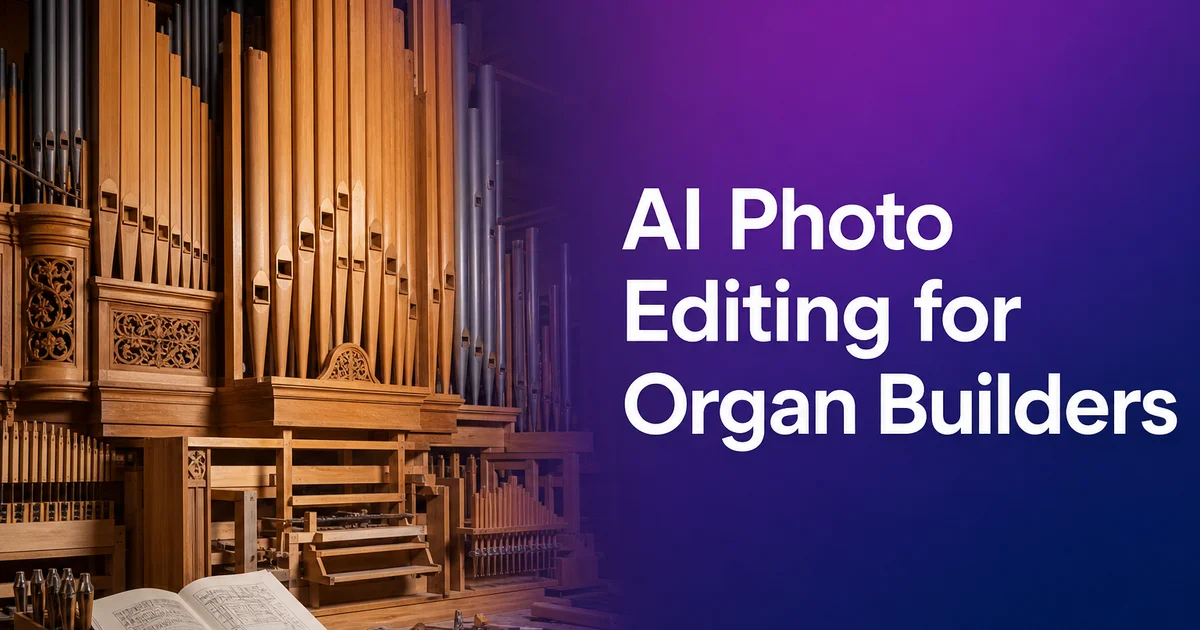
Pipe organ building is one of the most complex and least visible craft traditions in the modern world. A single instrument can contain thousands of pipes ranging from pencil-sized to over thirty feet tall, housed in a wooden case that may weigh several tons and stand three or more stories high, with mechanical, pneumatic, or electrical action systems that connect each key to specific pipes through engineering as precise as any watchmaker's work. Building a pipe organ requires mastery of woodworking, metalworking, acoustics, architecture. Mechanical engineering, and a single instrument may take years to complete from design through installation and voicing. Yet most people have never seen inside an organ case, never examined the precision of pipe scaling. Never appreciated the carved casework that frames the visible facade. High-quality photography is key for organ builders to share the extraordinary craftsmanship that goes into every instrument.
The photography challenges unique to pipe organs are among the most demanding in any craft records field. The instruments are enormous — a large church organ may fill an entire wall of a building — making it impossible to capture the full instrument and fine detail in a single image. They are installed in architecturally challenging spaces. Dimly lit church galleries, behind ornate choir screens, in concert halls with complex lighting rigs — where photographic conditions are rarely ideal. They contain surfaces that are very difficult to photograph well: highly polished tin pipes that throw specular reflections, matte wooden pipes that absorb light, gilded carvings that shift color under different illumination. Dark mechanical components in the shadowed interior that are invisible without added lighting. And records must often occur during installation when scaffolding and construction equipment are still present.
AI photo editing tools address these challenges by giving organ builders the ability to transform installation snapshots and workshop records into portfolio-quality images without hiring specialized architectural photographers for every project. Magic Eraser removes scaffolding, tools, and temporary equipment from installation photographs. AI Enhance corrects the mixed lighting conditions found in churches, recovers shadow detail in dark organ interiors. Balances the extreme dynamic range between bright pipe facades and shadowed case depths. Background Eraser isolates individual components — a console, a pipe rank, a carved element — from cluttered workshop settings for catalog and marketing use. This guide covers the complete workflow for organ builder photography, from initial capture through final portfolio display.
- Magic Eraser removes scaffolding, construction debris, and temporary installation equipment from organ photography, showing instruments as they will appear when installation is complete.
- AI Enhance corrects mixed church lighting with stained glass color temperature issues and recovers shadow detail in dark organ galleries without overbrightening the overall scene.
- Pipe surface balancing manages the extreme reflectivity of polished tin facade pipes, preserving metal character detail without blown-out specular highlights.
- Selective sharpening reveals the precision of case carvings, pipe shades, and console woodwork that communicates the quality of the builder's craftsmanship.
- Consistent editing workflows across all installation projects create a unified portfolio that demonstrates sustained excellence throughout a decades-long building career.
Photographing pipe organs: capturing scale, detail, and architectural integration
The fundamental challenge of organ photography is at once sharing the instrument's enormous scale and its fine craftsmanship detail. Both are key to understanding what the builder has achieved. A wide-angle facade shot that shows the full organ within its architectural setting establishes the scale and visual impact of the instrument. The viewer needs to see how the organ relates to the building, how its case design complements the architecture, and how the pipe facade fills the space. But this overall view cannot show the precision of pipe scaling, the quality of case carving, the detail of console craftsmanship, or the engineering of the mechanical action. A full records approach requires both scales: the establishing architectural shots and the intimate detail images that reveal the craft quality invisible at viewing distance.
Pipe rank photography demands particular attention because the pipes themselves are the visual signature of any organ and the primary evidence of the builder's metalworking skill. Facade pipes in most organs are made of polished or hammered tin alloy, and their visual quality depends on the alloy composition, the casting technique, and the finishing method. All of which are visible to an informed observer. The graduated scaling of pipes from the large bass to the small treble shows the builder's understanding of acoustics and visual proportion. Photograph pipe ranks from a slight angle rather than straight on to show the three-dimensional depth of the rank and the way individual pipes project from the rack board. Include at least one close-up showing the pipe mouth. The opening where sound is produced — because mouth geometry and finishing quality are key indicators of voicing craftsmanship.
Console photography documents the organist's interface with the instrument and reveals the builder's approach to ergonomic design and decorative finishing. The console contains the manual keyboards, pedalboard, stop controls, expression shoes, combination action. All the controls that allow the organist to access the instrument's tonal resources. The arrangement, labeling, and physical quality of these controls share both the builder's engineering philosophy and their attention to the organist's working experience. Photograph the console from the organist's perspective showing all manuals and controls in context, then capture detail shots of stop knobs or tablets showing the engraving quality, key surfaces showing the material quality and touch. Any special controls or combination systems that distinguish the builder's work.
- Wide-angle facade shots establish scale and architectural integration, while detail images reveal pipe scaling precision, case carving quality. Console craftsmanship invisible at viewing distance.
- Pipe ranks photographed at slight angles show three-dimensional depth and graduated scaling, with close-ups of pipe mouths documenting voicing craftsmanship quality.
- Console photography from the organist's perspective documents ergonomic design, followed by detail shots of stop knob engraving, key surfaces, and specialized control systems.
- Comprehensive documentation requires both scales of photography — architectural establishing shots and intimate detail images — processed to consistent quality standards.
Removing installation artifacts and workshop clutter from organ photography
Organ installation photography almost always contains visual elements that need to be removed because the records happens during the installation process when the building is still a construction site. Scaffolding surrounds the organ case during assembly and voicing, often obscuring the facade in multiple images taken during the weeks or months of on-site work. Protective coverings — plastic sheeting, moving blankets, cardboard — drape over finished surfaces while adjacent work continues. Tools, air compressors, voicing equipment, and the builders' personal effects occupy the floor and ledge space around the console. These elements are acceptable in behind-the-scenes records but must be removed from portfolio images that are meant to showcase the completed instrument.
Magic Eraser handles the specific challenges of organ installation cleanup with particular effectiveness. Scaffolding removal is complex because scaffold poles cross in front of pipes, carvings. Other detailed surfaces that must be reconstructed after the obstruction is removed. The AI understands the visual pattern of pipe ranks. Evenly graduated cylinders at consistent spacing — and can reconstruct obscured sections by inferring the missing pipes from the visible portions of the rank. Similarly, carved woodwork follows consistent stylistic patterns within a single instrument. The AI can reconstruct a section of carving hidden behind a scaffold pole by referencing the adjacent visible sections. Protective coverings that partially obscure the organ are handled by removing the covering and reconstructing the hidden surface based on what is visible around the covered area.
Workshop photography of organs under construction requires different cleanup approaches because the context is a busy shop rather than an architectural space. Pipe racks being prepared for installation sit on sawhorses surrounded by tools, clamps, and scrap metal. Consoles being wired and adjusted have cables, testing equipment, and assembly notes visible. Wind chests being assembled show the internal mechanism in various states of completion alongside assembly tools and fixtures. For portfolio records of work in progress, the goal is to clean up enough of the workshop clutter to keep the viewer focused on the craftsmanship being showed without making the image look sterile. Some workshop context is desirable to share the handmade nature of the work, but the balance should favor clarity about the organ component being featured.
- Scaffolding removal is handled by AI that understands pipe rank patterns and can reconstruct evenly graduated cylinders hidden behind scaffold poles from visible adjacent sections.
- Protective coverings, tools, and construction debris are removed while preserving the architectural setting that establishes the instrument's spatial context.
- Workshop photography cleanup maintains enough shop context to communicate handmade craft quality while removing excessive clutter that distracts from the featured components.
- The AI reconstructs carved woodwork behind obstructions by referencing the consistent stylistic patterns visible in adjacent sections of the same instrument.
Correcting church lighting and managing extreme dynamic range in organ photography
Church lighting presents one of the most challenging photographic settings for any subject. Pipe organs occupy the most difficult positions within these already challenging spaces. Organs installed in rear galleries receive backlight from the rose window above while the facade faces into the fairly dark nave. Organs positioned in chancel areas compete with stained glass windows that create extreme brightness contrasts and colored light spills. Side-aisle organs are illuminated by windows on one side and shadow on the other. In every case, the available light is a mixture of daylight through stained glass, artificial lights of various color temperatures, and reflected light from colored walls and surfaces. A combination that produces extreme color shifts across a single image and dynamic range that exceeds the capability of most cameras.
AI Enhance addresses these challenges through intelligent multi-zone processing that treats different areas of the image according to their specific lighting conditions rather than applying uniform corrections that compromise one area to improve another. The bright pipe facade receives highlight recovery that brings back metal surface detail without darkening the overall luminosity that makes the organ visually commanding within the space. The shadowed case interior receives selective lightening that reveals the mechanical components and structural details within while maintaining the natural sense of depth that shadow provides. Stained glass color spills that wash colored light across pipe surfaces are neutralized to reveal the true metal finish without completely eliminating the ambient character of the space. Some warmth from candlelight and some color from windows are preserved to maintain the authentic architectural atmosphere.
Dynamic range management is mainly critical for documenting the interior mechanical components that show the builder's engineering skill. The wind system, tracker action, pneumatic relays, or electrical switching mechanisms that connect the console to the pipes are housed within the case structure where ambient light rarely penetrates. These components are invisible in standard exposure photographs where the facade is properly exposed. AI Enhance brings up shadow detail in these areas to make mechanical components visible and documentable without requiring the builder to set up added lighting during installation. A major practical advantage when access to the organ's interior may be limited by scaffolding, time constraints, or the building's schedule for other events.
- Multi-zone processing treats facade highlights, case shadows, and stained glass color spills independently rather than applying uniform corrections that compromise one area for another.
- Highlight recovery on reflective pipe surfaces brings back metal detail without diminishing the visual commanding presence of the bright facade within the architectural space.
- Shadow recovery reveals mechanical components in dark case interiors — wind systems, tracker action, and switching mechanisms — without requiring supplementary lighting during installation.
- Stained glass color neutralization restores true metal and wood finishes while preserving enough ambient character to maintain the authentic architectural atmosphere of the space.
Building an archival portfolio and marketing presence for organ building firms
Organ building firms operate on timescales that make portfolio quality a long-term business investment rather than a short-term marketing expense. A single organ may take three to seven years from contract signing to final voicing. The firm's reputation rests on the accumulated evidence of every instrument they have built across careers that may span generations. The photography portfolio must serve multiple purposes at once: marketing to prospective clients who are evaluating builders for a new instrument, records for organological scholarship and historical record, reference for maintenance and restoration work that may occur decades after installation. Expert recognition within the organ building community where peer evaluation is key for continued commission opportunities. Each of these audiences requires different emphasis. Clients want to see visual beauty and architectural integration, scholars need technical detail, maintenance firms need component records, and colleagues want to see craft quality — but all require consistent photographic excellence.
Consistent editing standards across the full portfolio are key because organ building firms may photograph instruments across dozens of different buildings over decades of work. Without standardization, the portfolio shows dramatic variation in quality as lighting conditions, camera equipment. Photographer skill change from project to project and year to year. AI editing normalizes these variations by bringing every image to a consistent quality standard regardless of the original capture conditions. Early career instruments photographed with basic cameras under challenging church lighting are brought up to the same visual quality as recent projects shot with expert equipment, ensuring the portfolio presents a narrative of consistent excellence rather than a visible progression from amateur to expert photography that could undermine confidence in the firm's earlier work.
Digital portfolio display for organ builders should be organized to tell the story of each instrument as a complete project rather than presenting isolated images out of context. Each instrument entry should include an overview architectural photograph showing the organ within its building, facade details showing pipe work and case design, console records, mechanical detail shots. Installation process images that share the complexity and care of the building process. Written records accompanying each instrument should include the specification, scaling details, and any notable design or engineering features. The AI editing workflow makes this full records practical by enabling builders to process large image sets quickly to consistent standards, transforming hundreds of installation snapshots into a curated portfolio that shares the full scope of the firm's capabilities.
- Portfolio quality is a decades-long investment serving marketing, scholarly records, maintenance reference, and peer expert recognition. Each requiring different emphasis but all demanding excellence.
- AI editing normalizes quality across decades of projects, ensuring early career instruments photographed under challenging conditions match the visual standard of recent professional photography.
- Each instrument entry should tell the complete project story: architectural context, facade detail, console documentation, mechanical components, and installation process.
- Batch processing enables comprehensive documentation by transforming hundreds of installation snapshots into a curated portfolio that demonstrates sustained craft excellence across an entire career.
How to do it
- 1
Photograph the organ from multiple angles to document scale, casework, and pipe ranks
Capture the instrument from a central position that shows the full facade including pipe ranks, case carvings. Console placement within the architectural space. Pipe organs are among the largest and most architecturally integrated musical instruments in existence. Sharing their scale and presence requires wide-angle photography that includes enough of the surrounding building to establish spatial context. Follow the full facade shot with detail images: the console showing manual keyboards, stop knobs, and pedalboard. Individual pipe ranks from an angle that shows the graduated scaling from treble to bass. Carved case elements and decorative pipe shades. And any mechanical components like trackers, wind chests, or bellows that show the engineering complexity of the instrument.
- 2
Remove scaffolding, construction debris, and temporary installation equipment from images
Use Magic Eraser to clean up the visual distractions that in time appear in organ installation and workshop photography. New organ installations are documented while scaffolding is still in place, protective coverings partially drape the casework, tools and equipment litter the floor. Temporary lighting rigs cast unflattering shadows. Workshop photography of organs under construction includes sawhorses, clamps, wiring. Partially assembled components that distract from the craftsmanship of the finished work. Magic Eraser removes these temporary elements while keeping the architectural setting and the instrument's detail, producing images that show the organ as it will appear once the installation is complete and the builders have departed.
- 3
Enhance pipe detail, wood carving definition, and metal finish quality with AI tools
Apply AI Enhance to sharpen the visual detail of pipe ranks, case carvings. Metal finishes that define the quality of an organ builder's work. The polished tin and spotted metal pipes that form the visual facade of most organs are highly reflective surfaces that challenge even expert photographers. The AI balances highlight and shadow detail across reflective pipe surfaces so that the metal character is visible without blown-out specular highlights. Wood carving detail in case elements, pipe shades. Console surrounds receives selective sharpening that reveals the precision of the carver's work. The gilding, painting, and polychrome decoration that many historical and new organs feature requires accurate color rendering that preserves the distinction between gold leaf, gold paint, and natural wood finish.
- 4
Correct challenging church lighting conditions and color temperature issues
Use AI Enhance to address the extreme lighting challenges that organ photography presents. Pipe organs are often installed in churches, cathedrals, concert halls, and chapels where the lighting is designed for the congregation's comfort rather than photography. Dim ambient light supplemented by stained glass windows creates mixed color temperatures, dramatic brightness ranges, and deep shadows in upper gallery locations where organ cases often reside. The AI corrects these conditions by normalizing color temperature across the image, recovering shadow detail in dark recesses without overbrightening the overall scene. Managing the extreme dynamic range between brightly lit pipe facades and the shadowed depths of the case interior where mechanical components are visible.
- 5
Create a comprehensive installation portfolio with consistent documentation standards
Process your complete installation photography through a consistent editing workflow that documents each organ project with expert archival quality. Establish a standard records sequence for every instrument: exterior facade from the congregational viewpoint, console detail showing all manuals and stop controls, pipe rank detail shots for each division, case carving close-ups, mechanical action detail where visible. Contextual shots showing the organ's relationship to the building architecture. Apply the same color correction, boost, and cleanup standards to every image so that your firm's portfolio presents a unified visual quality regardless of the lighting conditions at each installation site. This consistency is key because organ building firms maintain their reputations across decades-long careers. The portfolio must show sustained excellence from the earliest projects to the most recent.
Sources
- The Art of Organ Building: A Comprehensive Historical, Theoretical, and Practical Treatise — Dover Publications — George Ashdown Audsley
- Photography of Musical Instruments: Documentation and Conservation Standards — Smithsonian Museum Conservation Institute
- E-Commerce Product Photography Best Practices — Baymard Institute