
AI Photo Editing for Makeup Artists — Magic Eraser
How makeup artists use AI photo editing for portfolio images, before-and-after transformations, virtual try-on previews, and social media content that showcases their artistry accurately.
SEO & Growth
Reviewed by Magic Eraser Editorial ·
Table of Contents
- Why makeup photography fails to capture the real quality of your work
- Building a consistent portfolio with AI background removal and lighting correction
- Before-and-after content that builds trust and drives bookings
- Virtual try-on previews and client consultation workflows
- Social media content strategy and multi-platform optimization
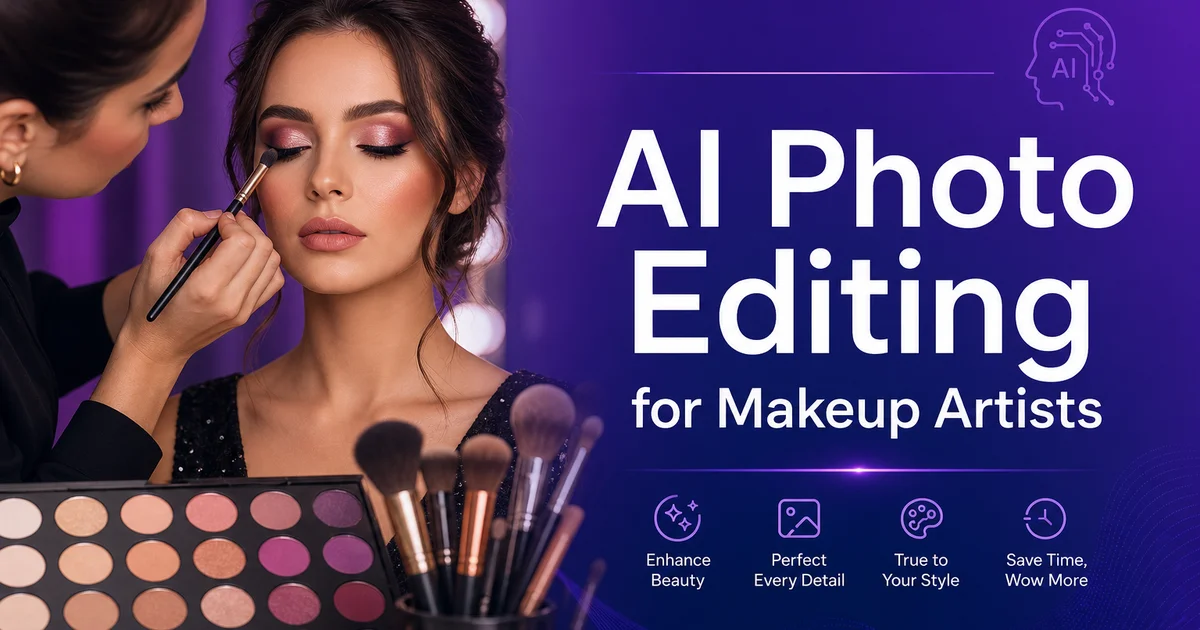
Expert makeup artists live and die by their visual portfolio. Every new booking, brand collaboration, and social media follower is earned through images that show technical skill and creative range. Yet the gap between how makeup looks in person under perfect lighting and how it photographs under real-world conditions is one of the industry's persistent frustrations. A flawless bridal look can appear washed out in outdoor ceremony photos, an editorial eye design loses its dimensional blending in a phone snapshot. The subtle gradient of a contour that took twenty minutes to perfect can vanish fully under fluorescent salon lighting. The result is that many talented makeup artists have portfolios that undersell their actual skill because photography conditions failed to capture what their hands created.
AI photo editing tools are transforming how makeup artists build, maintain. Present their visual portfolios without crossing the ethical line into misrepresentation. The key distinction — and it matters enormously in an industry where clients expect to receive what they see in portfolio images — is between editing that reveals the true quality of the work and editing that fabricates quality that was never there. Correcting a color cast so that a red lipstick appears the accurate shade of red it actually was, rather than the orange tint that tungsten lighting imposed, is honest representation. Smoothing skin until pores disappear or reshaping facial features is misrepresentation. AI tools now offer the intelligence to understand this distinction, enhancing makeup photography in ways that bring the image closer to what the artist and client saw in the mirror rather than further from reality.
This guide covers the complete AI-assisted workflow for makeup artists. From capturing raw images during client sessions through background removal, lighting correction, detail boost, before-and-after formatting, virtual try-on previews, and multi-platform export. Each technique is designed to showcase your actual craftsmanship with maximum visual impact while keeping the authentic colors, textures. Skin quality that clients need to see before they trust you with their face on their most important days. Whether you are a freelance bridal artist building a booking portfolio, a studio-based editorial artist pitching to agencies, or a content creator growing an audience through change videos, these tools eliminate the photography bottleneck that has in the past separated great makeup from great makeup marketing.
- Background removal isolates your subject against clean, professional backdrops, transforming phone-captured behind-the-scenes shots into portfolio-quality images without dedicated studio reshoots.
- AI-powered lighting correction matches exposure and color temperature across before-and-after pairs so the visible transformation is attributed to your artistry rather than photographic differences.
- Micro-detail boost sharpens individual lash placement, eyeshadow blending gradients. Shimmer particle texture while distinguishing intentional makeup detail from unintentional imperfections.
- Multi-format export optimizes images for portfolio sites, Instagram grid, Stories, Reels, and client delivery — preserving subtle tonal transitions even in heavily compressed social formats.
- Ethical boost brings images closer to what the artist and client saw in the mirror rather than fabricating artificial smoothness or reshaping features, maintaining client trust and booking accuracy.
Why makeup photography fails to capture the real quality of your work
Makeup is a three-dimensional art form applied to a three-dimensional surface. Photography compresses it into two dimensions under lighting conditions that rarely match the setting where the work was created and evaluated. A contour that sculpts the cheekbone with subtle gradient blending relies on directional light hitting the face at a specific angle. The same contour photographed under flat overhead fluorescent lighting loses its dimensional effect fully, appearing as a muddy stripe rather than a sculpted shadow. Highlight products that catch light and create luminous skin under natural window light can blow out into harsh white spots under direct flash, losing the creamy, diffused glow that the artist spent minutes building. The fundamental physics of how makeup interacts with light means that a single photograph at a single angle under a single light source can only capture a fraction of what the work actually looks like.
Color accuracy is the second major failure point in makeup photography. Human eyes adapt always to ambient light color temperature. We perceive a red lipstick as red whether we are standing in warm tungsten light, cool fluorescent light, or neutral daylight. Cameras do not adapt this way. A warm-toned salon with tungsten bulbs shifts every color toward orange-yellow, making cool-toned lip colors look muddy and blue-based eyeshadows appear grey. A salon with mixed lighting sources. Natural window light on one side, overhead fluorescents on the other — creates impossible color casts where one half of the face appears warm and the other appears cool. White balance correction in standard editing tools can fix the overall cast. It cannot separately correct different color channels affected by complex mixed lighting, which is why AI color intelligence offers a genuine advantage over manual white balance adjustment.
The third failure point is the timing gap between peak makeup look and photography opportunity. Makeup looks its absolute best in the first thirty to sixty minutes after application, before natural oils begin to break through foundation, before humidity affects powder products. Before the client's facial expressions and movements settle the products into expression lines. Yet many of the most important photography moments. The wedding ceremony, the editorial shoot, the event red carpet — happen hours after application. The artist's work may genuinely be excellent at the moment of application. The photographs that end up in the portfolio are captured later under worse conditions. AI restoration of original makeup quality from later-in-the-day photographs brings the portfolio image closer to what the work actually looked like at its peak. Is the honest representation that both artist and client remember.
- Dimensional makeup techniques like contouring and highlighting lose their sculptural effect under flat overhead lighting because the shadow and highlight gradients require directional light to be visible.
- Camera sensors lack the human eye's continuous color adaptation, causing tungsten-lit salons to shift colors toward orange and mixed lighting to create split warm-cool casts across the face.
- Standard white balance correction cannot separately address different color channels affected by complex mixed lighting. AI color intelligence corrects each channel on its own for accurate product representation.
- The timing gap between peak makeup look and actual photography moments means portfolio images often show degraded versions of the artist's best work. AI can restore to application-time quality.
Building a consistent portfolio with AI background removal and lighting correction
Portfolio consistency is one of the strongest signals of professionalism that potential clients evaluate before booking. It is nearly impossible to achieve through photography alone when shoots happen across dozens of different venues, lighting settings, and equipment setups throughout the year. One bridal look was photographed in a hotel suite with warm afternoon light streaming through sheer curtains. Another was captured in a church preparation room under harsh overhead fluorescents. A third was snapped in a dimly lit backstage area at a fashion show using a phone flash. Each individual image might be excellent, but presented side by side in a portfolio grid, the inconsistent lighting, background clutter. Color variation make the collection look amateur even when the makeup work itself is uniformly superb.
AI background removal solves the environmental inconsistency problem by extracting your subject from whatever chaotic real-world setting surrounded them and placing them against a uniform backdrop that you control. The technology handles the challenging edge cases that makeup photography specifically demands. Individual false lashes extending beyond the natural lash line, flyaway bridal veil edges, statement earrings with negative space between decorative elements, and the critical jawline transition where foundation coverage meets bare neck skin. A clean white or neutral grey background puts one hundred percent of the viewer's attention on the makeup work. When every portfolio image shares the same background treatment, the collection reads as a curated expert body of work rather than a haphazard collection of snapshots from different jobs.
Lighting correction across the portfolio set requires more than matching brightness levels. It requires harmonizing the direction, quality, and color of light so that every image appears to have been shot under the same expert studio conditions. AI analyzes the lighting traits in each photo. Where shadows fall on the face, whether the light is hard or soft, what color temperature it carries — and adjusts them toward a target lighting profile. You might choose soft, diffused beauty lighting as your portfolio standard, in which case the AI softens harsh shadows, opens up under-eye darkness. Wraps light evenly around facial contours in images that were originally shot under less flattering conditions. The corrected portfolio maintains the authentic makeup work while presenting it under the consistent, controlled lighting that it deserved but never received during the original capture.
- Portfolio consistency across dozens of venues and lighting conditions is the strongest signal of professionalism that potential clients evaluate before booking a makeup artist.
- AI background removal handles makeup-specific edge cases including individual false lash tips, bridal veil edges, statement earring negative space, and the jawline foundation-to-bare-skin transition.
- Uniform backdrops focus one hundred percent of viewer attention on the makeup artistry rather than competing with cluttered venues, mismatched furniture, or distracting ambient environments.
- AI lighting harmonization adjusts shadow direction, light quality, and color temperature toward a target profile — presenting every image as though shot under identical professional beauty lighting.
Before-and-after content that builds trust and drives bookings
Before-and-after change content is the single most effective format for makeup artist marketing because it provides undeniable visual proof of skill. Viewers can see exactly what the artist started with and exactly what they created. Platforms like Instagram, TikTok, and Pinterest always rank before-and-after makeup content among their highest-engagement formats because the change triggers a dopamine response in viewers who enjoy witnessing dramatic change. However, the power of before-and-after content is undermined when the photography conditions differ between the two halves, because skeptical viewers. And potential clients are inherently skeptical — will attribute the improvement to lighting, filters, or angles rather than to the makeup itself. Maintaining identical visual conditions between before and after frames is therefore not just aesthetic preference but a trust-building necessity.
AI editing enables honest before-and-after matching by correcting the photographic variables while keeping the makeup variable. In a typical bridal session, the before photo might be taken in a preparation room with overhead lighting. The after photo captured near a window once the makeup is complete and the bride has moved to better light for getting-dressed photos. The AI matches the exposure, white balance. Shadow traits of the after photo back to the conditions of the before photo, or vice versa, so that the only visible difference between the two frames is the makeup application itself. This matched display is more honest than unedited photos where better lighting in the after shot exaggerates the change. It isolates the actual contribution of the artist's work from the contribution of improved photographic conditions.
Formatting before-and-after content for maximum platform impact requires understanding how each social media algorithm rewards different display styles. Instagram feed posts perform best with side-by-side layouts in a square format where both halves are right away visible without interaction. Instagram Reels and TikTok prefer a slider reveal or swipe transition that creates a moment of surprise as the after image replaces the before. Pinterest favors tall vertical pins with the before image on top and the after on the bottom, accompanied by text overlay describing the look. AI export tools can generate all three formats from a single edited pair, optimizing crop, resolution. Compression for each platform's specific needs so that the subtle eyeshadow gradients and lip color transitions remain visible even after aggressive social media compression that would normally destroy fine tonal detail.
- Before-and-after content provides undeniable visual proof of skill and consistently ranks among the highest-engagement formats across Instagram, TikTok, and Pinterest.
- Mismatched lighting between before and after frames undermines trust because skeptical viewers attribute the visible improvement to photography rather than to the makeup artistry itself.
- AI matching corrects photographic variables — exposure, white balance, shadow direction — while preserving the makeup variable, isolating the actual transformation for honest presentation.
- Platform-specific formatting generates side-by-side layouts for Instagram feed, slider reveals for Reels and TikTok, and tall vertical pins for Pinterest from a single edited image pair.
Virtual try-on previews and client consultation workflows
The consultation phase is where makeup artists win or lose bookings, and visual communication during consultations has in the past been limited to showing reference images from other artists' work or from celebrity looks. Neither of which shows the client what a specific technique will look like on their own face with their own features, skin tone, and facial structure. AI-powered virtual try-on previews bridge this gap by mimicking how proposed makeup looks will appear on the actual client's face before any product touches their skin. The artist uploads a clean photo of the client's bare face, selects or describes the proposed look. A smoky eye with specific shadow colors, a bold lip in a particular red family, a dewy highlight placement — and the AI generates a realistic preview that accounts for the client's actual skin tone, face shape, eye spacing, and lip proportions.
This preview capability transforms the consultation from an abstract discussion into a concrete visual conversation. Instead of telling a bride that a soft glam look with champagne tones and a nude lip will complement her warm undertone, the artist can show her exactly what that combination looks like on her face compared to options with cooler tones or bolder lip options. Clients who can see specific outcomes are greatly more likely to book with confidence, less likely to request changes during the actual session. More satisfied with the final result because their expectations were set by a preview on their own face rather than by reference images of a different person under different lighting. The booking conversion improvement from virtual try-on consultations represents one of the highest-return applications of AI editing technology for independent makeup artists.
Privacy and consent are key considerations when implementing virtual try-on workflows. Client facial photographs used for previews should be processed locally or through encrypted channels, never stored on third-party servers without explicit consent. Deleted after the consultation unless the client agrees to portfolio use. The AI preview should be clearly communicated as an approximation rather than a guarantee. Actual results will vary based on skin texture, product interaction, and lighting conditions on the day of application. Setting this expectation during consultation protects the artist from unrealistic demands while still providing the visual communication advantage that makes the preview valuable. Artists who handle preview technology with transparency about its capabilities and limitations build deeper trust than those who present AI-generated previews as exact promises.
- Virtual try-on previews simulate proposed makeup looks on the actual client's face, accounting for individual skin tone, face shape, eye spacing. Lip proportions rather than relying on reference images of other people.
- Visual consultations improve booking conversion because clients who see specific outcomes on their own face commit with greater confidence and experience fewer expectation mismatches during the session.
- Privacy protocols require processing client photos through encrypted channels, avoiding third-party storage without consent. Deleting preview images after consultations unless portfolio use is explicitly agreed.
- Clear communication that previews are approximations rather than guarantees protects artists from unrealistic demands while preserving the visual communication advantage that drives bookings.
Social media content strategy and multi-platform optimization
Makeup artists operate in one of the most visually competitive social media verticals. Thousands of skilled experts post daily content competing for the same audience of potential clients and industry followers. Standing out requires not just excellent makeup work but excellent visual display. And AI editing tools provide the production quality advantage that separates expert-grade content from the vast sea of adequate phone snapshots. Consistent color grading across all posts creates a distinct visual brand that followers associate with a specific aesthetic identity. Uniform background treatment ensures the grid layout on Instagram presents a cohesive, curated look. Optimized sharpness reveals the micro-details of product texture and application technique that show expertise to knowledgeable viewers evaluating skill level.
Content variety across platforms requires adapting the same makeup work for at its core different audience behaviors. Instagram grid posts serve as a permanent portfolio that potential clients browse before making booking decisions. These should be the highest-quality, most polished images with clean backgrounds and perfect lighting correction. Instagram Stories and Reels serve as real-time engagement and personality content. These benefit from AI boost that improves quality while maintaining the authentic, in-the-moment energy that Story viewers expect. TikTok rewards raw, educational content where viewers learn technique. AI editing should enhance visibility of product application without making the content look overly produced. Pinterest drives discovery and wedding planning traffic. Bridal and event looks should be formatted as tall vertical pins with descriptive text overlays and tagged with relevant beauty and wedding keywords.
Batch processing through AI tools enables a content production workflow that would otherwise require a dedicated photographer and retoucher. After a client session, the artist can upload all captured images, apply consistent lighting correction and background treatment to the entire set, select the strongest images for each platform. Export optimized versions in minutes rather than hours. This efficiency is critical for solo practitioners and small teams who cannot afford to dedicate hours per session to post-production. The time saved through AI batch processing can be redirected to creating more content, engaging with followers, or serving extra clients. Turning what was before a production bottleneck into a streamlined step that requires minimal manual intervention while producing maximum visual impact across every platform at once.
- Consistent color grading and background treatment across all posts creates a recognizable visual brand identity that followers associate with a specific aesthetic in a crowded competitive vertical.
- Platform-specific optimization adapts the same work for Instagram grid permanence, Stories engagement, TikTok educational authenticity, and Pinterest discovery with wedding planning keywords.
- Batch processing entire session galleries through AI enables consistent correction, format optimization, and export in minutes — eliminating the post-production bottleneck for solo practitioners.
- Time saved through automated editing redirects to content creation, audience engagement, and client servicing. Turning a production cost into a competitive advantage across all platforms at once.
How to do it
- 1
Upload your makeup portfolio images and assess lighting consistency
Open your makeup photographs in AI Enhance and evaluate the overall lighting quality across your portfolio set. Expert makeup photography demands consistent, even lighting that reveals product texture and color accuracy. But real-world shoots at bridal venues, studio sessions, and on-location events rarely deliver identical conditions. The AI analyzes each image for exposure balance, color cast. Shadow patterns, then flags inconsistencies that would make your portfolio look disjointed. Upload your full set of before-and-after pairs or individual finished-look shots so the tool can establish a visual baseline and suggest corrections that bring the entire collection into harmony without destroying the authentic skin tones and product colors that makeup clients need to see accurately.
- 2
Remove distracting backgrounds to spotlight the makeup work
Use Background Eraser to isolate your subject against a clean, expert backdrop that keeps attention on the artistry rather than a cluttered salon, busy event venue, or inconsistent studio setup. The AI detects the precise boundary between your subject and the background with sub-pixel accuracy, keeping flyaway hairs, earring edges. The delicate transitions where foundation meets the jawline. Choose a solid color background — white or soft grey for editorial portfolios, brand-colored gradients for social media content — or replace the setting fully with a matching setting. This single step transforms phone-captured behind-the-scenes shots into portfolio-quality images, eliminating the need to reshoot in a dedicated studio for every client.
- 3
Enhance skin texture and makeup detail without artificial smoothing
Apply AI Enhance with focus on micro-detail sharpening to bring out the precise texture of foundation application, individual lash placement, eyeshadow blending gradients, and lip liner definition. The AI distinguishes between intentional makeup texture. Shimmer particles on cheekbones, the matte-to-satin transition in contouring, glitter placement in editorial looks — and unintentional imperfections like harsh flash spots or muddy shadow areas. Unlike beauty filters that flatten everything into porcelain-smooth unreality, AI Enhance respects the actual craftsmanship of your work, sharpening the deliberate details that show your skill while balancing exposure so every product layer is visible. The result shows clients exactly what your makeup looks like in person rather than a filtered fantasy.
- 4
Create consistent before-and-after comparison layouts
Process your before-and-after pairs through AI Enhance to match lighting, white balance. Exposure between the two halves so the change speaks for itself. Clients and social media audiences right away distrust before-and-after content where the lighting or angle differs greatly between frames because the improvement could be attributed to photography rather than makeup skill. The AI aligns color temperature, corrects exposure differences caused by changing light conditions during the session. Ensures skin tones appear identical in both frames aside from the makeup application itself. This honest, consistent display builds credibility and shows that the visible change is genuinely the result of your artistry rather than photographic manipulation.
- 5
Export optimized versions for portfolio, social media, and client delivery
Generate multiple export formats from your edited images. High-resolution files for your website portfolio and print lookbooks, square-cropped versions for Instagram grid posts, vertical formats for Stories and Reels, and compressed versions for quick client delivery via messaging apps. The AI optimizes each format on its own, ensuring that the fine details of eyeshadow gradients and lip color remain visible even in heavily compressed social media formats where subtle tonal transitions often collapse into flat blocks. Watermark placement options protect your work on public platforms while keeping the watermark small enough that it does not obscure the makeup artistry that potential clients need to evaluate before booking your services.
Sources
- The Role of Visual Content in Beauty Industry Marketing — BeautyMatter
- Social Media Trends in the Professional Makeup Industry — Statista
- Digital Photography Standards for Professional Portfolios — Professional Photographers of America