
AI Photo Editing for Horse Trainers — Magic Eraser
How equestrian trainers and breeders use AI photo editing for conformation photography, action shot enhancement, tack removal, background cleanup, and stable marketing. Covers ethical editing standards for equine sales and breed records.
SEO & Growth
Reviewed by Magic Eraser Editorial ·
Table of Contents
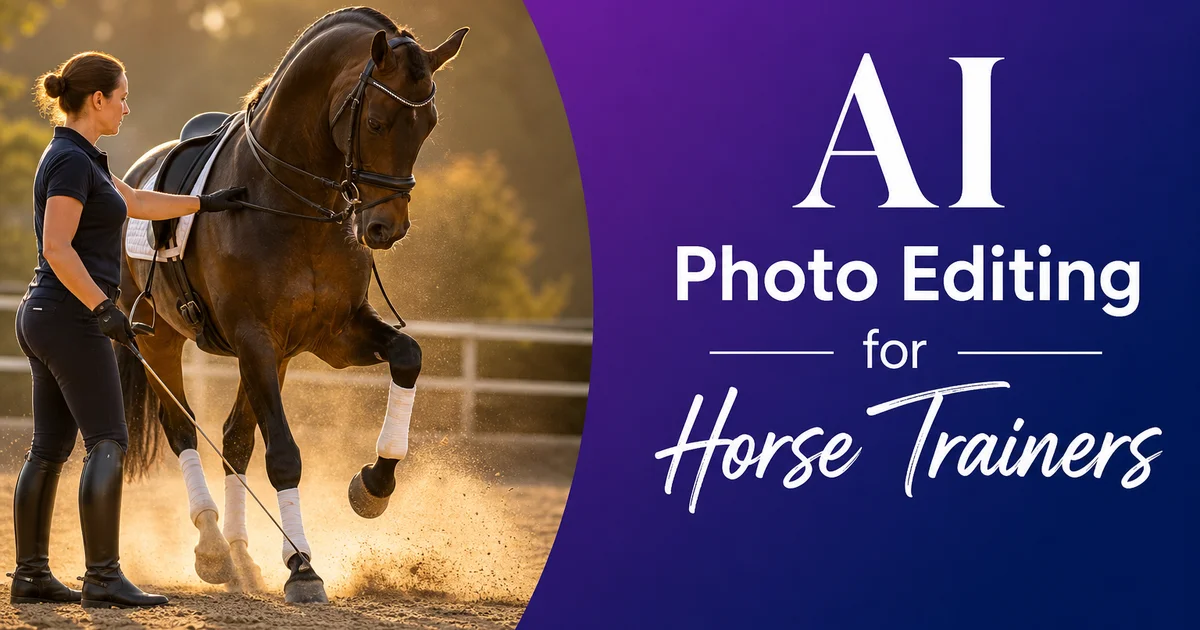
The equestrian industry relies heavily on photography for communication, marketing, and records at every level. From backyard horse owners sharing progress photos on social media to elite breeding operations producing six-figure sale catalog images for international auctions. A horse's value, training progress, competitive achievements, and breeding potential are all communicated primarily through photographs. Conformation images document the horse's physical structure for breed registries and sales catalogs. Action photographs show training level, athletic ability, and competitive performance. Marketing photographs promote training facilities, boarding operations, lesson programs, and breeding services. In each of these contexts, photograph quality directly affects business outcomes. A well-presented conformation photo can increase a sale price by thousands of dollars, and expert-quality facility images drive more inquiries from prospective clients.
The challenge for equestrian professionals is that horse photography is exceptionally difficult to execute at a consistently high standard. Horses are living subjects that move unpredictably, change their posture from moment to moment. Rarely cooperate with the photographer's timing needs. The ideal conformation photograph — a perfectly square stance with weight evenly distributed on all four legs, ears pricked forward, neck arched. The horse standing on clean level ground against an uncluttered background — might occur for a fraction of a second during a handling session, and the photographer must capture it at exactly the right angle with exactly the right lighting. The gap between what the photographer captures and what the market requires is where AI photo editing becomes a key tool for equestrian professionals.
AI-powered photo editing tools address the specific challenges of equine photography by providing intelligent object removal, coat and presentation enhancement, background cleanup, and tack removal capabilities that understand the unique needs of horse imagery. Magic Eraser enables trainers, breeders, and equestrian businesses to transform everyday photographs taken in the practical realities of barn yards, training arenas, and show grounds — into polished expert images suitable for sale catalogs, breed registries, social media marketing, and facility promotion. This guide covers how equestrian professionals use AI editing for conformation photography, action shot enhancement, tack removal, and full stable marketing.
- Conformation photographs — standardized side-view images for breed registration and sales — require precise background cleanup, accurate color representation. and display that shows the horse's structure clearly.
- AI object removal eliminates distracting barn equipment, other horses, handling gear, and environmental clutter that is nearly impossible to avoid in working equestrian settings.
- Coat enhancement optimizes lighting and color balance to show the horse's coat, mane, and eye as they appear under ideal grooming and lighting conditions without misrepresenting actual appearance.
- Tack and halter removal cleanly restores the horse's natural head and body appearance for marketing and artistic applications.
- Ethical equine editing enhances presentation without altering conformation — removing a halter reveals actual head structure, but digitally changing leg angles would constitute misrepresentation.
Conformation photography standards and how AI editing achieves them
Conformation photography is the visual standard for documenting a horse's physical structure. Its proportions, angles, muscling, and overall balance as viewed from a standardized side-on perspective. Breed registries, sale catalogs, insurance records, and veterinary records all require conformation photographs that accurately represent the horse's build. The industry standard calls for the horse standing square. All four legs visible and supporting weight evenly — on level ground, photographed from directly at the horse's side at shoulder height, with the horse's head carried naturally and ears forward. The background should be clean and uncluttered so the horse's outline. Its topline from poll to tail, its leg angles, and its overall silhouette — reads without visual interference. Achieving this standard in a single unedited photograph requires simultaneous control of the horse's stance, expression. Setting, which is why even expert equine photographers often shoot hundreds of frames to capture a few that meet the standard.
AI editing bridges the gap between the captured photograph and the conformation standard by addressing the environmental and display elements that the photographer could not fully control during the shoot. Background cleanup removes the barn wall, fence line, parked truck, or other visual clutter behind the horse, replacing it with a clean neutral background or an enhanced pastoral setting that allows the horse's outline to read clearly. Ground cleanup removes manure, hoof prints, uneven footing. Debris that the horse was standing in but that detracts from the expert display. Shadow correction ensures the horse's underside, lower legs, and face are visible with adequate detail rather than lost in shadow. A common problem in outdoor equine photography where overhead sunlight creates harsh shadows under the barrel and on the face.
Color accuracy is especially important in conformation photography because a horse's coat color is a registered spotting trait. A bay horse must appear bay — not washed out to chestnut by overexposure or darkened to near-black by underexposure. AI color correction optimizes the exposure and white balance to show the coat color as it actually appears in person under neutral lighting conditions, correcting for the warm golden cast of late-afternoon pasture light, the cool blue cast of overcast conditions, or the harsh mixed lighting of indoor arenas with both fluorescent and natural light sources. The result is a conformation photograph that accurately represents both the horse's physical structure and its registered color and markings.
- Conformation standards require square stance, level ground, side-on perspective, natural head carriage, and clean uncluttered background.
- Background cleanup removes barn walls, fences, vehicles, and environmental clutter to let the horse's structural outline read clearly.
- Shadow correction recovers detail in the horse's underside and lower legs lost to harsh overhead sunlight — a persistent challenge in outdoor equine photography.
- Color accuracy ensures the coat appears as it does in person under neutral light, preserving the registered color and marking identification.
Action shot enhancement for training documentation and competition marketing
Action photographs document the horse in motion. Jumping, performing dressage movements, galloping across country, working cattle, barrel racing, or performing reining maneuvers — and these dynamic images are the primary marketing tool for training programs, competition horses, and breeding operations promoting athletic progeny. The challenge of action photography is that the dramatic moment of peak athletic expression often occurs in cluttered settings. Over a jump surrounded by other jumps, in an arena full of markers and other riders, or on a course with sponsor banners and spectators in the background. The photographer captures the athletic moment, and AI editing isolates and enhances it by removing the visual noise that dilutes the dramatic impact.
Subject isolation in action photographs involves removing or de-emphasizing background elements that compete with the horse and rider for the viewer's attention. In show jumping, this means removing adjacent jumps, other competitors warming up, judges' stands. Arena infrastructure so the featured horse and its jump occupy the frame without distraction. In dressage, background simplification removes arena letters, other riders. Spectator areas to focus attention on the horse's movement and frame. In western performance events, removing arena fencing, cattle handling equipment. Other competitors creates a clean composition that highlights the featured horse's athleticism. The AI preserves the critical ground reference. The footing surface, jump elements the horse is actually jumping, and the spatial context needed to understand the athletic movement — while removing elements that add no information about the horse's performance.
Motion clarity enhancement addresses the reality that peak athletic moments involve rapid movement that challenges camera autofocus and shutter speed capabilities, especially for amateur photographers without expert sports photography equipment. The AI can sharpen a slightly soft subject where autofocus tracked a fraction late, enhance the definition of the horse's legs and feet to show the precise moment of takeoff or landing. Increase the contrast between the moving subject and the background to create visual separation that makes the horse pop from its surroundings. For breeding marketing, where photographs of offspring in motion show the athletic qualities inherited from the stallion or mare, these enhanced action shots become a critical sales tool that directly influences breeding decisions worth tens of thousands of dollars.
- Background simplification removes adjacent jumps, other riders, arena infrastructure, and sponsor banners to isolate the dramatic athletic moment.
- Subject isolation preserves critical ground reference and spatial context while removing elements that add no information about the horse's performance.
- Motion clarity enhancement sharpens slightly soft subjects and increases horse-to-background contrast for photographs taken with non-professional equipment.
- Enhanced action shots of offspring in motion become critical breeding marketing tools that directly influence decisions worth tens of thousands of dollars.
Tack removal and ethical boundaries in equine photo editing
Tack removal — digitally removing halters, bridles, saddles. Other equipment from photographs — is one of the most requested equine editing operations because many of the best casual photographs of horses show them wearing everyday equipment that detracts from their look. A field photograph of a valuable broodmare may show her in a mud-stained nylon halter with a lead rope dangling from her chin. Equipment that was necessary for handling but that makes the photograph unsuitable for breeding marketing. AI halter removal cleanly restores the horse's head and jaw profile, revealing the refined bone structure and clean throatlatch that buyers evaluate. The AI reconstructs the portions of the face and jaw that were hidden behind halter straps, using the visible anatomy as reference to generate anatomically correct continuations of the horse's features.
Lead rope and handler removal addresses another common issue. The presence of a person holding the horse at the edge of the frame, visible as an arm, hand, and lead rope that breaks the composition and makes the image feel like a snapshot rather than a portrait. AI removal cleanly eliminates the handler and rope, extending the background into the space they occupied. For under-saddle photographs, the AI can remove girth marks, sweat patterns, and saddle pad impressions that appear on the horse's coat after tack is removed. Evidence of work that is visually unwanted in a marketing photograph even though it indicates a horse in active training. Blanket strap marks, leg wrap marks, and other equipment impressions on the coat are similarly cleaned to present the horse at its visual best.
The ethical boundary in equine photo editing is the distinction between presentation enhancement and conformation misrepresentation. Removing a halter reveals the horse's actual head structure. The halter was hiding it, and removal shows what is genuinely there. Cleaning up background clutter, enhancing coat condition. Correcting lighting all show the horse more clearly and favorably without changing its physical traits. However, digitally altering leg angles to disguise a conformational fault, narrowing or widening the chest, lengthening the neck, or changing the horse's actual proportions crosses the line into misrepresentation. In a sales context, conformation misrepresentation can constitute fraud and damages the seller's reputation when the horse's actual structure is revealed at a pre-purchase examination. Responsible AI editing tools and ethical practitioners maintain this boundary between showing the horse at its best and fabricating a horse that does not exist.
- Halter removal restores the horse's actual head profile and jawline — revealing bone structure and throatlatch that buyers evaluate for breeding and performance quality.
- Handler and lead rope removal transforms handling snapshots into clean portrait compositions suitable for professional marketing.
- Girth marks, sweat patterns, and equipment impressions are cleaned from the coat to present the horse at its visual best after tack removal.
- Ethical editing enhances presentation without altering conformation — changing leg angles or body proportions constitutes misrepresentation that can constitute fraud in sales contexts.
Stable and farm marketing photography for training businesses and breeding operations
Equestrian training businesses and breeding operations depend on photography to market their facilities, attract clients. Present the quality of their program. Prospective boarding clients, lesson students, training clients. Breeding customers all evaluate facilities online before visiting in person, making website and social media photography the first impression that determines whether prospects make an inquiry. AI photo editing transforms the working photographs taken during daily operations. A trainer lunging a horse in the round pen, a lesson group jumping in the outdoor arena, mares and foals grazing in the broodmare pasture — into polished marketing images that share professionalism, quality, and the aspirational experience the facility offers.
Facility photography enhancement addresses the visual reality that working equestrian facilities always contain elements that are necessary for daily operations but detract from marketing imagery. Muck carts, wheelbarrows, stacked hay bales, water troughs, feed buckets. Maintenance equipment are key to running a barn but visually cluttered in promotional photographs. AI removal cleanly eliminates these working elements while keeping the facility's architecture, landscaping. The horses and people that are the actual subjects of the marketing image. Arena photographs benefit from removing old footing, jump standards being stored along the rail. Maintenance equipment that was present during the shoot. Pasture photographs benefit from removing feeding stations, run-in shed clutter. Utility installations that break the pastoral aesthetic that prospects expect from a quality equestrian facility.
Consistency across marketing materials — website, social media, print brochures. Advertising — requires that photographs from different days, seasons, and lighting conditions present a unified visual identity. AI color and lighting correction normalizes photographs taken across months of varied conditions into a consistent look. Matching the warm golden tone of a preferred aesthetic, or the clean bright look of a modern facility brand. Seasonal variation is managed by enhancing green grass and foliage in images from the growing season and ensuring winter photographs maintain appeal despite bare trees and brown pastures. This visual consistency, applied across dozens or hundreds of photographs on a facility website, creates the expert impression that distinguishes an operation that takes its marketing seriously from one that simply uploads unedited phone snapshots.
- Prospective clients evaluate equestrian facilities online before visiting — website photography quality directly determines whether prospects make an inquiry.
- AI removal eliminates muck carts, feed equipment, and maintenance clutter while preserving the facility architecture, horses, and people that are the marketing subjects.
- Arena cleanup removes old footing, stored jump standards, and maintenance equipment that was present during the shoot but detracts from the facility's presentation.
- Color and lighting normalization across photographs from different seasons and conditions creates the visual consistency that communicates professional facility management.
How to do it
- 1
Upload the horse photograph and identify the editing objectives
Open the photograph in Magic Eraser and assess what type of equine editing is needed. Conformation photographs — standardized side-view images used for breed registration, sales listings. Veterinary records — require precise background cleanup, lighting correction, and display standards. Action shots from training sessions, competitions, or trail rides need motion clarity enhancement, background simplification, and subject isolation. Marketing photographs for breeding farms, training facilities, and equestrian businesses need environmental enhancement, branding consistency, and professional finish. Identify which category your image falls into because each requires different editing priorities. Conformation work demands accuracy and restraint, action shots need drama and clarity, and marketing images need polished appeal.
- 2
Remove unwanted objects and clean up the background environment
Use Magic Eraser to remove unwanted elements that detract from the horse as the primary subject. In barn and paddock settings, remove manure, water buckets, loose hay, tangled lead ropes. Stable equipment that clutters the background. In arena photographs, remove jump standards from previous courses, ground poles, traffic cones. Other horses or riders that distract from the featured subject. In pasture settings, remove fence posts that appear to intersect the horse's body, parked vehicles visible in the background. Utility structures that detract from the natural pastoral setting. For conformation photographs specifically, the background should be clean and uncluttered so the horse's outline. Its topline, leg angles, and overall proportions — reads clearly without visual interference from environmental objects.
- 3
Enhance the horse's coat, mane, and overall presentation
Apply AI enhancement to bring out the horse's best visual display without misrepresenting its actual look. Coat enhancement adds depth and shine to the horse's coat color. Bringing out the warm red tones in a chestnut, the blue-black depth in a true black, or the dappled pattern in a gray — by optimizing the lighting and color balance to show the coat as it appears under ideal grooming and lighting conditions. Mane and tail enhancement improves the visual flow and condition of the hair, reducing the wind-tangled or unkempt look that outdoor photography often captures when a horse has been turned out in pasture. Eye enhancement ensures the horse's eye is visible, bright, and expressive. A critical element in equine photography where a dull or partially hidden eye makes the horse appear lethargic or unengaged.
- 4
Remove or minimize tack, halters, and handling equipment as needed
For certain marketing and artistic applications, remove visible tack and handling equipment to present the horse in its natural form. Halter removal is the most common request. Many casual photographs show the horse in a nylon turnout halter that detracts from the animal's look, and AI removal cleanly restores the head and face without the halter straps. Lead rope removal eliminates the dangling rope and the handler's arm or body at the edge of the frame. For sale photographs where the horse is shown under saddle, the AI can clean up girth marks, sweat marks. Saddle pad impressions that appear after tack removal. The key ethical principle in equine photo editing is enhancing display without misrepresenting conformation. Removing a halter reveals the horse's actual head structure, but digitally altering leg angles or body proportions would constitute misrepresentation in a sales context.
- 5
Export for the appropriate equine marketing channel
Export the edited photograph at the resolution and format right for its intended use. For breed registry submissions and sale catalog listings, export at high resolution with accurate color representation. Registries and auction houses expect photographs that truthfully represent the horse's color, markings, and conformation. For social media marketing of training services and breeding programs, export at platform-optimized dimensions with consistent branding treatment. A watermark, stable logo, or branded border that identifies the business. For website use on facility pages and sales listings, export at web-optimized resolution that loads quickly while keeping the coat color detail and conformation clarity that potential buyers examine closely. For large-format barn display prints, export at three hundred DPI or higher to produce wall-quality images suitable for facility reception areas and client display.
Sources
- Equine Conformation Photography: Standards and Best Practices for Breed Documentation — American Association of Equine Practitioners
- The Role of Visual Marketing in Equine Sales: Photography Standards for Horse Auctions — Blood-Horse Publications
- Digital Image Enhancement for Livestock Marketing: Ethical Guidelines and Industry Standards — Livestock Science Journal