
AI Photo Editing for Gyms: Visual Marketing That Drives Memberships
How gyms and fitness centers use AI photo editing to create expert marketing imagery. Covers facility photography, clutter removal, member spotlights, change photos, and multi-platform distribution for membership growth.
SEO & Growth
Reviewed by Magic Eraser Editorial ·
Table of Contents
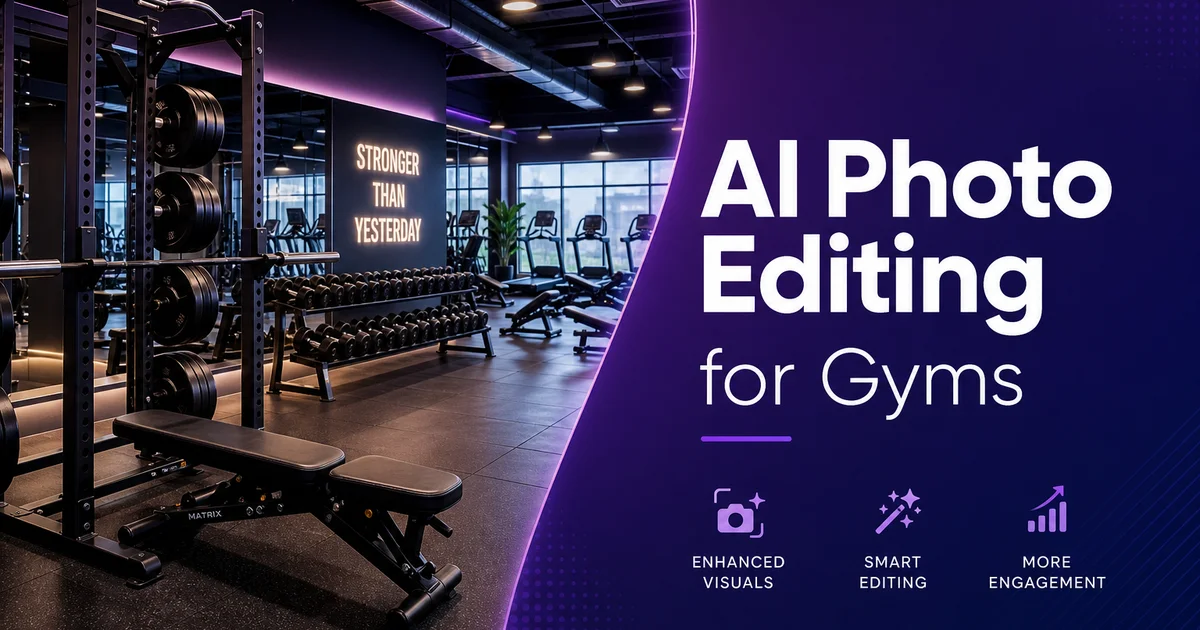
The fitness industry is a $96 billion global market where gym memberships are sold primarily through visual marketing. A potential member evaluating local gyms will visit their websites, scroll through their Instagram feeds, check their Google Business Profile photos. Look at tagged member content before ever walking through the door. The images they see form an immediate impression about the gym's cleanliness, equipment quality, member demographics, energy level, and overall atmosphere. And that impression either motivates them to book a tour or moves them to the next option on the list. In a market where most gyms within a geographic area offer broadly similar equipment and pricing, the quality of visual marketing is often the differentiating factor that determines which gym wins the new member.
The challenge for gym operators is that fitness facilities are inherently difficult to photograph well. The lighting is often a combination of harsh overhead fluorescents, colored LED accent strips. Variable natural light from windows that changes greatly throughout the day. The gym floor during operating hours is covered with water bottles, towels, phone chargers, chalk bags, personal items. The general visual entropy of dozens of people using shared equipment at once. Mirrors — ubiquitous in gyms — reflect everything in the room including the photographer, other members who did not consent to being photographed. The operational clutter that exists behind the camera. The result is phone photos that show a busy, cluttered, poorly lit space that fails to share the energy, community. Results that the gym actually delivers.
AI photo editing solves these problems systematically. Object removal eliminates the floor clutter, personal items, and unwanted background elements that accumulate in every working gym. Background replacement isolates members and trainers from busy settings for spotlight and change content. Color correction neutralizes mixed lighting and creates a consistent, energetic visual tone. The complete workflow transforms ordinary gym snapshots into expert marketing assets that share cleanliness, energy, and results. The three things potential members need to see before they commit to a tour or a trial membership. This article covers the full photo editing process for gym and fitness center marketing, from capture strategy to multi-platform distribution.
- Visual marketing is the primary differentiator for gyms in competitive local markets — most facilities offer similar equipment and pricing, making imagery the deciding factor for prospective members.
- Gym environments are challenging to photograph due to mixed lighting, mirror reflections, floor clutter, and the visual entropy of active shared spaces.
- Object removal eliminates water bottles, towels, personal items, and operational clutter that makes gym photos look disorganized rather than energetic.
- Member transformation and trainer spotlight photos perform best on social media when isolated from busy gym backgrounds with consistent, branded backdrop replacement.
- Consistent color correction across all marketing images neutralizes the mixed fluorescent and LED lighting that plagues gym photography.
Why gym photography drives membership decisions
Gym membership purchases follow a pattern that is uniquely dependent on visual information. Unlike products that can be evaluated through specifications or services that can be compared through reviews, a gym membership is a commitment to spend time in a physical space. And the most important question a prospective member needs answered is whether they can see themselves in that space. Visual marketing answers this question directly. When a potential member sees photos of people who look like them working out in a clean, well-equipped, energetic setting, the psychological distance between considering the gym and joining it shrinks greatly. When they see poorly lit photos of a cluttered gym floor, the distance grows.
The discovery pathway for new gym members has shifted almost fully to digital channels. A prospective member often begins with a Google search for gyms near me, scans the Google Business Profile listings and photos, visits the websites of two or three candidates, checks their Instagram accounts for recent content and member engagement. Then books a tour or trial at the gym whose visual presence was most strong. At each step of this discovery journey, the gym's photographs are the primary content being evaluated. The website hero image, the Google listing photos, the Instagram grid, the member change posts. Each touchpoint is an opportunity to share the gym experience visually or to lose the prospect to a competitor whose imagery is stronger.
Member change photos deserve special attention because they are the highest-engagement content type for gym social media accounts. A strong before-and-after change photo tells a complete story. The member started at one point, committed to the gym, and achieved visible results — in two images. This visual proof of outcomes is more persuasive than any written testimonial because it is right away verifiable and emotionally impactful. However, change photos taken in a busy gym with cluttered backgrounds, inconsistent lighting between the before and after shots. Unflattering angles undermine the credibility of the change. Consistent, expert editing that isolates the subject and maintains visual parity between before and after images makes the change credible and shareable.
- Gym membership decisions depend on whether prospective members can see themselves in the space — visual marketing directly answers this question.
- The discovery pathway is almost entirely digital: Google search, Business Profile photos, website hero images, and Instagram feeds are evaluated in sequence before a tour is booked.
- Transformation photos are the highest-engagement content type for gym social media because they provide immediate, visual proof of outcomes.
- Consistent professional editing of transformation photos — same background, same lighting, same framing — makes results credible and shareable rather than questionable.
Facility photography: capturing energy without chaos
The goal of gym facility photography is to share energy, cleanliness, and capability at once. And these three qualities are in natural tension. An empty gym looks clean and capable but lacks energy. A packed gym looks energetic but possibly chaotic and uninviting. The sweet spot is a moderately active facility with enough members to show that the gym is popular and vibrant but not so many that the space looks overcrowded or the floor is cluttered with personal belongings. Aim to photograph during mid-morning or early afternoon on a weekday when attendance is moderate and the most dedicated, photogenic members tend to be training.
Wide shots establish the space and should showcase the gym's best features. The variety and quality of equipment, the cleanliness of the floor, the ceiling height and openness of the layout, and any premium amenities like turf areas, Olympic lifting platforms, or functional training zones. Position yourself at one end of the gym floor and shoot at a slight downward angle to show the depth of the space. Medium shots of individual members or small groups using equipment create human connection and show the gym in action. These shots should capture good form and genuine effort. Not posed smiles at the camera, but real training moments that share the gym's culture.
Avoid common gym photography mistakes that undermine even well-intentioned efforts. Do not photograph members from behind without their knowledge or consent. Do not include close-ups of weight amounts on machines, which can intimidate beginners. Do not show only one body type, age group, or gender. The photo set should represent the diversity of your membership to signal inclusivity. Do not photograph the gym right away after a busy class when equipment is scattered and towels are everywhere. And never use flash on the gym floor. It creates harsh shadows, washes out skin tones, and disturbs members who are mid-workout.
- Photograph during moderate attendance hours — enough members for energy but not so many that the space looks chaotic or cluttered with personal belongings.
- Wide shots establish the space and showcase equipment variety; medium shots of members training create human connection and show the gym's culture in action.
- Represent the diversity of your membership in photos — different body types, ages, and genders signal inclusivity that welcomes prospective members who need to see themselves in the space.
- Never use flash on the gym floor — it creates harsh shadows, washes out skin, and disturbs active members, producing worse photos than available light.
Cleaning up gym environments for professional visual marketing
Every working gym has visual clutter that does not belong in marketing photography. Magic Eraser is the fastest way to eliminate it. The most common distractions are personal items: water bottles on and around equipment, towels draped over machines, gym bags tucked under benches, phones propped against mirrors for workout tracking, headphone cases on windowsills. Chalk dust residue around free weight areas. These items are completely normal in a gym but in a photograph they read as mess rather than activity. Removing them transforms the image from a snapshot of a busy gym into a expert representation of a clean, well-maintained facility.
Mirror reflections are the most challenging aspect of gym photography because they can reveal elements you do not want in the marketing image. Other members who did not consent to be photographed, the photographer holding their phone, operational areas behind the camera like the front desk or storage closets, and any clutter that was moved out of the direct frame but is still visible in the mirror. Magic Eraser can selectively remove specific reflections from mirrors while keeping the mirror's reflective quality and the overall depth that mirrors add to gym photography. For mainly problematic mirror situations, consider photographing from an angle where the mirror reflects the gym's best features rather than its worst.
Equipment-specific cleanup improves the expert quality of close-up and detail shots. Remove visible scuff marks, wear patterns, and scratches from equipment surfaces. Clean up cable management and power cords that run across floors or along walls. Remove commercial equipment labels and serial number stickers that make machines look institutional. For weight racks, ensure the dumbbells and plates appear organized even if they were not perfectly racked when photographed. A neatly organized weight rack shares operational discipline and respect for the facility that resonates with prospective members who care about gym culture.
- Personal items — bottles, towels, bags, phones, chalk residue — are normal in a gym but read as mess in photographs; removing them conveys cleanliness and maintenance.
- Mirror reflections can reveal non-consenting members, the photographer, and operational areas behind the camera — selectively remove problematic reflections while preserving mirror depth.
- Equipment cleanup removes scuff marks, commercial labels, and cable clutter that makes machines look institutional rather than premium.
- Organized weight racks communicate operational discipline — edit rack photos to show neatly arranged equipment even if they were not perfectly racked when photographed.
Color correction for the unique challenges of gym lighting
Gyms present one of the most difficult mixed-lighting settings for photography because different zones within the same space often use different light sources. The main gym floor may have cool-white fluorescent tubes. The functional training area might have warm halogen spotlights. Colored LED accent strips along walls or ceilings add purple, blue, or red ambient light. Natural window light varies from warm morning sun to cool overcast depending on orientation and time of day. A single photo can contain light from three or four different sources at different color temperatures, producing images where skin tones shift from green to orange across the frame and equipment surfaces look different colors than they actually are.
AI Enhance addresses mixed lighting by analyzing the image globally and applying white balance correction that neutralizes competing color casts without flattening the image to a single, uniform tone. The algorithm preserves intentional lighting design. Gym owners who installed colored LED accents want those colors to be visible in marketing photos — while correcting the unintentional color casts from fluorescent fixtures and mixed natural light. The result is an image where skin tones look natural and consistent across the frame, equipment surfaces show their true colors. The gym's designed lighting ambiance is preserved.
Contrast and exposure adjustments are equally important for gym photography. Slightly boosting contrast makes equipment edges sharp and defined, muscle definition visible without being unflattering. The overall image feel energetic rather than flat. Increasing clarity or microcontrast brings out surface textures. The knurling on barbells, the grain of rubber flooring, the mesh of training equipment — that share quality and tactility. Be conservative with exposure brightening: gym photos often benefit from slightly dramatic lighting that creates depth and mood. Blowing out the highlights to make the space look brighter can strip away the atmosphere that makes a gym feel like a serious training setting.
- Gyms combine fluorescents, halogens, colored LEDs, and natural light — AI white balance correction neutralizes competing casts while preserving intentional lighting design.
- Consistent skin tones across the frame are the primary indicator of successful color correction in gym photos, where mixed lighting produces green-to-orange shifts.
- Boosting contrast and clarity brings out equipment textures — barbell knurling, rubber flooring grain, mesh surfaces — that communicate quality and tactile presence.
- Avoid over-brightening gym photos: slightly dramatic lighting creates depth and mood that communicates a serious training environment.
How to do it
- 1
Photograph your facility, equipment, and members during peak energy hours
Gym marketing imagery must share energy, cleanliness, and community. Photograph your facility during active hours when members are working out to capture genuine energy and movement. Avoid extreme crowds that make the space look uncomfortably packed. Capture a mix of wide shots showing the gym floor layout and equipment variety, medium shots of members using specific machines or performing exercises. Detail shots of clean equipment, organized weight racks, and any unique amenities. Natural light from windows is ideal. Supplement with the gym's overhead lighting and avoid flash, which creates harsh shadows and washes out skin tones.
- 2
Remove visual distractions and safety hazards with Magic Eraser
Gym floors accumulate visual clutter that does not belong in marketing photos: water bottles left on equipment, scattered towels, personal bags near benches, phones propped against mirrors, chalk dust residue. Visible scuff marks on floors and equipment. Use Magic Eraser to brush over these distractions. Also remove any identifiable personal information. Gym bags with visible names, car keys, membership cards — and any safety signage or equipment labels that make the space look institutional rather than inviting.
- 3
Clean up backgrounds for member spotlight and transformation photos
Member change photos and trainer spotlights are among the highest-performing content types for gym social media. Use Background Eraser to isolate the member or trainer from the busy gym setting and replace the background with a clean, branded backdrop. This focuses attention on the person and their results rather than the treadmill, mirror reflections, and other members visible behind them. For before-and-after change photos, use the same background treatment on both images to ensure a fair visual comparison.
- 4
Enhance lighting, color, and skin tones with AI Enhance
Gym lighting is notoriously challenging for photography. A mix of overhead fluorescents, colored LED accent strips, and natural window light that changes throughout the day. Use AI Enhance to correct the mixed color temperature and create consistent, flattering white balance across all your images. Boost contrast slightly to make equipment and muscles look defined without creating harsh shadows. For images with visible skin, ensure the boost preserves natural skin tones. Gym photos should show real people with authentic skin textures, not over-smoothed or artificially tanned looks.
- 5
Export and distribute across social media, website, and Google Business Profile
Save edited photos in the formats each platform needs: square for Instagram grid, 9:16 for Stories, Reels. TikTok, landscape for Facebook covers and Google Business Profile, and full-resolution originals for your website. Create a posting schedule that rotates between facility shots, member spotlights, change stories, class action shots. Equipment close-ups to present a complete picture of the gym experience. Upload the best facility photos to Google Business Profile with descriptive captions including your gym's name, location. Key amenities to improve local search visibility.