
AI Photo Editing for Escape Rooms — Magic Eraser
How escape room businesses use AI photo editing for room preview photography, spoiler-free marketing, team celebration content. Booking platform visuals that fill time slots without revealing puzzles.
SEO & Growth
Reviewed by Magic Eraser Editorial ·
Table of Contents
- The marketing paradox: selling an experience that depends on secrecy
- Editing room photos: removing spoilers while preserving atmosphere
- Team celebration photos: your highest-return marketing asset
- Multi-platform visual strategy for booking conversion
- Seasonal themes and event marketing through photo editing
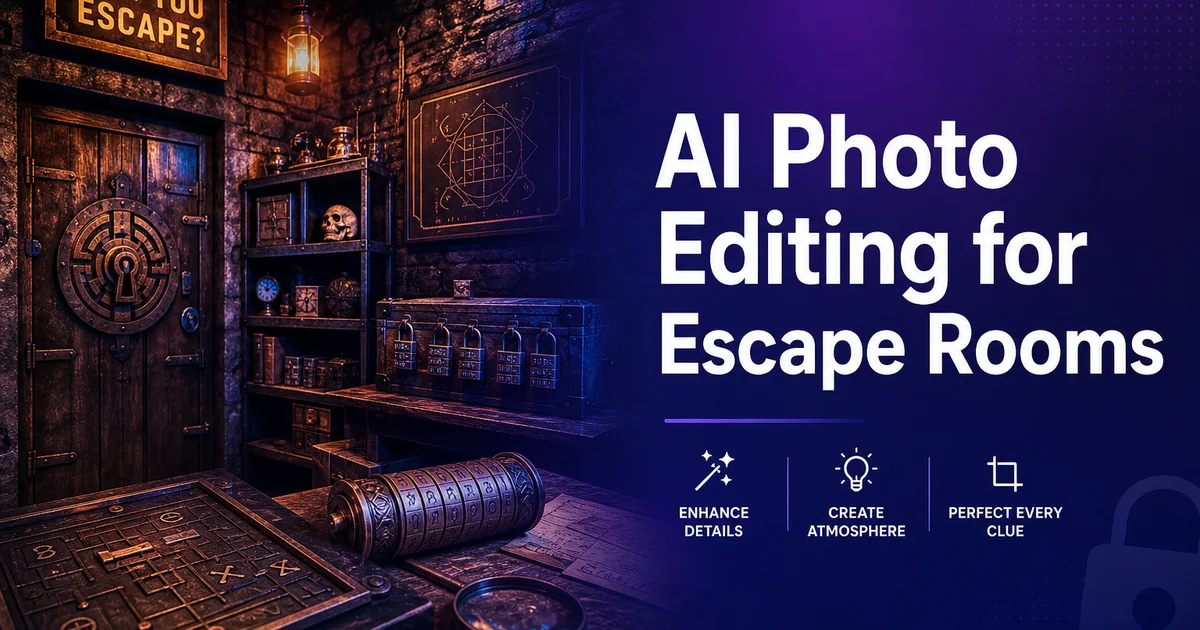
Escape rooms occupy a unique position in entertainment marketing: the product is an experience that depends on surprise. Photographing it risks destroying the very thing you are selling. A restaurant can post photos of every dish. A concert venue can share videos of performances. A theme park can showcase its rides from every angle. But an escape room owner who posts the wrong photo gives away a puzzle solution and diminishes the experience for every future customer. This creates a marketing tension that most escape room businesses solve badly. Either they post barely anything, hiding their production investment behind generic graphics, or they post too much and let puzzle-hungry visitors reverse-engineer solutions from marketing photos.
AI photo editing resolves this tension by giving escape room operators precise control over what appears in their marketing imagery. Magic Eraser removes puzzle mechanisms, lock combinations, clue cards, and hint system components from mood room shots, leaving the set design, lighting, and thematic props visible while eliminating everything that would spoil the experience. AI Enhance recovers the detail lost in intentionally dark rooms so potential customers can appreciate the production quality. AI Filter applies genre-right color grading that shares whether a room is horror, mystery, sci-fi, or adventure before the viewer reads a single word of description.
This guide covers the complete photo marketing workflow for escape room businesses. From room setting photography through spoiler removal, mood boost, team celebration content, and multi-platform distribution. The goal is a visual marketing presence that showcases your rooms compellingly enough to fill every time slot while protecting the puzzle experience that makes those rooms worth booking.
- Magic Eraser removes lock codes, clue cards, hint screens, and puzzle mechanisms from room photos while preserving atmospheric set design.
- AI Enhance recovers shadow detail in intentionally dark rooms to reveal the production craftsmanship that justifies ticket prices.
- Genre-matched AI Filter color grading communicates each room's theme — horror, noir, sci-fi, adventure — at first glance.
- Team celebration photos generate organic social reach when groups share and tag your business immediately after finishing a room.
- Consistent visual treatment across all rooms and platforms builds a professional brand that converts browsing into bookings.
The marketing paradox: selling an experience that depends on secrecy
Every escape room owner has invested thousands to tens of thousands of dollars building immersive settings that customers experience for sixty minutes and then leave. The hand-painted murals, custom-fabricated props, integrated electronic puzzles, theatrical lighting, and mood sound design represent the core value proposition. And photographing these elements is the obvious marketing approach. But embedded in every set piece, every bookshelf, every desk drawer, and every wall panel are the puzzle mechanisms that make the room work. A photograph of a beautiful Victorian study also shows the portrait whose eyes move when the correct book is pulled from the shelf. A shot of an elaborate control panel reveals which buttons are functional and which are decorative. The same photo that showcases your investment also spoils your product.
The consequences of accidental spoilers are real and measurable. Escape room review communities actively discuss and catalog puzzle types. A marketing photo that reveals a mechanism becomes information that circulates among enthusiast groups. More practically, local customers who see puzzle solutions in your marketing photos before visiting have a diminished experience. And diminished experiences produce lower review scores, which affect your visibility on Google, TripAdvisor, and booking platforms. The irony is that posting more photos to improve your listing can actually hurt your business if those photos contain spoilers that reduce the quality of the experience.
The solution is not fewer photos — it is smarter photos. Escape rooms need more visual content than most entertainment businesses, not less. The booking decision is driven fully by whether the potential customer believes the experience is worth their time and money. They need to see that your rooms are expertly built, atmospherically lit, and richly detailed. They need to see that other groups had an amazing time. They just cannot see how the puzzles work. AI editing makes this possible by separating the atmosphere from the mechanics in every photo.
- Room photos that showcase set design inevitably contain embedded puzzle mechanisms that are difficult to avoid in standard photography.
- Spoilers circulate through enthusiast communities and reduce experience quality for future customers, lowering review scores.
- The solution is not fewer photos but smarter editing that separates atmospheric set design from puzzle mechanics.
- Escape rooms need more visual content than most entertainment businesses because the booking decision is entirely visual and experiential.
Editing room photos: removing spoilers while preserving atmosphere
The spoiler removal workflow starts before the camera is picked up. Walk through each room and mentally categorize every visible element as either mood or functional. Mood elements contribute to the theme but do not participate in puzzles. Wall textures, furniture style, lighting fixtures, decorative props, ceiling treatments, and floor surfaces. Functional elements are puzzle components or provide puzzle clues. Locks, keypads, electronic sensors, movable objects that trigger mechanisms, hidden compartments, UV-reactive markings, and any text or symbols that are part of a solution. Photograph from angles that emphasize the mood elements and minimize the functional ones. You will remove the remaining functional elements in editing. Starting with a good angle reduces the editing workload and produces more natural-looking results.
In Magic Eraser, work through the photo systematically. Start with the most obvious spoilers: visible lock combinations, keypad entry panels, clue cards or hint sheets left on surfaces, and the hint system screen or speaker that the game master uses to share hints. Then address the subtler elements: the edges of hidden compartments that a careful viewer might notice, electronic sensor housings that reveal where interactive elements are located, UV lights that indicate UV-reactive clues exist in the room, and any prop arrangement that clearly suggests a specific action, such as books pulled partially from a shelf, drawers left slightly open, or levers in obvious positions. Finally, remove the operational elements that break thematic immersion regardless of puzzle spoilers: fire extinguisher signs, emergency exit placards in modern fonts on a medieval wall, cable conduit for electronic props, and the small dome cameras the game master uses for monitoring.
For rooms where the set design and puzzle mechanics are deeply integrated — where major scenic elements are themselves puzzles — switch from wide shots to detail photography. A close-up of an ornate lock mechanism is mood and intriguing. A close-up of a weathered map is strong without revealing that the map is part of a navigation puzzle. A tight shot of a mysterious artifact with dramatic lighting showcases craftsmanship without showing how it connects to other room elements. These detail shots share production quality through individual set pieces rather than through spatial relationships that reveal puzzle flow.
- Categorize room elements as atmospheric or functional before photographing, then shoot angles that emphasize atmosphere.
- Remove spoilers in order: obvious locks and codes first, then subtle sensor housings and compartment edges, then operational safety elements.
- Deeply integrated rooms where set pieces are puzzles require detail photography of individual props rather than wide establishing shots.
- Close-up shots of crafted props communicate production quality without revealing spatial relationships that expose puzzle flow.
Team celebration photos: your highest-return marketing asset
The most valuable photos an escape room takes are not room shots. They are the group celebration photos captured when teams finish a room. A group of friends holding a completion sign, wearing themed props from the photo station, cheering with genuine excitement. These images drive bookings because they show real people having authentic fun. Room photos sell the setting; celebration photos sell the experience. Potential customers see a group of people their age having an obviously great time and project themselves into that scenario. The emotional response is immediate and much stronger than any description or setting photo can produce.
The marketing multiplier comes when groups share these photos on social media. A group of six friends who post their escape room celebration photo and tag your business collectively reach hundreds to thousands of people in their social networks. People who are demographically similar to existing customers and therefore prime booking prospects. This organic reach costs nothing and carries the credibility of a personal recommendation. The key is making the photo shareable: it needs to look good enough that people want to post it. It needs to be delivered fast enough that they post it while the excitement is still fresh. A photo delivered three days later by email gets saved and forgotten. A photo delivered to their phones in the lobby gets posted in the car on the way home.
Magic Eraser transforms lobby celebration photos from operational snapshots into share-worthy content. The typical lobby photo backdrop includes scheduling monitors, staff workstations, brochure racks, waiver clipboards. Whatever operational infrastructure your front desk requires. These elements make the photo look like it was taken in an office that happens to have a themed sign on the wall. Remove them, and the background becomes the themed decor, your business branding, and the room completion display. Exactly the elements that make the photo worth sharing and that promote your business when shared. AI Enhance corrects the flat, compromise lighting that most lobbies use, producing sharp faces with natural skin tones against a visually appealing backdrop.
- Celebration photos sell the experience through authentic emotion, which drives bookings more effectively than environment photography.
- Groups who share tagged photos produce organic social reach to demographically similar audiences at zero cost.
- Immediate photo delivery captures the excitement window — photos shared from the parking lot outperform photos emailed days later.
- Magic Eraser removes operational lobby clutter, leaving only themed decor and business branding in the shared image.
Multi-platform visual strategy for booking conversion
Escape rooms depend on booking platforms for discovery. Each platform presents your photos in a different format with different viewer expectations. Google Business Profile shows your photos in a scrollable gallery that potential customers browse before clicking your booking link. The first three to five photos determine whether they keep scrolling or click through. TripAdvisor features a larger hero image and mixes your uploaded photos with customer-contributed images. Yelp emphasizes customer-uploaded photos but allows business owner uploads. Dedicated escape room directories like Morty and EscapeTheReview have room-specific photo slots tied to individual booking options. Your photo strategy must account for all of these formats.
For Google Business Profile, lead with your highest-impact celebration photo. An energetic group of diverse customers having an unmistakably great time. Follow with your best room setting shots, one per room, showing the genre diversity of your facility. Include exterior and lobby photos so customers recognize the location when they arrive. For TripAdvisor, the hero image should be a mood-driven room shot because TripAdvisor's audience is more experience-focused and makes decisions based on production quality perception. For escape room directories, match each room's booking slot with its strongest spoiler-free setting photo and its genre-right color grade.
Consistency across platforms matters as much as quality on any single platform. When a potential customer finds you on Google, visits your website, checks your TripAdvisor reviews, then sees your Instagram, the visual language should be distinct at every touchpoint. Same color grading conventions, same photo quality, same balance of setting and celebration content. This consistency builds the subconscious impression of a well-run business. And since escape rooms are evaluated on their attention to detail, the visual consistency in your marketing directly reinforces the claim that your rooms deliver meticulous, immersive experiences.
- Google Business Profile photos determine booking click-through — lead with high-energy celebration photos followed by room environment shots.
- TripAdvisor's experience-focused audience responds to atmospheric room photography that communicates production quality.
- Escape room directories require room-specific spoiler-free photos matched to individual booking slots with genre-appropriate color treatment.
- Visual consistency across all platforms reinforces the attention-to-detail brand promise that escape rooms depend on.
Seasonal themes and event marketing through photo editing
Escape rooms frequently run seasonal overlays. Halloween horror additions, holiday-themed decorations, Valentine's Day couple challenges, and summer break promotions for families. Each seasonal event needs dedicated visual marketing, and AI editing accelerates the content creation timeline. Photograph your seasonal decorations and overlay elements, then edit the photos with seasonal color grading. Darker, more ominous tones for Halloween. Warm, festive gold and red tones for holiday themes. Romantic soft focus and warm tones for Valentine's events. The seasonal treatment should be applied consistently across all photos for the event period, creating a visual identity that is recognizably different from your standard marketing while maintaining your brand quality.
Corporate event marketing is another high-value application. Companies booking team-building escape room sessions want to see photos of other corporate groups in your facility. Professional teams in business casual having fun together, not just friend groups in casual clothing. When you host corporate events, photograph the group (with permission) and edit the photos with the same workflow: clean the lobby background, enhance the lighting, and add your branding. Share these corporate-specific photos in your B2B marketing materials, on LinkedIn, and in the proposals you send to companies inquiring about team events. A dedicated corporate gallery on your website converts corporate inquiries far better than the same celebration photos used for consumer marketing.
Limited-time room launches benefit from teaser campaigns where AI editing plays a central role. Photograph mood details of the new room — textures, props, and lighting — and edit them heavily with dramatic color grading and selective detail boost. Release these teasers on social media in the weeks before launch to build anticipation. The key is showing enough to generate excitement without showing the room layout or any puzzle elements. A sequence of seven to ten cryptic, beautifully edited detail shots posted over two weeks creates far more buzz than a single wide-angle room photo on launch day. The editing ensures that no teaser image accidentally reveals a puzzle mechanism.
- Seasonal overlays need dedicated photo marketing with event-specific color grading applied consistently across all seasonal content.
- Corporate event photos edited for B2B marketing materials convert team-building inquiries more effectively than consumer celebration photos.
- New room launches benefit from teaser campaigns of heavily edited atmospheric detail shots released over multiple weeks pre-launch.
- AI editing ensures teaser content builds excitement through atmosphere and craftsmanship without accidentally revealing puzzle mechanics.
How to do it
- 1
Photograph themed environments, lobby areas, and group celebrations
Build three categories of visual content. First, room setting shots that show set design, lighting, and atmosphere without revealing puzzle solutions. Photograph wide establishing shots and tight detail shots of impressive props. Second, lobby and staging area photos that show your branding, themed decor, and the anticipation before a game. Third, post-game celebration photos of groups who just finished a room. Their excitement is the most authentic marketing you can produce. Use a wide-angle lens or phone setting for room shots and standard focal length for group portraits.
- 2
Remove puzzle mechanisms and spoiler elements with Magic Eraser
Walk through each room photo and identify elements that would spoil the experience: visible lock combinations, keypad codes, clue cards left on surfaces, hint system screens, UV-reactive markings that are visible under certain lighting, magnetic sensor placements, and hidden compartment edges. Brush Magic Eraser over each spoiler element. The AI fills the area with surrounding textures. Stone walls, wood paneling, wallpaper patterns — keeping the atmosphere while eliminating the puzzle mechanics. Also remove operational elements that break immersion: modern fire extinguisher signs, exit placards, cable conduit for electronic props, and game master camera housings.
- 3
Apply genre-matched color grading with AI Filter
Each room has a theme, and the photos should share that theme at first glance. Apply AI Filter to shift the color mood to match: cool blue-green tones with heightened contrast for horror and thriller rooms, warm amber and sepia tones for detective noir and steampunk themes, clinical blue-white tones for laboratory and sci-fi rooms, warm golden tones for pirate and adventure themes. Muted earth tones for historical and archaeological themes. Consistent color treatment across all photos for a single room creates a cohesive visual identity on your booking page.
- 4
Recover shadow detail in dark rooms using AI Enhance
Escape rooms are intentionally dark — moody lighting is part of the experience. But photos taken in dim conditions lose the scenic detail that makes your rooms impressive. AI Enhance lifts shadow areas to reveal the hand-painted murals, custom-built furniture, aged props. Theatrical lighting rigs that represent thousands of dollars of production investment. The boost should recover detail without making the room look bright and ordinary. The goal is a photo that conveys both the atmosphere and the craftsmanship, showing potential customers that the production quality justifies your ticket price.
- 5
Export and distribute across booking platforms and social channels
Save room setting photos at high resolution for your website room gallery and booking page headers. Create square crops for Instagram grids and Google Business Profile. Export horizontal versions for Facebook event covers, TripAdvisor listings, and Yelp business pages. For group celebration photos, offer immediate digital delivery so groups can share on social media within minutes of finishing. The freshness of the excitement produces more engagement than a photo shared days later, and every tag of your business reaches an audience of potential customers.
Sources
- Escape Room Industry Report: Growth Trends and Marketing Strategies — Room Escape Artist
- Visual Marketing for Entertainment Businesses: Best Practices — Social Media Examiner
- How to Market an Escape Room Without Spoilers — Escape Room Tips