
AI Photo Editing for Farriers — Magic Eraser
Professional photo editing guide for farriers and horseshoers. Use AI tools to clean up barn photography, enhance hoof close-ups, create before-and-after portfolios, and build a visual marketing presence that wins equine clients.

Content Lead
Reviewed by Magic Eraser Editorial ·
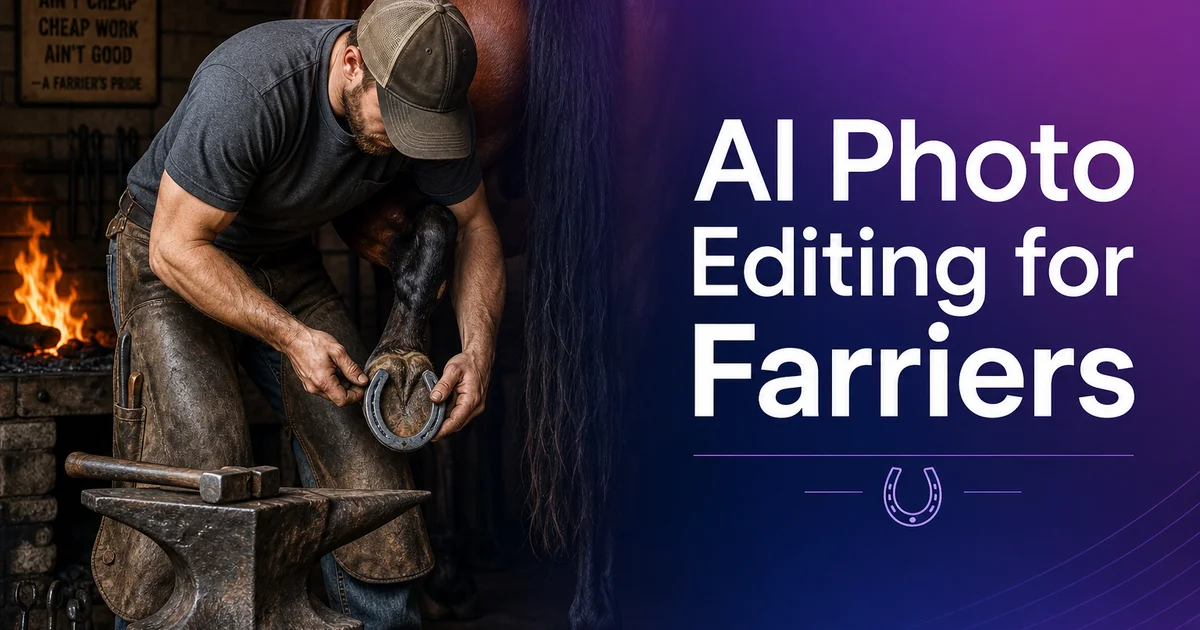
Farriery is one of the most visually demonstrable skilled trades in existence — the difference between a well-trimmed, properly shod hoof and a neglected or poorly fitted one is immediately visible to trained eyes, and even horse owners with limited hoof knowledge can see the transformation when presented with clear before-and-after images. Yet most farriers dramatically underutilize visual marketing because the conditions under which they work — dim barns, dusty arenas, muddy paddocks, and uncooperative equine patients — produce photographs that fail to showcase the precision and artistry of their craft. A beautifully fitted custom shoe photographed in a dark barn aisle with hay on the floor and a manure cart in the background does not communicate the same quality as that same shoe photographed with clean lighting, a clear background, and enhanced detail that reveals the precise nail placement and seamless heel fit. The gap between the quality of the work and the quality of the photography costs farriers clients every single day.
The farrier industry operates almost entirely on word-of-mouth referrals and reputation, and in the age of social media, reputation is increasingly visual. Horse owners researching farriers in their area look at Instagram portfolios, Facebook business pages, and Google Business Profile images before making initial contact. They compare the visual presentation of different farriers' work and — consciously or unconsciously — associate photographic quality with work quality. A farrier whose portfolio shows clean, well-lit, professional images of precise shoe fitting signals competence and attention to detail, while one whose images are dark, cluttered, and hard to interpret may be doing equally excellent work but communicating that quality far less effectively. The visual gap between the two does not reflect a skill gap — it reflects a photography and editing gap that AI tools can close completely.
AI photo editing tools solve the specific problems that make farrier photography difficult without requiring any photographic expertise or expensive equipment. Magic Eraser removes the barn clutter, manure, equipment, and other distractions that surround every real-world farrier workspace. AI Enhance corrects the dim lighting, color casts, and exposure problems inherent to barn interiors. Background Eraser isolates hoof close-ups on clean backgrounds for portfolio presentation and before-and-after comparisons. These tools work directly on smartphone photographs — the same phone the farrier already carries in their truck — transforming working-conditions snapshots into portfolio-quality images in seconds. This guide walks through the specific workflow for farrier photography, from capturing shots in challenging conditions through editing and organizing a professional portfolio that wins new clients.
- Magic Eraser removes barn clutter, equipment, manure, and environmental distractions from farrier work photos, focusing viewer attention entirely on hoof and shoe craftsmanship.
- AI Enhance corrects the dim lighting, color casts, and harsh shadows of barn interiors, revealing critical details like nail clinch placement, shoe fit, and hoof wall texture.
- Background Eraser isolates hoof close-ups on clean backgrounds for portfolio images and side-by-side before-and-after comparisons that visually demonstrate the transformation.
- All editing works on smartphone photos taken in real working conditions — no professional camera, studio lighting, or photography expertise required.
- Farriers with professional-quality visual portfolios consistently report that potential clients cite photography as a deciding factor when choosing between competing farriers in their area.
Photography techniques for capturing farrier work in barn and field conditions
The single most important farrier photography technique is capturing the before image at the same angle and distance as the after image, because the transformative power of your work only becomes visible when viewers can directly compare the two states. Before you begin trimming or shoeing, take a standardized set of photographs: a lateral view of each hoof showing the hoof-pastern axis, a solar view from below showing the sole and frog condition, a frontal view showing medial-lateral balance, and a full-body standing shot showing overall conformation and stance. After your work is complete, replicate each of these angles as precisely as possible. Consistency in angle, distance, and framing between before and after shots is more important than any other photographic factor, because it eliminates variables and lets the viewer attribute all visible changes to your work rather than to differences in camera position.
Lighting in barns is almost universally terrible for photography — overhead fluorescent or sodium fixtures cast greenish or orange color over everything, natural light from barn doors creates extreme contrast between bright and shadow areas, and the interior surfaces of most barns absorb rather than reflect light, keeping ambient levels low. The most effective quick fix is to position the horse near the barn door but facing inward, so the natural daylight illuminates the hooves from the side rather than backlighting them. If you must work deeper inside the barn, use your smartphone's flashlight or a cheap clip-on LED video light to add fill light from the side opposite the overhead fixture. AI Enhance will correct color casts and exposure problems afterward, but starting with reasonable light levels gives the AI more detail to work with in the original image.
Timing your shots around the horse's behavior is crucial because horses rarely stand still and perfectly square for more than a few seconds. Ask the handler to position the horse squarely on a level surface and then capture multiple burst-mode frames during the brief moment of stillness. For hoof close-ups, the best time is immediately after you set the foot down from the hoof stand — the horse is momentarily still and the hoof is clean from your work. For solar views, either photograph the hoof while it is still on the hoof stand with the sole facing your camera, or lift the foot yourself with one hand and shoot with the other. Practice one-handed smartphone photography so you can hold a hoof in your left hand and capture a sharp image with your right — this is an essential farrier photography skill.
- Standardize before-and-after angles: lateral for hoof-pastern axis, solar for sole and frog, frontal for medial-lateral balance, and full-body for overall stance and conformation.
- Position the horse near the barn door facing inward for natural side lighting, or add a clip-on LED fill light when working deeper inside dim barns.
- Use burst mode during the brief moments of stillness, and practice one-handed smartphone photography so you can hold a hoof while shooting with the other hand.
- Capture solar views on the hoof stand while the sole faces your camera, giving you a stable platform and clean lighting angle for this critical portfolio shot.
Cleaning up farrier photos with Magic Eraser and Background Eraser
Every farrier workspace contains visual distractions that compete with the actual work for the viewer's attention. Barn aisles have cross-tie chains, grooming tools, feed buckets, wheelbarrows, pitchforks, and scattered hay or shavings. Outdoor workspaces have truck bumpers, anvils, forge setups, toolboxes, extension cords, and other horses or dogs wandering through the background. Even the horse itself may be wearing splint boots, bell boots, or leg wraps that partially obscure the hooves you are trying to showcase. Magic Eraser removes all of these distractions without affecting the hoof and shoe work that is the focus of your image. Systematically erase background clutter starting with the largest objects and working toward smaller details until the background reads as a clean neutral space that does not pull attention away from your craftsmanship.
Hoof close-up images benefit from particularly aggressive cleanup because small debris items that would be invisible in a full-body shot become prominent distractions at close range. Bedding shavings stuck to hoof dressing, dirt packed into the white line, straw caught between the shoe and the hoof wall, and old nail holes from previous shoeing cycles all create visual noise that detracts from the clean precise appearance of your fresh work. Magic Eraser removes these minor imperfections so the image shows the idealized clean version of your work — the same view that a veterinarian or horse owner would see after carefully cleaning the hoof for a formal examination. This is not misrepresenting your work; it is presenting it at the same standard of cleanliness that you would use for a veterinary evaluation.
Background Eraser creates the cleanest possible presentation by removing the entire background and placing the hoof on a white or transparent surface. This is the gold standard for farrier portfolio images because it eliminates all environmental context and presents your work with the clinical clarity of a veterinary radiograph. Isolated hoof images are particularly powerful for before-and-after comparisons — place the pre-work and post-work hooves on identical white backgrounds and the viewer's eye immediately focuses on the changes your work has made. These comparison pairs are the single most effective marketing asset a farrier can create, because they make the invisible visible: horse owners who would not otherwise notice the difference between adequate and excellent farrier work can see it immediately when presented with clean side-by-side comparisons.
- Remove barn clutter systematically from largest objects to smallest details — wheelbarrows, tools, hay, manure — until the background reads as a clean neutral space.
- Clean up hoof close-ups by erasing bedding shavings, dirt, straw debris, and old nail holes that become prominent distractions at close viewing distance.
- Background Eraser on white creates clinical-clarity isolated hoof images ideal for before-and-after comparison pairs that visually demonstrate your work's transformative impact.
- Before-and-after comparison pairs on matching clean backgrounds are the single most effective marketing asset for farrier businesses.
Enhancing hoof detail and correcting barn lighting with AI Enhance
The details that distinguish excellent farrier work from adequate farrier work are often subtle and easily lost in poor photography: the precise placement of nail clinches in a uniform line at the correct height, the seamless contact between shoe and hoof wall with no daylight visible at the interface, the smooth rasp finish on the hoof wall without flat spots or gouges, the correct angle of heel expansion relative to the frog, and the balanced proportions of the trimmed sole. These details are clearly visible to the naked eye under good lighting conditions, but they disappear in dim barn photographs where underexposure, noise, and color casts reduce everything to a muddy indistinct mess. AI Enhance recovers these critical details by intelligently brightening shadow areas, reducing noise without losing edge definition, and bringing out the texture and tone differences that make fine craftsmanship visible.
Color correction is particularly important for farrier photography because accurate colors communicate material quality and condition. A freshly fitted steel shoe should appear bright silvery-gray, not the sickly yellow-green that sodium barn lighting produces. Healthy hoof wall should show its natural dark gray, brown, or striped coloring, not the washed-out pale gray that underexposure creates. The sole should show the distinction between hard waxy live sole and softer chalky dead sole that your trimming has correctly preserved. Frog tissue should appear in its natural dark rubbery color and texture. AI Enhance neutralizes the artificial color casts from barn lighting and restores accurate color representation so that viewers — including veterinarians and trainers who evaluate your work by looking at these images — see the hoof in colors that match what they would see in person under natural daylight.
Exposure balancing solves the high-contrast problem that plagues almost every barn interior photograph. When a horse stands in a barn aisle with an open door at one end, the camera's automatic exposure either properly exposes the bright outdoor area and leaves the horse in near-darkness, or properly exposes the horse and completely blows out the bright background. AI Enhance applies intelligent tone mapping that recovers detail in both the shadow and highlight regions, bringing the horse and hoof detail up to visible levels while keeping the bright areas from turning into featureless white blowouts. The result looks like the photograph was taken under the kind of evenly distributed studio lighting that no barn has ever had — properly exposed throughout the frame with every detail visible and legible.
- AI Enhance recovers subtle craftsmanship details — nail clinch placement, shoe-hoof contact, rasp finish quality — that distinguish excellent work but disappear in dim barn photography.
- Color correction neutralizes sodium and fluorescent barn lighting casts, restoring accurate steel, hoof wall, sole, and frog colors that match natural daylight appearance.
- Exposure balancing uses intelligent tone mapping to recover detail in both dark barn interiors and bright door-lit backgrounds simultaneously.
- Enhanced images show hoof condition and shoe fit with the same clarity that veterinarians and trainers expect when evaluating farrier work in person.
Building a farrier portfolio and social media presence that wins equine clients
Organizing your edited images into a structured portfolio demonstrates the breadth and depth of your farrier skills in a format that horse owners and barn managers can quickly evaluate. Create distinct portfolio sections for each service category: routine maintenance trimming and shoeing, corrective shoeing for conformation issues, therapeutic shoeing for laminitis and navicular syndrome, custom forge work and specialty shoes, barefoot trimming programs, and emergency repair work. Within each section, lead with your strongest before-and-after pairs that show the most dramatic transformations. Include a variety of horse breeds and hoof conditions to show potential clients that you have experience with different foot types — a sport horse with long thin walls presents very different challenges than a draft horse with thick heavy feet, and showing competence across the range builds confidence in your abilities.
Social media posting for farriers works best as a consistent stream of educational content rather than pure self-promotion. Horse owners engage most with posts that teach them something about hoof care while simultaneously showcasing your expertise. A before-and-after image pair accompanied by a caption explaining what was wrong with the hoof, what corrective approach you chose, and what outcome the horse owner can expect is both educational content and portfolio demonstration simultaneously. Use your AI-enhanced close-up images to point out specific details in the caption — the nail clinch line, the breakover point, the heel support — training your audience to notice the quality indicators that differentiate your work. Over time, this educational approach positions you as a knowledgeable authority rather than just another service provider, and horse owners naturally prefer to hire the farrier who clearly understands and can articulate the science behind their decisions.
Google Business Profile optimization with professional photography directly affects whether horse owners find and contact you when searching for farriers in your area. Upload your best AI-enhanced images to your Google Business Profile listing, ensuring that the first image a potential client sees is a clean, well-lit before-and-after comparison that demonstrates the quality of your work. Include images of your mobile setup — your truck, forge, and tools — to reassure potential clients that you are properly equipped. Add images showing you working with different horse breeds and in different settings to communicate versatility. Farriers who maintain Google Business Profiles with professional-quality photography consistently rank higher in local search results because Google's algorithm favors listings with more and higher-quality images, and potential clients who see professional images are more likely to click through and make contact.
- Organize portfolio sections by service category — maintenance, corrective, therapeutic, custom forge work, barefoot, and emergency — with strongest before-and-after pairs leading each section.
- Post educational content that teaches hoof care while showcasing expertise, using AI-enhanced close-ups to point out quality indicators like nail clinch lines and breakover points.
- Optimize Google Business Profile with professional AI-enhanced images to rank higher in local farrier searches and increase click-through rates from horse owners.
- Show variety in horse breeds and hoof conditions across your portfolio to demonstrate versatility and build confidence across the full range of potential client needs.
Specialized photography for corrective and therapeutic farrier cases
Corrective and therapeutic farrier work produces the most dramatic before-and-after transformations and therefore the most compelling portfolio content, but these cases also require the most careful photographic documentation to show what changed and why it matters. A laminitic hoof with a severely rotated coffin bone, a club foot with an upright hoof-pastern axis, or a hoof with severe medial-lateral imbalance all present conditions where your corrective work produces visible structural improvement over a series of shoeing cycles. Documenting these cases requires standardized serial photography — the same angles and distances at each visit over weeks or months — so the progressive improvement is clearly visible. AI Enhance is particularly valuable for these serial images because it normalizes the lighting and color across photographs taken on different days in different conditions, ensuring the visual comparison reflects actual hoof changes rather than photographic variations.
Radiographic correlation adds tremendous credibility to therapeutic farrier case documentation. When veterinarians take lateral radiographs of problem hooves, photograph the radiograph on the light box alongside your close-up image of the external hoof from the same angle. The paired images show the internal bone alignment that your external trimming and shoeing is designed to address, making the connection between your work and the horse's structural improvement visible to non-professionals. AI Enhance can improve the clarity of photographed radiographs by enhancing contrast between bone and soft tissue, and Magic Eraser can clean up the light box background so the radiograph appears on a clean field. These radiograph-plus-hoof pairs are the most powerful case study images a farrier can create because they demonstrate that your work is guided by veterinary diagnosis and anatomical understanding.
Veterinary referral relationships are strengthened when you can provide the referring veterinarian with professional-quality photographic documentation of your work on their patients. After completing corrective or therapeutic shoeing on a veterinary-referred case, send the vet a set of your AI-enhanced before-and-after images showing the hoof condition at the start and the improvement your work has achieved. These images become part of the horse's medical record and demonstrate to the veterinarian that you are thorough, detail-oriented, and invested in documenting outcomes. Veterinarians who receive this level of professional documentation from their farrier referrals are far more likely to continue and expand those referral relationships, and they often share the images with horse owners as evidence that the treatment plan is progressing — giving your professional photography direct visibility to the people who make hiring decisions.
- Standardize serial photography across shoeing cycles for corrective cases, using AI Enhance to normalize lighting and color so visual comparisons reflect actual hoof changes.
- Pair photographed radiographs with external hoof close-ups from matching angles to show the bone-alignment connection between internal structure and your external corrective work.
- Send AI-enhanced before-and-after documentation to referring veterinarians to strengthen referral relationships and contribute professional images to the horse's medical record.
- Corrective and therapeutic case studies with progressive serial documentation are the most compelling portfolio content and the strongest driver of veterinary referral expansion.
Sources
- American Farriers Association: Marketing Best Practices for Farrier Businesses — American Farriers Association
- Visual Marketing in Skilled Trades: Photography and Social Media for Service Businesses — U.S. Small Business Administration
- Equine Industry Marketing Trends: Digital Presence and Client Acquisition — Equine Business Association