
Magic Eraser + Substack: Newsletter Hero Photos, Notes, and Email Inline Imagery
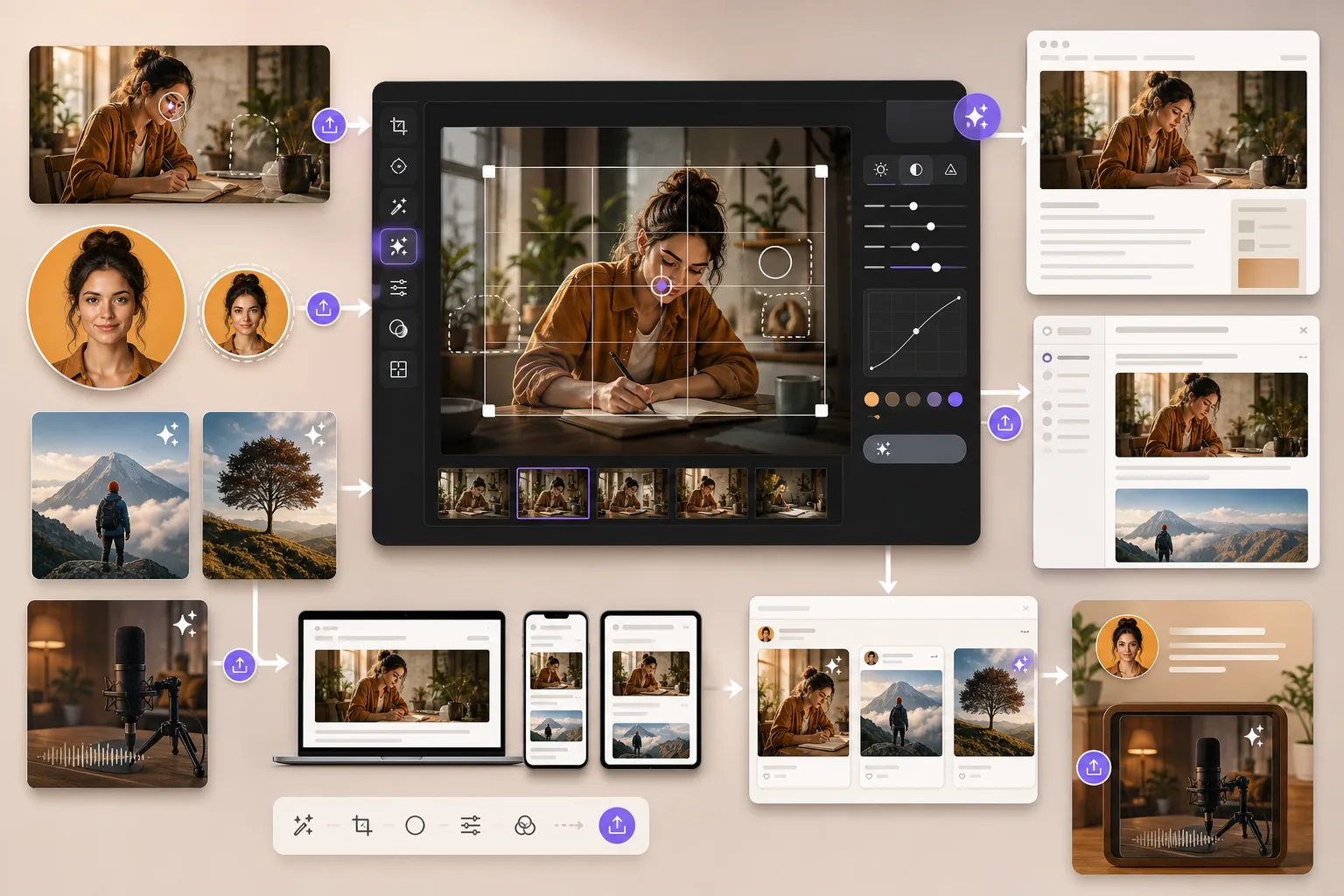
Substack is the dominant direct-to-audience publishing platform for writers, journalists, podcasters, and indie creators — 35M+ active subscribers across 2M+ paid subscriptions powering the long-form newsletter economy. The platform's visual surfaces span post hero images (1456×816 recommended), author bio photos, Notes (Substack's microblog feed at 1080×1080 or 4:5 portrait), Chat thumbnails, podcast episode covers for Substack Podcast, and email-newsletter inline imagery that renders across every email client subscribers read in. Magic Eraser preps the full Substack image stack — phone-to-publish in minutes per asset — without a designer on staff.
About Substack
Substack is the leading newsletter-and-direct-publishing platform with 35M+ active subscribers and 2M+ paid subscriptions across 25,000+ paying-subscriber publications. The platform's visual surfaces span post hero images (1456×816 recommended for the post-page render, downsampled for email-thumbnail and recommendation-feed renders), author photos (renders across publication pages, post bylines, About sections, email signatures), section dividers (publication-specific imagery for editorial section breaks), Notes (Substack's microblog feed at 1080×1080 square or 4:5 portrait 1080×1350, displayed in the home feed and notification surfaces), Chat thumbnails for subscriber-only Chat threads, Substack Podcast cover art (3000×3000 — same dimension as Apple Podcasts), and email-newsletter inline imagery (variable per template, with the email client rendering at 600px wide for most major clients including Gmail / Apple Mail / Outlook).
Benefits
Post hero photos that survive Substack's multi-render pipeline
Substack's post hero image renders at 1456×816 on the post page (full-bleed at the top of the post), at smaller thumbnail sizes in the recommendation feed and home page, in the email-newsletter delivery (typically 600px wide rendered to subscribers' inboxes), and at social-share preview dimensions (1200×630 OG image for Twitter/X, LinkedIn, Facebook share cards). Each render needs the subject of the photo to remain legible at the target size. Magic Eraser preps post heroes with AI Fill outpaint extending the source photo to 1456×816 with subject roughly centered (so smaller crops still include the subject), Background Eraser for clean isolated subjects, AI Enhance for sharpening low-light phone-camera source, and AI Filter for the publication's consistent color grade across every post hero.
Author photos that work across publication pages, bylines, and email signatures
Substack author photos render in multiple surfaces with different aspect-ratio assumptions: square crop on the publication About page (typically 200×200 or larger), circular crop on post bylines and comment threads (200×200 displayed at 40-60px), email-signature image at the bottom of newsletter deliveries (variable per template). Each render needs the photo to read clearly at the smallest display size — typically a 40-60px circular byline crop where the subject's face needs to fill the frame. Magic Eraser preps author photos by Background Eraser for clean isolated face on brand-color background, AI Enhance for crisp render at 200×200 even when downsampled to 40-60px byline, and Magic Eraser brush for light blemish cleanup. The same prepped author photo serves every Substack surface plus the rest of the writer's platform footprint (LinkedIn, X, conference speaker bios, press features).
Notes content with the consistent visual identity Substack's microblog rewards
Substack Notes — the platform's microblog feed launched 2023 — is the discovery surface that drives a meaningful fraction of paid-subscription conversions for active publications. Notes images render at 1080×1080 square or 4:5 portrait 1080×1350 in the home feed, where they compete with text-only Notes for attention and where image-bearing Notes get measurably higher engagement than text-only equivalents. Magic Eraser preps Notes imagery from the writer's existing photo library: AI Fill outpaints source to square or 4:5 portrait, Background Eraser swaps cluttered backgrounds for the publication's brand-color, Magic Eraser brush handles distraction cleanup, AI Filter applies the publication's color grade. For writers posting 3-7 Notes per week to compound discovery, the AI batch workflow handles the per-Note image prep in 2-5 minutes per Note versus 15-30 minutes manually.
Email-newsletter inline imagery that renders across Gmail, Apple Mail, and Outlook
Newsletter inline imagery is the most-viewed surface of any Substack publication — every subscriber sees inline images at email-delivery time, in their inbox-app, on their phone, on their laptop, multiple times if they archive and re-read. The technical constraint: email clients render inline images at 600px wide for the most-common templates, with subscribers reading on screen sizes ranging from 320px mobile to 1920px desktop. Inline images need to read clearly at the 600px standard while still looking sharp at desktop client widths. Magic Eraser preps inline imagery at 1200×600 (which renders at 600px wide while supporting retina display at 2x), with the same Background Eraser + AI Enhance + AI Filter recipe applied for visual consistency across the publication's full email archive over months and years.
How to Use Magic Eraser with Substack
Identify the image's role across Substack surfaces
Before opening any editor, decide what the image is doing on Substack: post hero image (1456×816 recommended, downsampled to recommendation-feed thumbnail + email-delivery render + 1200×630 OG share card), author photo (200×200 square cropped to circle for bylines at 40-60px), Notes image (1080×1080 square or 4:5 portrait 1080×1350), Chat thumbnail (variable), Substack Podcast cover (3000×3000 square — same dimension as Apple Podcasts), section divider (variable per publication design), or email-newsletter inline image (1200×600 source for 600px render in email clients). Each role has different framing and editing priorities. Substack serves automatic WebP and responsive image renders downstream, so the source upload should be the highest-quality version — don't pre-compress.
Prep post hero images with the publication's consistent color grade
Open the source photo for the post hero in Magic Eraser. AI Fill outpaints if the source isn't already 16:9 or close to it (Substack's hero render is approximately 16:9 at 1456×816). Background Eraser swaps backgrounds if the subject needs isolation on a brand-color solid. AI Enhance recovers detail and sharpens. AI Filter applies the publication's color-grade preset for visual consistency across the full archive of posts. Magic Eraser brush handles any per-photo cleanup. Save the AI Filter preset as the publication's standard recipe so every post hero uses the same color treatment — visual consistency across the publication's archive is the single biggest brand-recognition lever for subscribers scrolling the archive.
Prep the master author photo for use across every Substack surface
From one master author headshot (shot in a focused 30-45 minute session producing 4-6 angles), prep the Substack-specific variants: Background Eraser swaps to brand-color background, AI Enhance produces the 200×200 crisp render that survives downsampling to 40-60px byline crop, Magic Eraser brush handles any light blemish cleanup. Export at 400×400 or higher so Substack's responsive image pipeline has retina-display resolution to work with. The same master headshot library serves the rest of the writer's platform footprint — LinkedIn profile, X profile, conference speaker bios, press features — so the visual identity stays coherent across every surface the writer appears on.
Batch Notes imagery from the writer's existing photo library
Substack Notes drives discovery — writers posting 3-7 Notes per week compound subscriber growth measurably faster than writers posting weekly long-form alone. The image-bearing Notes outperform text-only Notes on engagement. From the publication's existing photo library (post heroes from past archive, original photography, licensed stock), batch-produce Notes imagery: AI Fill outpaints to square 1080×1080 or 4:5 portrait 1080×1350, AI Filter applies the consistent publication color grade, Magic Eraser brush handles distraction or watermark cleanup. For writers posting Notes daily, the batch workflow runs in 10-20 minutes per week versus 60-90 minutes manually.
Prep email-newsletter inline imagery at the 1200×600 source standard
Email-newsletter inline imagery renders at 600px wide in most email clients (Gmail, Apple Mail, Outlook, Yahoo) regardless of subscriber device. Prep inline images at 1200×600 source (double-resolution for retina-display support), with the subject clearly readable at the 600px render and the composition working at both retina and standard renders. AI Fill outpaints source photos to 2:1 aspect, Background Eraser maintains brand-color consistency, AI Enhance handles sharpening, AI Filter applies the publication's grade. For a typical post with 3-5 inline images, the batch workflow runs in 10-15 minutes versus 30-45 minutes manually. The discipline pays back across every newsletter delivery and every email-archive view over years.
Frequently Asked Questions
Does Magic Eraser have a direct Substack integration?
+
No native plugin — Magic Eraser is a web/iOS/Android image editor that runs outside the Substack post editor. The workflow is: prep images in Magic Eraser, export at full resolution (PNG or JPEG), then upload to Substack through the standard image-upload flow in the editor. Substack's image pipeline handles the WebP conversion, responsive srcset, and CDN distribution from there. For most writers, the lack of a direct plugin isn't a friction — image prep happens in batches at a different point in the workflow than post writing, and the separation actually helps with consistency (one editing session per week's image batch, then per-post uploads as posts ship).
What's the optimal post hero source-image size for Substack?
+
Substack recommends 1456×816 as the source for the post hero image, which gives the platform enough resolution for the post-page full-bleed render and the responsive downsampling to recommendation-feed thumbnails, email-delivery render, and 1200×630 OG share card. Magic Eraser's AI Fill outpaint solves the common composition problem of phone-camera source photos that aren't natively 16:9 — start with whatever source you have, AI Fill out to 1456×816 with margin to spare, and Substack's responsive pipeline handles the downsampling across every render context cleanly.
Should I upload pre-compressed images to Substack?
+
No. Upload the highest-quality source — Substack's image pipeline serves automatic WebP, builds responsive srcset for every breakpoint, and applies its own compression based on viewport and connection. Pre-compressing images before upload (saving as 80% JPEG, for instance) just compounds with Substack's own compression and produces visibly worse output at every render size. Magic Eraser exports at full quality by default — keep that quality through the upload step and let Substack handle downstream optimization.
How do I keep visual consistency across a publication's full archive over years?
+
Define the publication's visual recipe upfront and save it as a Magic Eraser preset: one AI Filter color-grade preset for the photographic-look identity, one Background Eraser brand-color palette, one composition discipline for hero photos (subject-centered, subject-left, subject-right based on the publication's editorial voice). Apply the same recipe to every post hero, every Notes image, every email-inline image. Over months and years, the cumulative recipe discipline produces an archive that reads as one coherent body of work — which signals editorial seriousness to new subscribers browsing the archive and reinforces returning-subscriber recognition.
Can I prep Substack Podcast cover art with Magic Eraser?
+
Yes. Substack Podcast cover art uses the same 3000×3000 square dimension as Apple Podcasts and Spotify (covered in detail by the podcaster-cover-art-ai-workflow blog post on the same site). The cover renders at 3000×3000 on the podcast landing page, at smaller sizes in the Substack home feed and podcast directory, and at thumbnail size in directory-list contexts. Magic Eraser's cover-prep workflow: AI Fill outpaints the source photo to 3000×3000 square, Background Eraser applies the publication's brand color, AI Enhance sharpens for crisp render at thumbnail size, and title typography at 80-100pt proportional carries the show title. Run the 100×100 thumbnail test before publishing — Substack Podcast renders at thumbnail size in feed where the cover competes for attention against other podcasts and other Substack content.
How does this compare to using Substack's built-in image editor?
+
Substack's built-in image editor handles upload, cropping, and basic positioning — useful for in-the-moment adjustments inside the post editor. Magic Eraser handles operations Substack's editor doesn't: object removal (distractions, unintended people in the frame, watermarks from stock-photo sources), background swap (cluttered home backgrounds to clean brand-color), AI Fill outpainting (extending source photos to the 1456×816 hero aspect or 1080×1080 Notes aspect), and AI Enhance (upscaling and sharpening low-light phone photos to retina-display resolution). The right shape is sequential: prep in Magic Eraser first for the major transforms, then use Substack's editor for the final upload and positioning.
What about email-newsletter design constraints across different email clients?
+
Inline images in Substack email deliveries render at 600px wide across the most-common email clients (Gmail, Apple Mail, Outlook, Yahoo Mail), regardless of subscriber device. The constraint to design for: subject visibility at 600px render, retina-display sharpness for users on iPhone / iPad / high-DPI desktop screens (which means uploading 1200×600 source for 600px display), high-contrast composition that doesn't rely on subtle gradients (some email clients render gradients poorly), and conservative file sizing (Gmail clips emails larger than 102KB total, so individual images should be 80-150KB max). Magic Eraser's full-quality export combined with Substack's downstream optimization typically produces inline images in the 100-200KB range — within the Gmail clip threshold and supporting retina render across modern email clients.
Newsletter visual identity without a designer
Magic Eraser preps post hero images, author photos, Notes content, Substack Podcast covers, and email-newsletter inline imagery with one consistent editing approach — phone-to-publish in minutes per image. Free tier on web, iOS, and Android.
Try Magic Eraser freeRelated use cases
See how professionals use these tools in real-world workflows.
Listing photos cluttered with personal items, parked cars, or construction equipment can turn buyers away. Magic Eraser uses AI to clean up your property photos instantly — no Photoshop skills required.
Product listings need clear images before shoppers can judge the item. Magic Eraser helps sellers remove messy backgrounds, table edges, labels, props, glare, and other distractions so each product photo is easier to review before publishing.
Photobombers ruining your travel pics? Messy backgrounds killing your selfie game? Stop wasting hours in Photoshop. Magic Eraser removes distractions, cleans up cluttered shots, and expands your photos to fit any platform format — all in one tap.
Related comparisons
See how Magic Eraser compares to similar tools.
TouchRetouch is a popular paid mobile app for removing objects and blemishes. Magic Eraser offers free AI-powered editing on any device with no install required. See how they compare across features, pricing, and ease of use.
Cleanup.pictures is a free web tool with one generic eraser brush. Magic Eraser gives you 100+ purpose-built removal tools — one for emoji, glasses, watermarks, sky, power lines, and dozens more — plus background removal, AI enhance, and mobile apps, in 16 languages. See how breadth changes the result.
remove.bg is the market leader for background removal, offering a powerful API and integrations with Photoshop and Figma. Magic Eraser goes further with eight AI-powered editing tools — from object removal and generative fill to AI enhance and design — all in one editor.
Two powerful AI photo editors with different strengths. Magic Eraser offers a broader set of generative AI tools for creative editing, while Photoroom excels at e-commerce product photography and batch processing. See which fits your workflow.
Related articles
Tips, guides, and tutorials related to this topic.
Learn how to use Magic Eraser to remove objects, people, text, and distractions from photos with cleaner AI editing results.
Learn how to remove people from photos using AI in seconds. Step-by-step guide for travel photos, real estate shots, and product images.
Step-by-step guide to removing watermarks from your own photos using AI. Learn when it is appropriate, the best techniques, and how Magic Eraser handles it.
Other integrations
Explore more platforms that work with Magic Eraser.