
Remove Screen Glare From Photos
Window light, ring lights and overhead bulbs leave a white hotspot or mirror-like reflection across phone, laptop, monitor and TV screens — and it usually lands right where the content matters. Magic Eraser wipes the glare and reconstructs a clean, readable screen in seconds.
Last updated
Remove glare now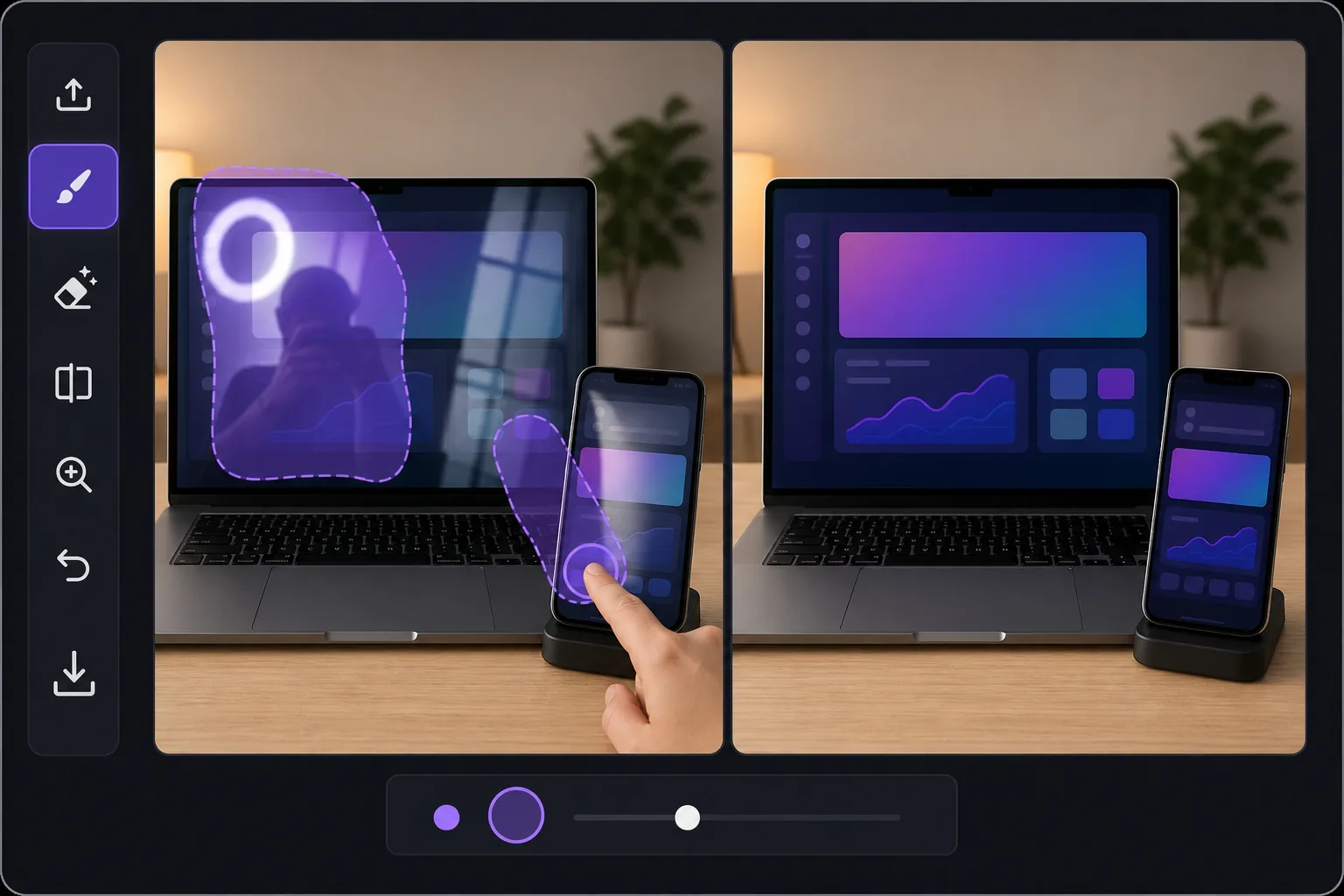
Why screen glare is harder than ordinary glare
Glare on a glossy display is a special problem. Phones, laptops, tablets, monitors and TVs are mirrors when they are dark, and they blow out to pure white when light hits them at the wrong angle. In product shots and how-to tutorials, that hotspot or reflection sits directly over the UI, the app screen, or the thing you are trying to show — so a viewer can't read the interface or see the demo. Reshooting means re-staging the device, dimming lights, and chasing the reflection around the room. Magic Eraser skips all of that. Brush over the bright streak, the reflected window, or even your own silhouette caught in the screen, and the AI removes it. Because this is inpainting, it does not recover the literal pixels that were hidden under the glare — it synthesizes a plausible, glare-free continuation of the surrounding screen, bezel and on-screen content. For a uniform wallpaper, a solid app background, or a simple gradient that looks seamless. For dense, specific UI text buried under a full white-out, treat it as a believable clean-up rather than a perfect copy of what was there.
Before you start
Remove screen glare in 3 steps
Start with upload your screen photo. The result preview above and tips below use this guide's existing content; no separate before-and-after proof is assumed.
- 1
Upload your screen photo
Open Magic Eraser on web, iOS or Android and add the photo of the phone, laptop, monitor or TV. High-resolution shots give the AI more surrounding screen detail to rebuild from.
- 2
Brush over the glare or reflection
Paint across the white hotspot, the mirrored window, the lamp streak, or your reflection in the display. Stay tight to the bright area so you keep the readable parts of the screen intact.
- 3
Preview, refine and export
Let the AI reconstruct the screen, then check the edge of the bezel and any on-screen text. Re-brush leftover shine if needed, then download in full resolution with no watermark.
Best for
- Product photos of phones and tablets where a window or ring light hotspot covers the app on screen
- Laptop and monitor shots for how-to tutorials, with overhead-light glare washing out the interface
- TV and smart-display listings where reflections of the room hide what's playing
- Removing your own silhouette or camera caught reflected in a dark, glossy screen
- E-commerce and marketplace device listings that need a clean, glare-free display to look trustworthy
Tips for cleaner screen reconstructions
Work in zoomed-in passes rather than one big stroke — small, accurate brushing over the glare protects the surrounding UI and bezel. If a reflection has soft edges, include the faint halo around the hotspot so no gray smear is left behind. For partially blown-out screens, erase the glare first, then judge what's left: if real content survives at the edges, the AI blends it convincingly; if the whole screen is white, expect a believable synthesized fill, not the exact original interface. When the screen shows simple, repeating content (a solid color, wallpaper or plain background), results look near-flawless. For critical UI text or a chart you must show accurately, the cleanest route is to erase glare on a re-shot, dimmer image — and let Magic Eraser handle the residual shine.
Frequently asked questions
- Can Magic Eraser recover what was hidden under the screen glare?
- Not literally. The bright glare destroys the pixels underneath, so the AI inpaints a plausible, glare-free reconstruction based on the surrounding screen, bezel and content. It looks seamless on simple backgrounds and wallpapers; for dense, specific UI text under a full white-out, treat it as a believable clean-up rather than an exact copy.
- Does it work on phone, laptop, monitor and TV screens equally?
- Yes. The same brush-and-erase workflow handles any glossy display — smartphones, tablets, laptops, desktop monitors and TVs. Larger, higher-resolution screen photos give the AI more context to rebuild a clean surface, and uniform on-screen content reconstructs most convincingly.
- Is Magic Eraser free to start?
- Yes. There's a free tier on web, iOS and Android, and exports have no watermark. You can remove screen glare and reflections with limited free edits after sign-in.