
Remove an Unwanted Object in Adobe Photoshop — or Erase It in 1 Click
The Adobe Photoshop method genuinely works, but it takes selections, layers, and patience. Magic Eraser does the same job in seconds: brush over the object, erase, done — free, no install, right in your browser.
Last updated
Erase an object free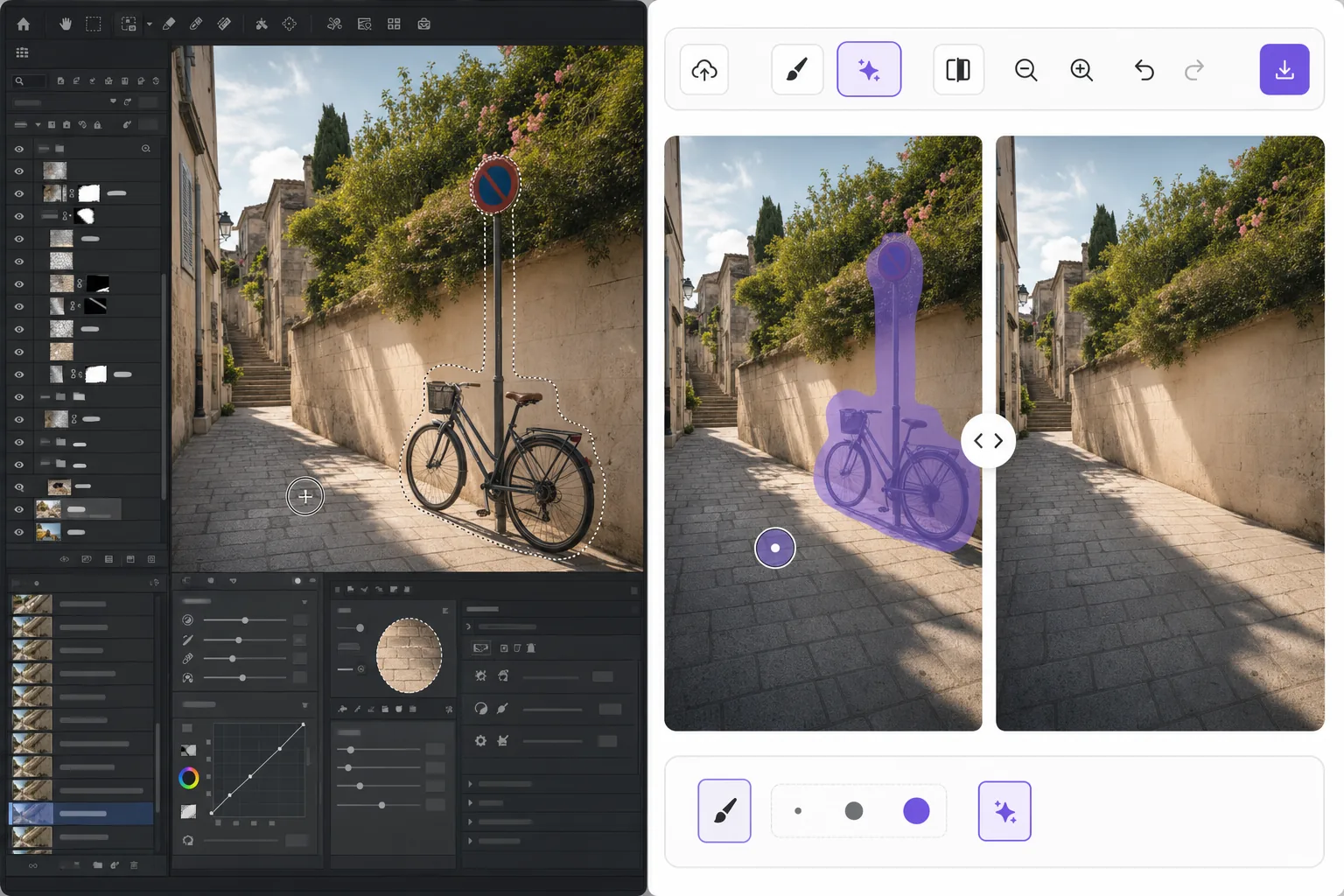
Two ways to remove an unwanted object
Searching for how to remove an unwanted object in Adobe Photoshop usually leads to a multi-step tutorial: make a selection around the object, then use Content-Aware Fill or the Clone Stamp and Spot Healing tools to paint over it with surrounding pixels. Adobe Photoshop is a powerful, professional editor and this approach produces excellent results — especially when you want frame-by-frame control over textures, edges, and shadows. The trade-off is the learning curve and the time: you need a paid Adobe subscription, the app installed, and several minutes of careful selecting and retouching per object. Magic Eraser takes the honest shortcut. Instead of selections and layers, you brush over the unwanted object and let AI inpainting reconstruct a plausible background fill. It runs in any browser plus iOS and Android, costs nothing to start, and handles most everyday photos — stray people, signs, wires, blemishes — in a single pass. If you need pixel-perfect compositing for a client deliverable, Photoshop is still a fine choice. For everything else, here is the faster path.
Before you start
Remove an object in 3 steps with Magic Eraser
Start with upload your photo. The result preview above and tips below use this guide's existing content; no separate before-and-after proof is assumed.
- 1
Upload your photo
Open Magic Eraser in your browser and drop in the image. No Adobe account, no install, no setup — where the Photoshop route asks you to launch the app and create selections, you just upload and start.
- 2
Brush over the object
Paint across the unwanted object with the eraser brush. Adjust the size to cover wires, signs, people, or blemishes. This replaces the Photoshop loop of lassoing a selection and configuring Content-Aware Fill sampling.
- 3
Erase and download
Tap erase and the AI inpainting fills the area with a natural-looking background in seconds. Review the result, re-brush any spot if needed, then download — a job that can take several minutes of clone-stamp retouching in Photoshop.
Best for
- Removing photobombers and strangers from travel and event photos
- Cleaning up power lines, poles, and wires from landscape shots
- Erasing signs, logos, watermarks, and date stamps
- Deleting blemishes, dust, or stray objects from product images
- Quick edits on mobile when you don't have Photoshop installed
Tips for the cleanest erase
Brush slightly beyond the object's edges so the AI has room to blend the fill, and include any contact shadow the object casts. For large objects against busy or detailed backgrounds (brick patterns, faces, repeating text), work in smaller passes and re-erase rather than covering everything at once — this gives the inpainting cleaner reference pixels. If a single result looks off, undo and re-brush; the fill is regenerated each time. And remember the honest caveat: Magic Eraser reconstructs a plausible background, it does not recover the real pixels hidden behind the object — so for forensic or pixel-exact compositing work, the manual Adobe Photoshop method still wins.
Frequently asked questions
- Is the Adobe Photoshop method better, and when should I use it?
- Yes, for some jobs. Adobe Photoshop gives you full manual control with the Clone Stamp, Spot Healing, and Content-Aware Fill, which is ideal for high-stakes retouching, complex backgrounds, or client deliverables that need pixel-perfect edges and shadows. It does require a paid subscription, the installed app, and more time. For fast everyday object removal, Magic Eraser gets you most of the way there in one click.
- Is Magic Eraser free?
- Yes, you can start removing objects for free with no install. It works in any browser and on iOS and Android, so you don't need an Adobe Photoshop license to clean up a photo.
- Does it actually recover what was behind the object?
- No — and it's important to be clear about this. Magic Eraser uses AI inpainting to generate a plausible, natural-looking fill based on the surrounding pixels. It does not reveal the real scene that was hidden behind the object. For most photos the result looks seamless, but if you need the literal hidden detail, that data simply isn't in the image.