
The Lightroom Alternative Built for AI Photo Editing
Lightroom excels at RAW processing and color grading, but it lacks AI-powered object removal and generative fill. Magic Eraser fills that gap — giving you the AI editing tools Lightroom doesn't have, without requiring an Adobe Creative Cloud subscription.
Last updated
Try Magic Eraser freeComparison rows are editorial summaries from the latest page review, not a guarantee of current pricing, limits, watermark policy, batch support, speed, or platform availability.
Overview
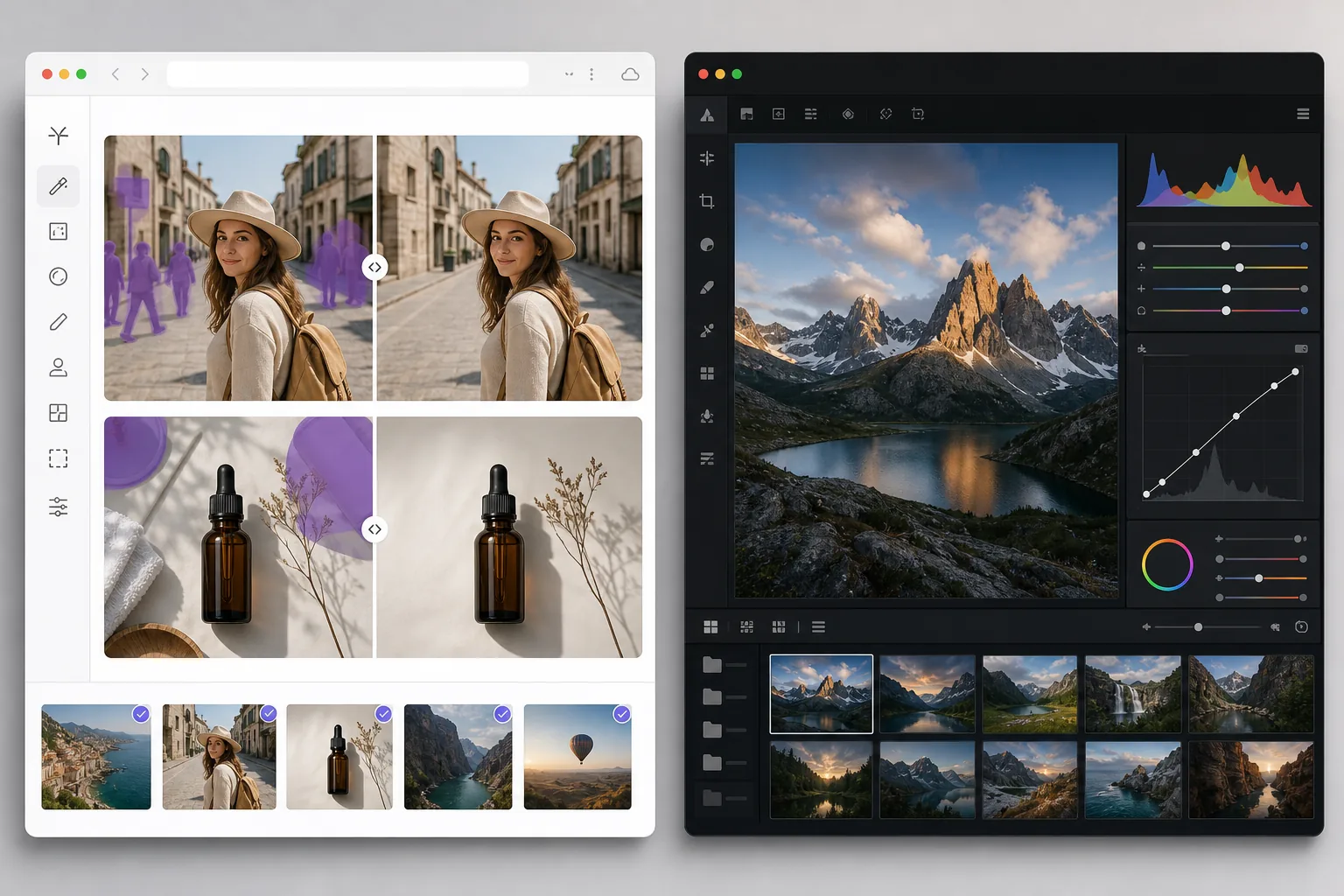
Magic Eraser specializes in AI editing tasks that Lightroom cannot do: object removal, background replacement, generative fill, AI enhancement, and intelligent batch processing. It works in any browser with no installation.
Adobe Lightroom is the industry standard for RAW photo processing, color grading, library management, and non-destructive editing. While it recently added basic AI masking, it does not offer object removal, generative fill, or background replacement.
Feature Comparison
Magic Eraser specializes in AI editing tasks that Lightroom cannot do: object removal, background replacement, generative fill, AI enhancement, and intelligent batch processing. It works in any browser with no installation.
Adobe Lightroom is the industry standard for RAW photo processing, color grading, library management, and non-destructive editing. While it recently added basic AI masking, it does not offer object removal, generative fill, or background replacement.
| Feature | Magic Eraser | Lightroom |
|---|---|---|
| Object removal | Yes — AI brush | Limited — Content-Aware Remove |
| Background removal | Yes | No |
| RAW processing | No | Yes — industry standard |
| Generative fill | Yes | No |
| Color grading | Basic | Advanced |
| Library management | No | Yes |
| Subscription required | No — free tier | Yes — Adobe CC |
| AI enhancement | Yes | AI Denoise + Enhance |
| Best for | AI cleanup & editing | RAW processing & color |
Feature rows summarize visible product positioning and should be rechecked against official product pages before purchase, migration, or compliance decisions.
- Last content review May 17, 2026
- Lightroom source: official product site (https://www.adobe.com/products/photoshop-lightroom.html)
- Magic Eraser source: https://magiceraser.live/en/product/magic-eraser
- Pricing, feature availability, platform support, and limits can change; recheck official sources before relying on a buying decision.
Why Switch to Magic Eraser for AI Tasks
AI editing Lightroom can't match
Lightroom's Content-Aware Remove is basic compared to Magic Eraser's AI brush and generative fill. For removing people, complex objects, and reconstructing backgrounds, Magic Eraser produces significantly better results.
No Adobe subscription needed
Lightroom requires an ongoing Adobe Creative Cloud subscription. Magic Eraser offers a free tier and affordable plans without locking you into the Adobe ecosystem.
Instant access from any browser
No installation, no updates, no storage management. Open Magic Eraser in your browser and start editing immediately — on any device, any operating system.
Complementary, not a replacement
Many photographers use Lightroom for RAW processing and color work, then Magic Eraser for the cleanup tasks Lightroom handles poorly. The two tools work well together.
Frequently Asked Questions
Can Magic Eraser replace Lightroom completely?
+
For RAW processing and advanced color grading, Lightroom remains stronger. For AI editing tasks — object removal, background replacement, generative fill — Magic Eraser is the better tool. Many photographers use both.
Is Magic Eraser free?
+
Yes. Magic Eraser offers a free tier. Lightroom requires an Adobe Creative Cloud subscription starting at $9.99/month (pricing as of 2026 — check Adobe for current rates).
Does Magic Eraser process RAW files?
+
Magic Eraser works with JPG, PNG, and WebP exports. Export from Lightroom or your camera's software, then use Magic Eraser for AI editing tasks.
Which produces better object removal?
+
Magic Eraser. Lightroom's Content-Aware Remove is limited to simple cases. Magic Eraser's generative fill handles complex removals with natural-looking background reconstruction.
Need AI editing that Lightroom can't do?
Try Magic Eraser free and add object removal, generative fill, and batch enhancement to your photo workflow — no Adobe subscription required.
Try Magic Eraser freeRelated use cases
See how professionals use these tools in real-world workflows.
Listing photos cluttered with personal items, parked cars, or construction equipment can turn buyers away. Magic Eraser uses AI to clean up your property photos instantly — no Photoshop skills required.
Product listings need clear images before shoppers can judge the item. Magic Eraser helps sellers remove messy backgrounds, table edges, labels, props, glare, and other distractions so each product photo is easier to review before publishing.
Photobombers ruining your travel pics? Messy backgrounds killing your selfie game? Stop wasting hours in Photoshop. Magic Eraser removes distractions, cleans up cluttered shots, and expands your photos to fit any platform format — all in one tap.
Related guides
Explore more guides and editorial content related to this workflow.
Learn how to use Magic Eraser to remove objects, people, text, and distractions from photos with cleaner AI editing results.
Learn how to remove people from photos using AI in seconds. Step-by-step guide for travel photos, real estate shots, and product images.
Step-by-step guide to removing watermarks from your own photos using AI. Learn when it is appropriate, the best techniques, and how Magic Eraser handles it.
Other comparisons
See how Magic Eraser compares to other photo editing tools.
Cleanup.pictures is a free web tool with one generic eraser brush. Magic Eraser gives you 100+ purpose-built removal tools — one for emoji, glasses, watermarks, sky, power lines, and dozens more — plus background removal, AI enhance, and mobile apps, in 16 languages. See how breadth changes the result.
Two powerful AI photo editors with different strengths. Magic Eraser offers a broader set of generative AI tools for creative editing, while Photoroom excels at e-commerce product photography and batch processing. See which fits your workflow.
We tested and compared the top AI photo editing tools so you don't have to. From object removal to background replacement, see which editor delivers the best results for your workflow.
Fotor is a capable all-round AI editor that competes on the big head-term features. Magic Eraser wins on depth: 130+ task-specific removal tools — including the emoji and sticker niches Fotor has no dedicated tool for — each tuned for that exact job. When your need is "remove THIS specific thing," the depth is the difference.
Snapseed remains a popular free mobile editor, but it depends more on manual adjustments and traditional photo tools. Magic Eraser adds modern AI workflows for users who want faster cleanup and enhancement with less effort.
Pixlr gives users a classic browser-based editing environment with layers and effects. Magic Eraser focuses on AI-first cleanup, enhancement, and background work for users who want polished results without a full editing interface.