AI Photo Editing for Chandlers: Showcase Handmade Candles — Magic Eraser
Professional candle photography editing for chandlers and candle makers. AI-powered tools for wax translucency, flame glow, container styling, scent-ingredient flat-lays, and marketplace-ready product images.
Content Lead
审稿人 Magic Eraser Editorial ·
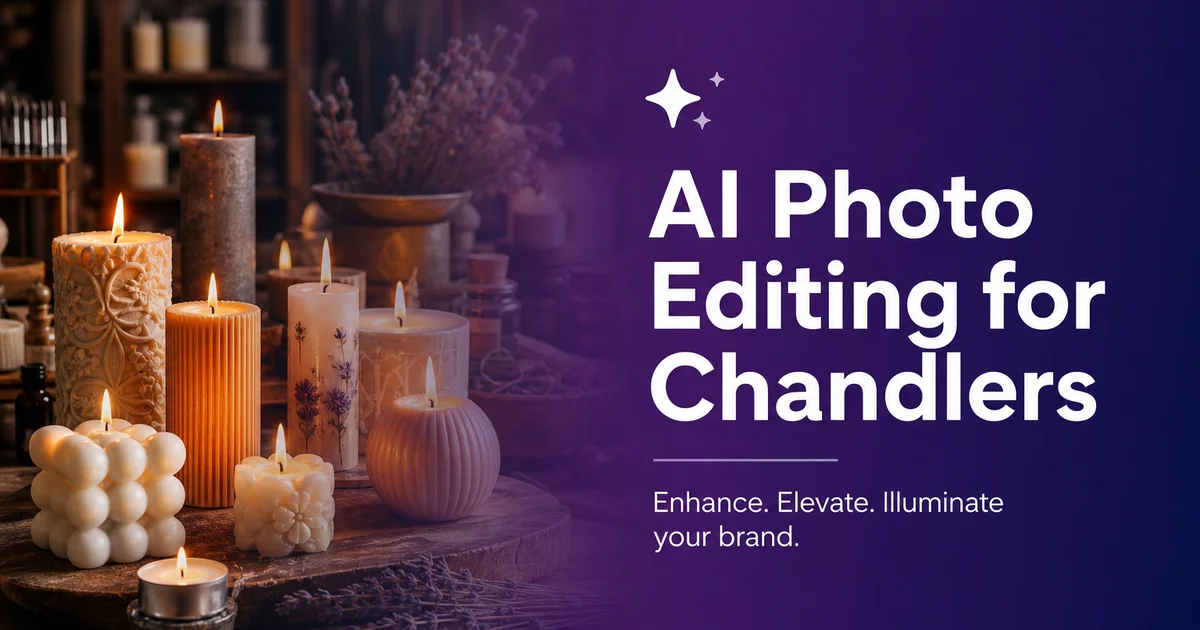
Candle making is a craft where the visual presentation of the product is inseparable from the sensory experience it promises — a customer cannot smell a candle through a screen, so the photograph must communicate fragrance, warmth, and atmosphere through purely visual means. This puts extraordinary pressure on product photography to do work that goes far beyond showing what the candle looks like. The image must convey the feeling of the lit candle in a room, the quality of the wax and the vessel, and the care that went into the handmade creation. For chandlers selling through online marketplaces, craft fairs with social media presence, and direct-to-consumer websites, the product photograph is the single most important factor in whether a potential customer stops scrolling and considers a purchase.
The technical challenges of candle photography are unique among handmade products. Wax is a translucent material that interacts with light in complex ways — it glows when backlit, shows internal color depth that flat surfaces do not, and changes appearance dramatically depending on whether the candle is lit or unlit. Glass containers create reflections and transparency effects. Flame photography requires specific exposure settings that conflict with the settings needed to show container and label detail. Colored wax shifts hue under different light sources, making color accuracy a persistent challenge. Phone cameras, which most small-batch chandlers rely on, struggle with all of these properties simultaneously, producing images that fail to capture the qualities that make handmade candles special.
AI photo editing tools solve these candle-specific photography challenges without requiring professional studio equipment or advanced technical knowledge. Background removal lets you place candles in styled settings that match your brand without building physical sets for every product shot. AI enhancement recovers the wax translucency, color accuracy, and surface detail that phone cameras compress or distort. Object removal cleans up the inevitable imperfections that close-up photography reveals on handmade products. This guide walks through the complete workflow for chandlers — from initial photography setup through editing and export — covering the specific techniques that make candle product images sell the sensory experience customers are looking for.
- Background Eraser isolates candles from workshop clutter and places them in lifestyle settings or clean studio backgrounds that communicate brand positioning and usage context.
- AI Enhance recovers the wax translucency and internal color depth that phone cameras flatten, restoring the luminous glow that makes handmade candles visually distinctive.
- Color accuracy correction ensures that pastel and earth-tone wax photographs true to its in-person appearance, preventing the customer disappointment that leads to returns and negative reviews.
- Magic Eraser removes fingerprints on glass containers, wax drips on vessel rims, wick debris, and dust particles that become distractingly visible in close-up product photography.
- Batch export creates platform-specific image sizes for Etsy, Amazon, Instagram, wholesale catalogs, and direct-to-consumer websites from a single edited master file.
Photographing candles: capturing wax translucency, flame glow, and container detail
The most important property that distinguishes candle photography from other product categories is wax translucency. When light passes through wax, it creates an internal glow that reveals the depth and quality of the material — a characteristic that premium handmade candles possess in abundance but that phone cameras consistently fail to capture. Side lighting from a low angle is the key technique: position a diffused light source beside the candle so that light enters the wax from the side rather than reflecting off the surface. This reveals the internal color richness, shows any embedded botanicals or dye patterns, and creates the luminous quality that customers associate with high-quality handmade wax. Front lighting, by contrast, bounces off the wax surface and shows only the exterior color, making an artisanal candle look no different from a mass-produced grocery store product.
Flame photography requires a different approach entirely. A burning candle needs a relatively dark environment for the flame to register properly — if the ambient light is too bright, the flame appears pale and insignificant rather than warm and inviting. Reduce the room lighting, turn off the flash, and let the candle flame serve as a primary light source. The warm glow illuminating the immediate surroundings — the wax pool reflecting light, the glass container glowing from within, the soft light falling on a nearby surface — creates the ambiance photograph that sells the experience of burning the candle. Shoot with a slightly longer exposure or increased ISO to capture this low-light warmth, accepting that the background will fall to darkness, which actually enhances the cozy intimate feeling.
Container and label photography is the third essential angle for candle product listings, and it requires the clearest, most evenly lit conditions. Customers want to read the scent name, see the container craftsmanship, evaluate the label design, and assess the overall size and proportions before purchasing. Soft, even lighting from two sides minimizes shadows and reflections on glass while maintaining enough contrast to show container texture and shape. For ceramic, concrete, or wooden vessels, slightly more directional lighting reveals the surface material quality. Photograph the candle from straight on for the label, from a three-quarter angle for vessel shape, and from directly above for wax surface and wick detail.
- Side lighting from a low angle reveals wax translucency and internal color depth that front lighting misses, distinguishing artisanal candles from mass-produced products.
- Flame photography requires reduced ambient light so the candle glow registers properly, creating the warm ambiance that sells the burning experience.
- Container and label shots need soft even lighting from two sides to minimize glass reflections while maintaining contrast that shows vessel texture and label legibility.
- Photograph every candle in three states — unlit with detail lighting, lit in ambient darkness, and flat-lay with scent ingredients — to cover all listing and social media needs.
Background replacement and lifestyle staging for candle brand positioning
The background behind a candle in a product photo communicates as much about the brand as the candle itself. A rustic wooden surface with linen and dried lavender says farmhouse and natural ingredients. A clean marble slab with geometric accents says modern minimalism. A cozy reading nook with soft blankets and a book says relaxation and self-care ritual. Most small-batch chandlers cannot afford to build and maintain multiple physical sets for different product lines and seasonal collections, but Background Eraser makes it possible to photograph candles in your workspace and place them in any setting that serves your brand story. The technical key is photographing on a contrasting surface that the AI can cleanly separate from the candle — a solid-color board that differs from your container color works reliably.
Lifestyle background selection should match both the specific scent family and the customer's intended use occasion. A cedar and sandalwood candle photographed against a cabin interior with dark wood and a fireplace mantel tells a coherent olfactory story. A lavender and chamomile candle placed in a serene bathroom setting with a freestanding tub suggests the relaxation ritual it accompanies. A citrus and herb candle in a bright kitchen with fresh produce on the counter connects scent to the space where the customer will burn it. This scent-to-setting alignment helps customers imagine the product in their own lives, which is the fundamental purpose of lifestyle product photography. The AI handles the compositing so that shadow interaction between candle and surface looks natural rather than pasted in.
Seasonal background rotation is one of the most powerful applications of AI background replacement for chandlers. The same unlit candle can be photographed once and placed in fall foliage settings for autumn collections, evergreen and snow scenes for holiday campaigns, floral garden settings for spring launches, and beach or outdoor patio scenes for summer. This multiplies your content output without requiring repeat photography sessions, and it lets you maintain visual freshness in your listings and social media throughout the year. Consistent product photography with seasonally updated backgrounds signals an active, professionally managed brand to both customers and marketplace algorithms that favor regularly refreshed content.
- Background Eraser isolates candles from workshop surfaces, enabling placement in lifestyle settings that match brand positioning without building physical photo sets.
- Scent-to-setting alignment places cedar candles in cabin interiors, lavender in spa bathrooms, and citrus in bright kitchens, helping customers imagine the product in their space.
- Seasonal background rotation lets a single product photo serve fall, winter, spring, and summer campaigns, maintaining visual freshness without repeat photography.
- AI compositing ensures natural shadow interaction between candle and replacement surface, avoiding the pasted-in appearance of manual background swaps.
Enhancing wax color accuracy and surface detail for customer confidence
Color accuracy is arguably the most consequential photo editing challenge for chandlers because candle purchases are heavily driven by color preference, and color inaccuracy is the most common reason for customer disappointment and returns. Pastel wax colors — blush pink, sage green, soft lavender — are particularly vulnerable to camera-introduced color shifts. Phone cameras auto-adjust white balance based on ambient lighting conditions, which can push warm-toned wax toward orange or cool-toned wax toward gray. AI Enhance addresses this by analyzing the overall color profile of the image and correcting systematic shifts while preserving the natural warmth that makes candle wax visually appealing. The goal is not clinical color perfection but rather accurate representation of what the customer will receive.
Surface detail enhancement recovers the tactile qualities of candle wax that phone cameras compress. Soy wax has a characteristic frosted appearance with crystalline texture. Beeswax shows a natural golden color with a slightly rough surface. Coconut wax blends produce an exceptionally smooth, creamy surface. Paraffin can be glossy or matte depending on additives. Each wax type has a distinctive surface quality that experienced candle customers recognize and use to evaluate ingredients and quality. When phone cameras flatten these textures into uniformly smooth surfaces, they erase the visual information that justifies premium pricing for artisanal wax. Enhancement brings back the surface character that tells the story of your ingredients and craftsmanship.
Container detail enhancement is equally important for chandlers who invest in premium vessels. The crystalline clarity of a thick glass jar, the hand-thrown irregularity of a ceramic pot, the hammered texture of a copper tin, the turned grain of a wooden bowl — these container qualities are major purchase drivers that customers want to examine closely before buying. AI Enhance sharpens container edges, recovers reflection detail in glass surfaces, and brings out the material texture of ceramic, metal, and wood vessels. It also improves label legibility so that customers can read scent descriptions, ingredient lists, and burn time specifications directly from the listing photo, reducing the friction between interest and purchase.
- AI Enhance corrects the white balance shifts that make pastel wax photograph inaccurately, preventing the color disappointment that drives returns and negative reviews.
- Surface detail recovery reveals wax type characteristics — soy frosting, beeswax grain, coconut creaminess — that justify premium pricing and communicate ingredient quality.
- Container detail enhancement sharpens glass clarity, ceramic texture, metal finish, and wooden grain that customers evaluate when assessing vessel quality.
- Label legibility improvement lets customers read scent names, ingredients, and burn times directly from listing photos, reducing purchase friction.
Scent-ingredient flat-lays and styled composition techniques
Since online shoppers cannot smell candles through their screens, flat-lay compositions that include scent ingredients alongside the candle serve as a powerful visual proxy for fragrance. A vanilla bean candle photographed next to split vanilla pods and warm spices, a pine forest candle surrounded by evergreen sprigs and pinecones, or a fresh linen candle paired with lavender stems and cotton bolls — these compositions translate olfactory information into visual language that customers understand intuitively. The flat-lay format works particularly well because it fills the frame with sensory cues, creating an immersive mini-scene that engages the viewer's scent imagination. Background Eraser can clean up the base surface of a flat-lay composition to ensure the arrangement sits on a consistent, brand-appropriate background.
Composition technique for candle flat-lays follows principles specific to the product category. Place the candle as the clear center of the arrangement, typically offset from exact center using the rule of thirds. Arrange scent ingredients in decreasing size from the candle outward — large elements like fruit, flowers, and spice bundles closest, smaller elements like individual beans, petals, and scattered spices toward the edges. Leave breathing room between elements; cramped compositions look cluttered rather than curated. Use a limited color palette that harmonizes with the candle wax and container — the ingredients should enhance the candle's visual story, not compete with it. Overhead shooting angle gives the cleanest flat-lay result and works best for marketplace listings.
Magic Eraser plays a specific role in flat-lay refinement by removing the small imperfections that become visible when multiple objects are arranged in close proximity. A stray leaf that landed between props during the shoot, a crack in a vanilla bean that was not visible at arm's length, dust on the surface between items, a price tag visible on a prop that was not fully removed — these minor distractions pull attention away from the candle that should be the focal point. Clean-up editing also lets you remove props that are not working and adjust spacing between elements without reshooting, giving you the precision of a professional food photographer's styling process through software rather than physical arrangement.
- Flat-lay compositions with scent ingredients serve as visual fragrance proxies — vanilla beans beside vanilla candles, pine sprigs around forest candles — translating smell into sight.
- Composition technique places the candle off-center with ingredients arranged by decreasing size outward, maintaining breathing room and a harmonious limited color palette.
- Overhead shooting angle produces the cleanest flat-lay result for marketplace listings and social media, filling the frame with sensory cues.
- Magic Eraser refines flat-lay compositions by removing stray debris, imperfect props, and spacing issues without requiring a complete reshoot of the arrangement.
参考资料
- Product Photography for Handmade and Artisan Goods — Etsy Seller Handbook
- Candle Photography: Capturing Flame, Wax, and Ambiance — National Candle Association
- Lighting Techniques for Translucent and Reflective Product Photography — Adorama Learning Center