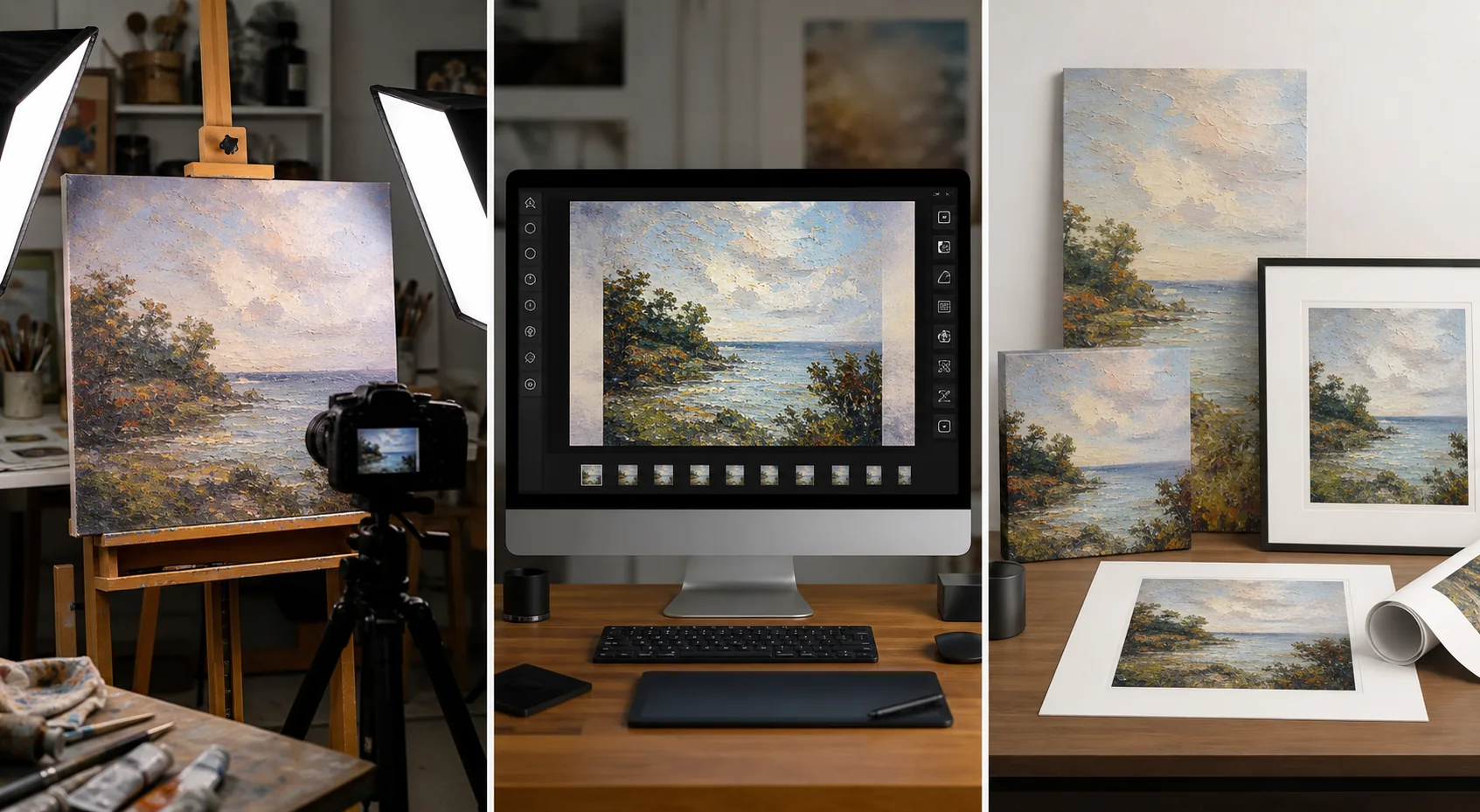
Art Reproduction & Print Sales: Upscale, Expand & Prepare Artwork for Print
Selling prints is the most accessible recurring-revenue stream for visual artists — but the gap between a painting on the wall and a print-ready digital file is wider than most artists expect. Phone and DSLR captures of physical artwork introduce color shifts, glare, uneven lighting, and resolution limits that degrade reproduction quality at print sizes above 8x10 inches. AI Enhance recovers detail and upscales artwork captures to large-format print resolution, while AI Expand extends the canvas for aspect ratios that differ from the original — letting artists sell a single painting as a 24x36 poster, a 16x20 matted print, and a 1:1 square canvas wrap without cropping or distorting the composition.
立即尝试Phone and camera captures of physical artwork lack print-resolution detail
Most artists photograph their work with a phone camera or a consumer DSLR under imperfect lighting conditions. The resulting file — typically 12-48 megapixels — is sufficient for social media and online galleries but falls short for large-format prints. A 24x36 inch print at 300 DPI requires a 7200x10800 pixel file; a 12-megapixel phone capture delivers roughly 4000x3000 pixels. Upscaling with traditional interpolation produces soft, mushy prints that lose the texture and brushwork that make the original artwork compelling. AI Enhance upscales while preserving fine detail — individual brush strokes, canvas texture, pencil marks, and paper grain remain sharp at print scale.
Different print formats require different aspect ratios from a single original
A painting created at 18x24 inches needs to be sold as prints in standard frame sizes: 8x10, 11x14, 16x20, 18x24, and 24x36 — each with a different aspect ratio. Traditional approaches either crop the composition (losing edges the artist considers integral) or add generic borders (which look cheap). AI Expand intelligently extends the artwork's edges — continuing background gradients, patterns, textures, and negative space — to fill the target aspect ratio without cutting into the composition. This means one original can populate an entire print-size catalog.
Color accuracy across capture, screen, and print is difficult to maintain
The color journey from physical artwork to digital capture to screen preview to printed reproduction introduces shift at every stage. Camera white-balance errors produce warm or cool casts. Screen calibration varies between the artist's editing display and the customer's viewing device. Print profiles differ between printers, papers, and ink sets. AI Enhance normalizes the white balance and exposure of the capture to produce a clean digital master that more faithfully represents the original artwork, giving the print lab a better source file to work from. The artist still needs to soft-proof against the printer's ICC profile, but starting from a cleaner digital master reduces the calibration gap.
使用方法
Capture the original artwork under controlled conditions
Photograph the artwork using two matched diffused light sources at 45-degree angles to minimize glare and surface reflections. Use a tripod to keep the camera parallel to the artwork surface — any angle introduces keystone distortion that warps straight edges. If possible, photograph in RAW format for maximum editing latitude. Remove the artwork from glass frames before photographing to eliminate reflections. For textured work (oil, acrylic, impasto, mixed media), consider raking light at a shallow angle for a separate texture-capture pass.
Enhance and upscale the digital capture with AI Enhance
Run the artwork capture through AI Enhance to recover fine detail, correct white-balance shifts from lighting conditions, and upscale to the resolution needed for your largest print size. For a 24x36 print at 300 DPI, you need 7200x10800 pixels; AI Enhance can upscale a 4000x3000 phone capture to this resolution while maintaining brush stroke detail, canvas texture, and medium-specific qualities. Process the image at the maximum resolution — you can always downsample for smaller prints, but upscaling after the fact always loses quality.
Expand the canvas for additional aspect ratios with AI Expand
Take the enhanced master file and use AI Expand to generate variants for each target print size. Extend an 18x24 original to fill 8x10, 16x20, 11x14, and 1:1 square formats by expanding the edges of the composition. AI Expand continues the artwork's visual language — extending background colors, gradients, textures, and patterns — rather than adding a blank border. Review each expanded variant to ensure the extensions are faithful to the original's style and make manual corrections if any extended area deviates from the artwork's visual language.
Prepare print-ready files and upload to print-on-demand platforms
Export each size variant as a high-resolution TIFF or PNG in the color space required by your print partner (typically sRGB for online print-on-demand, Adobe RGB or CMYK for professional print labs). Upload to your print-on-demand platform (Printful, Fine Art America, Society6, Redbubble) or deliver to your local print lab. Maintain the enhanced master file as the single source of truth — regenerate size variants from the master if you ever need to adjust the crop or expansion for a new product format like canvas wraps, metal prints, or greeting cards.
常见问题
How large can I print from a phone-camera capture after AI upscaling?+
A modern phone camera (12-48 megapixels) captured under good conditions can be AI-enhanced and upscaled to produce prints up to 24x36 inches at 300 DPI. For larger formats — 30x40, 40x60, gallery-wrap sizes — a higher-resolution DSLR or mirrorless capture (45-100+ megapixels) provides a better starting point. The key factor is the quality of the original capture: sharp focus, even lighting, and minimal glare matter more than raw pixel count because AI Enhance recovers detail from well-captured images far better than from soft or glare-affected ones.
Does AI Expand work on all types of artwork or only certain styles?+
AI Expand works best on artwork with definable edge patterns — abstract backgrounds, gradients, atmospheric landscapes, textured fields, and geometric patterns extend naturally. Artwork with hard compositional edges or figures cut off at the border requires more careful review because the AI must infer what continues beyond the original frame. For highly detailed figurative work, consider expanding only the less-complex edges (typically the background side) and accepting a slight crop on the detailed edges when adapting to a new aspect ratio.
Will the AI enhancement change the character of my artwork?+
AI Enhance is designed to recover and preserve detail, not to reinterpret the artwork. Brush strokes, canvas texture, pencil marks, ink bleeds, and paper grain are maintained and sharpened rather than smoothed over. However, any digital enhancement involves interpolation, so artists should compare the enhanced file against the original at 100% zoom before approving for print production. If the enhancement introduces artifacts in a specific area, you can mask that area and blend manually. The goal is a print that viewers cannot distinguish from a high-resolution drum scan of the original.
Can I use this workflow for mixed-media and three-dimensional artwork?+
Mixed-media work (collage, assemblage, textile art) benefits from the same capture-enhance-expand workflow, with the caveat that three-dimensional elements cast shadows that change with lighting angle. For heavily textured or dimensional pieces, capture under flat diffused lighting for the color-accurate master and consider a separate raking-light capture for texture documentation. AI Enhance processes both captures effectively. For artwork with extreme depth (shadow boxes, sculptural relief), consider focus stacking multiple captures before enhancement to ensure the full depth is sharp.
相关使用场景
了解专业人士如何在实际工作流程中使用这些工具。
杂乱的背景和粗糙的产品图每天都在让你流失订单。Magic Eraser帮你在几秒钟内创建干净、专业的产品图片——不需要PS技能。上传、擦除干扰元素、安心上架。
旅行照片里总有路人乱入?自拍背景太杂乱?别再花几个小时P图了。Magic Eraser一键去除干扰物、清理杂乱背景、智能扩展照片适配各种平台格式。
护照和签证办公室每天因背景不合格拒绝数千张照片。Magic Eraser可在数秒内去除任何背景,替换为您需要的精确颜色——白色、浅灰色或蓝色。
受够了和竞争对手用同样的素材图?别再为每篇帖子花大价钱请设计师了。AI Create从简单的文字描述生成原创插画、艺术作品和视觉素材——AI Filter和AI Enhance再完美打磨。每天为每个平台提供独一无二的品牌内容。
Wedding photos deserve perfection, but manual retouching takes hours. Magic Eraser helps photographers and couples remove distracting elements, clean backgrounds, and enhance details so every shot looks its best.
Yearbook photos need consistent backgrounds, even lighting, and clean portraits. Magic Eraser helps schools, studios, and parents get professional-looking results without expensive retouching workflows.
Vehicle listings with clean, professional photos sell faster. Magic Eraser helps dealers, private sellers, and automotive marketers remove background clutter, fix reflections, and enhance car images without a photo studio.
Great food photos drive orders and engagement, but messy tables, utensils, and background clutter ruin the shot. Magic Eraser helps restaurants, food bloggers, and delivery platforms clean up food images fast.
A clean, professional headshot matters for LinkedIn profiles, team pages, and corporate directories. Magic Eraser helps individuals and companies produce polished portraits without a studio reshoot.
Pet photos rarely come out the way you want. The dog moves, the cat is half in shadow, the background is full of clutter. Magic Eraser handles all of that in seconds — background swaps, leash removal, blur cleanup, sharper fur — without manual masking or expensive software.
Empty listings sit on the market longer because buyers struggle to visualize the space. Virtual staging with AI fills the rooms with furniture in the style your buyer wants — modern, transitional, coastal, traditional — in minutes per room instead of days. Magic Eraser handles the pre-staging cleanup (paint touch-ups, painter's tape, debris) and the post-staging polish (lighting refinement, edge cleanup).
Dish photos move delivery and dine-in revenue more than menu copy ever will. Magic Eraser turns phone-shot food photos into delivery-platform-ready images: clean the cluttered table, enhance the dish, swap to a brand-consistent background, and export to DoorDash, Uber Eats, Yelp, and Instagram specs without a food photographer.
Travel photos are the most-edited and most-shared images on most cameras — and the hardest to fix manually. Crowds at every landmark, harsh midday sun, lens glare from phone cameras pressed against bus windows, dim interiors, and decades-old film scans that finally need restoration. Magic Eraser handles every common travel-photo failure mode in seconds, on the same phone you took the photo with.
Pinterest is a visual search engine, not a social feed — pins keep earning impressions for 6-18 months on evergreens and 2-5 years on seasonal evergreens like holiday recipes and gift guides. That long-tail traffic only compounds if every pin is built for the 2:3 vertical canvas at 1000×1500 displayed at ~320px on mobile (85%+ of Pinterest traffic). Magic Eraser's AI tools turn a landscape source photo library into pin-ready vertical compositions in 2-3 minutes per pin instead of 20-40 minutes in Photoshop.
Online course businesses live or die by their visual production quality. The sales-page hero photo, the instructor headshot in the bio section, the in-lesson screenshots, the social-promo carousels driving traffic to the sales page, and the email-newsletter inline imagery in the launch sequence — every one of those surfaces directly affects conversion, completion, and refund rates. Magic Eraser handles the full course-creator image workflow without a designer on staff, on the same laptop or phone you record courses with.
Podcasting is a uniquely visual-poor medium that lives or dies by its visual surfaces. The cover art is the most-viewed surface of every podcast brand, displayed at 56-100px in feed where new listeners decide whether to tap in under a second. The supporting graphic set per episode (Instagram squares, Stories, TikTok, YouTube audiogram covers, email-newsletter inline imagery) is where the show's growth happens between episodes. Magic Eraser handles the full podcaster visual stack — 3000×3000 cover art, host-portrait libraries, per-episode guest graphics, per-season AI refreshes, supporting graphic sets — without a designer on staff, on the laptop or phone you record episodes with.
Indie authors compete with traditional publishing on Amazon's discovery surface where the same algorithms, the same readers, and the same 100-150px mobile-thumbnail decision window apply equally to both. The difference is the production budget — traditional publishers have in-house art departments and marketing teams; indie authors have to handle covers, author headshots, BookTok and Instagram promo, A+ Content modules, and series-consistent visual identity themselves. Magic Eraser preps the full self-published author visual stack — book covers that survive the thumbnail render, author headshots for back covers and bios, social-promo across BookTok / Instagram / Pinterest, Amazon A+ Content modules, and series-consistent presets across 3-12 books — in minutes per asset instead of $400-1500 of designer time per book.
Newsletter writing in 2026 is platform-fragmented across Substack (35M+ subscribers), beehiiv, ConvertKit, Ghost, and Beehiiv-adjacent indie tools — and the visual surfaces have multiplied with each platform's discovery features (Substack Notes, beehiiv Boost, Ghost's recommendation network). Newsletter writers need post hero images that survive every platform's render pipeline, author photos that work across bylines and email signatures, microblog imagery for the discovery-driving feed surfaces, and email-newsletter inline graphics that render across Gmail / Apple Mail / Outlook. Magic Eraser preps the full newsletter visual stack — phone-to-publish in minutes per asset — without a designer on staff.
Dental practices rely on visual proof more than almost any other healthcare vertical — prospective patients evaluate smile transformations, office environment, and team professionalism before ever calling the front desk. The challenge is that clinical photography happens under operatory lighting with clamps, bibs, cheek retractors, and background clutter that undermines the professional impression the photo needs to convey. Magic Eraser cleans up clinical before-and-after shots, standardizes team headshots against consistent backgrounds, and prepares office interior photos for Google Business Profile, social media, and website use — all while keeping the dental team focused on patient care rather than photo production.
Insurance claims live and die on photographic evidence — adjusters, underwriters, and claims examiners make coverage and settlement decisions based on photos that were often taken in poor lighting, at awkward angles, with smartphones, by stressed policyholders moments after a loss event. The gap between what the damage actually looks like and what the claims photo conveys is a direct source of disputes, delays, and underpayments. Magic Eraser and AI Enhance bridge that gap by improving photo clarity, removing irrelevant visual distractions, and ensuring damage details are visible enough to support accurate assessment without altering the evidentiary content of the image.
Cultural institutions worldwide are racing to digitize fragile photograph collections before physical deterioration makes them unrecoverable — but raw scans of century-old prints arrive with fading, foxing, tears, stains, scratches, and color shifts that make them unsuitable for public-facing digital collections, educational materials, or exhibition displays. The traditional restoration workflow requires a trained conservator spending 30-90 minutes per image in Photoshop, which makes large-scale digitization projects cost-prohibitive. AI Enhance and Magic Eraser reduce per-image restoration time to 2-5 minutes, making it practical to process collections of thousands of photographs within realistic institutional budgets and timelines.
Fashion influencers operate in a visual-first economy where feed consistency, photo quality, and content volume directly determine brand-partnership rates, follower growth, and affiliate revenue. The production reality is that most outfit shoots happen in bedrooms, parking lots, coffee shops, and hotel lobbies — not studios — and the gap between where the photo was taken and where it needs to look like it was taken is the core editing challenge. Background Eraser, AI Filter, and AI Enhance transform location-constrained outfit photos into feed-consistent, brand-ready content at the volume Instagram's algorithm and brand partners demand.
An interior designer's portfolio is the primary sales tool for landing new clients — prospective homeowners and commercial clients evaluate design sensibility, style range, and attention to detail entirely through project photography. The challenge is that completed projects are photographed in occupied spaces where client belongings, everyday clutter, power cords, and personal items compete with the design work for visual attention. Magic Eraser removes the distractions that undermine design photography, AI Enhance corrects the mixed-lighting conditions endemic to interior spaces, and AI Fill extends tight compositions to show the full spatial context of the design.
School yearbook production means processing 300-2,000+ student portraits, 200-500 event and activity photos, and dozens of candid shots into a cohesive publication — typically managed by a yearbook advisor and a student committee working on a compressed timeline with limited editing skills and no professional photo-production budget. The biggest visual challenge is consistency: portrait photos arrive from picture day with varying background quality, event photos are shot by student photographers in gymnasium lighting, and candids include background clutter that distracts from the moment being captured. Background Eraser, AI Enhance, and Magic Eraser make it possible to produce a professionally consistent yearbook without professional editing skills or budget.
Nonprofits compete for donor attention in the same visual channels as brands with six-figure marketing budgets — Instagram, email, direct mail, and event presentations. The photos that drive donations are the ones that show impact clearly and emotionally: the community garden thriving, the after-school program in action, the families served by the food bank. But most nonprofits capture these moments with volunteers' smartphones in unglamorous settings, and the resulting photos need significant cleanup before they're suitable for donor-facing communications. Background Eraser, AI Enhance, and design tools bridge the gap between volunteer-captured reality and donor-ready visual storytelling without requiring a graphic designer on staff.
Transformation photos are the single most persuasive marketing asset a personal trainer or fitness coach has — prospective clients make enrollment decisions based on visual proof that the training program delivers real results for real people. The challenge is that before photos are typically taken with a smartphone in a gym locker room or home bathroom with poor lighting, cluttered backgrounds, and no attention to composition, while after photos are taken weeks or months later in a different location with different lighting. The inconsistency between before and after conditions makes it harder for viewers to evaluate the actual physical transformation. AI Enhance and Magic Eraser standardize lighting, backgrounds, and clarity so the before-and-after comparison communicates the real results without visual noise.
A tattoo artist's portfolio is the primary factor clients use when choosing an artist — prospective clients scroll through Instagram feeds and portfolio websites evaluating line quality, color saturation, shading technique, and style fit before they ever contact the shop. The gap between the tattoo's actual quality and what the portfolio photo conveys costs artists bookings every day. Studio lighting creates glare on fresh ink and skin, smartphone cameras soften the fine line detail that distinguishes skilled work, and studio backgrounds with equipment, ink bottles, and supply clutter distract from the artwork. AI Enhance and Magic Eraser close this gap so the portfolio photo represents the tattoo's actual quality.
Documenting a classic car restoration from disassembly through completion serves three critical purposes: proving the scope and quality of work to the owner or future buyer, building the build-thread content that attracts new restoration commissions, and satisfying the photographic-evidence requirements for concours judging and marque-club certifications. The challenge is that restoration shops are optimized for metalwork and paint, not photography — the lighting is industrial, the backgrounds are cluttered with parts, tools, and other projects, and the person capturing the photos is usually the restorer between work steps rather than a photographer. AI Enhance and Magic Eraser transform shop-floor documentation captures into presentation-quality photos that serve all three purposes.
Construction progress photography serves multiple critical functions simultaneously — client update reports, lender draw-request documentation, subcontractor coordination records, dispute resolution evidence, code-inspection support, and the firm's portfolio marketing. The photos are captured by project managers and superintendents on smartphones during site walks, in conditions optimized for building rather than photography: dust, scaffolding, temporary lighting, weather exposure, and the constant visual clutter of an active construction site. Magic Eraser and AI Enhance transform these site-walk captures into documentation that communicates clearly to every audience — clients, lenders, inspectors, attorneys, and prospective customers — without requiring a photographer on the project budget.
Jewelry is one of the most photographically demanding product categories — customers purchasing a $200 ring or a $5,000 necklace online are making the decision almost entirely from photos, and they expect to see the precise color of the gemstone, the quality of the metalwork, the clasp mechanism, and the scale on a human hand or neck. The technical challenge is that jewelry is small, reflective, and transparent in ways that confuse smartphone cameras and even entry-level DSLRs: gemstones refract light unpredictably, polished metal reflects everything in the environment, and the scale demands macro-level sharpness that consumer cameras struggle to deliver. Background Eraser, AI Enhance, and Magic Eraser solve the three core jewelry-photography problems — background consistency, detail sharpness, and reflection cleanup — so independent jewelers and Etsy sellers can produce catalog-quality product photos without a dedicated studio.
Online plant sales have grown into a multi-billion-dollar category, and nurseries competing for orders on their own e-commerce sites, Etsy, Amazon, and wholesale platforms need product photos that accurately represent foliage color, plant health, and specimen size — the three attributes customers evaluate when deciding whether to pay $12 for a 4-inch pot or $85 for a specimen-size plant. The photography challenge is that plants are photographed in greenhouse environments with filtered light, surrounded by hundreds of other plants competing for visual attention, and the foliage color that defines a cultivar's appeal shifts dramatically under different light temperatures. Background Eraser and AI Enhance produce the clean, color-accurate catalog photography that drives online plant sales without requiring a photo studio separate from the growing operation.
Family photographs are often the most emotionally significant artifacts in a genealogy research project — they put faces to the names on census records, give physical context to the immigration stories, and connect living family members to ancestors they never met. But the physical photographs that carry this connection are deteriorating in shoeboxes, albums with acid-adhesive pages, and envelopes passed between relatives over decades. Fading, water damage, foxing, torn edges, and surface scratches make many of these photos difficult to share in their current condition. AI Enhance and Magic Eraser restore scanned family photos to a quality that can be shared with relatives, published in family history books, displayed at reunions, and preserved digitally for generations that will never see the physical originals.
Event photographers face a unique production bottleneck: hundreds to thousands of images captured in a single session under mixed lighting, crowded venues, and unpredictable conditions — all due for delivery within 24-72 hours. The margin between a profitable event photography business and an unsustainable one lives in post-production speed. Magic Eraser handles the repetitive cleanup work — removing photobombers, exit signs, stray cables, and branded clutter from venue backgrounds — so you can focus on color grading and creative selects instead of pixel-level retouching.
Property managers are not photographers — but they photograph more frequently than most professionals. Every unit turn requires listing photos, every move-in and move-out needs inspection documentation, every maintenance issue demands visual evidence, and every owner report benefits from property-condition imagery. Across a portfolio of 20-200 units, that is thousands of photos per year captured on phone cameras under fluorescent lighting in occupied or half-turned units. Magic Eraser transforms phone-camera property photos into listing-ready imagery and clear maintenance documentation without hiring photographers for routine work.
Sports photography demands technical precision under the worst possible conditions — fast-moving subjects under stadium mixed lighting, shooting through chain-link fences and safety netting, capturing peak action moments at 1/1000s+ shutter speeds that force high ISO and thin depth of field. The captures that survive the cull often need significant post-production: fence removal, noise reduction from high-ISO shooting, distraction cleanup from sideline clutter, and enhancement to recover detail the camera sacrificed for shutter speed. Magic Eraser and AI Enhance handle these sports-specific post-production challenges so the final images match the intensity of the moment captured.
Veterinary practices live and die by trust — pet owners choose their vet based on perceived warmth, competence, and genuine care for animals. The visual communication of that trust happens through the practice's website, social media, and Google Business Profile, where photos of happy patients, caring staff, and a clean welcoming facility signal everything words cannot. The problem is that veterinary clinics are clinical environments: stainless steel tables, medical equipment, fluorescent overhead lighting, and animals that are often anxious or restrained. Magic Eraser's Background Eraser and AI Enhance transform clinical snapshots into the warm, approachable imagery that builds the trust pet owners are looking for.
Antique dealers move inventory constantly — acquiring at estate sales, auctions, and picker networks, then listing across multiple platforms (eBay, Ruby Lane, Etsy, 1stDibs, Chairish, LiveAuctioneers, their own website) with photos that must communicate condition, provenance quality, and value. The photography challenge is unique: items are photographed in cluttered booths, packed storage units, and show floors where isolating a single item visually is nearly impossible without a dedicated studio setup most dealers do not have. Magic Eraser's toolset handles the antique dealer's specific photo challenges — isolating items from cluttered backgrounds, enhancing detail in patina and maker's marks, and removing price tags and display clutter for clean catalog presentation.
Daycare centers and preschools take more photos than almost any other small business — daily activity documentation for parents, enrollment marketing for their website and social media, seasonal event documentation, and milestone celebrations. The challenge is that classrooms are visually chaotic environments: primary-colored furniture, cluttered art stations, snack remnants, cubbies overflowing with backpacks, and other children who may not have photo release permission in the background. Background Eraser creates clean, warm compositions that focus on the activity and the child, while AI Enhance corrects the fluorescent classroom lighting that makes every phone photo look institutional.
For hair stylists and colorists, the portfolio is the primary client-acquisition tool. New clients choose their stylist based on Instagram galleries, Google Business Profile photos, and the salon's website portfolio. The quality of these photos directly determines whether a potential client books a $150-$400 color appointment or scrolls past. The problem is that salon environments — mirrors reflecting the photographer, mixed warm and cool lighting that shifts color perception, cluttered station backgrounds, and other clients in frame — fight against accurate color representation at every turn. Magic Eraser's toolset solves the specific visual challenges that prevent salon photos from showcasing the actual quality of the work.
Landscape contractors sell their next project based on photos of their last one. Homeowners evaluating contractors compare portfolio images side by side — the contractor whose patio installation, retaining wall, or planting design looks cleanest and most professional in photos wins the bid, often regardless of price difference. The challenge is that landscape work is photographed on active job sites and in real neighborhoods where construction debris, neighbor clutter, parked cars, trash cans, garden hoses, and utility boxes all compete for attention in the frame. Magic Eraser removes the real-world distractions that undermine portfolio presentation, while AI Enhance compensates for overcast skies and harsh midday shadows that flatten the dimensionality of hardscape and planting work.
On dating apps, the profile photo is evaluated in 1-3 seconds during a swipe. The lighting, sharpness, composition, and background quality of the photo influence the swipe decision as much as physical attractiveness — a well-lit, clear photo with a clean background consistently outperforms a better-looking person photographed poorly. The problem is that most people do not have a library of high-quality solo photos with clean backgrounds and flattering lighting. They have group shots where they need to be isolated, photos with exes who need to be removed, and dimly-lit bar or restaurant photos that are their only recent full-body shots. Magic Eraser's toolset handles these specific dating-photo challenges without creating misleading or catfish-level alterations.
When a family is preparing for a funeral or memorial service, the search for the right photos happens under the worst possible emotional and time conditions. The ideal portrait — the one that captures the person as their family wants to remember them — is often a decades-old print, a faded snapshot from a family gathering, or the only good photo from a period when the person was healthy and vibrant. These source photos frequently need significant restoration: fading, color shifts, physical damage, and low resolution from the era they were captured. AI Enhance restores memorial photos with the dignity and care the moment requires, while Magic Eraser removes unwanted elements to create the portrait the family envisions.
Handmade sellers compete against mass-produced alternatives on visual presentation — and the price premium of handcrafted work only holds when the product photos communicate the material quality, craftsmanship detail, and tactile appeal that distinguish a $45 handmade ceramic mug from a $12 factory version. Most makers photograph their work on kitchen tables, workshop benches, or craft-fair booth surfaces using phone cameras that flatten texture and lose the material detail that justifies the price. Background Eraser creates clean, professional product presentations, while AI Enhance reveals the wood grain, fiber texture, glaze variation, and handmade character that makes the work worth the premium.
Musicians and bands need a constant supply of visual assets — electronic press kit photos for venue and festival submissions, social media content to maintain audience engagement between releases, gig posters and flyers for upcoming shows, and merchandise designs for an increasingly important revenue stream. Professional photo shoots cost $300-$1,500 per session, and the results age quickly as lineups change, looks evolve, and the visual identity needs refreshing for each release cycle. Background Eraser isolates band and artist photos from venue and rehearsal-space clutter. AI Filter applies stylized treatments that establish visual identity. AI Enhance recovers detail from low-light live performance captures. Together, they maintain a professional visual presence on the budget reality of working musicians.
相关对比
了解 Magic Eraser 与类似工具的对比。
Cleanup.pictures是一款免费的网页端快速物体移除工具。Magic Eraser提供8种AI编辑工具、移动应用和高级处理能力。查看详细对比。
remove.bg是抠图市场的领导者,提供强大的API以及Photoshop和Figma插件。Magic Eraser更进一步,将物体移除、生成填充、AI增强、设计等八大AI工具集于一体。
两款各具优势的强大AI照片编辑器。Magic Eraser提供更广泛的生成式AI工具集,而Photoroom在电商产品摄影和批量处理方面表现出色。看看哪款更适合您的工作流程。
我们测试并对比了顶级AI照片编辑工具。从物体移除到背景替换,看看哪个编辑器能为你的工作流程提供最佳效果。