
How to remove window reflection from a photo
When you shoot through a glass pane — a storefront display, a car side window, an aquarium tank — the glass mirrors the scene in front of it: your own silhouette, the street behind you, the sky, the camera. That reflected layer sits right on top of what you actually wanted: the mannequin in the window, the view from the car, the fish in the tank. Magic Eraser lets you brush away the reflection so the subject behind the glass comes through clearly.
Last updated
Clear the glass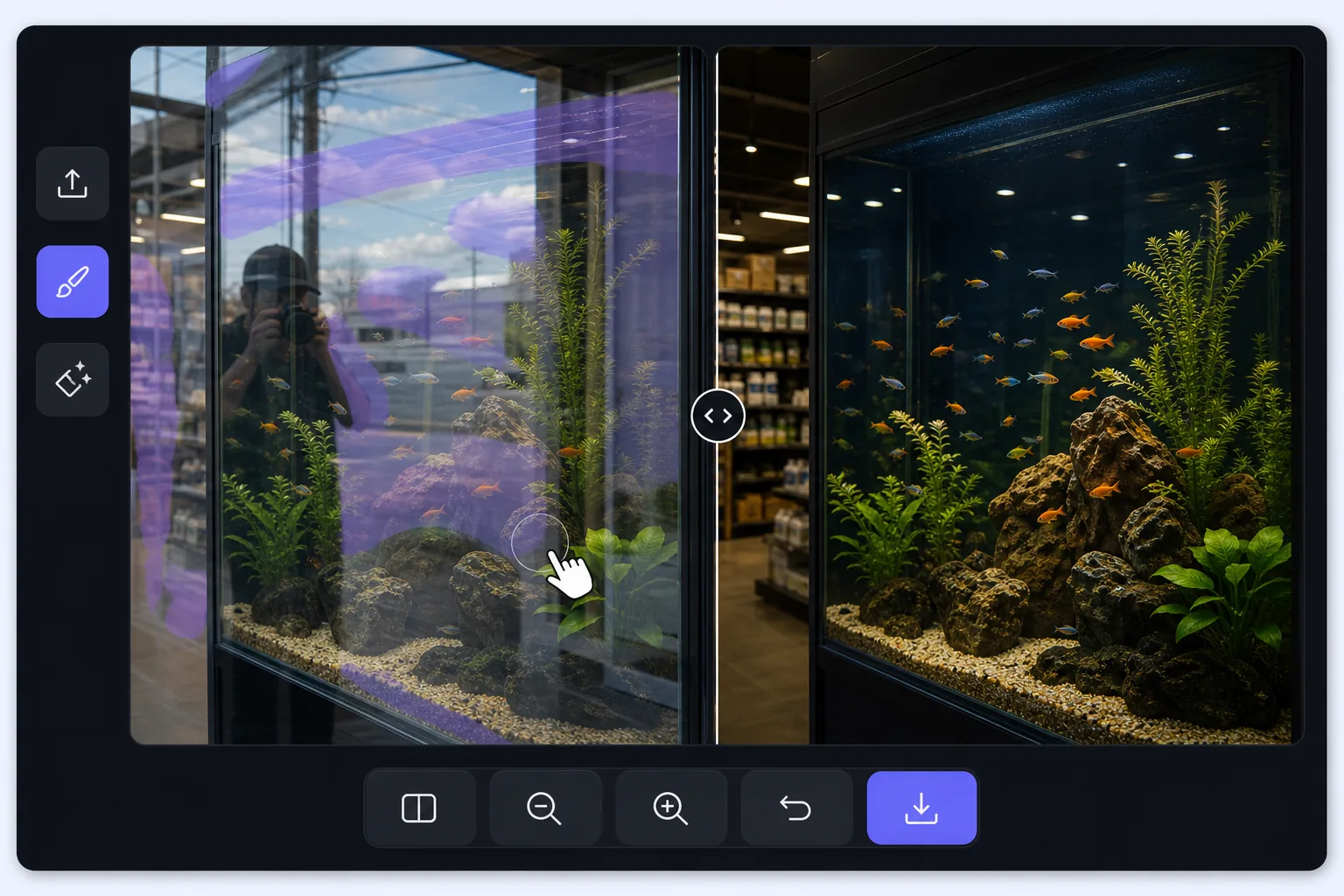
Shooting through glass is a layering problem
A window pane does two things at once: it lets you see through to what is behind it, and it reflects whatever is in front of it. When you photograph through it, the camera records both layers stacked together — the storefront mannequin and your own reflection, the aquarium octopus and the gallery lights behind you, the road ahead and the dashboard mirrored in the windshield. The reflected layer is usually brightest where the glass is darkest behind, which is exactly where your subject hides. A polarizing filter helps at capture time, but if the shot is already taken, the reflection is baked in. Magic Eraser approaches it differently: you mark the reflected streaks and shapes, and its AI inpainting reconstructs a plausible version of what was behind the glass using the surrounding visible detail. It is honest to say the result is a synthesized reconstruction, not literal recovery of pixels the reflection covered — but when the subject behind the pane is mostly visible and the reflection only veils part of it, the rebuild is convincing.
Before you start
Clear a through-glass reflection in three steps
Start with upload the through-glass shot. The result preview above and tips below use this guide's existing content; no separate before-and-after proof is assumed.
- 1
Upload the through-glass shot
Open Magic Eraser on web, iOS, or Android and add the photo taken through the pane — a storefront window, a train or car window, an aquarium tank, a display case. JPEG, PNG, HEIC, and WebP all work. Zoom in so you can see exactly where the reflection overlaps the subject behind the glass.
- 2
Brush the reflected layer, not the subject
Paint over the reflection sitting on the glass — your own silhouette, the street or sky behind you, the bright window frames, the camera and hands. Trace the soft reflected shapes but stop short of the subject you want to keep. Where the reflection is faint and the subject shows through, a light pass is enough; where it is a bright solid glare, cover the whole patch including its halo.
- 3
Erase, then check the rebuild
The AI removes the reflected layer and reconstructs what was likely behind the glass from the surrounding context. Inspect the rebuilt area against the parts of the subject that were always visible — the rest of the mannequin, the continuing aquarium scene, the road ahead. If a region was almost entirely hidden by glare, the reconstruction is invented, so confirm it reads naturally before exporting at full resolution.
Best for
- Storefront and shop-window photos where your reflection or the street sits on top of the display behind the glass
- Car, train, and bus window shots where the dashboard, your face, or interior lights veil the view outside
- Aquarium and zoo-enclosure photos where gallery lighting and visitors reflect over the animals in the tank
- Museum display cases and glass cabinets where overhead spots reflect across the exhibit you are shooting
- Photos through office, gallery, or skyscraper windows where the indoor room reflects over the cityscape outside
Tips for shooting and cleaning through glass
The cleaner the original capture, the more convincing the rebuild: press the lens close to the glass and shoot at a slight angle to push your own reflection out of frame, and cup a hand or use a rubber lens hood against the pane to block stray light. When you do edit, work the reflection in patches rather than one giant selection — the AI has more surrounding subject to reference, so the reconstruction stays faithful to what is actually behind the glass. Watch the boundary between reflected and clear areas; that seam is where artifacts show, so a second light pass along it usually tidies things up. Be realistic about coverage: a reflection that only veils the subject lifts away cleanly, but a hot spec of glare that completely hides a section means the AI is inventing that patch, and on aquarium or storefront scenes with busy detail behind the glass, re-shooting from another angle often beats fighting a fully blocked area.
Frequently asked questions
- Can it really show what was behind the window glass?
- It reconstructs a plausible version of it. When the subject behind the pane is mostly visible and the reflection only veils part of it — a streak across a storefront mannequin, lights over an aquarium fish — the AI rebuilds the covered area from the surrounding detail and the result looks natural. Where a reflection completely hides a section, the tool synthesizes that patch rather than recovering true hidden pixels, so check it against the visible parts of the scene.
- What about strong glare versus a faint mirrored layer?
- A faint mirrored layer — your dim silhouette, the soft sky, a window frame — is the easiest case, because the subject still shows through and gives the AI clear reference. A bright blown-out glare spot is harder: it erases the detail underneath entirely, so the rebuild is more of an educated guess. For those, brush the whole hot spot including its halo, then judge the result against the rest of the through-glass scene.
- Is it free to remove window reflections?
- Yes. Magic Eraser's free tier includes the brush-and-erase tool for reflection removal on web, iOS, and Android, with daily usage limits and no watermark on your export. Upload the through-glass shot, brush the reflected layer, and download the cleaned image. Premium lifts the daily limits and adds high-resolution exports for larger batches.