
How to remove a price sticker from a photo
Selling secondhand on eBay or Facebook Marketplace? The price tag, clearance sticker, or barcode still stuck to your item makes a listing look like a re-sold store return. Magic Eraser removes the sticker and reconstructs the box, label, or surface that was underneath it — so your photo shows the product, not the markdown.
Last updated
Remove the price tag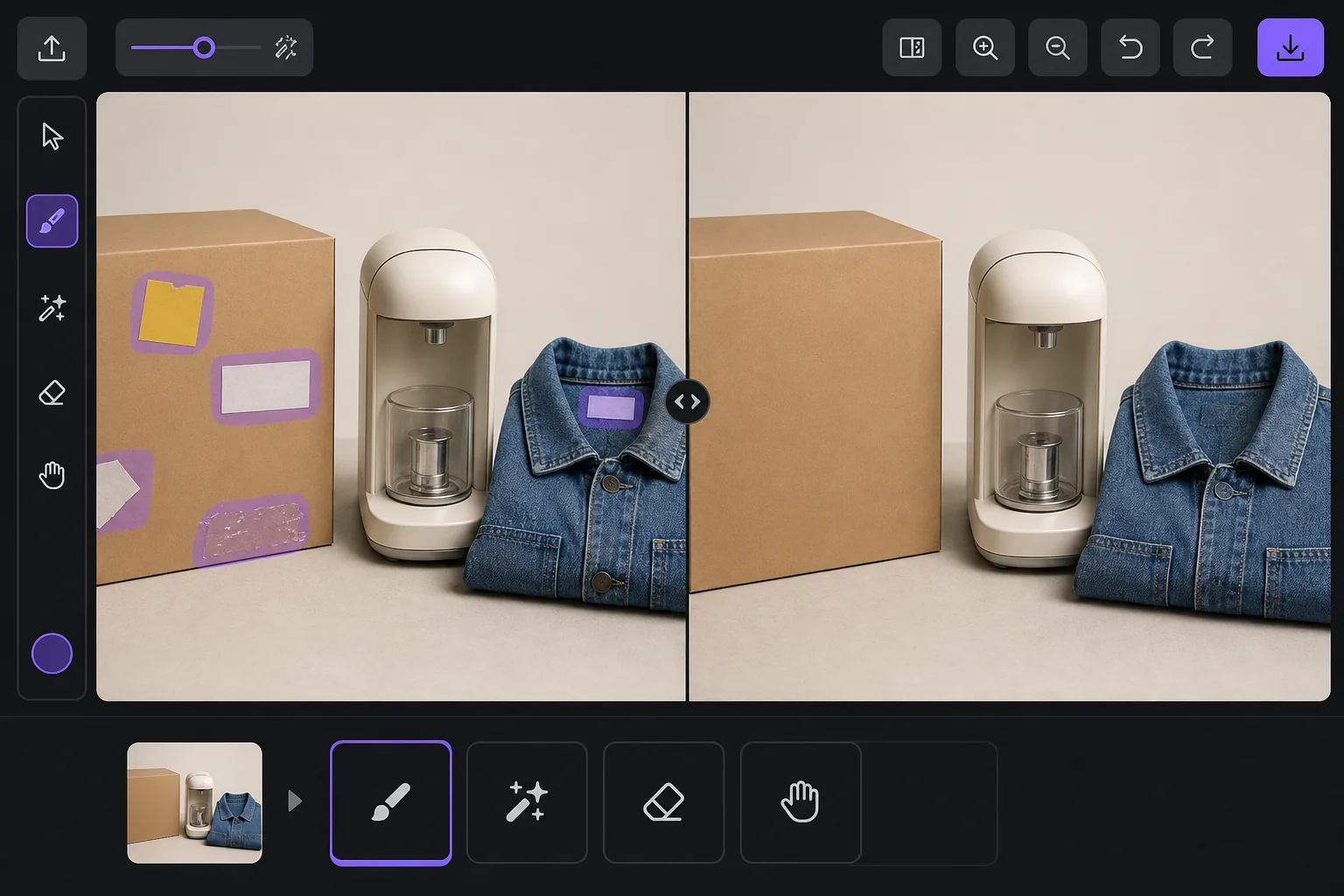
Why a visible price sticker hurts your resale listing
A price tag in a listing photo quietly works against you. Buyers see the original retail or clearance price and anchor their offer below it, so a leftover $4.99 yellow sticker can cost you more than five dollars in negotiation. It also signals the item came from a closeout bin or was already returned once, which lowers perceived condition even when the product is genuinely good. And some platforms care: marketplaces and their image guidelines generally want a clean product shot, and a barcode or store tag clutters the main image where buyers decide in a half-second whether to tap. Peeling a sticker off physically often leaves adhesive residue, a torn label, or a faded rectangle where the box was protected from light — so the photo problem survives the physical one. Removing it in the photo is the faster fix. A price sticker is rendered onto the image pixels just like any other object, so it replaces whatever box art, fabric, or surface sat behind it. Magic Eraser's AI brushes the sticker away and generates a plausible reconstruction of that hidden area from the surrounding pixels. Be clear on what that means: over a flat colored box or a plain surface the result is usually seamless, but the AI is synthesizing what was likely there, not recovering literal hidden detail — so printed text or a logo that sat entirely under the sticker is invented, not restored.
Before you start
Remove a price sticker in three steps
Start with upload your product photo. The result preview above and tips below use this guide's existing content; no separate before-and-after proof is assumed.
- 1
Upload your product photo
Open Magic Eraser on web, iOS, or Android and upload the listing photo with the price tag, clearance label, or barcode sticker on it. JPEG, PNG, and WebP all work. Shoot the item in even light first — a sticker on a well-lit, in-focus surface reconstructs far more cleanly than one buried in shadow or glare.
- 2
Brush over the sticker and any residue
Paint over the whole sticker, including its edges, peeling corners, and any shadow it casts. Also brush the adhesive shine or faded outline left where a sticker was partly removed — those marks are as much of a giveaway as the tag itself. For a barcode strip, cover the full printed area; for a price gun tag on clothing, get the tag and the plastic fastener.
- 3
Erase, review, and export
Tap Erase. The AI removes the sticker and rebuilds the surface underneath from the surrounding area. Over a solid box panel or plain fabric the fill is seamless; over busy box artwork or printed text, check the result at full zoom for smudges or invented patterns before you list. Export at full resolution so the cleaned photo stays sharp on the marketplace.
Best for
- eBay and Facebook Marketplace sellers cleaning price tags off secondhand items before listing
- Resellers and thrift flippers removing clearance and markdown stickers that anchor buyers low
- Hiding barcode and store-inventory labels stuck to product boxes and packaging
- Removing price gun tags and plastic fasteners from clothing and accessory photos
- Erasing adhesive residue or the faded outline left after a sticker was peeled off by hand
Tips for clean resale photos
Whenever you can, peel the sticker off the real item and photograph the actual surface — a true photo always beats a reconstruction, and it spares you any question about whether the listing image is accurate. Use the eraser for what's left behind: adhesive gunk, a torn corner, or the sun-faded rectangle a long-stuck tag protected. Keep your edits honest about the product itself. Removing a price tag or barcode is fine, but don't erase genuine flaws a buyer needs to see — scratches, stains, or damage belong in the listing, and most marketplaces treat a doctored condition photo as grounds for a return or a policy strike. Reconstruction quality tracks the background: a sticker on a flat single-color box vanishes cleanly, while one sitting across detailed printed artwork, a logo, or a model number is the hardest case, because the AI has to guess at text it can't see. If part of the hidden label is still visible elsewhere on the item, photograph that angle instead. Finally, shoot a little wider than the sticker so there's plenty of surrounding surface for the AI to sample from — tightly cropped tags leave it less to work with.
Frequently asked questions
- Will the box artwork or text under the price sticker come back correctly?
- Only if the AI can infer it from what surrounds the sticker. Over a solid color or a repeating pattern, the fill is usually convincing. But if printed text, a logo, or a model number sat entirely beneath the tag, the AI invents a plausible surface rather than recovering the real thing — it can't see pixels that the sticker covered. For those cases, peel the sticker off and reshoot, or use an angle where that detail is visible.
- Is it dishonest to remove a price tag from a resale photo?
- Removing a price sticker or barcode is normal listing cleanup and isn't deceptive on its own — you're showing the product, not the markdown. What crosses the line is editing out actual condition issues. Leave scratches, stains, wear, and damage visible; most marketplaces consider a misleading condition photo grounds for a return or a seller penalty.
- Is removing price stickers free?
- Yes. Magic Eraser's free tier includes the brush tool for removing price tags, barcodes, and residue, with daily usage limits. If you're cleaning up a large batch of listings, Premium lifts those limits for higher-volume editing.