
Comment corriger la distorsion en barillet dans les photos — Magic Eraser
Corrigez la distorsion en barillet et le gondolage des objectifs grand-angle dans les photos grâce à l'AI. Guide étape par étape couvrant la correction d'objectif, le redressement de la perspective et la récupération des bords pour la photographie d'architecture, d'immobilier et de paysage.
SEO & Growth
Vérifié par Magic Eraser Editorial ·
Sommaire
- Comprendre la distorsion en barillet : pourquoi les objectifs grand-angle courbent les lignes droites
- Correction AI-powered vs. profils d'objectif traditionnels : pourquoi l'analyse de contenu gagne
- Récupérer les bords perdus : utiliser AI Expand après la correction de distorsion
- Applications pratiques : photographie d'architecture, d'immobilier et de produits
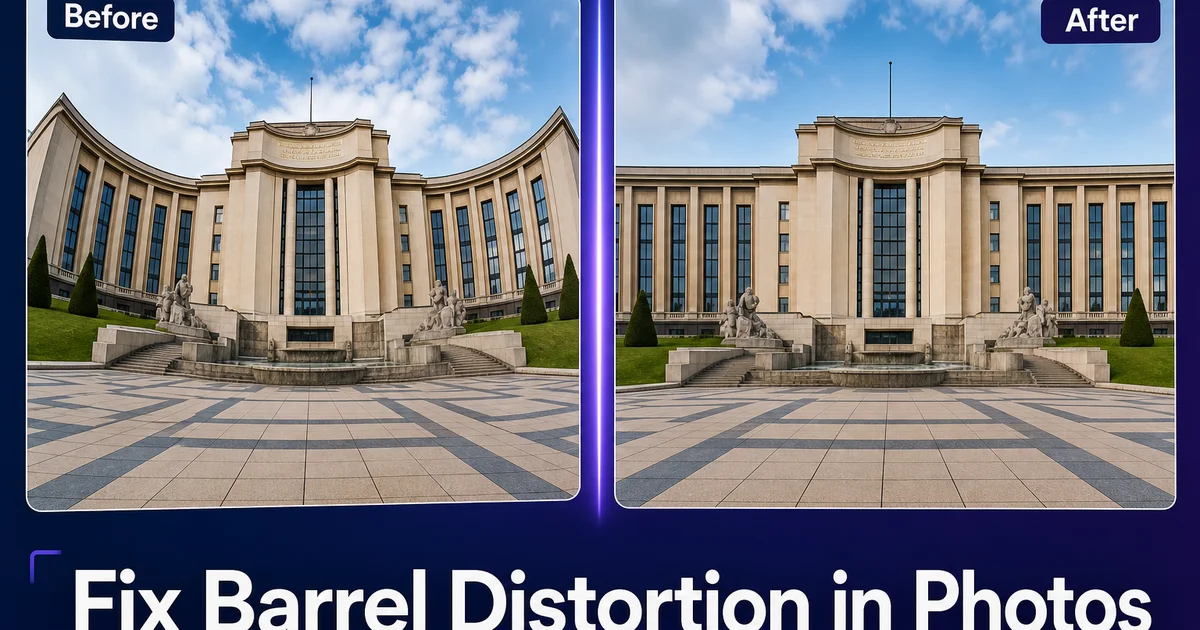
La distorsion en barillet est l'aberration optique qui fait que les lignes droites se courbent vers l'extérieur sur les bords d'une photographie, donnant à l'image un aspect subtil — ou pas si subtil — renflé qui donne l'impression que la scène est vue à travers une surface de verre incurvée. C'est une propriété physique inhérente à la conception des objectifs grand-angle, causée par la façon dont les courtes focales courbent la lumière à travers plusieurs éléments en verre pour atteindre leur large champ de vision. Chaque objectif grand-angle produit un certain degré de distorsion en barillet, depuis le gondolage à peine perceptible d'un objectif rectilinéaire de 24 mm jusqu'à la déformation extrême en œil de poisson d'un ultra grand-angle de 10 mm. L'effet est particulièrement problématique dans la photographie d'architecture, d'immobilier et d'intérieur où les murs droits, les cadres de porte et les lignes de plafond sont bien visibles et où toute courbure semble immédiatement anormale.
Pendant des décennies, corriger la distorsion en barillet nécessitait soit un logiciel spécialisé avec des profils de distorsion spécifiques à chaque objectif, soit un réglage manuel fastidieux des curseurs jusqu'à ce que les lignes paraissent droites à l'œil. Lightroom et Photoshop proposent des profils de correction d'objectif pour des milliers de combinaisons appareil-objectif, mais ces profils doivent être sélectionnés manuellement et n'existent pas pour tous les objectifs. Ils appliquent une correction universelle qui ne tient pas compte de la distance de mise au point, de l'ouverture ou des caractéristiques optiques spécifiques d'un exemplaire d'objectif particulier. La correction manuelle à l'aide des curseurs de distorsion offre plus de contrôle mais exige du photographe qu'il juge le redressement à l'œil nu — ce qui est étonnamment difficile lorsque la distorsion est subtile et que l'image contient peu de lignes de référence.
La correction de distorsion AI-powered adopte une approche fondamentalement différente en analysant le contenu réel de l'image plutôt qu'en s'appuyant sur des profils d'objectif préétablis. L'AI identifie les éléments qui devraient être géométriquement droits — bords de bâtiments, cadres de fenêtres, lignes d'horizon, clôtures, bibliothèques — et calcule la correction précise nécessaire pour les rendre droits. Cette approche contextuelle fonctionne avec n'importe quel objectif, n'importe quel appareil photo et n'importe quelle focale, et s'adapte automatiquement aux caractéristiques de distorsion spécifiques présentes dans chaque image individuelle. Ce guide vous explique comment utiliser AI Enhance, AI Expand et Magic Eraser pour corriger la distorsion en barillet et retrouver la géométrie nette et professionnelle qu'exigent la photographie d'architecture, d'immobilier et de paysage.
- L'AI analyse le contenu réel de l'image — bords de bâtiments, lignes d'horizon, cadres de fenêtres — pour calculer la correction de distorsion plutôt que de s'appuyer sur des profils d'objectif préétablis qui pourraient ne pas correspondre à votre configuration spécifique.
- L'intensité de la correction est réglable, allant d'une correction partielle qui préserve une légère perspective grand-angle à une correction complète qui produit des lignes mathématiquement droites sur tout le cadre.
- AI Expand remplit les coins vides laissés par la correction de distorsion avec du contenu AI-generated, préservant la composition complète sans recadrage réduisant la résolution.
- Cette technique est essentielle pour la photographie d'architecture, d'immobilier et d'intérieur où les murs courbes et les cadres de porte gondolés semblent immédiatement non professionnels.
- AI Enhance gère à la fois la distorsion en barillet et son cousin, la distorsion en coussinet, en détectant automatiquement le type présent et en appliquant la direction de correction appropriée.
Comprendre la distorsion en barillet : pourquoi les objectifs grand-angle courbent les lignes droites
La distorsion en barillet est une aberration optique géométrique qui se produit lorsque le grossissement de l'image diminue avec la distance par rapport à l'axe optique. En termes plus simples, le centre de l'image est plus grossi que les bords, ce qui provoque un renflement de l'image vers l'extérieur comme le côté d'un baril. C'est une conséquence fondamentale de la physique des objectifs grand-angle plutôt qu'un défaut de fabrication. Lorsqu'un concepteur d'objectifs crée une optique grand-angle, il doit courber les rayons lumineux provenant d'un très large champ de vision sur un capteur plat. La relation mathématique entre le trajet incurvé de la lumière et le plan plat du capteur introduit une distorsion radiale. La corriger complètement dans la conception optique nécessiterait des éléments d'objectif supplémentaires qui ajoutent du poids, du coût et d'autres compromis optiques comme une netteté réduite ou une aberration chromatique accrue.
La sévérité de la distorsion en barillet est directement corrélée à la focale : les focales plus courtes produisent plus de distorsion. Un objectif grand-angle typique de 24 mm sur un appareil plein format peut présenter un à deux pour cent de distorsion en barillet — à peine perceptible dans les scènes naturelles mais clairement visible lorsque des lignes architecturales traversent les bords du cadre. Un ultra grand-angle de 16 mm peut présenter trois à cinq pour cent de distorsion, évidente dans toute scène contenant des lignes droites. Un œil de poisson de 10 mm peut montrer vingt pour cent de distorsion ou plus, courbant fortement tout ce qui se trouve près des bords du cadre. Les appareils photo des smartphones, qui utilisent souvent des objectifs à très courte focale équivalant à 24 mm à 28 mm, produisent également une distorsion en barillet, bien que de nombreux téléphones appliquent une correction logicielle automatique avant d'enregistrer l'image.
Il existe une distorsion opposée mais apparentée appelée distorsion en coussinet, où les lignes se courbent vers l'intérieur plutôt que vers l'extérieur — elle apparaît souvent avec les téléobjectifs. Un troisième type, la distorsion en moustache ou complexe, combine la distorsion en barillet au centre avec la distorsion en coussinet sur les bords, créant un motif ondulé plus difficile à corriger avec des outils à curseur simples. La correction de distorsion par AI gère les trois types car elle travaille à partir du contenu de l'image plutôt qu'en appliquant une modification radiale fixe. Elle redresse les lignes quelle que soit leur courbure, que celle-ci soit en barillet, en coussinet ou en moustache.
- La distorsion en barillet résulte d'un plus grand grossissement du centre de l'image par rapport aux bords — une propriété fondamentale de la physique des objectifs grand-angle, pas un défaut de fabrication.
- La sévérité augmente avec la focale : les objectifs de 24 mm montrent un à deux pour cent de distorsion, les ultra grand-angle de 16 mm montrent trois à cinq pour cent, et les œils de poisson de 10 mm peuvent dépasser vingt pour cent.
- Les appareils photo des smartphones produisent également une distorsion en barillet à leurs focales équivalentes typiques de 24 mm à 28 mm, bien que de nombreux téléphones appliquent une correction logicielle automatique avant l'enregistrement.
- La correction par AI gère la distorsion en barillet, en coussinet et en moustache complexe car elle redresse les lignes en fonction du contenu de l'image plutôt qu'en appliquant une formule de transformation radiale fixe.
Correction AI-powered vs. profils d'objectif traditionnels : pourquoi l'analyse de contenu gagne
La correction de distorsion traditionnelle repose sur des profils d'objectif — des modèles mathématiques des caractéristiques de distorsion de chaque objectif spécifique stockés dans une base de données. Lorsque vous importez une photo dans Lightroom et activez les corrections d'objectif, le logiciel lit les métadonnées EXIF pour identifier l'appareil photo et l'objectif, cherche le profil correspondant et applique la correction précalculée. Ce système fonctionne bien lorsqu'un profil existe et que l'objectif se comporte de manière constante sur toute sa plage. Il échoue dans plusieurs scénarios courants : les objectifs tiers peuvent manquer de profils, les objectifs adaptés sur les appareils sans miroir perdent leurs métadonnées, les objectifs zoom présentent une distorsion différente à différentes focales et un seul profil ne peut pas capturer chaque position. Les objectifs d'époque argentique n'ont aucun profil numérique du tout.
La correction de distorsion AI-powered élimine la dépendance aux bases de données d'objectifs en analysant ce qui se trouve réellement dans l'image. L'AI identifie les primitives géométriques — lignes, rectangles, cercles, motifs réguliers — et évalue si elles présentent la courbure radiale caractéristique de la distorsion optique. Un bord de bâtiment qui se courbe vers l'extérieur près du bord du cadre est identifié comme une ligne qui devrait être droite. L'AI calcule précisément la correction radiale nécessaire à cette distance du centre pour la redresser. En analysant plusieurs lignes à différentes positions dans le cadre, l'AI construit une carte de distorsion spécifique à l'image réelle, tenant compte de l'objectif, de la focale, de la distance de mise au point et de tout autre facteur ayant influencé la distorsion dans cette prise de vue particulière.
L'avantage pratique est immédiat : vous n'avez pas besoin de savoir quel objectif a été utilisé, vous n'avez pas besoin de vérifier si un profil existe et vous n'avez pas besoin de régler manuellement des curseurs jusqu'à ce que les lignes paraissent droites à votre œil. La correction par AI est également plus précise dans de nombreux cas car elle s'adapte à l'image spécifique plutôt que d'appliquer un profil générique. Un objectif peut présenter une distorsion légèrement différente à différentes distances de mise au point — plus de distorsion en barillet lorsqu'il est réglé sur l'infini que lorsqu'il est réglé sur un mètre — et un seul profil ne peut pas capturer cette variation. L'AI voit la distorsion réelle dans l'image réelle et la corrige précisément, indépendamment de la configuration de l'objectif au moment de la prise de vue.
- Les profils d'objectif traditionnels échouent lorsque l'objectif n'a pas de profil, que les métadonnées sont absentes des objectifs adaptés ou que la position du zoom ne correspond pas aux focales échantillonnées du profil.
- La correction par AI analyse les primitives géométriques de l'image — bords de bâtiments, cadres de fenêtres, motifs réguliers — et calcule la correction radiale spécifique nécessaire pour redresser chaque ligne.
- L'analyse basée sur le contenu s'adapte à la distorsion réelle présente dans chaque image, tenant compte de la distance de mise au point, de l'ouverture et d'autres variables qu'un seul profil d'objectif ne peut pas capturer.
- L'absence de dépendance aux métadonnées signifie que l'AI fonctionne aussi bien sur les photos d'appareils inconnus, les objectifs vintage adaptés, les images de films scannés et les captures d'écran avec données EXIF supprimées.
Récupérer les bords perdus : utiliser AI Expand après la correction de distorsion
La correction de la distorsion en barillet fonctionne en remappant mathématiquement les pixels de leurs positions déformées vers leurs positions correctes sur une grille rectilinéaire. Ce remappage tire les pixels du centre bombé de l'image vers l'extérieur, ce qui signifie que les coins de l'image corrigée s'étendent au-delà des limites du cadre d'origine. Le résultat est une image corrigée avec des zones triangulaires vides dans les coins — des coins noirs où aucune donnée pixel d'origine n'existe. La solution traditionnelle consiste à recadrer l'image au plus grand rectangle qui tient dans les limites corrigées. Cela réduit la résolution et peut éliminer des éléments de composition importants qui se trouvaient près des bords du cadre.
AI Expand offre une alternative en générant du contenu pour remplir ces zones de coin vides. Après l'application de la correction de distorsion, AI Expand analyse le contenu visible près de chaque zone vide — dégradés de ciel, textures de mur, surfaces de sol, motifs de feuillage — et génère de nouveaux pixels qui prolongent de manière transparente la scène existante dans les zones manquantes. Pour de nombreux sujets courants, le contenu généré est impossible à distinguer du contenu réel capturé. Un ciel bleu avec des nuages épars se prolonge naturellement dans le coin. Un mur de briques étend son motif sans couture visible. Une pelouse remplit le coin avec une texture et une couleur cohérentes. Le résultat est une image corrigée de la distorsion qui conserve sa composition originale complète sans la perte de résolution du recadrage.
Cette technique est particulièrement précieuse pour la photographie immobilière où les prises de vue grand-angle des pièces sont effectuées à la focale la plus large disponible pour agrandir visuellement les espaces, produisant une distorsion en barillet importante qui nécessite une correction agressive. Après correction, les coins vides pourraient empiéter sur des parties critiques de la pièce — le bord d'une fenêtre, le coin d'un plafond, le côté d'une porte. Recadrer ces éléments réduit la taille perçue de la pièce, contrecarrant l'objectif de la prise de vue grand-angle. AI Expand remplit les coins avec la texture du mur, du plafond ou du sol qui s'y trouverait naturellement, préservant à la fois la précision géométrique de la correction et l'impression spatiale de la composition grand-angle.
- La correction de distorsion crée des zones triangulaires vides dans les coins où les données pixels ont été tirées vers l'intérieur lors du remappage — autrefois résolu par le recadrage, ce qui réduit la résolution et peut couper la composition.
- AI Expand génère du contenu homogène pour remplir les coins vides en analysant les textures voisines — dégradés de ciel, surfaces de mur, motifs de sol — produisant des extensions naturelles de la scène existante.
- La photographie immobilière en bénéficie le plus car les prises de vue grand-angle des pièces nécessitent une correction agressive qui recadrerait autrement des éléments architecturaux critiques comme les fenêtres, les plafonds et les portes.
- Le flux de travail combiné correction-plus-expansion produit des images géométriquement précises qui conservent la composition originale complète sans perte de résolution ni compromis de composition.
Applications pratiques : photographie d'architecture, d'immobilier et de produits
La photographie d'architecture a les exigences les plus strictes en matière de précision géométrique car les bâtiments sont définis par leurs lignes droites, leurs angles droits et leurs proportions précises. Une photographie d'un bâtiment où les murs semblent se bomber vers l'extérieur a fondamentalement l'air faux — elle sape la qualité même que la photographie d'architecture est censée mettre en valeur. Les photographes d'architecture experts utilisent des objectifs à décentrement spécifiquement pour contrôler la perspective et la distorsion. Ces objectifs spécialisés coûtent deux mille dollars ou plus et sont peu pratiques pour la grande majorité des photographes. La correction de distorsion par AI obtient des résultats géométriques comparables avec n'importe quel objectif, rendant la photographie d'architecture de qualité experte accessible aux agents immobiliers, aux gestionnaires de propriétés, aux entreprises de construction et à toute autre personne qui photographie des bâtiments sans équipement spécialisé.
La photographie immobilière est l'application la plus courante pour la correction de la distorsion en barillet car chaque annonce a besoin de prises de vue intérieures grand-angle — et chaque prise de vue intérieure grand-angle présente de la distorsion. Une seule annonce immobilière peut comprendre quinze à vingt photos d'intérieur, toutes prises en grand-angle entre 10 mm et 24 mm équivalent. Sans correction, ces images montrent des murs gondolés, des plans de travail incurvés et des cadres de porte déformés qui donnent aux espaces un aspect déformé et peu fiable — exactement l'inverse de l'impression de confiance et d'accueil qu'une annonce doit transmettre. Le traitement par lots de toutes les photos d'annonce via la correction de distorsion par AI produit une géométrie droite et professionnelle sur chaque image, établissant une crédibilité visuelle qui soutient la confiance des acheteurs.
La photographie de produits rencontre la distorsion en barillet principalement lors de la prise de vue de grands objets à courte distance avec des objectifs grand-angle modérés. Une photographie d'une table rectangulaire, d'un téléviseur à écran plat ou d'une œuvre encadrée prise avec un objectif de 35 mm à quelques mètres montrera un gondolage visible le long des bords du sujet rectangulaire. Pour les annonces e-commerce où les acheteurs doivent évaluer précisément la forme et les proportions du produit, cette distorsion est plus qu'esthétique — elle déforme la géométrie du produit. La correction de distorsion par AI redresse les bords du produit pour montrer la véritable forme rectangulaire. La correction améliore également l'apparence des étiquettes, du texte et des motifs qui sont déformés par la courbure de l'objectif lorsqu'ils apparaissent près des bords du cadre.
- La photographie d'architecture exige la plus grande précision géométrique — la correction par AI obtient des résultats de qualité équivalente à ceux d'un objectif à décentrement avec n'importe quel objectif, éliminant le besoin d'optiques spécialisées à deux mille dollars.
- Les annonces immobilières nécessitent quinze à vingt photos d'intérieur grand-angle par propriété, toutes nécessitant une correction de distorsion — le traitement par lots par AI produit une géométrie experte cohérente sur chaque image.
- La distorsion en photographie de produits déforme les objets rectangulaires et altère les étiquettes et le texte près des bords du cadre — la correction montre les véritables proportions du produit pour une évaluation précise par l'acheteur.
- Ces trois applications bénéficient du flux de travail combiné correction-plus-expansion qui maintient les compositions complètes tout en obtenant un rendu géométriquement précis des lignes droites sur tout le cadre.
How to do it
- 1
Identify the type and severity of barrel distortion in your photo
Examine your image for the telltale signs of barrel distortion: straight lines near the edges of the frame that bow outward, a bulging center that makes the middle of the image appear closer than the edges. Stretched or curved objects along the periphery. Barrel distortion is most visible in images with strong horizontal and vertical lines. Architecture, interior rooms, bookshelves, fences, and horizon lines. The severity increases with shorter focal lengths. Ultrawide and fisheye lenses produce the most extreme distortion while standard and telephoto lenses produce little to none.
- 2
Upload the image and apply AI lens distortion correction
Open the photo in AI Enhance and select the lens distortion correction tool. The AI analyzes the geometry of the entire image, identifying straight lines that should be straight and curved surfaces that should be flat. It then applies the precise mathematical correction needed to un-bend those lines without the trial-and-error slider adjustment that manual correction tools require. The AI often detects the lens model from EXIF metadata and applies the known distortion profile for that specific lens, producing optimal corrections on the first pass.
- 3
Adjust the correction strength for your creative intent
After the initial AI correction, evaluate whether the result looks natural. In some cases, completely removing all barrel distortion creates an image that feels sterile or over-corrected, mainly if the viewer expects some natural perspective in the scene. Reduce the correction strength to eighty or ninety percent if you want to preserve a slight sense of wide-angle perspective while eliminating the most objectionable bowing. Conversely, increase the correction if the AI's initial pass did not fully straighten the lines nearest the frame edges. This can happen with extreme wide-angle or fisheye captures.
- 4
Crop or expand the corrected image to fill the frame
Distortion correction necessarily changes the geometry of the image. This often leaves empty areas at the corners where the original frame edge pulled inward during the straightening process. You have two options: crop the image to exclude the empty corners. Cropping reduces resolution and may cut important compositional elements, or use AI Expand to fill those empty areas with AI-generated content that seamlessly continues the scene. AI Expand is mainly effective for landscape and architecture photos where the fill content — sky, wall texture, or ground surface — follows predictable patterns.
- 5
Verify the correction by checking straight lines and natural proportions
Overlay a grid or straight-line guide on the corrected image to confirm that horizontal and vertical lines in the scene are now rendered straight. Pay particular attention to lines near the frame edges, which are the most affected by barrel distortion and the most visible when the correction is incomplete. Also check that the correction has not introduced unnatural proportions. Objects near the frame edges should look naturally sized relative to objects in the center, and human faces or bodies near the periphery should not appear stretched or compressed by the correction mathematics.