
How to Create a Yosegi-zaiku Effect with AI Photo Editing — Magic Eraser
Transformez vos photos en motifs de marqueterie bois Yosegi-zaiku de Hakone grace au transfert de style AI. Guide pas a pas couvrant les palettes de couleurs naturelles du bois, les motifs geometriques en mosaique et les techniques traditionnelles de marqueterie japonaise.
SEO & Growth
Vérifié par Magic Eraser Editorial ·
Sommaire
- En quoi la conversion AI yosegi-zaiku differe des filtres generiques de mosaique bois
- Motifs traditionnels de Hakone et leur logique de construction geometrique
- La palette de couleurs naturelles du bois : selection des essences et projection tonale
- Applications creatives : portraits, paysages et design de surfaces decoratives
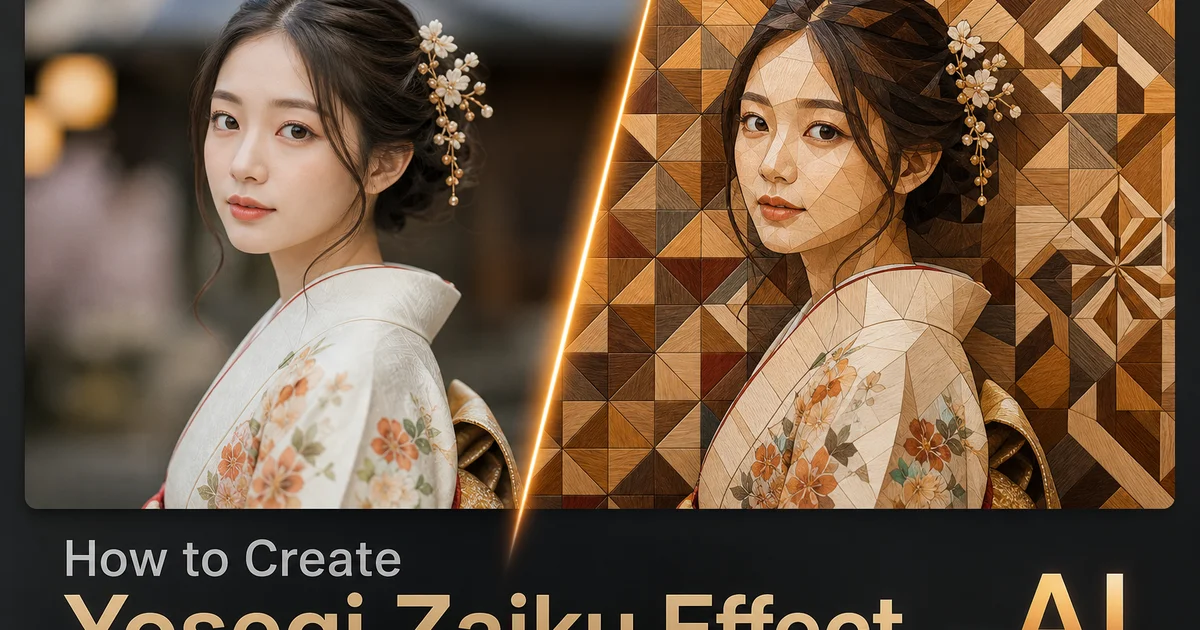
Le Yosegi-zaiku est une technique traditionnelle japonaise de marqueterie originaire de la region de Hakone. Les artisans creent des motifs geometriques complexes en utilisant uniquement les couleurs naturelles de dizaines d'essences de bois assemblees selon des agencements precis. La technique est remarquable pour ce qu'elle n'utilise pas. Il n'y a ni teintures, ni colorants, ni peintures, ni colorants artificiels d'aucune sorte. Chaque couleur d'un motif yosegi-zaiku provient d'une essence de bois reelle : le blanc creme du paulownia, l'ambre tiede du cerisier, le brun riche du noyer, le jaune vif de l'epine-vinette et le presque noir du coeur de plaqueminier. Ces bois sont decoupes en fines baguettes de section identique, arrangees en faisceaux de motifs geometriques, collees, puis tranchees transversalement en feuilles aussi fines que du papier qui revelent toute la complexite du motif assemble. Les placages obtenus decorent des boites a puzzle, des plateaux, des panneaux de meubles et des objets decoratifs avec des motifs qui portent la chaleur et le realisme materiel du bois naturel.
Les simulations numeriques de la marqueterie bois ont echoue par le passe car elles traitaient l'effet comme un probleme de subdivision geometrique : decouper une image en cellules polygonales et remplir chaque cellule avec une texture de grain de bois echantillonnee dans une bibliotheque generique. Les resultats ressemblent a une mosaique texturee plutot qu'a du yosegi-zaiku car ils omettent les caracteristiques specifiques de la technique reelle. Dans un veritable travail yosegi, le grain court dans la meme direction au sein de chaque element du motif car tous les elements ont ete coupes a partir de faisceaux de baguettes avec une orientation de grain parallele. La palette de couleurs se limite a ce que le bois naturel peut produire. Pas de primaires vives, pas de bleu, pas de noir pur, seulement le spectre chaud des teintes de bois. Les joints entre les elements sont extremement fins car le placage a ete tranche a partir d'un bloc solide plutot qu'assemble a partir de pieces individuelles. Ces contraintes de construction definissent le caractere visuel du yosegi-zaiku et doivent etre reproduites pour que l'effet soit percu comme authentique plutot que comme generiquement geometrique.
La conversion yosegi-zaiku par AI repond a ces limitations en encodant la logique de construction de la technique reelle dans son processus de generation de motifs. L'AI genere des motifs geometriques qui suivent le vocabulaire de design traditionnel de Hakone : les etoiles asanoha, les fleches yabane, le damier ichimatsu, les hexagones kikkou — en utilisant uniquement des teintes de bois issues de la gamme de couleurs naturelles des essences reelles. L'orientation du grain est coherente au sein de chaque element et suit la logique de construction de l'assemblage en faisceaux de baguettes. Les lignes de joint entre les elements sont extremement fines pour reproduire l'aspect tranche du placage du veritable travail yosegi. Les valeurs tonales de la photo sont projetees sur la palette d'essences de bois afin que les zones sombres de l'image recoivent des bois sombres et les zones claires des bois pales. Les tons moyens sont repartis sur les essences ambre et dorees qui forment le coeur de la palette yosegi. Ce guide couvre l'ensemble du processus de creation d'authentiques effets yosegi-zaiku a l'aide de AI Filter et de AI Enhance.
- L'AI genere des motifs geometriques issus du vocabulaire traditionnel de Hakone : asanoha, yabane, ichimatsu, kikkou — en utilisant exclusivement des teintes de bois naturelles plutot que des couleurs arbitraires ou une subdivision geometrique generique.
- L'orientation du grain de bois au sein de chaque element du motif suit la logique de construction de l'assemblage reel en faisceaux de baguettes yosegi, avec une direction de grain parallele qui correspond a la facon dont les placages de marqueterie sont reellement produits.
- La palette de couleurs naturelles du bois va du blanc du paulownia pale en passant par le tiede cerisier et l'ambre du zelkova jusqu'au brun fonce du noyer et du katsura, sans couleurs en dehors de la gamme des essences de bois reelles.
- Les lignes de joint entre les elements geometriques sont extremement fines pour reproduire l'aspect tranche du placage du veritable yosegi-zaiku, distinguant l'effet des simulations de mosaique en pieces assemblees.
- AI Enhance affine les textures individuelles du grain de bois : cernes de croissance, rayons medullaires, grain directionnel — au sein de chaque element geometrique, ajoutant le realisme materiel qui distingue la marqueterie bois des remplissages de couleur unie.
En quoi la conversion AI yosegi-zaiku differe des filtres generiques de mosaique bois
Les filtres generiques de mosaique bois dans les logiciels de retouche photo divisent les photographies en cellules geometriques et appliquent une texture de grain de bois a chaque cellule, en echantillonnant la couleur de la zone d'image sous-jacente. Cette approche produit des images qui ressemblent a des photographies imprimees sur des carreaux de bois. La subdivision geometrique est presente, le grain de bois est present, mais le caractere cle du yosegi-zaiku est absent. La difference cruciale est que le veritable yosegi-zaiku est contraint par les proprietes physiques du bois : les couleurs doivent etre realisables par des essences de bois reelles, le grain doit aller dans une direction coherente au sein de chaque piece car les pieces sont coupees a partir de baguettes, et les motifs geometriques doivent pouvoir etre construits a partir de faisceaux de baguettes. Chaque element du motif a donc la meme forme de section transversale qui peut etre assemblee en un faisceau de tessellation. Ces contraintes sont ce qui donne au yosegi-zaiku son caractere distinctif. Les ignorer produit des resultats qui semblent generiquement decoratifs plutot que specifiquement evocateur de l'artisanat du bois japonais.
La conversion AI yosegi-zaiku commence par encoder ces contraintes de construction avant meme tout changement visuel. L'AI selectionne les motifs geometriques du vocabulaire etabli de Hakone, des motifs dont la constructibilite a ete prouvee par des siecles d'assemblage reel en faisceaux de baguettes. Elle projette les valeurs tonales de la photo sur une palette de couleurs d'essences de bois reelles, garantissant qu'aucun element du resultat n'utilise une couleur qui ne pourrait pas exister dans le bois naturel. Elle oriente le grain simule au sein de chaque element selon la logique de construction en faisceaux de baguettes : toutes les pieces d'une zone de motif presentent un grain allant dans la meme direction, comme elles le feraient si elles etaient coupees a partir d'un seul bloc assemble. Et elle rend les joints inter-elements avec la precision de fine lame du tranchage de placage plutot que les ecarts visibles d'une construction en pieces assemblees, correspondant a la qualite visuelle specifique des surfaces yosegi-zaiku.
La difference pratique est immediatement visible lorsqu'on compare les deux approches cote a cote. Une mosaique bois generique montre des textures de grain orientees aleatoirement dans chaque cellule, des couleurs qui s'etendent sur tout le spectre photographique avec une superposition de grain de bois, et des bordures de cellules visibles qui evoquent des carreaux assemblees. Une conversion AI yosegi-zaiku montre une direction de grain coherente au sein des zones de motif, une palette de bois naturels chauds restreinte aux teintes de bois reelles, des motifs geometriques issus du vocabulaire de design traditionnel de Hakone, et des joints si fins qu'ils disparaissent presque — correspondant exactement aux caracteristiques visuelles d'une veritable surface de placage yosegi-zaiku. La difference est celle entre un filtre decoratif generique et la simulation d'une tradition artisanale specifique avec des proprietes visuelles identifiables.
- Les filtres generiques de mosaique bois divisent les images en cellules avec une orientation de grain aleatoire et des couleurs echantillonnees photographiquement, omettant la logique de construction qui definit le caractere visuel distinctif du yosegi-zaiku.
- L'AI encode les contraintes de construction — couleurs d'essences de bois reelles, direction de grain coherente issue de l'assemblage en faisceaux de baguettes, motifs geometriques constructibles issus du vocabulaire de Hakone — avant tout changement visuel.
- Le rendu des joints utilise une precision de tranchage de placage a la fine lame plutot que des ecarts visibles de pieces assemblees, correspondant a la qualite de surface specifique des veritables panneaux yosegi-zaiku.
- La palette contrainte, l'orientation de grain coherente et les motifs traditionnels creent un effet percu comme une tradition specifique de l'artisanat du bois japonais plutot qu'un filtre decoratif generique.
Motifs traditionnels de Hakone et leur logique de construction geometrique
Le motif asanoha est sans doute le design yosegi-zaiku le plus largement reconnu. Un motif hexagonal en forme d'etoile base sur la forme des feuilles de chanvre qui tesselle sur les surfaces en un champ entrelace d'etoiles a six branches. La construction implique la decoupe de fines baguettes de bois clair et fonce en sections triangulaires assemblees en faisceaux hexagonaux ou chaque triangle rayonne depuis un point central. Lorsque le faisceau est tranche, la section transversale revele le motif etoile caracteristique avec chaque rayon montrant une essence de bois differente. L'asanoha a une profonde signification culturelle au Japon. Le chanvre pousse rapidement et droit, faisant du motif un symbole traditionnel de croissance saine, raison pour laquelle il apparait sur les kimonos d'enfants et dans la decoration des temples. L'AI genere des motifs asanoha avec la geometrie triangulaire correcte et la symetrie rayonnante, en utilisant des assignations d'essences de bois qui creent un contraste clair entre les elements adjacents.
Le motif yabane utilise des chevrons en forme de plumes de fleche disposes en rangees alternées ou la direction du chevron s'inverse a chaque rangee, creant un champ dynamique en zigzag. La construction necessite des baguettes rectangulaires d'essences de bois alternees assemblees en faisceaux angulaires qui produisent la section en chevron lors du tranchage. L'ichimatsu, le damier japonais, est le motif yosegi le plus simple geometriquement mais atteint un impact visuel frappant grace au contraste entre deux essences de bois soigneusement choisies, souvent un bois tres pale associe a un bois tres fonce. Le motif kikkou dispose des formes hexagonales d'ecaille de tortue avec des remplissages contrastes, creant un motif associe a la longevite car l'ecaille de tortue symbolise la longue vie dans la culture japonaise. Chacun de ces motifs a des regles de construction specifiques que l'AI suit : l'angle des chevrons, les proportions des carreaux du damier, la geometrie hexagonale precise du kikkou — garantissant que les motifs generes correspondent a ce qu'un artisan de Hakone produirait.
Les motifs yosegi-zaiku les plus complexes combinent de multiples motifs geometriques en zones concentriques ou bandes alternees, le travail artisanal le plus fin comportant plus de cinquante essences de bois differentes disposees en motifs d'une extraordinaire complexite. Ces motifs combines sont construits en assemblant plusieurs blocs de motifs en blocs composites plus grands : un faisceau hexagonal d'asanoha entoure de bandes de yabane, encadre par des bordures d'ichimatsu, par exemple, puis en tranchant l'ensemble de l'assemblage pour reveler tous les motifs a la fois. L'AI reproduit cette construction en couches en generant des motifs combines qui suivent la meme logique d'assemblage hierarchique, les zones de composition de la photo etant assignees a differents types de motifs. Le sujet central recoit un motif, les elements secondaires en recoivent un autre, les zones de bordure en recoivent un troisieme, creant ainsi des compositions multi-motifs qui representent le plus haut niveau de l'artisanat yosegi-zaiku.
- Les motifs d'etoiles asanoha utilisent des dispositions hexagonales d'elements triangulaires dans des essences de bois alternees, portant une signification culturelle comme symbole de croissance saine issu de la forme de la feuille de chanvre.
- Les chevrons yabane, le damier ichimatsu et les hexagones kikkou en ecaille de tortue suivent chacun des regles de construction specifiques que l'AI reproduit de la tradition artisanale de Hakone.
- Les motifs combines complexes superposent de multiples motifs geometriques en zones concentriques, correspondant a la facon dont les artisans reels assembient de multiples blocs de motifs en designs composites tranches comme des placages unifies.
- L'AI assigne differents types de motifs a differentes zones de composition de la photo, creant des designs multi-motifs qui representent le plus haut niveau de complexite du yosegi-zaiku.
La palette de couleurs naturelles du bois : selection des essences et projection tonale
La palette de couleurs naturelles du bois est a la fois la plus grande force et la contrainte determinants du yosegi-zaiku. Comprendre comment l'AI projette les tons photographiques sur les essences de bois est essentiel pour controler la qualite du resultat. Les teintes les plus claires de la palette yosegi proviennent du paulownia, un bois tendre dont le coeur est presque blanc et qui sert le meme role que le marbre blanc dans la marqueterie de pierre, fournissant la valeur la plus lumineuse de la gamme tonale. Le cornouiller et le fusain d'Europe apportent des tons pales similaires avec des sous-tons legerement plus chauds. La gamme des tons moyens est la plus riche de la palette, comprenant le cerisier avec son tiede rose-ambre, le zelkova avec son brun dore, le cypres japonais avec son jaune tiede et propre, et le camphrier avec son brun clair distinctif. Ces bois de tons moyens produisent le caractere tonal chaud qui fait que le yosegi-zaiku se sent fondamentalement different de la tessellation en pierre ou en verre. Il y a une chaleur organique dans le centre tonal ambre-et-or qu'aucune autre palette de materiaux ne produit.
L'extremite foncee de la palette presente le plus grand defi pour une simulation authentique car les bois naturels les plus fonces n'approchent pas la noirceur de l'encre ou du charbon. Le bois reel culmine a un brun fonce tiede, meme dans des essences comme le noyer et le coeur de plaqueminier. Les zones vraiment noires d'une photo doivent donc etre rendues non pas en noir mais dans le brun le plus fonce que la palette de bois permet, ce qui constitue une compression tonale majeure que l'AI doit gerer avec elegance. La solution consiste a repartir les valeurs sombres de la photo sur les essences de bois plus foncees avec des distinctions subtiles : le noyer pour les ombres les plus profondes, le katsura pour les tons moyens fonces, le cerisier vieilli pour la zone de transition entre fonce et moyen — afin que les zones sombres conservent des details visuels et une variete tonale meme dans la gamme compressee. L'obscurite uniforme et plate dans une conversion yosegi est un signe revelateur d'une mauvaise projection tonale car la veritable marqueterie montre toujours des variations de grain meme dans ses elements les plus fonces.
Les bois de couleur speciale fournissent des tons d'accent qui elargissent la palette au-dela du spectre de base clair-a-fonce. L'epine-vinette apporte un jaune vif et clair qui peut servir d'accent de surbrillance. Le murier produit un rouge-orange tiede qui ajoute une variete chromatique dans les zones de tons moyens. Certains types de magnolia, lorsqu'ils sont traites avec les methodes traditionnelles fer-tanin, produisent des tons gris et presque noirs qui etendent la gamme des fonces. Ces bois speciaux sont utilises avec parcimonie dans le yosegi-zaiku traditionnel — quelques pieces d'accent dans un champ plus vaste de bois standards — et l'AI reproduit cette retenue en limitant leur deploiement aux zones ou la source photographique contient les qualites de couleur specifiques auxquelles chaque bois special correspond. L'effet global est une image tonale chaude rendue entierement dans des couleurs de bois plausibles, avec des essences d'accent ajoutant un interet chromatique a des points soigneusement choisis.
- Le paulownia pale et le cornouiller fournissent les valeurs les plus claires, tandis que le noyer et le coeur de plaqueminier fournissent les bruns les plus fonces. Aucun bois n'approche le vrai noir, necessitant une gestion elegante de la compression tonale par l'AI.
- La riche gamme de tons moyens du cerisier, du zelkova, du cypres et du camphrier produit le centre tonal ambre-dore tiede qui rend le yosegi-zaiku fondamentalement plus chaud que la tessellation en pierre ou en verre.
- Les valeurs photographiques sombres sont reparties sur de multiples essences de bois fonce avec des distinctions subtiles de grain, maintenant le detail visuel plutot que de s'effondrer dans l'obscurite uniforme et plate qui trahit une mauvaise projection tonale.
- Les bois d'accent speciaux comme le jaune d'epine-vinette et le rouge-orange de murier sont deployes avec parcimonie a des points correspondant aux couleurs, reproduisant la retenue traditionnelle des artisans de Hakone dans l'utilisation d'essences speciales rares.
Applications creatives : portraits, paysages et design de surfaces decoratives
Les photographies de portrait converties en marqueterie yosegi-zaiku creent des images ou les visages humains sont rendus dans les tons naturels chauds de dizaines d'essences de bois disposees en motifs geometriques. L'effet est extraordinaire : le visage est a la fois distinct en tant que portrait et incontestablement compose de bois, creant une tension visuelle entre l'humanite organique du sujet et la precision geometrique de la technique artisanale. La palette de bois chauds est particulierement flatteuse pour les tons de peau, traduisant les tons naturels chauds des visages humains dans la gamme harmonieuse ambre-et-brun des essences de bois sans les decalages chromatiques alienants que les transferts de style pierre ou metal peuvent produire. Les yeux deviennent des points focaux rendus dans des bois plus fonces par rapport au visage environnant plus clair. La structure de motif geometrique cree une sorte d'encadrement decoratif qui attire l'attention sur les traits du visage avec le vocabulaire ornemental du design japonais.
Les photographies de paysage se transforment en panneaux panoramiques yosegi-zaiku qui ressemblent aux surfaces decoratives des meubles traditionnels japonais et des elements architecturaux. Les montagnes rendues en noyer fonce et katsura s'elevent au-dessus de vallees de tiede cerisier et de zelkova, avec des cieux de paulownia pale au-dessus et des motifs de premier plan detailles dans toute la gamme des essences de tons moyens. La structure de motif geometrique ajoute une couche d'ordre compositionnel aux formes organiques de la nature, creant des images qui semblent appartenir au couvercle d'une boite a puzzle ou a la surface d'un coffre tansu traditionnel. L'AI gere la transition entre les differents elements du paysage — ciel a montagne, foret a champ, eau a rivage — en decalant a la fois la palette d'essences de bois et le type de motif geometrique, creant des limites visuelles naturelles qui respectent l'organisation spatiale de la photo.
Les applications de design de surfaces decoratives utilisent la conversion yosegi-zaiku pour generer des motifs pour le design de produits reels, l'emballage, l'impression textile et les surfaces numeriques. Les motifs yosegi generes par AI conservent la constructibilite geometrique de la veritable marqueterie, ce qui signifie qu'ils pourraient theoriquement etre produits comme de veritables placages de bois par un artisan de Hakone — une qualite qui donne aux designs numeriques une credibilite materielle. Les designs d'etuis de telephone, les concepts de couvertures de livres, les motifs de papiers peints et l'art d'emballage peuvent tous faire reference a la tradition yosegi-zaiku grace a des images converties par AI qui portent la chaleur et le realisme materiel de la veritable marqueterie de bois. Pour les entreprises vendant des produits d'inspiration japonaise, ces images fournissent un contenu visuel culturellement ancre qui montre une veritable comprehension de la tradition artisanale plutot qu'un emprunt decoratif superficiel.
- Le portrait yosegi-zaiku rend les visages dans des tons de bois chauds naturellement flatteurs pour la peau, avec une structure de motif geometrique creant un encadrement ornemental qui attire l'attention sur les traits du visage.
- Les conversions de paysage produisent des panneaux de marqueterie panoramiques ressemblant a la decoration de meubles traditionnels, les essences de bois et les types de motifs changeant aux frontieres naturelles entre les elements du paysage.
- Les designs de surfaces decoratives conservent la constructibilite geometrique de la veritable marqueterie, ce qui signifie que les motifs generes par AI pourraient theoriquement etre produits comme de veritables placages de bois par un artisan de Hakone.
- La palette de bois naturels chauds et la precision geometrique creent des images avec une authenticite materielle qui distingue la conversion yosegi-zaiku des effets de filtres geometriques generiques.
How to do it
- 1
Upload your photo and evaluate its suitability for yosegi-zaiku conversion
Open your photograph in AI Filter and assess the image for the tonal variety and spatial organization that translate well into yosegi-zaiku parquetry patterns. Yosegi-zaiku is a traditional Hakone woodworking technique where thin rods of different naturally colored woods are glued together into geometric pattern blocks, then sliced into paper-thin veneers that are applied as decorative surfaces. The technique produces geometric designs composed fully of natural wood colors. No stains, dyes, or paints — with the pattern variety coming from the selection of wood species that range from pale paulownia white through warm cherry and zelkova mid-tones to dark walnut and katsura browns. Photographs with good tonal distribution across light, medium, and dark values convert most convincingly because the AI needs this tonal range to map onto the natural wood color spectrum. Portraits, landscapes, and still life compositions with clear tonal organization all work well.
- 2
Select the yosegi-zaiku pattern style and configure geometric parameters
Choose from yosegi-zaiku presets that simulate the traditional geometric patterns developed by Hakone artisans. The asanoha pattern — a star-like geometric form based on hemp leaf shapes — is one of the most distinct yosegi designs, creating an intricate repeating field of six-pointed stars that tessellate across the surface. The yabane pattern uses arrow-feather chevrons arranged in alternating rows. The ichimatsu pattern features a checkerboard arrangement using contrasting wood species. The kikkou pattern arranges hexagonal tortoiseshell shapes in interlocking fields. Complex combination patterns layer multiple geometric motifs in concentric zones, with the finest artisan work featuring dozens of different wood species arranged in patterns of extraordinary intricacy. Adjust the pattern scale to control the size of individual geometric elements relative to the image dimensions.
- 3
Adjust wood species palette and grain orientation for authentic parquetry appearance
Control the wood species palette to replicate the natural color range used in traditional Hakone yosegi-zaiku. The technique relies fully on the natural colors of different wood species to create pattern contrast — no artificial coloring is used. Pale woods include paulownia, dogwood, and spindle tree providing near-white tones. Mid-tone woods include cherry, zelkova, Japanese cypress, and camphor in warm amber and golden hues. Dark woods include walnut, katsura, and dyed magnolia in rich brown tones. Some artisans also use woods that provide special colors: the bright yellow of barberry, the subtle pink of aged cherry, and the gray-green of certain oaks. The AI mimics each wood species with accurate color and grain texture, and the grain orientation within each geometric element follows the construction logic of real yosegi-zaiku: rods glued with parallel grain that produce consistent directional texture within each pattern piece.
- 4
Use AI Enhance to refine wood grain detail and joint precision
After the initial yosegi-zaiku conversion, apply AI Enhance to sharpen the wood grain texture within each geometric element and clarify the boundaries between adjacent pieces. Real yosegi-zaiku has extraordinarily precise joints. The paper-thin veneer slices reveal pattern elements that fit together with almost invisible seam lines, a testament to the precision of the rod-gluing process. Boost tightens these inter-piece boundaries to replicate the clean precision of actual yosegi veneer while adding the subtle wood grain details. Fine growth ring lines, medullary ray patterns, and the directional texture of grain running through each element — that distinguish real wood parquetry from flat geometric color fill. The boost step also ensures that the tonal gradation across the image, as mapped onto different wood species, maintains smooth natural transitions rather than abrupt jumps between species at arbitrary boundaries.
- 5
Export the finished yosegi-zaiku image and compare against traditional examples
Save the completed yosegi-zaiku effect at full resolution and compare it against photographs of actual Hakone yosegi-zaiku work from artisan collections and museum pieces. Check that the geometric patterns use consistent element sizes as they would in pieces cut from a single pattern block, that the wood colors fall within the natural range of real timber species without tones that could not occur in natural wood, and that the grain direction within each element is consistent and parallel as it would be in actual glued rod construction. Verify that the overall composition respects the conventions of yosegi-zaiku design: geometric regularity within pattern zones, balanced use of light and dark woods, and pattern complexity that matches the scale of the image. Adjust any parameters that produce results outside what traditional Hakone parquetry techniques can achieve.
Sources
- Hakone Yosegi Zaiku: Traditional Japanese Marquetry — Hakone Maruyama — Yosegi Zaiku Artisan
- Image Style Transfer Using Convolutional Neural Networks — IEEE Conference on Computer Vision and Pattern Recognition
- Japanese Woodworking Traditions and Techniques — Japan National Tourism Organization