
Comment Créer un Effet Temari avec AI — Magic Eraser
Transformez vos photos en motifs de broderie temari japonaise avec AI style transfer. Guide étape par étape couvrant les divisions géométriques, les palettes de fils, les textures de couture et les effets de broderie traditionnelle.

SEO & Growth
Vérifié par Magic Eraser Editorial ·
Sommaire
- Comment la AI temari conversion projette la géométrie sphérique sur les photographies planes
- Sélectionner des styles de motifs temari pour compléter différents sujets
- Les palettes de couleurs de fil et leur relation avec la photographie source
- Simulation de texture de broderie pour un aspect artisanal authentique
- Applications créatives : portraits, oeuvres d'art cadeaux et designs de célébration culturelle
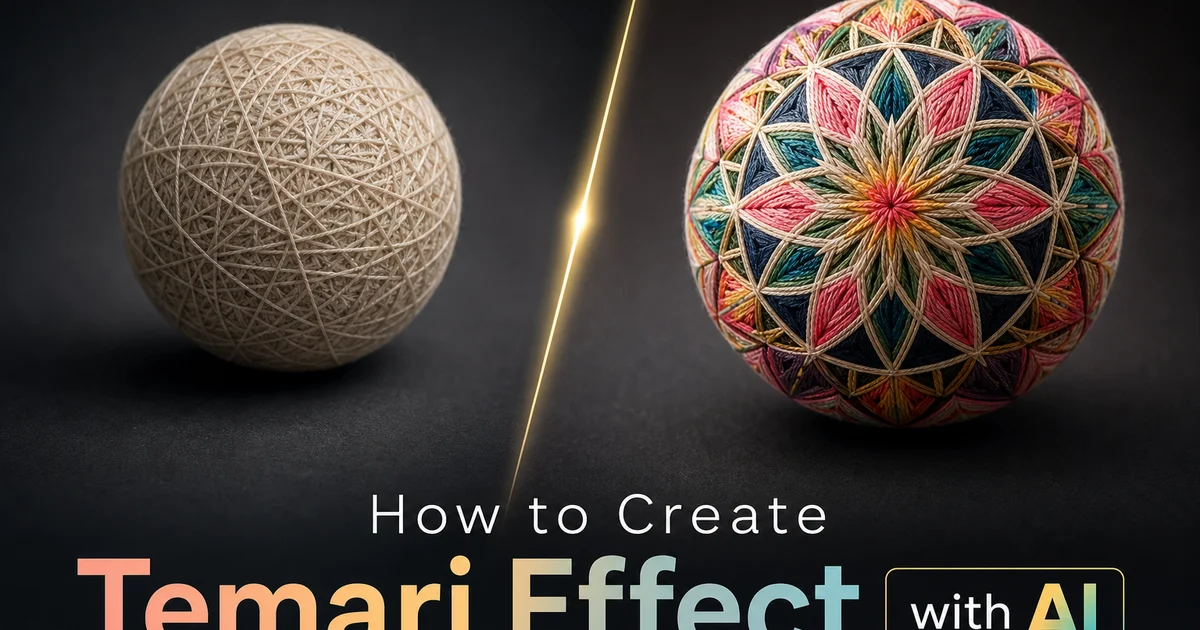
Les temari sont des boules de fil brodé traditionnelles japonaises qui transforment de simples sphères en oeuvres d'art géométriques à couper le souffle grâce à l'enroulement précis de fil coloré selon des motifs mathématiquement réguliers. Originaires de Chine et perfectionnés au Japon au fil des siècles, les temari ont évolué de jouets pour enfants faits de chutes de tissu compressées en objets artisanaux sophistiqués offerts en cadeau, symbolisant l'amitié profonde, la loyauté et les voeux d'une vie brillante. Les motifs géométriques qui couvrent une boule temari — pétales de chrysanthème, étoiles entrelacées, fuseaux tissés et polygones tessellés — émergent d'un système étonnamment simple consistant à diviser la surface de la sphère en sections égales à l'aide de fils guides, puis à remplir chaque section de fil de soie ou de coton coloré soigneusement enroulé.
L'élégance mathématique des motifs temari a fasciné les artistes et designers au-delà de la communauté artisanale traditionnelle. Ces motifs sont, à leur coeur, des tessellations sphériques — les mêmes principes géométriques qui régissent les dômes géodésiques, les panneaux de ballon de football et les coques de protéines virales — exprimés en fil sur une sphère tenue à la main. Cette intersection de précision mathématique et de beauté artisanale fait des motifs temari une esthétique décorative puissante pouvant être appliquée à des images planes, transformant les photographies en compositions qui semblent enveloppées de fil brodé suivant des règles géométriques. L'effet fusionne le sujet photographique avec la beauté ordonnée de la géométrie textile.
AI-powered temari conversion rend ce changement esthétique accessible en analysant n'importe quelle photographie et en générant des motifs de fil géométriquement précis qui suivent la structure compositionnelle de l'image. L'AI projette le système de division sphérique sur l'image plane, détermine comment les couleurs de fil doivent être dérivées de la palette de la photographie originale, et rend la texture de broderie qui imite l'aspect physique du fil enroulé — son léger lustre, le grain directionnel des points posés et les minuscules ombres là où les fils se croisent aux limites de division. Ce guide couvre l'utilisation de AI Filter et AI Enhance pour créer des oeuvres d'art de style temari à partir de photographies, y compris la sélection de motifs, la configuration de la palette de couleurs, le contrôle de la texture du fil et les considérations géométriques qui déterminent si le résultat honore la discipline mathématique de l'artisanat d'origine.
- L'AI projette les systèmes de division sphérique temari traditionnels sur les photographies, générant des motifs de fil géométriquement précis qui suivent la structure compositionnelle de l'image et les contours du sujet.
- Plusieurs styles de motifs temari simulent différentes traditions de broderie, notamment les pétales de chrysanthème, les fuseaux entrelacés, les motifs d'étoiles tissées et les bandes à chevrons, adaptés à différents sujets.
- Les palettes de couleurs de fil vont des combinaisons traditionnelles japonaises d'indigo, de vermillon et d'or aux gradients contemporains et aux couleurs échantillonnées directement de la photographie originale.
- La simulation de texture de broderie reproduit la façon dont le fil réel repose sur la surface de la boule — point satin lisse, point de chaînette texturé ou fil métallique — avec un grain directionnel visible et des ombres de croisement.
- AI Enhance affine les chemins de fil individuels et les points d'intersection géométrique après la conversion, garantissant la régularité mathématique et les détails de broderie qui caractérisent l'artisanat temari authentique.
Comment la AI temari conversion projette la géométrie sphérique sur les photographies planes
La construction traditionnelle du temari commence par la division de la surface de la sphère en sections égales à l'aide de fils guides épinglés à des points soigneusement mesurés. Les schémas de division les plus courants sont le simple 8 (basé sur trois grands cercles perpendiculaires créant une symétrie octaédrique), la combinaison 10 (basée sur la symétrie icosaédrique produisant des pentagones et des triangles) et le simple 16 (créant un réseau plus dense de sections en quartier étroites). Le réseau de fils guides établit le cadre géométrique dans lequel tous les points décoratifs s'effectuent — chaque motif visible est contraint par et construit sur cette structure mathématique sous-jacente.
La AI temari conversion applique ce même cadre géométrique à une photographie rectangulaire plane via une projection sphérique. L'AI traite l'image comme si elle était enroulée autour d'une sphère, projette le schéma de division choisi sur cette sphère virtuelle, puis rend le réseau de fil résultant sur l'image plane. Cela signifie que les divisions géométriques se courbent doucement à travers la surface de l'image, convergeant vers des pôles virtuels qui peuvent être positionnés au centre de l'image, à l'emplacement du sujet principal ou à des points mathématiquement optimaux basés sur la composition. La courbure est subtile mais essentielle — des divisions droites ressembleraient à une superposition de grille, tandis que des lignes courbes créent la qualité nettement sphérique des motifs temari réels.
Le nombre de divisions affecte directement la quantité d'image originale visible à travers le motif de fil. Les faibles nombres de division comme le simple 8 créent de grandes sections où des zones substantielles de la photographie apparaissent à travers le réseau de fil, le motif géométrique servant de cadre décoratif. Les nombres élevés comme la combinaison 72 créent des réseaux denses de sections étroites où le motif de fil domine et où le contenu photographique devient une influence tonale subtile sur la couleur du fil plutôt qu'un élément d'image visible. La plupart des sujets sont plus beaux dans la fourchette moyenne où le motif géométrique et le sujet photographique maintiennent tous deux une présence visuelle, chacun enrichissant l'autre.
- Les schémas de division temari traditionnels — simple 8, combinaison 10, simple 16 — établissent des cadres géométriques mathématiquement réguliers qui contraignent tous les points décoratifs.
- L'AI applique une projection sphérique pour créer des lignes de division doucement courbées qui convergent vers des pôles virtuels, produisant la qualité nettement sphérique des motifs temari réels.
- Les faibles nombres de division préservent plus de photographie visible à travers le réseau de fil, tandis que les nombres élevés créent des motifs denses où l'image devient une influence tonale sur la couleur du fil.
- Le placement du pôle de division au centre du sujet, au centre de l'image ou à des points mathématiquement optimaux détermine comment le cadre géométrique interagit avec la composition.
Sélectionner des styles de motifs temari pour compléter différents sujets
Les motifs de chrysanthème (kiku) sont parmi les designs temari les plus reconnaissables, avec des sections rayonnantes qui émanent d'un point central comme les pétales de la fleur qui donne son nom au motif. Chaque section est remplie de fil enroulé en couches superposées créant un dégradé du centre vers l'extérieur, produisant un effet d'éclat d'étoile qui attire le regard vers l'intérieur. L'AI applique ce motif de manière optimale aux sujets ayant une structure radiale naturelle — fleurs, soleils, détails architecturaux circulaires et portraits où le visage sert de point central à partir duquel les pétales de fil rayonnent. Le motif chrysanthème ajoute une qualité méditative et centrée à toute image en imposant un ordre radial à la composition.
Les motifs de fuseaux entrelacés divisent la sphère en un réseau de formes ovales pointues qui se chevauchent et s'entrelacent, créant une texture visuelle complexe de formes géométriques superposées. Contrairement à la simplicité radiale des designs chrysanthème, les motifs de fuseaux sont multidirectionnels — plusieurs ensembles de fuseaux orientés à différents angles créent un motif d'ensemble sans point focal unique. Cela rend les designs de fuseaux bien adaptés aux paysages, aux compositions abstraites et aux scènes animées où l'objectif est de transformer l'image entière en une tapisserie géométrique uniformément texturée plutôt que d'attirer l'attention sur un sujet central. Les formes de fuseaux qui se chevauchent créent une sensation de profondeur car certaines formes semblent passer au-dessus d'autres.
Les motifs de bandes à chevrons enveloppent la sphère virtuelle dans des pistes parallèles de fil en motif de chevron, créant un effet rayé qui suit les lignes de latitude de la sphère. Là où les motifs chrysanthème sont radiaux et les motifs de fuseaux sont d'ensemble, les bandes à chevrons sont linéaires — elles imposent un flux directionnel fort à travers l'image qui peut compléter ou contraster avec l'orientation naturelle du sujet. Les bandes horizontales accentuent le calme et la stabilité, les bandes diagonales ajoutent de l'énergie dynamique, et les bandes qui suivent les lignes de contour du sujet intègrent le motif géométrique au contenu photographique. La texture de chevron dans chaque bande ajoute une richesse visuelle qui distingue ce motif d'une simple superposition rayée.
- Les motifs chrysanthème avec des sections de pétales rayonnantes fonctionnent mieux avec les sujets à focalisation centrale — fleurs, portraits, détails circulaires — ajoutant une qualité méditative centrée.
- Les motifs de fuseaux entrelacés créent une texture de tapisserie géométrique d'ensemble adaptée aux paysages et aux scènes animées sans point focal unique dominant.
- Les motifs de bandes à chevrons imposent un flux directionnel à travers l'image, la texture de chevron les distinguant de simples rayures et ajoutant de l'énergie visuelle linéaire.
- Le choix du motif détermine si l'effet temari centre l'attention, la distribue uniformément ou la dirige le long d'un flux linéaire à travers la composition.
Les palettes de couleurs de fil et leur relation avec la photographie source
Les temari traditionnels utilisent des combinaisons de couleurs soigneusement sélectionnées qui portent une signification culturelle dans la tradition artisanale japonaise. L'indigo foncé associé au blanc crée une élégance classique. Le vermillon et l'or suggèrent la célébration et la bonne fortune. Le vert, le violet et le rose évoquent la saison des cerisiers en fleurs au printemps. L'AI propose ces palettes traditionnelles comme préréglages, projetant les couleurs sur les sections géométriques dans l'ordre traditionnel. Appliquées à une photographie, ces palettes remplacent les couleurs originales par les teintes de fil traditionnelles, transformant l'image en une composition chromatiquement pure de temari, indépendamment du schéma de couleurs de la photographie originale.
Les palettes dérivées de la photographie adoptent une approche différente en échantillonnant les couleurs de l'image originale et en les assignant aux sections de fil géométriques. L'AI analyse les couleurs dominantes dans chaque section de la photographie et utilise ces couleurs comme teintes de fil pour cette section, créant un motif temari qui reflète la palette de couleurs de l'image originale. Une photographie de coucher de soleil produit des sections de fil orange et violet chaud. Une scène forestière génère des sections vertes et brunes. Un portrait utilise les tons de peau, les couleurs de cheveux et les teintes de vêtements. Cette approche maintient l'identité chromatique de la photographie originale tout en transformant sa texture visuelle en motifs de fil géométriques brodés.
Les palettes de gradient modernes appliquent des transitions de couleurs douces à travers le cadre géométrique, créant des designs temari où les couleurs de fil changent progressivement de section en section plutôt que par paliers nets. Ces palettes de style ombre produisent une interprétation moderne du temari, moins traditionnelle dans le traitement des couleurs mais tout aussi précise dans la structure géométrique. Les gradients pastel créent des compositions douces et rêveuses adaptées aux sujets délicats. Les gradients audacieux d'une teinte saturée à une autre créent une énergie dynamique. Les gradients monochromes du foncé au clair produisent des compositions élégantes qui mettent l'accent sur la structure géométrique plutôt que sur la variété des couleurs.
- Les palettes traditionnelles japonaises portent une signification culturelle — indigo et blanc pour l'élégance, vermillon et or pour la célébration — appliquées comme schémas de couleurs de fil préréglés.
- Les palettes dérivées de la photographie échantillonnent les couleurs dominantes de chaque section de l'image originale, maintenant l'identité chromatique tout en transformant la texture visuelle.
- Les palettes de gradient contemporaines appliquent des transitions de couleurs ombre douces à travers le cadre géométrique pour une interprétation moderne de l'esthétique temari.
- Le choix de la palette détermine si le résultat honore les traditions de couleurs japonaises, préserve les propres couleurs de la photographie ou crée une interprétation de gradient contemporaine.
Simulation de texture de broderie pour un aspect artisanal authentique
La texture physique du fil sur une boule temari est essentielle à son caractère visuel et distingue un effet temari convaincant d'une simple superposition de couleurs géométriques. Le fil réel a un grain directionnel — les fibres individuelles qui composent le fil créent une texture linéaire subtile le long de la direction d'enroulement. Lorsque le fil s'enroule autour d'une boule temari, ce grain suit le chemin d'enroulement, changeant de direction aux limites de section où le fil fait demi-tour. L'AI imite ce grain directionnel en rendant une texture linéaire fine dans chaque bande de fil qui suit la direction d'enroulement calculée, produisant le rythme visuel caractéristique du fil posé.
La simulation de point satin produit des sections lisses et lustrées où les fils sont placés parfaitement parallèles, créant l'aspect poli de la broderie de soie sur un temari de haute qualité. Chaque section apparaît comme une bande de couleur uniforme avec un léger reflet qui change à mesure que l'angle de lumière simulé varie sur la surface, imitant la façon dont la soie réelle capte la lumière différemment le long de sa longueur par rapport à sa largeur. C'est la texture temari la plus propre et la plus élégante, fonctionnant mieux lorsque vous souhaitez que le motif géométrique se lise clairement avec une interférence visuelle minimale de la texture du fil elle-même.
Les simulations de point de chaînette et de point texturé ajoutent des marques de point individuelles visibles qui créent un aspect plus rustique et artisanal. Au lieu d'un fil lisse et uniforme, la surface montre des unités de point discrètes qui captent la lumière une par une, produisant une texture granuleuse sur chaque section. Cette texture est plus visible et ajoute plus de bruit visuel que le point satin, mais elle transmet également un sens plus fort de fabrication artisanale. Les options texturées fonctionnent particulièrement bien aux grandes tailles d'impression où les marques de point individuelles deviennent visibles et invitent à un examen attentif, récompensant l'attention du spectateur avec un artisanat détaillé qui n'est pas apparent à l'échelle de la vignette.
- Le grain directionnel du fil est simulé le long des chemins d'enroulement calculés, changeant de direction aux limites de section pour reproduire le rythme visuel du fil posé sur un temari réel.
- Le point satin produit des sections lisses et lustrées avec un léger reflet qui change avec l'angle de lumière simulé, créant l'élégance polie de la broderie de soie.
- Les simulations de point de chaînette et de point texturé ajoutent des marques de point individuelles visibles pour un aspect artisanal plus rustique qui récompense l'examen attentif aux grandes tailles d'impression.
- Le choix de texture équilibre la clarté géométrique propre du point satin et le caractère artisanal du point texturé, en fonction de la distance de visualisation prévue et de l'esthétique souhaitée.
Applications créatives : portraits, oeuvres d'art cadeaux et designs de célébration culturelle
La conversion de portrait temari crée des oeuvres d'art uniques qui réimaginent des visages familiers à travers le prisme de l'artisanat géométrique japonais. Le motif chrysanthème centré sur le visage crée une composition saisissante où les traits du sujet sont visibles à travers un réseau rayonnant de fil brodé. Les couleurs de fil dérivées de la palette de la photographie maintiennent des tons de peau, des couleurs de cheveux et des couleurs d'yeux distincts dans le cadre géométrique. Ces portraits temari servent de cadeaux distinctifs qui combinent la photographie personnelle avec la tradition artistique culturelle — photos de mariage enveloppées de fil d'or et de vermillon de bon augure, photos de bébé en motifs de chrysanthème pastel doux, ou portraits commémoratifs en indigo et blanc dignes.
Les oeuvres d'art de style temari pour les événements culturels et les célébrations sur le thème japonais apportent une esthétique artisanale authentique aux invitations numériques, décorations d'événements et contenus de médias sociaux. Les photographies de cerisiers en fleurs converties en motifs temari en fil rose et blanc créent des images de célébration de la saison sakura. Les photographies de festival transformées avec des motifs de fil aux couleurs primaires audacieuses capturent l'énergie des célébrations matsuri. Les compositions de natures mortes de cérémonie du thé enveloppées de sections de fil aux tons terre discrets transmettent l'esthétique wabi-sabi. Chaque application relie le contenu photographique à la riche tradition visuelle des arts décoratifs japonais à travers le langage géométrique du temari.
Les compositions mixtes combinent la conversion temari avec une rétention photographique sélective pour créer des images où une partie de la scène apparaît comme du fil brodé tandis que le reste reste photographique. Un portrait où l'arrière-plan se transforme en géométrie temari complexe tandis que le visage conserve le détail photographique crée un contraste saisissant figure-fond. Une nature morte où l'objet central reste photographique tandis que l'espace environnant se remplit de motifs de fil chrysanthème attire l'attention vers l'intérieur à travers le contraste entre la texture géométrique et le réalisme photographique. Ces compositions relient deux langages visuels — la photographie et l'artisanat — en une seule image qui invite à une contemplation prolongée.
- Les portraits temari servent de cadeaux personnels distinctifs — photos de mariage en fil d'or de bon augure, photos de bébé en chrysanthème pastel, portraits commémoratifs en indigo et blanc dignes.
- L'imagerie de célébration culturelle relie le contenu photographique aux arts décoratifs japonais à travers des motifs temari en rose sakura, couleurs primaires de festival ou tons terre wabi-sabi.
- Les compositions mixtes préservent sélectivement le détail photographique dans les zones clés tout en transformant l'espace environnant en motifs de fil géométriques temari.
- La combinaison de la photographie personnelle avec l'esthétique artisanale traditionnelle crée des oeuvres d'art qui honorent à la fois le sujet et la tradition artistique culturelle simultanément.
How to do it
- 1
Upload your photo and evaluate its composition for temari conversion
Open your image in AI Filter and examine it for strong central subjects with clear outlines. Temari effects work by wrapping the image in geometric thread patterns that follow a spherical division scheme. Photos with central focal points, circular or rounded subjects, and balanced compositions convert most well. Portraits centered in the frame, single flowers, round objects, and symmetrical compositions produce the most harmonious temari results. Busy scenes with many competing elements tend to lose coherence when overlaid with the geometric thread network.
- 2
Select the temari pattern style and configure the geometric division
Choose from temari presets that simulate different traditional stitching patterns. Chrysanthemum (kiku) with radiating petal sections, interlocking spindles (spindle-shaped wedges), woven star patterns with hexagonal symmetry, or herringbone bands that wrap around the sphere in parallel tracks. AI Filter analyzes the image content and suggests a division scheme based on subject geometry: radial subjects default to chrysanthemum patterns, linear subjects default to herringbone banding. Balanced subjects default to interlocking star designs. Adjust the division count to control how many sections the sphere is divided into, from simple 8-division patterns to complex 72-division designs.
- 3
Configure thread color palette and embroidery texture for authentic needlework appearance
Select a thread color palette that determines the hues used in the geometric pattern. Traditional Japanese palettes with deep indigo, vermillion, gold, and forest green, or modern palettes with pastel gradients, monochrome variations, or colors sampled from the original photograph. Then configure the embroidery texture to simulate how real thread sits on the ball surface: smooth satin stitch for clean geometric sections, textured chain stitch for visible individual stitch marks, or metallic thread for a lustrous holiday ornament effect. The thread texture is most visible along the edges of pattern sections where stitches change direction.
- 4
Use AI Enhance to sharpen thread texture and geometric precision
After the initial temari conversion, apply AI Enhance to tighten the definition of individual thread paths and ensure that the geometric divisions maintain precise mathematical regularity. The boost step refines the stitching texture so individual thread wraps are visible rather than blending into flat color bands, and it sharpens the intersection points where multiple thread paths cross. Preserve obi bands and guide pin markers because they are characteristic structural elements of real temari construction.
- 5
Export the final temari artwork and compare with traditional temari ball references
Save the completed temari image at full resolution and compare it with photographs of real temari balls from craft galleries and museum collections. Verify that the geometric divisions are mathematically regular, that thread colors transition smoothly between sections, that the pattern reads as a coherent spherical design rather than a flat overlay, and that the embroidery texture suggests real thread rather than smooth digital color. Adjust the division count, palette, or texture if any element falls outside the authentic range of traditional temari craft.
Sources
- Temari: Traditional Japanese Embroidered Thread Balls — Japan House
- Geometric Pattern Generation Using Neural Networks for Textile Design — arXiv — Computer Graphics and Multimedia
- Spherical Symmetry Groups and Their Application in Decorative Arts — American Mathematical Society