
Comment Creer un Effet Scrimshaw avec l'IA — Magic Eraser
Transformez vos photos en œuvres d'art gravees scrimshaw authentiques grace au transfert de style IA. Guide pas a pas couvrant les styles de gravure, les materiaux de substrat, les couleurs d'encre et les techniques artistiques de l'epoque baleiniere historique.

Product Marketing
Vérifié par Magic Eraser Editorial ·
Sommaire
- Comment la conversion scrimshaw par IA traduit la teinte photographique en gravure au trait
- Les materiaux de substrat et leur impact visuel sur l'effet scrimshaw
- Les traditions historiques du scrimshaw et leur influence sur les parametres de style IA
- Applications creatives: themes nautiques, œuvres patrimoniales et produits decoratifs
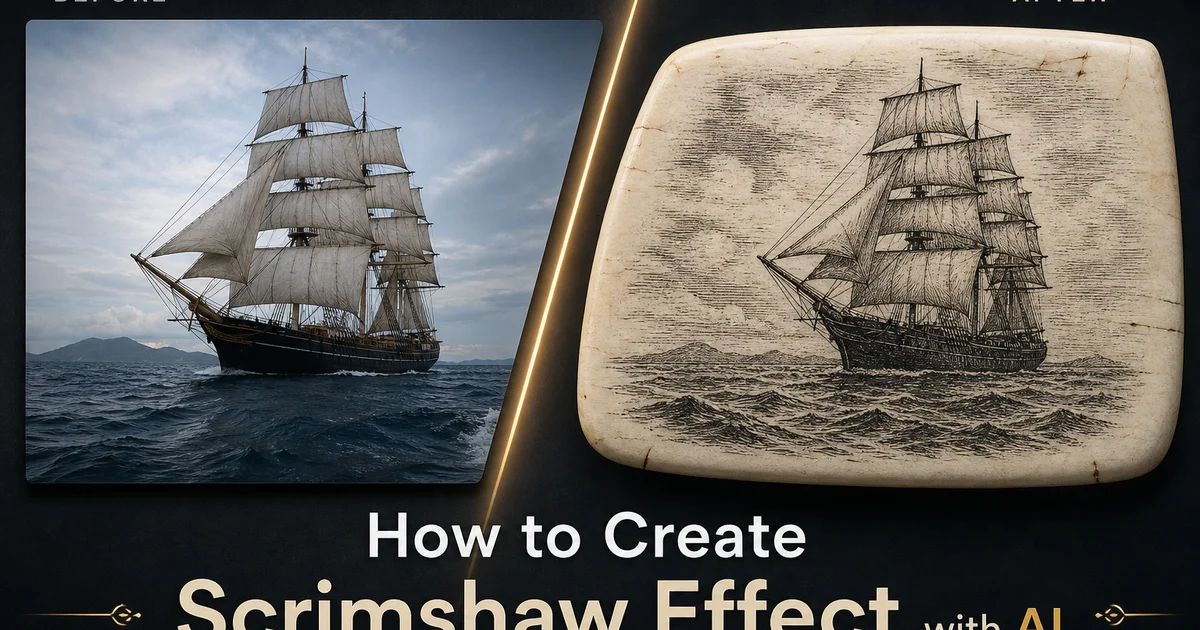
Le scrimshaw est l'art de graver ou d'inciser des lignes fines dans des surfaces dures et lisses. Historiquement, on utilisait l'ivoire de baleine, la defense de morse, l'os de baleine et la coquille — puis on frottait de l'encre ou du pigment dans les incisions pour rendre l'imagerie visible sur le substrat pale. Developpe principalement par les baleiniers americains et europeens aux XVIIIe et XIXe siecles, le scrimshaw a transforme les longs mois d'inactivite en mer en une tradition artistique qui a produit certaines des œuvres d'art populaire les plus minutieuses et historiquement majeures de l'histoire maritime. Les sujets allaient des portraits d'epouses et d'amourettes laissees a la maison, aux rendus detailles de navires baleiniers et de batailles navales, en passant par des motifs decoratifs elabores inspires des ports exotiques que les baleiniers visitaient. Chaque piece etait gravee avec rien de plus qu'une aiguille a voile ou un couteau de poche, exigeant une patience extraordinaire et une main sure. Toute rayure erronee dans l'ivoire etait permanente et irrecuperable.
Recreer numeriquement l'apparence du scrimshaw a partir de photographies a ete par le passe tres difficile car l'effet exige un changement complet de la maniere dont l'information visuelle est encodee. Contrairement aux filtres qui ajustent les couleurs, ajoutent des textures ou adoucissent les bords tout en preservant la nature photographique fondamentale de l'image, la conversion scrimshaw doit remplacer chaque zone de teinte stable par des motifs de lignes gravees discretes. Les zones d'ombre deviennent un hachure croise dense, les tons moyens deviennent des lignes paralleles espacees, et les hautes lumieres deviennent un substrat nu sans aucune marque. Cette traduction tonale-lineaire necessite des decisions artistiques a chaque point de l'image: dans quelle direction les lignes doivent-elles courir, a quelle distance doivent-elles etre espacees, ou le hachure croise doit-il commencer, ou les lignes doivent-elles simplement se terminer pour laisser le substrat servir de haute lumiere. Les filtres logiciels traditionnels qui appliquent simplement la detection de contours et le seuillage produisent des resultats qui ne ressemblent en rien au veritable scrimshaw car ils ne peuvent pas prendre ces decisions artistiques contextuelles.
La conversion scrimshaw par IA resout ce probleme de traduction en comprenant a la fois la structure tridimensionnelle du sujet photographique et les conventions artistiques de la gravure traditionnelle. L'IA identifie les surfaces, estime leur orientation et leur courbure, et genere des motifs de lignes gravees qui suivent les contours de chaque forme. Le hachure s'incurve autour d'une joue, court verticalement le long d'un mat de navire et rayonne vers l'exterieur depuis le centre d'une rose des vents. La densite des lignes correspond a la valeur tonale avec une intelligence artistique, passant en douceur de marques eparses dans les hautes lumieres a des lignes paralleles de densite moyenne dans les tons moyens, puis a un hachure croise dense dans les ombres profondes. La surface du substrat est rendue avec les bonnes caracteristiques materielles — le grain de l'ivoire, la porosite de l'os ou l'iridescence de la coquille — et la simulation de remplissage d'encre donne l'impression que les lignes sont physiquement incisees et remplies plutot que simplement dessinees par-dessus. Ce guide montre comment utiliser AI Filter et AI Enhance pour creer des effets scrimshaw qui honorent le langage visuel de cette remarquable tradition artistique maritime.
- L'IA convertit entierement les photographies en gravure au trait, remplacant les teintes stables par des motifs de hachure dont la densite, la direction et l'espacement encodent les informations tonales et structurelles originales de l'image.
- De multiples preconfigurations de style de gravure simulent differentes techniques de scrimshaw — le hachure parallele a aiguille fine, la gravure au pointille et la gravure graphique au trait gras — chacune adaptee a differents sujets et objectifs esthetiques.
- La selection du materiau de substrat inclut l'ivoire historiquement precis, la defense de morse, l'os et les surfaces de coquille, ainsi que des options ethiques modernes comme la noix de tagua, chacune avec son grain, sa porosite et ses caracteristiques de couleur appropriees.
- Les options de couleur d'encre vont du noir de lampe traditionnel aux remplissages polychromes, l'IA simulant la maniere dont le pigment se depose dans les rainures incisees et saigne legerement le long du grain du materiau.
- AI Enhance ajoute une irregularite controlee des lignes et un vieillissement de la surface du substrat — motifs de grain, rayures de manipulation et patine — qui distinguent un scrimshaw authentique d'un dessin au trait manifestement genere par ordinateur.
Comment la conversion scrimshaw par IA traduit la teinte photographique en gravure au trait
Le defi central de la simulation de scrimshaw est la traduction tonale: convertir les degrades continus d'une photographie en motifs discrets de lignes incisees qui encodent des informations de luminosite equivalentes. Dans le veritable scrimshaw, un graveur competent controle la teinte percue entierement par la densite et l'espacement des lignes. Une zone d'ombre pourrait etre representee par trois ou quatre couches de hachure croise a differents angles, construisant une couverture d'encre quasi totale qui se lit comme sombre a distance de vision normale. Une zone de ton moyen utilise des lignes paralleles unidirectionnelles espacees juste assez loin pour que la couleur du substrat entre elles cree une luminosite moyenne optique. Les hautes lumieres sont simplement des zones ou le graveur cesse completement de faire des marques, permettant a la surface d'ivoire ou d'os nu de servir de valeur la plus claire dans la gamme tonale.
La conversion scrimshaw par IA reproduit ce processus de traduction en analysant d'abord la carte tonale de la photographie source — identifiant les zones qui sont des hautes lumieres, des tons moyens et des ombres — puis en generant les motifs de lignes appropries pour chaque zone tonale. L'IA ne se contente pas de seuiller l'image en noir et blanc. Elle cree un mappage continu de la luminosite photographique a la densite de lignes qui preserve toute la gamme tonale de l'original. Dans les zones de haute lumiere, les lignes sont rares ou absentes. A mesure que les teintes s'assombrissent dans la gamme moyenne, des lignes paralleles apparaissent et se resserrent progressivement. Lorsque les teintes atteignent la gamme des ombres, un deuxieme ensemble de lignes a un angle different croise le premier, puis un troisieme angle est ajoute pour les ombres les plus profondes. Cette accumulation graduee de la densite des lignes est ce qui fait ressembler l'effet scrimshaw a une gravure competente plutot qu'a un simple filtre de seuillage.
La direction des lignes est tout aussi importante et c'est la que la comprehension du sujet par l'IA devient critique. Une direction de ligne aleatoire produirait la meme densite tonale mais ne serait pas lue comme un travail de gravure intentionnel. Cela ressemblerait a du bruit ou a un hachure mecanique de machine. L'IA analyse l'orientation tridimensionnelle de la surface de chaque partie de l'image et aligne les lignes de hachure pour suivre la forme, tout comme le ferait un graveur competent. Les lignes sur un visage suivent la courbure de la joue et l'arrete du nez. Les lignes sur l'eau coulent horizontalement avec les motifs de vagues. Les lignes sur le tissu suivent les directions de drap et de pli. Cette direction de ligne qui suit la forme est ce qui fait percevoir au spectateur le resultat comme une interpretation artistique plutot qu'une conversion mecanique. Elle relie la sortie de l'IA a la tradition seculaire de la gravure ou la direction des lignes etait un choix expressif delibere.
- La traduction tonale mappe la luminosite photographique a la densite de lignes — lignes eparses pour les hautes lumieres, hachure parallele pour les tons moyens, et hachure croise multi-angle pour les ombres.
- L'IA cree une densite continue graduee plutot qu'un seuillage binaire noir-et-blanc, preservant toute la gamme tonale de la photographie originale sous forme gravee.
- La direction des lignes suit l'orientation tridimensionnelle de la surface — s'incurvant autour des visages, coulant avec l'eau, epousant le drap du tissu — plutot que d'utiliser des angles arbitraires ou uniformes.
- La direction des lignes suivant la forme relie la sortie aux conventions de gravure traditionnelles ou la direction du hachure etait un choix artistique et structurel delibere.
Les materiaux de substrat et leur impact visuel sur l'effet scrimshaw
Le choix du materiau de substrat affecte grandement le caractere de l'effet scrimshaw fini car differents materiaux ont des couleurs, des motifs de grain, des niveaux de translucidite et des textures de surface differents qui interagissent tous avec les lignes gravees. L'ivoire de cachalot — le substrat scrimshaw le plus prise et historiquement majeur — a une couleur creme chaude a jaune pale avec un grain longitudinal subtil cree par les tubules de dentine courant sur la longueur de la dent. Une fois poli, il developpe un lustre cireux doux qui donne a la surface une lueur chaleureuse. Les lignes gravees fines dans l'ivoire montrent des bords legerement flous la ou l'aiguille a deplace le materiau plutot que de le couper nettement, creant une chaleur et une douceur dans la qualite du trait qui distingue le scrimshaw sur ivoire du travail sur des materiaux plus durs.
La defense de morse est plus dense et plus dure que l'ivoire de cachalot, produisant une surface plus blanche et plus opaque avec une caracteristique distinctive: le cœur d'une defense de morse a une texture quadrillee semblable a du porridge appelee dentine secondaire, visible en coupe transversale et ajoutant un element visuel unique lorsque la surface de scrimshaw inclut cette limite de materiau. L'os — souvent des sections de cote ou de machoire de baleine — est moins dense que l'ivoire avec une porosite cellulaire visible qui lui donne une texture legerement rugueuse meme poli. Les lignes gravees dans l'os ont tendance a etre plus larges et moins precises car le materiau poreux ne maintient pas un bord net. Les remplissages d'encre ont tendance a saigner legerement dans la structure des pores environnants, creant un aspect de ligne plus doux et plus diffuse. L'IA imite la reaction specifique de chaque materiau a la gravure, garantissant que les lignes sur l'ivoire semblent differentes des lignes sur l'os meme a des reglages de densite identiques.
Les options ethiques modernes a l'ivoire de mammifere marin sont devenues importantes pour des raisons a la fois pratiques et de conservation. L'IA inclut des preconfigurations de substrat pour ces materiaux. L'ivoire de noix de tagua — recolte a partir de la graine du palmier tagua d'Amerique du Sud — est remarquablement similaire a l'ivoire d'elephant en densite, couleur et usinabilite, et produit une surface qui accepte les fins details graves avec une definition de ligne nette. Le Micarta et le Corian offrent des surfaces lisses et uniformes sans grain organique, produisant des lignes propres et precises avec des remplissages d'encre coherents. L'IA offre egalement une option de substrat blanc pur qui supprime toute texture de materiau, utile lorsque vous voulez que le travail de ligne grave se suffise a lui-meme sans que le caractere du substrat n'influence l'experience visuelle. Chaque choix de materiau modifie la temperature de couleur globale, la qualite du trait et le caractere textural de l'effet scrimshaw.
- L'ivoire de cachalot a une couleur creme chaude avec un grain longitudinal et des bords de ligne doux dus au deplacement de l'aiguille, produisant l'apparence scrimshaw historiquement canonique.
- La defense de morse est plus blanche et plus dense avec une structure de cœur quadrilee distinctive, tandis que l'os a une porosite visible qui provoque des lignes plus larges et un leger saignement d'encre.
- La noix de tagua offre une alternative ethique avec une densite et un usinage proches de l'ivoire animal, tandis que les surfaces synthetiques comme le Corian produisent des lignes propres et uniformes.
- Chaque materiau de substrat modifie la temperature de couleur, la qualite du trait et le caractere textural de l'effet fini, et l'IA simule la reaction de gravure specifique au materiau.
Les traditions historiques du scrimshaw et leur influence sur les parametres de style IA
Le scrimshaw de l'epoque baleiniere americaine, produit principalement entre 1820 et 1870 sur les baleiniers yankees operant dans le Pacifique, a etabli le vocabulaire visuel que la plupart des gens associent a cette forme d'art. Ces pieces etaient essentiellement gravees sur des dents de cachalot avec des aiguilles a voile. L'imagerie reflete les preoccupations d'hommes passant trois a quatre ans loin de chez eux: portraits d'epouses et de membres de la famille, aigles et drapeaux patriotiques, images du navire lui-meme, scenes de chasse a la baleine montrant la dangereuse poursuite, et motifs decoratifs copies de sources imprimees disponibles a bord. La qualite du trait varie enormement, du travail gratte grossier de debutants non qualifies a la gravure extraordinairement raffinee de marins talentueux qui ont developpe leurs competences sur de multiples voyages. L'IA offre une preconfiguration d'epoque baleiniere qui capture les caracteristiques typiques de cette tradition — epaisseur de trait legerement irreguliere, substrat d'ivoire chaleureux et les imperfections charmantes qui viennent du travail avec des outils a main sur un navire berce par les vagues.
Les traditions de scrimshaw britannique et europeenne, bien que moins connues que la tradition baleiniere americaine, ont produit un travail distinctif avec des caracteristiques esthetiques differentes. Les baleiniers britanniques travaillant depuis des ports comme Hull, Whitby et Dundee tendaient vers des motifs plus geometriques et decoratifs influences par les traditions de gravure ornementale deja etablies dans le travail du metal et l'imprimerie europeens. La qualite du trait est souvent plus precise et reguliere que le travail americain, refletant une pollinisation croisee avec des competences de gravure expertes. Les sujets penchent davantage vers l'heraldique maritime, les motifs de cordes et de nœuds, et les bordures geometriques entourant des scenes figuratives centrales. Les traditions de type scrimshaw des Polynesiens et des Insulaires du Pacifique sur coquille et os precedent entierement le contact baleinier europeen et utilisent des motifs spiraux et curvilignes distinctifs qui refletent les vocabulaires de design autochtones.
Les artistes scrimshaw modernes travaillant avec des materiaux legaux et ethiques ont elargi la forme d'art vers un territoire photorealiste, utilisant des outils de precision modernes comme les stylets a pointe en carbure de tungstene et les stylos a graver electriques pour atteindre des densites de ligne et un controle qui auraient ete impossibles avec une aiguille a voile. Les portraits scrimshaw modernes peuvent etre presque photographiques dans leur precision tonale, avec un hachure croise si fin que les lignes individuelles sont a peine visibles a l'œil nu. L'IA inclut une preconfiguration moderne qui imite cette precision contemporaine, produisant des lignes tres fines etroitement espacees avec un poids constant et une precision geometrique. Ce style est bien adapte a la conversion de portraits ou l'objectif est une fidelite tonale maximale. La preconfiguration d'epoque baleiniere historique sert mieux les images ou le caractere artisanal fait main du scrimshaw traditionnel fait partie de l'attrait.
- Le scrimshaw de l'epoque baleiniere americaine presente une epaisseur de trait legerement irreguliere et des imperfections artisanales charmantes, avec des sujets allant des portraits de famille aux scenes de chasse a la baleine et a l'imagerie patriotique.
- Les traditions britannique et europeenne montrent des motifs geometriques plus precis influences par les competences professionnelles de gravure sur metal et d'imprimerie, avec des motifs d'heraldique maritime et des bordures ornementales.
- Le scrimshaw contemporain atteint une precision tonale quasi photographique avec des outils en carbure de tungstene et des stylos a graver electriques, produisant des densites de ligne invisibles a l'œil nu.
- L'IA offre a la fois des preconfigurations historiques et contemporaines, vous permettant d'adapter le caractere du scrimshaw a votre intention creative — chaleur d'art populaire ou precision moderne.
Applications creatives: themes nautiques, œuvres patrimoniales et produits decoratifs
La photographie a theme nautique se convertit magnifiquement en effets scrimshaw car le sujet maritime s'aligne parfaitement avec le contexte historique de la forme d'art. Les photographies de voiliers, de scenes portuaires, de phares, de vie marine, de roses des vents et de details d'ancres se transforment toutes en pieces scrimshaw convaincantes qui semblent avoir ete gravees par un baleinier du XIXe siecle lors d'un long voyage dans le Pacifique. L'IA traite ces sujets particulierement bien car le vocabulaire de l'imagerie nautique — lignes de greement, courbes de coque, motifs de vagues et details architecturaux des structures maritimes — se mappe naturellement sur les techniques de gravure directionnelle qui definissent le caractere visuel du scrimshaw. Ces images scrimshaw maritimes fonctionnent comme des impressions d'art autonomes, comme illustrations pour des publications a theme nautique, et comme elements decoratifs pour restaurants, hotels et espaces de vente au detail a themes maritimes.
Les projets de patrimoine et de genealogie utilisent les effets scrimshaw pour donner aux photographies de famille une qualite artistique ancienne qui se connecte a une histoire familiale maritime ou de frontiere. Convertir le portrait d'un ancetre en gravure de style scrimshaw cree un artefact qui semble pouvoir etre une veritable piece d'epoque, evoquant les objets personnels fabriques a la main que les marins transportaient lors de longs voyages. Le substrat d'ivoire chaleureux, le travail de ligne patient et l'echelle intime du scrimshaw contribuent tous a une qualite emotionnelle qui manque a la reproduction photographique standard. Lorsqu'ils sont imprimes sur les bons materiaux — papier épais couleur creme, couvertures de cahier en cuir, ou veritables surfaces lisses en os ou coquille utilisant l'impression UV — ces conversions scrimshaw deviennent des souvenirs personnels significatifs qui brouillent la frontiere entre l'art numerique et la tradition artisanale physique.
Le design de produits decoratifs utilise les motifs scrimshaw pour des articles qui referencent le patrimoine de la forme d'art tout en atteignant les marches modernes. La gravure de manches de couteaux, la conception de cadrans de montres, la bijouterie sur mesure, l'emballage haut de gamme et les accessoires de bar a cocktails utilisent tous l'esthetique scrimshaw soit comme gravure reelle, soit comme imagerie imprimee qui evoque la tradition. La conversion scrimshaw par IA permet aux designers de prototyper rapidement comment une photographie ou une illustration aurait l'air en tant que design grave a la taille de production reelle, testant la composition, la densite de ligne et la gamme tonale avant de s'engager dans une gravure physique couteuse. L'IA peut egalement generer des motifs scrimshaw aux dimensions et a la courbure exactes de surfaces de produits specifiques — un manche de couteau avec un rayon specifique, un cadran de montre avec un diametre defini — tenant compte de la maniere dont la surface courbee affecte la densite visuelle des lignes gravees.
- La photographie nautique se convertit naturellement en scrimshaw car les sujets maritimes s'alignent sur le contexte historique de la forme d'art, avec le greement, les coques et les motifs de vagues se mappant sur les techniques de gravure directionnelle.
- Les projets patrimoniaux donnent aux portraits de famille une qualite gravee ancienne qui evoque les objets personnels faits main, particulierement significatifs lorsqu'ils sont imprimes sur du papier creme ou des surfaces naturelles lisses.
- Le design de produits utilise le scrimshaw IA pour prototyper des manches de couteaux graves, des cadrans de montres, des bijoux et des emballages haut de gamme aux dimensions de production reelles avant de s'engager dans la gravure physique.
- L'IA tient compte de la courbure de la surface du produit lors de la generation des motifs scrimshaw, ajustant la densite visuelle des lignes pour maintenir la coherence sur les manches de couteaux incurves et les surfaces cylindriques.
How to do it
- 1
Upload your photograph and evaluate its suitability for scrimshaw engraving conversion
Open your image in AI Filter and assess whether the photograph has strong tonal contrast and clear subject outlines that will translate into convincing engraved linework. Scrimshaw is an incised art form where fine lines are scratched or carved into a hard smooth surface. Historically, makers incised whale ivory, bone, or shell, then filled the cuts with ink or pigment to make the lines visible against the pale substrate. This means the AI needs to reduce your photograph fully to line work: every area of tone, texture, and shadow must be represented by patterns of engraved lines rather than steady shading. Photographs with clear subjects, strong directional lighting, and well-defined edges produce the most convincing scrimshaw because the AI can trace meaningful contours. Soft-focus images and low-contrast scenes lack the structural clarity that engraved linework demands.
- 2
Select the scrimshaw engraving style and configure line density parameters
Choose from engraving style presets that simulate different scrimshaw traditions and techniques. Fine-needle scrimshaw uses very thin closely-spaced parallel lines to build up tonal areas, producing a delicate intricate look trait of the finest nineteenth-century whaling-era work. Stipple scrimshaw replaces lines with one by one engraved dots, creating tone through dot density rather than line spacing. This technique produces softer tonal gradients but takes much longer in real life and is considered the most skilled variant. Bold-line scrimshaw uses thicker incised marks with wider spacing for a graphic high-contrast look. Adjust the line density slider to control how many lines per unit area the AI uses to build up shadow regions, from sparse gestural linework to dense closely-packed hatching.
- 3
Configure the substrate material and ink color for authentic scrimshaw appearance
Select the substrate surface that the engraving appears to be carved into. Historical sperm whale ivory has a warm cream color with subtle organic grain running lengthwise and a slight translucency at thin edges. Walrus ivory is denser and whiter with a distinctive cross-hatched core structure. Bone has a more porous texture with visible cellular structure in cross-section. Modern ethical options include tagua nut ivory, which has a dense white look, and Corian or other synthetic surfaces with uniform smooth coloring. Then choose the ink color that fills the engraved lines. Traditional scrimshaw used lamp black soot or India ink for deep black lines, but red, blue, and polychrome color fills were also historically used on decorative pieces. The ink color combined with substrate tone determines the overall contrast and mood of the finished effect.
- 4
Use AI Enhance to sharpen individual engraved lines and add substrate surface detail
After the initial scrimshaw conversion, run AI Enhance to tighten the individual engraved lines and add realistic surface traits to the substrate. Real scrimshaw shows crisp incised lines with slightly irregular edges where the needle or blade caught on material grain variations. This controlled imperfection is key for realism because perfectly uniform computer-generated lines right away reveal digital origin. The boost step also adds subtle surface details to the substrate including the natural grain pattern of ivory or bone, minor surface scratches from handling, and the slight yellowing and patina that develops on aged organic materials. These surface imperfections make the scrimshaw look like it exists on a real physical object.
- 5
Export the finished scrimshaw effect and verify against historical reference pieces
Save the completed scrimshaw image at full resolution and compare it against photographs of genuine museum-quality scrimshaw pieces to verify engraving realism. Check that lines follow the contours of the subject with intentional directional logic, that tonal buildup is achieved through line density variation rather than gray fill, that the substrate surface shows appropriate material traits, and that the overall composition fits within a shape that could plausibly be an ivory tooth, bone panel, or shell surface. Authentic scrimshaw pieces are often small; a sperm whale tooth is usually fifteen to twenty centimeters long — so the composition should feel intimate and precisely detailed rather than large-scale and expansive.
Sources
- Scrimshaw: History and Technique of the Whaleman's Art — Mystic Seaport Museum
- Line Engraving Simulation Using Neural Style Transfer — arXiv — Association for the Advancement of Artificial Intelligence
- Traditional Engraving Techniques and Digital Reproduction Methods — The Metropolitan Museum of Art — Heilbrunn Timeline of Art History