
Comment creer un effet laque Ryukyu avec la retouche photo par IA
Transformez vos photos en effets de laque Ryukyu d'Okinawa grace au transfert de style par IA. Guide pas a pas couvrant le modele en relief tsuikin, les lignes incrustees d'or chinkin, les feuilles dorees hakue. Incrustation de nacre raden avec palette polychrome.
SEO & Growth
Vérifié par Magic Eraser Editorial ·
Sommaire
- En quoi la decoration polychrome Ryukyu differe de l'esthetique laquiere japonaise continentale
- Le modelage tsuikin : le relief laque tridimensionnel et sa simulation par IA
- Chinkin, hakue et raden : simulation des techniques metalliques et irisees
- Applications creatives : design contemporain, revitalisation culturelle et usage musial
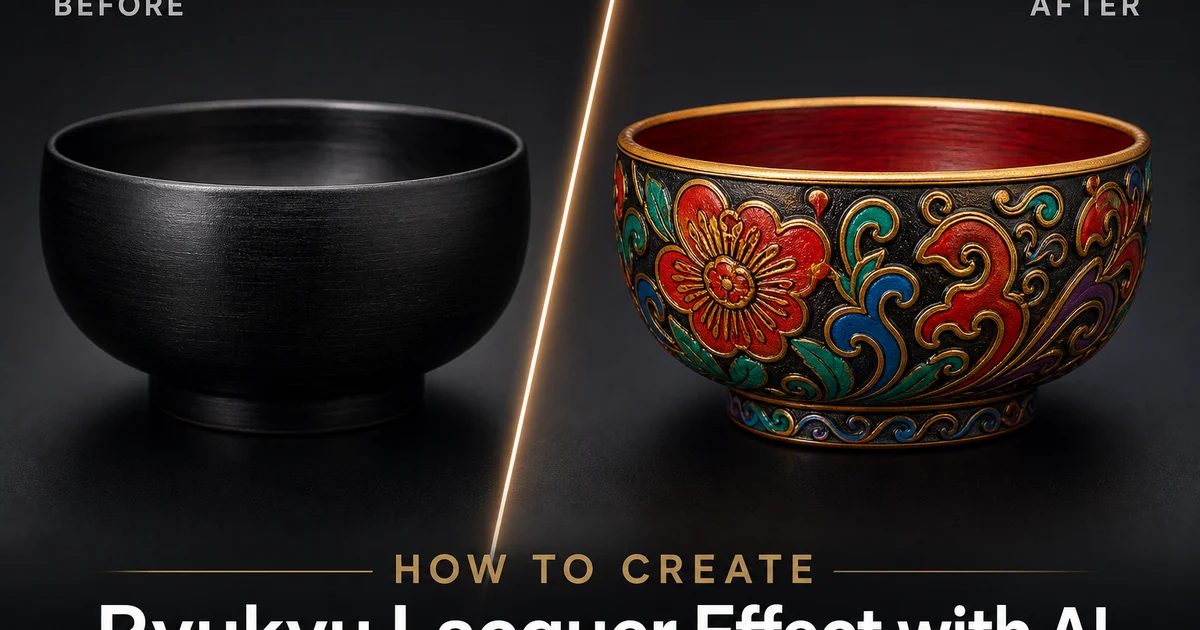
La laque Ryukyu — la tradition laquiere des iles Okinawa, developpee sous le royaume de Ryukyu du quatorzieme au dix-neuvieme siecle — se distingue des arts laquiers du Japon continental par sa decoration polychrome exuburante, sa composition figurative audacieuse et ses innovations techniques uniques. Alors que les traditions continentales comme le Wajima-nuri, le Tsugaru-nuri et la laque Kishu se sont developpees dans le cadre esthetique japonais plus large de la retenue raffinee, la laque Ryukyu a evolue au carrefour des influences culturelles chinoises, japonaises, coreennes et sud-est asiatiques, produisant un vocabulaire decoratif qui embrasse les contrastes chromatiques vifs, les scenes narratives elaborees et le modelage tridimensionnel de surface d'une maniere sans equivalent direct dans la production continentale.
Le royaume de Ryukyu — un Etat marchand maritime independant qui controlait l'archipel d'Okinawa de 1429 jusqu'a son annexion par le Japon en 1879 — utilisait les laques a la fois comme cadeaux diplomatiques pour les missions tributaires chinoises et comme produit de luxe d'exportation dans toute l'Asie de l'Est et du Sud-Est. Cette fonction diplomatique et commerciale exigeait des objets d'un impact visuel extraordinaire, poussant les artisans a developper des techniques distinctives comme le tsuikin (modelage en relief de pate de laque pigmente directement sur la surface), le chinkin (decoration incrustee d'or). Des combinaisons elaborees d'incrustation de nacre et de peinture laquee polychrome. Les objets qui en resultent comptent parmi les laques les plus complexes visuellement jamais produits en Asie de l'Est.
Le transfert de style par IA releve un defi particulier avec la laque Ryukyu car l'effet visuel implique de multiples elements techniques simultanes. Relief tridimensionnel, surfaces metalliques, incrustation de nacre irisee et decoration peinte polychrome — autant d'elements qui doivent etre rendus de maniere coherente sur une seule surface. Ce guide couvre le flux de travail complet pour creer des effets de laque Ryukyu avec AI Filter et AI Enhance, depuis la selection des presets techniques tsuikin, chinkin, hakue, raden jusqu'a la configuration de la hauteur du relief, du rendu metallique et du mappage chromatique polychrome audacieux qui distinguent la laque Ryukyu de toutes les autres traditions laquieres d'Asie de l'Est.
- L'IA imite la decoration polychrome audacieuse de la laque Ryukyu en mappant la structure tonale de la photo dans la palette vermillon vif, noir, jaune, vert et or caracteristique de la tradition okinawaienne.
- Quatre presets techniques couvrent le modelage en relief tsuikin, les lignes incrustees d'or chinkin, les feuilles dorees hakue et les techniques combinees nacre-relief raden-tsuikin.
- La simulation tridimensionnelle tsuikin rend les elements decoratifs saillants avec des ombres portees appropriees, une nettete des bords et une texture de surface distincte du fond de laque plat.
- Le rendu des materiaux metalliques et irises reproduit le comportement optique de la feuille d'or, de la poudre d'or et de la nacre sous forme de surfaces reflechissantes physiquement precises plutot que de colorations metalliques plates.
- AI Enhance affine l'interaction entre les multiples techniques decoratives qui apparaissent caracteristiquement ensemble sur les surfaces de laque Ryukyu.
En quoi la decoration polychrome Ryukyu differe de l'esthetique laquiere japonaise continentale
L'esthetique laquiere japonaise continentale — faconnee par la philosophie zen, la culture du the et l'appreciation wabi-sabi de l'imperfection et de l'impermanence — privilegie generalement les palettes de couleurs retenues, les compositions asymetriques et les espaces negatifs qui permettent a la surface laquee elle-meme de porter le poids visuel. Un chef-d'oeuvre de chinkin Wajima pourrait n'utiliser que des lignes d'or sur laque noire. Une boite maki-e celebree pourrait representer une seule branche de prunier en fleurs en or et argent sur fond noir. La laque Ryukyu opere a partir d'un fondement esthetique totalement different. Une piece Ryukyu caracteristique pourrait couvrir chaque centimetre carre de surface de dragons entrelaces au milieu de rouleaux de nuages en vermillon, jaune, vert, noir et or, avec des accents de nacre et des elements tsuikin emergent de la surface en relief tridimensionnel.
Cette difference n'est pas une question de sophistication technique — les artisans Ryukyu etaient tout a fait capables de decoration retenue et en produisaient occasionnellement pour le marche japonais — mais reflete le contexte culturel dans lequel la laque Ryukyu a developpe son esthetique principale. La relation tributaire du royaume de Ryukyu avec les dynasties Ming et Qing a expose les artisans okinawaiens aux traditions decoratives chinoises qui favorisaient la couverture de surface polychrome elaboree, le symbolisme auspicieux communique par des programmes visuels denses et la richesse materielle demontrable qui conferait un statut diplomatique. Parallelement, les relations commerciales avec l'Asie du Sud-Est ont introduit des materiaux tropicaux et des sensibilites decoratives qui ont encore enrichi la palette Ryukyu au-dela des normes continentales japonaises.
La simulation par IA doit capturer cette difference esthetique fondamentale pour produire des resultats qui se lisent comme authentiquement Ryukyu plutot que comme de la laque japonaise continentale avec des couleurs plus vives. Le parametre de densite decorative controle la couverture de surface. Les pieces Ryukyu authentiques atteignent souvent pres de cent pour cent de decoration de surface, ne laissant pratiquement aucun fond de laque non decore visible. La palette chromatique est calibree sur les pigments specifiques utilises dans les ateliers Ryukyu : un vermillon chaud legerement orange distinct du vermillon japonais plus froid, une teinte verte particuliere derivee de composes de cuivre et le jaune vif bien plus courant dans le travail Ryukyu que dans la laque japonaise continentale. Ces relations chromatiques specifiques etablissent l'origine culturelle de l'effet simule.
- La laque japonaise continentale favorise les palettes retenues et les espaces negatifs ; la laque Ryukyu adopte une couverture de surface quasi totale avec des programmes decoratifs polychromes elabores.
- Les influences tributaires chinoises et les echanges commerciaux sud-est asiatiques ont faconne l'esthetique Ryukyu vers une richesse materielle demontrable et un symbolisme auspicieux dense.
- La densite decorative controle une couverture de surface approchant cent pour cent, refletant la pratique Ryukyu authentique de ne laisser quasiment aucun fond de laque non decore visible.
- Le calibrage chromatique utilise des tons pigmentaires specifiques Ryukyu — vermillon orange chaud, vert cuivre et jaune prominent — qui distinguent le travail okinawaien des palettes de laque japonaise continentale.
Le modelage tsuikin : le relief laque tridimensionnel et sa simulation par IA
Le tsuikin — la contribution technique la plus distinctive de la laque Ryukyu aux arts laquiers d'Asie de l'Est — cree des elements decoratifs tridimensionnels en modelant de la pate de laque pigmente directement sur la surface laquee. La pate est un melange de laque urushi raffinee, de poudre de pigment et d'un agent gonflant (autrefois de la pate de riz ou de l'argile broyee) qui lui donne assez de corps pour etre faconnee, modelee et maintenue en relief pendant le processus de durcissement. Les artistes tsuikin utilisent de petites spatules, des outils de modelage et leurs doigts pour faconner cette pate en dragons, fleurs, oiseaux, rouleaux de nuages et autres elements decoratifs qui saillent de plusieurs millimetres au-dessus du fond de laque plat, creant un effet de bas-relief qu'aucune autre tradition laquiere d'Asie de l'Est n'a developpe a ce point.
La simulation du tsuikin par IA necessite de rendre une veritable saillie tridimensionnelle a partir d'une photographie bidimensionnelle. La simulation identifie les zones de l'image destinees au traitement tsuikin et genere les indices visuels qui communiquent le relief physique. Ombres portees coherentes avec une source lumineuse directionnelle, bords en lumiere sur les surfaces elevees faisant face a la lumiere, texture de surface legerement differente sur la pate modellee par rapport au fond de laque plat, et l'assombrissement subtil a la base des elements en relief la ou ils rencontrent la surface environnante. Ces indices de profondeur doivent etre physiquement coherents sur toute la surface decoree — toutes les ombres tombant dans la meme direction, tous les bords en lumiere repondant a la meme position de lumiere virtuelle — sinon l'illusion du relief s'effondre en un motif plat peu convaincant.
La difference de texture entre les elements tsuikin et le fond de laque plat est un detail crucial pour le realisme. Les surfaces de laque plates sont polies a un brillant miroir par abrasion progressive avec des materiaux de plus en plus fins. Les elements de relief tsuikin, en raison de leur geometrie tridimensionnelle et de la consistance plus molle de la pate modellee, ne peuvent pas etre polis a la meme qualite miroir. Ils conservent un brillant legerement plus doux avec des marques d'outils visibles du processus de modelage. L'IA rend ce contraste de texture, donnant aux elements eleves une qualite de surface nettement differente du fond plat brillant. Cette difference est immediatement apparente dans la laque Ryukyu authentique et sa reproduction precise separe les simulations convaincantes des revetements decoratifs plats.
- La pate tsuikin — laque urushi melangee a du pigment et un agent gonflant — est modelee en formes de bas-relief saillantes a l'aide de spatules et des doigts, creant une technique unique parmi les traditions laquieres d'Asie de l'Est.
- L'illusion tridimensionnelle necessite des ombres portees physiquement coherentes, des bords en lumiere, un assombrissement a la base et un eclairage directionnel sur tous les elements de relief de la surface decoree.
- Le contraste de texture de surface entre la laque plate polie miroir et le brillant plus doux marque par les outils des elements tsuikin modeles est essentiel pour une simulation authentique.
- Les parametres de hauteur de relief controlent la saillie apparente, des fractions de millimetre pour des effets subtils a plusieurs millimetres pour le modelage tsuikin audacieux des grandes pieces ceremoniales.
Chinkin, hakue et raden : simulation des techniques metalliques et irisees
Le chinkin — decoration incrustee d'or — cree des motifs lineaires fins en gravant dans la surface de laque durcie avec des outils pointus et en remplissant les lignes gravees de feuille d'or, de poudre d'or ou parfois d'argent. Dans le chinkin Ryukyu, les lignes gravees sont souvent plus audacieuses et plus profondement taillees que dans le chinkin japonais continental, produisant un impact visuel plus fort en accord avec l'esthetique Ryukyu de decoration audacieuse. Les lignes gravees peuvent definir les contours de dessins figures qui sont ensuite remplis de peinture laquee polychrome, ou elles peuvent former des motifs decoratifs independants de caractere geometrique ou floral. L'IA imite le chinkin en rendant des lignes fines avec les proprietes optiques de l'or — chaudes, hautement reflechissantes, avec la reflectance directionnelle specifique qui distingue les surfaces metalliques de la peinture jaune — placees dans des canaux peu profonds qui captent et concentrent la lumiere differemment de la surface plate environnante.
Le hakue — decoration laquee doree utilisant de la feuille d'or coupee — applique de fines feuilles d'or sur la surface laquee en motifs decoratifs. Contrairement au maki-e qui saupoudre de la poudre d'or dans la laque humide, le hakue pose des feuilles d'or plates sur la surface en formes decoupees, produisant de plus grandes zones metalliques stables avec la qualite miroir lisse distinctive de la feuille d'or plutot que la texture granuleuse de la poudre saupoudree. Le hakue Ryukyu couvre souvent des zones substantielles d'or — fonds, bordures et grands elements decoratifs — creant un aspect plus ouvertement riche et dore que l'utilisation souvent plus selective du maki-e continental. L'IA rend l'or hakue avec le comportement optique specifique d'une fine feuille metallique : haute reflectivite speculaire avec une legere irregularite de surface due au processus d'application, produisant des reflets brillants et chauds mais avec une qualite artisanale distincte d'un revetement metallique applique mecaniquement.
Le raden — incrustation de nacre — ajoute des elements de coquille irises a la surface laquee. Les artisans Ryukyu utilisaient le raden avec une liberte particuliere, decoupant la coquille en formes pour des elements figures, des fonds et des bordures decoratives. La qualite irisee de la nacre — changeant de couleur selon l'angle de vue lorsque la lumiere diffracte a travers la structure nacree en couches — presente un defi de rendu specifique car l'effet depend de l'angle et est impossible a capturer completement dans une image statique. La simulation par IA rend le raden avec le spectre chromatique caracteristique de la nacre (principalement l'iridescence bleu-vert a rose) et imite le changement de couleur dependant de l'angle du spectateur en montrant differentes positions spectrales sur les parties courbes ou inclinees des elements de coquille, communiquant la qualite irisee par variation chromatique spatiale au sein de chaque piece de coquille.
- La simulation du chinkin rend les lignes gravees incrustees d'or avec une veritable reflectance metallique placee dans des canaux graves, distinguant le comportement optique de l'or reel de la peinture jaune plate.
- Le rendu de la feuille d'or hakue capture la qualite miroir lisse de la feuille appliquee avec une legere irregularite de surface artisanale, distincte des finitions metalliques pulverisees ou saupoudreuses.
- L'iridescence de la nacre raden est communiquee par variation chromatique spatiale au sein de chaque element de coquille, simulant l'effet de diffraction nacree dependant de l'angle dans une image statique.
- Le rendu combine des techniques — contours chinkin remplis de laque polychrome, fonds hakue et accents raden — reproduit la richesse materielle en couches des grandes laques ceremoniales Ryukyu.
Applications creatives : design contemporain, revitalisation culturelle et usage musial
Les designers et artisans okinawaiens modernes qui travaillent a revitaliser les traditions laquieres Ryukyu utilisent des images de reference generees par IA pour explorer comment les techniques historiques pourraient etre adaptees aux formes de produits modernes, aux sensibilites chromatiques et aux combinaisons de materiaux contemporains. La simulation permet un prototypage rapide des schemas decoratifs — tester differents placements de motifs tsuikin, densites de lignes chinkin et variations de palette chromatique sur des maquettes de produits avant de s'engager dans les semaines d'application de laque qu'exige le prototypage physique. Cette iteration de conception acceleree aide a combler le fosse entre l'artisanat traditionnel et les attentes du marche moderne sans compromettre l'integrite technique des techniques laquieres elles-memes.
La conception d'expositions museales pour les presentations de laque Ryukyu utilise des images traitees par IA pour creer des decors contextuels, des affichages educatifs et des installations interactives qui aident les visiteurs a comprendre les techniques derriere les objets exposes. En generant des simulations detaillees agrandies des etapes de modelage tsuikin, des processus d'incision et de remplissage chinkin, de decoupe et de placement de l'incrustation raden, les concepteurs d'expositions peuvent creer des explications visuelles qui rendent la complexite technique de la laque Ryukyu accessible au grand public. Ces visualisations de processus completent les objets finis dans les vitrines et aident les visiteurs a apprecier le savoir-faire extraordinaire et l'investissement en temps que chaque piece represente.
Les architectes d'interieur et designers graphiques s'inspirant des traditions esthetiques Ryukyu pour des projets hoteliers, de centres culturels et residentiels de luxe utilisent les effets de laque Ryukyu par IA pour generer des references de motifs et de couleurs qui capturent le caractere visuel cle de la laque okinawaienne sans copier directement des objets historiques specifiques. La palette polychrome, les textures de relief tsuikin et les accents metalliques de la laque Ryukyu se traduisent bien en revetements muraux, imprimes textiles, programmes d'email ceramique et installations d'affichage numerique — ou l'esthetique Ryukyu audacieuse, chaleureuse et densement decoree offre une alternative culturellement ancre au vocabulaire de design japonais continental plus couramment reference.
- Les artisans okinawaiens contemporains utilisent la simulation pour un prototypage decoratif rapide, testant les placements de motifs et les variations chromatiques avant de s'engager dans des semaines d'application physique de laque.
- Les concepteurs d'expositions museales creent des visualisations techniques agrandies — etapes tsuikin, processus chinkin, decoupe raden — qui rendent la complexite de la laque Ryukyu accessible au grand public.
- Les architectes d'interieur traduisent les palettes polychromes et les textures de relief Ryukyu en revetements muraux, textiles et installations numeriques pour des projets hoteliers et de centres culturels.
- La revitalisation culturelle beneficie d'outils de conception qui permettent une exploration rapide de l'adaptation des techniques historiques Ryukyu aux formes de produits contemporains et aux attentes du marche.
How to do it
- 1
Upload your photo and evaluate its composition for Ryukyu lacquer decoration
Open your image in AI Filter and assess how its composition and color balance will interact with Ryukyu lacquerware decoration styles. Ryukyu lacquerware — produced in the Okinawa islands since at least the fourteenth century under the Ryukyu Kingdom — is distinguished from mainland Japanese lacquer by its vibrant polychromatic palette, bold figural decoration. Unique techniques like tsuikin (raised lacquer modeling) and hakue (gilded lacquer with gold leaf). Images with well-defined subjects, strong compositional areas suitable for decorative overlay. Warm color palettes translate most well because Ryukyu lacquer uses the entire surface as a canvas for elaborate decorative programs rather than relying on the lacquer material alone.
- 2
Select a Ryukyu lacquer technique preset and configure decorative parameters
Choose from presets mimicking the principal Ryukyu lacquerware techniques. Tsuikin (raised lacquer relief modeling where lacquer mixed with pigment and powdered materials is built up into three-dimensional sculptural forms directly on the lacquered surface), chinkin (incised gold-filled lines where designs are carved into the cured lacquer and filled with gold leaf or gold powder), hakue (gold-leaf overlay using cut gold sheet applied to the lacquered surface in decorative patterns), and raden-tsuikin (mother-of-pearl inlay combined with raised lacquer modeling for maximum decorative richness). Each preset configures relief height, metallic intensity, color palette, and decorative density.
- 3
Adjust relief depth, metallic rendering, and polychromatic color mapping
Fine-tune the parameters that define Ryukyu lacquer's distinctively bold decorative character. Unlike the refined restraint of many mainland Japanese lacquer styles, Ryukyu lacquerware embraces vivid color contrasts. Vermilion, black, yellow, green, and gold appear together in elaborate compositions depicting dragons, phoenixes, peonies, and other auspicious motifs drawn from both Chinese and indigenous Ryukyuan iconographic traditions. The color mapping controls determine how the original photograph's tonal structure is translated into this polychromatic palette. Relief depth controls the apparent three-dimensionality of tsuikin modeling where decorative elements project physically above the lacquer surface.
- 4
Use AI Enhance to refine relief modeling, gold rendering, and decorative detail
Run AI Enhance to sharpen the simulation of Ryukyu lacquer's distinctive textural and metallic qualities. For tsuikin effects, the boost accentuates the three-dimensional relief by refining shadow casting, edge definition, and the surface texture of the modeled lacquer. Which has a slightly different sheen than the flat surrounding surface because it is applied in thicker layers with different tool marks. For chinkin effects, boost sharpens the incised line quality and the way gold leaf catches light within the carved channels. For hakue and raden elements, boost brings out the optical play of light on metallic and iridescent surfaces.
- 5
Export and compare against museum examples of Ryukyu lacquerware
Save the completed image at full resolution and compare it with photographs of authenticated Ryukyu lacquerware from the Okinawa Prefectural Museum and Art Museum, the Shuri Castle collection reconstructions, the Urasoe Art Museum's extensive lacquer holdings. The British Museum's Ryukyu lacquer collection. Verify that the decorative density and color palette match the bold polychromatic character of genuine Ryukyu work rather than the more restrained mainland aesthetic, that tsuikin relief elements show right physical projection and tool-mark texture. That gold and mother-of-pearl rendering exhibits the optical qualities of real metallic and iridescent materials rather than flat metallic-colored paint.
Sources
- Ryukyu Lacquerware: The Unique Tradition of Okinawan Tsuikin and Chinkin — Okinawa Prefectural Government — Traditional Crafts Division
- The Art of Ryukyuan Lacquer: Historical Development and Technical Analysis — Studies in Conservation — International Institute for Conservation
- Okinawan Lacquerware in the Collections of the Okinawa Prefectural Museum — Okinawa Prefectural Museum and Art Museum