
Comment creer un effet de repousse metallique avec la retouche photo par IA
Transformez vos photos en art du repoussé métallique grâce à l'IA. Guide pas à pas couvrant les techniques de relief en bosse, la ciselure de précision, la simulation de surface métallique et les préréglages par tradition historique, de l'or au cuivre.

Product Marketing
Vérifié par Magic Eraser Editorial ·
Sommaire
- Comment la conversion repoussé par IA extrait la profondeur et simule le relief métallique
- Traditions métalliques : or cérémoniel, argent décoratif, cuivre architectural et bronze classique
- Profondeur de relief et ciselure : contrôler la dimension sculpturale et les détails de surface
- Applications créatives : art mural, image de marque de luxe et visualisation architecturale
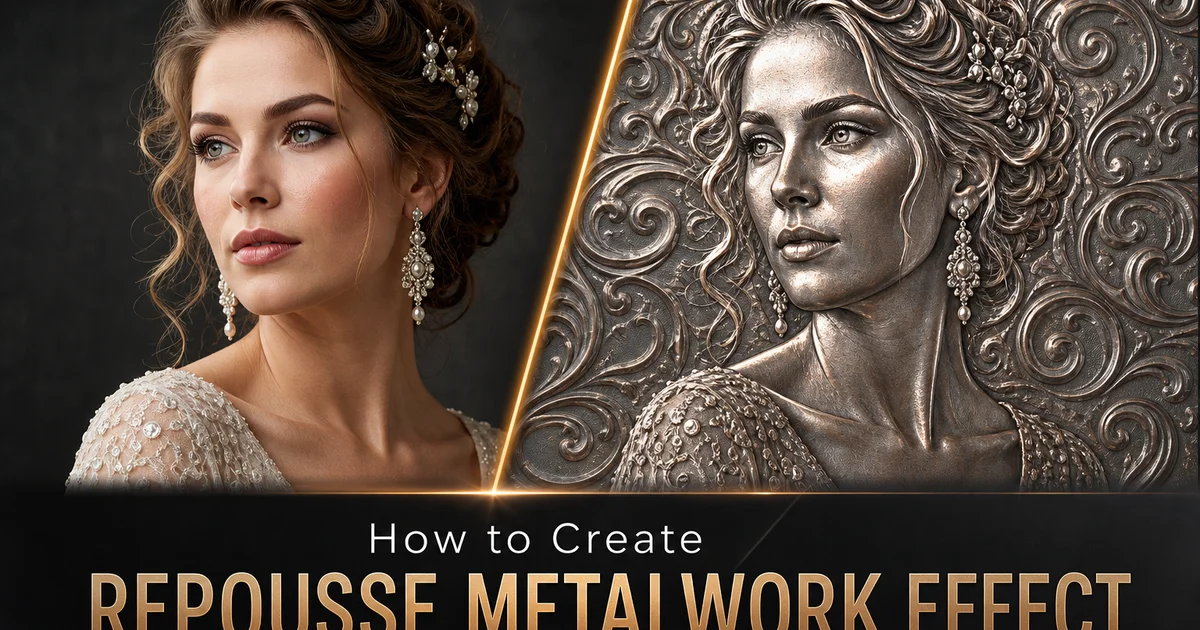
Le repoussé est l'une des techniques de travail des métaux les plus anciennes et les plus expressives, pratiquée sans interruption depuis plus de cinq mille ans, de l'ancienne Mésopotamie au monde méditerranéen classique, en passant par l'Europe médiévale, la Renaissance et jusqu'à l'art métallique moderne. La technique consiste à marteler une feuille de métal depuis l'envers pour créer un relief en bosse sur le devant, en construisant des formes tridimensionnelles à partir d'une feuille plate grâce à des milliers de coups de marteau soigneusement placés à l'aide de poinçons de formes variées pressés contre un matériau de support souple comme le poix ou le cuir. La technique complémentaire de la ciselure — travaillant depuis l'endroit avec des poinçons et des traçoirs pour raffiner les détails — achève le processus, produisant des surfaces sculpturales allant du bas-relief subtil au haut-relief fortement saillant qui semble émerger organiquement du plan métallique.
Recréer numériquement l'aspect du repoussé a longtemps nécessité des compétences avancées en rendu 3D ou un travail minutieux sur Photoshop : modéliser le sujet comme une surface en relief, calculer comment un matériau métallique réfléchirait la lumière sur cette géométrie, et ajouter les traces subtiles du martelage manuel qui confèrent au repoussé sa qualité organique caractéristique. Les résultats atteignaient rarement une conviction matérielle parce que la relation critique entre la forme, la lumière et la surface métallique est extrêmement complexe. Une surface métallique incurvée reflète son environnement en larges reflets fluides qui se déplacent constamment selon l'angle de vue, et ce comportement est très difficile à simuler de manière convaincante avec un traitement d'image 2D seul.
La conversion repoussé par IA aborde ce défi en analysant la structure tridimensionnelle suggérée par l'éclairage de la photographie, puis en calculant l'apparence de cette structure si elle était formée dans du métal martelé. L'IA extrait les informations de profondeur à partir des motifs d'ombre et de lumière, convertit cette profondeur en une surface de relief continue, applique le comportement réfléchissant du métal sélectionné et ajoute les traces de surface du processus de martelage manuel — marques d'outils, texture de planage et irrégularité organique du travail artisanal. Ce guide vous explique comment utiliser AI Filter et AI Enhance pour créer des effets repoussé qui capturent la puissance sculpturale et le réalisme matériel de l'une des techniques de travail des métaux les plus anciennes et les plus vénérées.
- L'IA extrait la profondeur tridimensionnelle des motifs d'ombre et de lumière de la photo et la convertit en une surface de relief métallique continue avec une courbure naturelle.
- De multiples préréglages métalliques simulent l'or, l'argent, le cuivre et le bronze avec un comportement réfléchissant physiquement précis et une couleur de surface ainsi qu'un caractère de patine propres à chaque matériau.
- Le contrôle de la hauteur du relief va du bas-relief subtil pour les objets décoratifs délicats au haut-relief dramatique pour l'ornementation architecturale monumentale.
- La ciselure de précision ajoute des détails linéaires nets en surface qui raffinent les formes plus douces du façonnage repoussé initial, reproduisant les séquences de travail recto-verso réelles.
- AI Enhance ajoute des marques d'outils authentiques — texture de planage, variation des coups de marteau et irrégularité organique du travail à la main — qui distinguent le repoussé du métal coulé ou embouti.
Comment la conversion repoussé par IA extrait la profondeur et simule le relief métallique
Le défi fondamental de la simulation repoussé est de convertir une photographie plate bidimensionnelle en un relief métallique tridimensionnel convaincant. Cela nécessite deux capacités qui manquent aux filtres d'image conventionnels : l'extraction de profondeur et le rendu de surface métallique. L'extraction de profondeur signifie analyser les indices d'éclairage de la photographie — dégradés d'ombre, placement des reflets, limites d'occlusion et raccourci perspectif — pour construire une carte de profondeur qui décrit jusqu'où chaque point du sujet projetterait depuis un plan d'arrière-plan plat si la scène était formée en relief. C'est à la base l'inverse du métier du photographe : là où l'appareil photo a compressé la profondeur de la scène 3D en une image 2D, l'IA doit récupérer cette profondeur à partir des indices visuels que cette compression a laissés derrière elle.
La carte de profondeur est ensuite utilisée pour générer une surface de relief continue. Non pas une découpe aux bords tranchants mais une forme qui s'écoule en douceur, où chaque point transitionne graduellement vers ses voisins, tout comme le métal martelé à la main ne peut pas supporter de plis nets ou de sauts discontinus sans se déchirer. L'IA applique des contraintes métallurgiques à la géométrie de surface, garantissant que les formes du relief sont physiquement plausibles pour une tôle formée par martelage. Cela signifie des courbures douces plutôt que des angles vifs, des transitions lisses entre différents niveaux de hauteur, et une profondeur de relief maximale proportionnée à l'épaisseur du métal et à la plage de travail typique de la tradition sélectionnée. Ces contraintes empêchent le résultat de ressembler à une carte de déplacement arbitraire et lui donnent le langage formel spécifique du métal martelé à la main.
Le rendu de surface métallique applique le comportement réfléchissant du matériau sélectionné à la surface du relief. Contrairement aux matériaux mats qui diffusent la lumière de manière diffuse, les métaux réfléchissent leur environnement selon des motifs précisément déterminés par la courbure de la surface. Une zone convexe lisse produit un large reflet doux. Une concavité crée un point lumineux focalisé. Une zone plate agit comme un miroir. L'IA calcule ces réflexions en fonction de la géométrie du relief et applique la couleur spectrale du métal sélectionné — jaune chaud pour l'or, blanc froid pour l'argent, rose saumon pour le cuivre, olive foncé pour le bronze patiné — produisant une surface qui se comporte optiquement comme le vrai métal plutôt que comme un plastique coloré ou une photographie teintée. Ce rendu physiquement réaliste est ce qui fait la différence entre un effet repoussé qui ressemble à du métal sculpté et un effet qui ressemble à un filtre gaufré.
- L'extraction de profondeur analyse les motifs d'ombre et de lumière de la photo, le placement des reflets et les limites d'occlusion pour construire une carte de profondeur de relief à partir d'images 2D.
- Les contraintes métallurgiques garantissent que la géométrie du relief utilise des courbures douces et des transitions lisses, conformes à une tôle formée par martelage plutôt qu'à un déplacement arbitraire.
- Le rendu de surface métallique calcule les réflexions environnementales basées sur la courbure du relief — larges reflets sur les zones convexes, points focalisés dans les concavités, comportement miroir sur les zones planes.
- La couleur métallique spectrale est appliquée physiquement — or chaud, argent froid, cuivre saumon, bronze patiné foncé — produisant des surfaces qui se comportent optiquement comme de vrais métaux.
Traditions métalliques : or cérémoniel, argent décoratif, cuivre architectural et bronze classique
Le repoussé d'or représente le sommet de la gamme expressive de la technique car l'or est le plus malléable de tous les métaux. Il peut être martelé jusqu'à une finesse extraordinaire sans se fissurer et formé dans les détails de relief les plus délicats sans les fractures de contrainte qui limitent les autres métaux. Les objets en repoussé d'or les plus célèbres incluent le Masque d'Agamemnon de Mycènes, l'Or de Troie découvert par Schliemann, et les somptueux reliquaires et devants d'autel des églises médiévales européennes. Le repoussé d'or possède une qualité chaude et lumineuse qu'aucun autre métal n'égale. La surface capte et réfléchit la lumière avec une profondeur et une richesse qui proviennent de la courbe unique de réflectance spectrale de l'or, qui réfléchit préférentiellement les longueurs d'onde longues et absorbe les longueurs d'onde courtes, produisant sa lueur chaude caractéristique. L'IA imite ce comportement spectral avec précision, produisant des surfaces dorées avec la chaleur et la profondeur indéniables du vrai métal.
Le repoussé d'argent est devenu le support dominant de l'orfèvrerie décorative du XVIIe au XIXe siècle, lorsque les argentiers produisaient des motifs en relief élaborés sur tout, des services à thé et chandeliers aux cadres de tableaux et dos de miroirs. Le caractère réfléchissant plus froid de l'argent lui confère une présence esthétique différente de l'or — plus architecturale, plus structurée, avec des reflets d'un blanc brillant plutôt que d'un jaune chaud. Le repoussé d'argent tend vers des détails plus fins et un traitement de surface plus contrôlé que l'or, en partie parce que l'argent est plus dur et nécessite un travail d'outil plus précis, en partie parce que ce matériau était associé à la sophistication domestique plutôt qu'à la cérémonie sacrée ou royale. L'IA rend l'argent avec ses reflets bleu-blanc froid caractéristiques et la subtile nuance chaude qui distingue le véritable argent du chrome ou de l'acier inoxydable.
Le repoussé de cuivre est le support de l'ornementation architecturale à grande échelle et de la sculpture publique, illustré de façon célèbre par la Statue de la Liberté — une structure colossale en cuivre repoussé formée de 300 panneaux martelés un par un. La chaleur, l'aptitude au travail et la résistance aux intempéries du cuivre le rendent idéal pour les applications extérieures, et sa surface développe une patine verte distinctive au fil du temps qui ajoute une autre dimension visuelle. L'IA fournit à la fois le cuivre poli brillant avec ses reflets rose saumon caractéristiques et le cuivre patiné avec la verdure bleu-vert qui se développe par exposition au temps. Le repoussé de bronze, bien que moins courant que le cuivre en raison de la dureté plus grande du bronze, apparaît sur les umbos de boucliers classiques, les panneaux de portes de temples et les armures de cérémonie de la Renaissance. L'IA rend le bronze avec sa surface plus sombre et plus dorée et la patine olive foncé caractéristique qui se développe sur le bronze exposé.
- Le repoussé d'or simule la réflectance spectrale chaude du métal le plus malléable — réfléchissant préférentiellement les longueurs d'onde longues pour une lueur riche et lumineuse caractéristique.
- Le repoussé d'argent rend des reflets bleu-blanc froid avec de subtiles nuances chaudes, correspondant à la précision architecturale et à la sophistication domestique de la tradition orfèvre.
- Le repoussé de cuivre offre à la fois une surface polie rose saumon brillant et des variantes patinées vert-de-gris pour l'ornementation architecturale et les applications sculpturales à grande échelle.
- Le repoussé de bronze produit des surfaces olive-doré plus foncées correspondant aux umbos de boucliers classiques et aux panneaux de temples, avec des options de patine pour un caractère atmosphérique vieilli.
Profondeur de relief et ciselure : contrôler la dimension sculpturale et les détails de surface
La profondeur du relief est le paramètre le plus impactant dans le rendu repoussé car elle détermine le caractère sculptural fondamental du résultat. Le haut-relief — où les formes se projettent fortement depuis l'arrière-plan, parfois à plus de la moitié de leur profondeur naturelle — crée des surfaces sculpturales audacieuses et puissantes avec des ombres profondes et une forte présence tridimensionnelle. Les hauts-reliefs historiques en repoussé incluent les vases d'argent romains avec des scènes mythologiques où les personnages se projettent de plusieurs centimètres de la paroi du vase, les devants d'autel de la Renaissance où saints et anges émergent du plan métallique en quasi-ronde-bosse, et l'orfèvrerie baroque où fruits, fleurs et rinceaux créent des surfaces dimensionnelles exubérantes. Le réglage haut-relief de l'IA produit une profondeur dramatique avec une intensité d'ombre correspondante et un fort contraste entre reflets et ombres.
Le bas-relief — où les formes s'élèvent subtilement de la surface avec de légers changements d'élévation — crée des surfaces raffinées et délicates qui récompensent un examen attentif. Les bas-reliefs historiques en repoussé incluent l'orfèvrerie georgienne avec son ornementation classique sobre, les métaux japonais avec des paysages et des scènes de nature en relief peu profond nuancé, et les panneaux Art déco où les formes géométriques se projettent juste assez pour capter la lumière directionnelle. Le travail en bas-relief exige un plus grand raffinement de surface car les formes peu profondes ne peuvent pas compter sur des ombres dramatiques pour se définir. Ce sont plutôt les subtilités de la courbure de surface et le comportement de la lumière sur le métal doucement incurvé qui deviennent l'expérience visuelle principale. Le réglage bas-relief de l'IA produit une profondeur douce avec des dégradés d'ombre légers et le jeu tranquille de la lumière sur des surfaces métalliques qui changent lentement.
La ciselure de précision opère indépendamment de la profondeur du relief, ajoutant des détails de surface qui raffinent les formes plus larges créées par le martelage depuis l'envers. Dans le travail réel du métal, la phase de repoussé établit les formes principales — le volume d'un visage, la courbe d'une feuille, le gonflement d'un drapé — tandis que la phase de ciselure ajoute une définition précise — le bord d'une paupière, les nervures d'une feuille, les lignes de plis d'un tissu. L'IA applique la ciselure comme une couche de détail secondaire qui repose sur les formes de relief primaires, ajoutant une définition linéaire nette, une texture de surface et des détails fins qui augmentent la richesse visuelle de la surface sans modifier la géométrie sculpturale sous-jacente. Un haut niveau de ciselure produit des surfaces densément détaillées typiques des œuvres de la Renaissance et du Baroque. Une ciselure faible produit les surfaces plus larges et minimalistes typiques des traditions classique et moderne.
- Le haut-relief crée une projection sculpturale audacieuse avec des ombres profondes, correspondant aux vases romains, aux devants d'autel de la Renaissance et à l'orfèvrerie baroque où les formes émergent dramatiquement du plan métallique.
- Le bas-relief produit une élévation subtile avec de légers dégradés d'ombre, correspondant à la retenue georgienne, au naturalisme en relief peu profond japonais et à la précision géométrique Art déco.
- La ciselure ajoute des détails de surface secondaires — bords de paupières, nervures de feuilles, plis de drapés — par-dessus les formes de relief primaires sans modifier la géométrie sculpturale sous-jacente.
- La ciselure de précision va du détail dense Renaissance-Baroque aux surfaces classiques-modernes minimalistes, contrôlée indépendamment du réglage global de profondeur du relief.
Applications créatives : art mural, image de marque de luxe et visualisation architecturale
Les effets repoussé comptent parmi les styles de travail du métal les plus polyvalents sur le plan commercial car la qualité sculpturale et dimensionnelle de la technique se transmet puissamment à travers différents médias et échelles. Un portrait rendu en repoussé d'or en haut-relief devient une œuvre d'art murale imposante qui combine la ressemblance photographique avec la gravité des orfèvreries cérémonielles antiques. Une photographie botanique rendue en repoussé d'argent en bas-relief crée un panneau décoratif élégant avec la sophistication sobre de l'orfèvrerie georgienne. Un détail architectural rendu en repoussé de cuivre produit une surface qui semble appartenir à la façade d'un bâtiment monumental. Ces applications fonctionnent sous forme d'impressions numériques mais sont particulièrement efficaces lorsqu'elles sont imprimées sur des substrats métalliques à l'aide de procédés de sublimation. La surface métallique physique renforce l'illusion visuelle du véritable travail du métal.
Le marketing des marques de luxe exploite le rendu repoussé car la qualité sculpturale de la technique communique la valeur premium bien plus efficacement que les éléments de design plats. Une photographie de produit rendue en repoussé transforme le produit en un objet qui semble avoir été fabriqué à la main par un maître orfèvre, chaque surface réfléchissant la lumière comme si elle avait été formée par des milliers de coups de marteau experts. La qualité dimensionnelle crée un sentiment de présence physique que la photographie plate ne peut égaler. Le spectateur perçoit l'image comme représentant un objet tridimensionnel plutôt qu'une image plate. Cette physicalité perçue est particulièrement efficace pour l'emballage, les présentoirs en point de vente et les environnements de vente au détail expérientiels où les supports de marque rivalisent pour attirer l'attention dans l'espace physique.
Les cabinets d'architecture et les architectes d'intérieur utilisent le rendu repoussé pour visualiser les commandes d'orfèvrerie sur mesure avant fabrication. Un panneau en relief proposé pour le hall d'un hôtel, un panneau de porte décoratif pour une résidence privée ou un médaillon de plafond ornemental peuvent être rendus en repoussé à partir d'une photographie de design, montrant au client comment l'orfèvrerie finie interagirait avec l'éclairage de l'espace et le caractère réfléchissant du métal sélectionné. Cette capacité de visualisation raccourcit le cycle d'approbation du design et réduit le risque de coûteuses divergences de fabrication en donnant aux clients un aperçu photoréaliste d'un travail qui, auparavant, ne pouvait être communiqué qu'à travers des croquis et des maquettes à petite échelle.
- L'impression sur substrat métallique par sublimation renforce l'illusion du repoussé, créant un art mural où le matériau physique et l'effet de métal rendu travaillent ensemble.
- Les applications de marques de luxe exploitent la dimensionnalité sculpturale qui communique la valeur artisanale premium plus efficacement que le traitement photographique plat.
- Les emballages de produits et les présentoirs en point de vente gagnent une présence physique perçue grâce au rendu repoussé, les spectateurs interprétant la surface tridimensionnelle comme un objet tangible.
- La visualisation architecturale prévisualise les commandes d'orfèvrerie sur mesure en contexte, montrant aux clients comment les panneaux en relief interagissent avec l'éclairage de l'espace et le comportement réfléchissant du métal sélectionné.
How to do it
- 1
Upload your image and evaluate it for repoussé conversion
Open your photograph in AI Filter and assess which elements will translate well into the raised-relief character of repoussé metalwork. Images with strong three-dimensional subjects, clear light-and-shadow modeling, and well-defined forms produce the most convincing results because repoussé is fundamentally a sculptural technique. The design emerges from the metal surface as a continuous relief without any seams or joins. Portraits with dramatic lighting, botanical subjects with natural dimensional form, and mythological or narrative scenes all work exceptionally well.
- 2
Select the metal type and relief tradition
Choose from repoussé presets that simulate different metals and historical traditions. Gold repoussé mimics the warm, highly malleable material used for ceremonial objects from Mycenaean death masks to Renaissance ecclesiastical art. Silver repoussé provides the cooler reflective surface favored for domestic and decorative silverwork from Georgian tea services to Art Nouveau panels. Copper repoussé offers the warm, workable surface used for architectural ornament, sculpture, and large-scale public art, including the Statue of Liberty. Bronze repoussé delivers the darker, heavier character of classical shield bosses and temple door panels.
- 3
Adjust relief height, surface detail, and chasing refinement
Control the apparent height of the raised relief to determine how far the design projects from the background plane. High relief creates bold, deeply sculpted forms with strong shadow that read clearly at distance. Suitable for architectural ornament and monumental work. Low relief creates subtle, delicate elevation with gentle shadow gradients. Suitable for jewelry, small decorative objects, and fine art panels. Chasing refinement controls the amount of surface detail applied from the front of the metal after the initial repoussé shaping, adding crisp linear definition to the softer forms created by hammering from behind.
- 4
Use AI Enhance to sharpen tool marks and refine reflective surfaces
After the initial repoussé conversion, run AI Enhance to sharpen the characteristic tool marks that distinguish hand-hammered repoussé from cast or stamped metalwork. Real repoussé displays subtle evidence of the process: faint planishing marks where the metal was smoothed, slight variations in surface curvature from individual hammer strokes, and the organic irregularity of hand-formed curves. The boost step also refines the metal's reflective quality, ensuring that highlight areas display the broad, flowing reflections characteristic of smoothly curved metal surfaces rather than the sharp, point-source reflections of faceted geometry.
- 5
Export the final image and compare against museum reference metalwork
Save the finished repoussé effect at full resolution and compare it with photographs of authentic repoussé metalwork from museum collections spanning different periods and traditions. Verify that the relief forms display natural three-dimensional curvature with smooth transitions between raised and recessed areas, that the metal surface shows right reflective behavior for the selected material. That the overall composition reads as a photograph of sculpted metal rather than an embossed or filtered digital image. Adjust relief height and chasing detail until the result achieves the sculptural quality of genuine hand-hammered metalwork.
Sources
- Repoussé and Chasing: Techniques in Metalwork — The Metropolitan Museum of Art
- The Art of Raising and Repoussé — Ganoksin — Jewelry Making Community
- Historical Metalworking Techniques: From Bronze Age to Modern — The British Museum