
Comment creer un effet Pyrographie avec l'IA — Magic Eraser
Transformez vos photographies en art de la pyrographie sur bois realiste grace a la simulation de brulure par IA. Guide pas a pas couvrant la selection du grain de bois, les techniques de brulure, les styles de pointe, le controle de la profondeur tonale et la finition de surface.

Product Marketing
Vérifié par Magic Eraser Editorial ·
Sommaire
- Comment la simulation de pyrographie par IA modelise la physique de la brulure du bois
- Choisir les types de bois et comprendre le comportement du grain
- Techniques de brulure et leurs applications artistiques
- Applications creatives : cadeaux personnalises, decor rustique et produits commerciaux
- Optimiser l'effet pyrographie pour la sortie d'impression et numerique
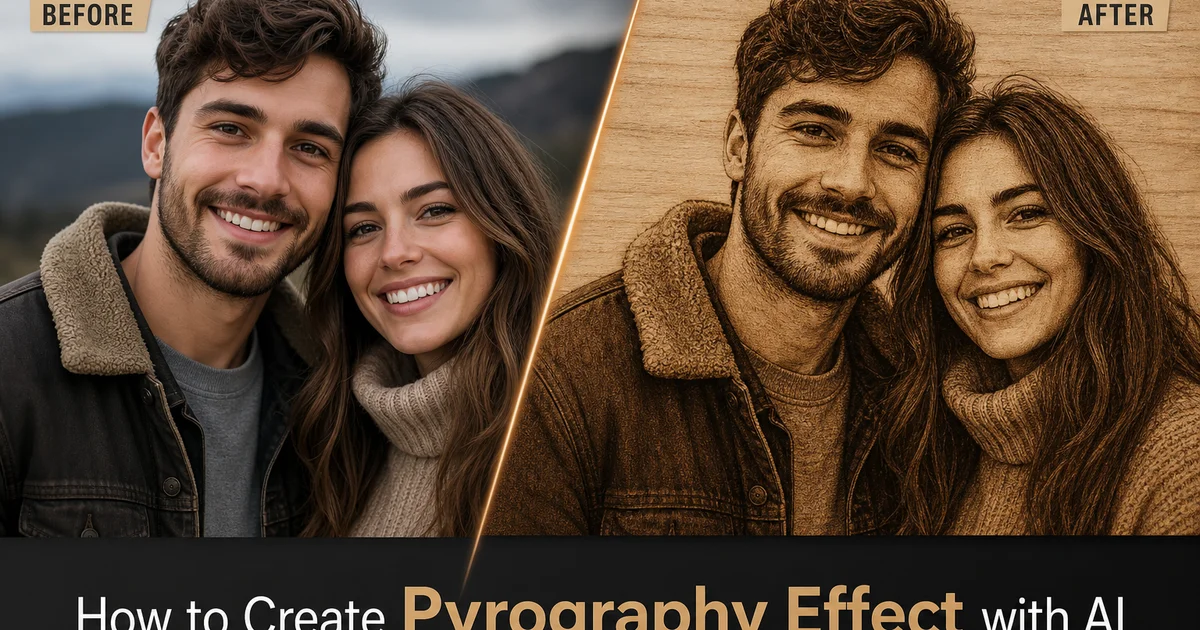
La pyrographie — l'art de decorer le bois en brulant des motifs a sa surface a l'aide d'un outil metallique chauffe — est l'un des rares mediums artistiques ou le substrat n'est pas simplement un support passif mais un participant actif dans le resultat visuel. Le grain du bois, avec ses motifs alternes de croissance printaniere molle et de croissance estivale dense, ses noeuds et ses figures de fil, sa variation de couleur du coeur a l'aubier, interagit avec chaque marque que l'outil de brulure produit. Un trait de brulure traversant une zone de grain tendre penetre plus profondement et produit une marque plus foncee que le meme trait traversant une zone dure, creant une modulation tonale naturelle qui donne a la pyrographie sa qualite texturee distinctive. Cette interaction physique entre l'outil et le materiau est ce qui rend la pyrographie authentique immediatement distinguishable de toute reproduction sur surface plane. Et c'est ce qui rend les effets de pyrographie numerique convaincants si techniquement difficiles a produire.
Les approches numeriques traditionnelles pour imiter la pyrographie ont ete limitees a des approximations grossieres : convertir la photographie en niveaux de gris, appliquer une teinte sepia ou brune, superposer une texture de bois. Peut-etre ajouter un assombrissement des bords pour suggerer des lignes brulees. Ces filtres produisent des resultats qui n'ont que la ressemblance la plus superficielle avec une vraie brulure de bois car ils ignorent la physique fondamentale du medium. Les marques de pyrographie reelles ne sont pas des pixels marron sur un fond de couleur bois. Ce sont des alterations physiques de la surface du bois ou la cellulose a ete thermiquement decomposee, carbonisant les fibres et creant des marques dont la couleur, la profondeur et la texture dependent de la temperature de l'outil, de la duree du contact, de la densite du bois a ce point specifique et de la direction du trait par rapport au fil. Un filtre sepia ne capture rien de cette complexite. C'est pourquoi les resultats ressemblent a des photographies teintees plutot qu'a du bois brule.
La conversion pyrographie par IA imite l'interaction physique entre un outil chauffe et une surface de bois en chaque point de l'image. L'IA modelise le grain du bois comme une surface tridimensionnelle avec une densite variable, genere des traits de brulure qui repondent a cette variation de densite. Elle calcule la couleur et la profondeur de chaque marque en fonction de la temperature simulee et du temps de contact. Les traits qui traversent les zones de grain tendre s'assombrissent et s'elargissent ; les traits qui traversent les zones dures s'eclaircissent et se retrecissent. Les noeuds et les irregularites du grain creent des perturbations visibles dans les passages de brulure autrement lisses, et la gamme tonale globale est contrainte au spectre physiquement atteignable du bois calcine. Du caramel dore le plus pale d'un toucher leger et bref au noir profond d'une carbonisation prolongee a haute temperature. Ce guide explique comment creer des effets de pyrographie avec AI Filter qui ressemblent de facon convaincante a des oeuvres d'art brulees a la main, couvrant la selection du bois, la technique de brulure, le controle tonal et les traitements de finition qui completent l'illusion.
- L'IA imite l'interaction physique entre les outils metalliques chauds et les surfaces de bois, produisant des marques dont la couleur et la profondeur repondent a la variation de densite du grain. Plus foncees dans les zones tendres, plus claires dans les zones dures.
- Plusieurs types de bois sont disponibles, y compris le tilleur lisse pour les portraits detailles, le contreplaque de bouleau pour une texture de grain subtile et le pin avec des motifs d'anneaux de croissance prononces qui creent une modulation de brulure visible.
- Quatre techniques de brulure distinctes — l'ombrage lisse, le trait calligraphie, le point stipple et la pointe filaire fine — peuvent etre appliquees a differentes regions de l'image en fonction du sujet detecte par l'IA.
- Les controles de profondeur de brulure simulent la gamme tonale allant du caramel dore pale d'une legere calcination au noir profond d'une carbonisation a haute temperature, contrainte au spectre physiquement atteignable du bois calcine.
- Les effets de finition de surface comprenant les traitements polyurethane, mat brut et huile frottee modifient la chaleur, le contraste et le brillant du resultat final pour un realisme maximal.
Comment la simulation de pyrographie par IA modelise la physique de la brulure du bois
Le fondement d'une simulation convaincante de pyrographie est un modele precis du bois en tant que materiau heterogene avec des proprietes thermiques variables sur sa surface. Le bois n'est pas une substance uniforme. C'est un composite de fibres de cellulose disposees en anneaux de croissance concentriques qui alternent entre le bois initial (earlywood) de faible densite (forme pendant la croissance rapide du printemps) et le bois final (latewood) de haute densite (forme pendant la croissance plus lente de l'ete). Lorsqu'un outil de pyrographie chauffe entre en contact avec le bois initial, les fibres a faible densite carbonisent rapidement et profondement, produisant des marques sombres avec un affaissement de surface important. Lorsque le meme outil a la meme temperature entre en contact avec le bois final, les fibres plus denses resistant a la carbonisation, produisant des marques plus claires avec moins de penetration de surface. Cette reponse alternee est ce qui cree la modulation striee caracteristique visible dans la pyrographie reelle, principalement sur les bois comme le pin et le frene ou la difference de densite entre le bois initial et le bois final est prononcee.
L'IA genere un modele de grain de bois procedural pour le type de bois selectionne, calculant les valeurs de densite a chaque emplacement de pixel. Cette carte de densite comprend le motif d'anneaux de croissance macroscopique (arcs concentriques qui courbent a travers la surface, refletant la section circulaire du tronc d'arbre), les rayons medullaires (caracteristiques radiales lineaires qui courent perpendiculairement aux anneaux de croissance chez certaines especes), les motifs de figure (figure flamme, matelasse ou oeil d'oiseau causee par un fil ondule ou entremele) et les irregularites locales comme les noeuds ou les branches intersectaient le tronc. Chacune de ces caracteristiques modifie la valeur de densite locale, ce qui a son tour modifie la facon dont l'outil de brulure simule interagit avec la surface a ce point. Le resultat est un modele de grain qui non seulement semble realiste en tant que texture visuelle mais se comporte de maniere realiste lorsque les marques de brulure sont calculees contre lui.
Le calcul des marques de brulure combine la carte de densite du grain avec les parametres de trait (temperature, duree de contact, geometrie de la pointe et direction du trait) pour produire la marque finale a chaque point. L'IA resout une equation de diffusion thermique simplifiee qui modelise le transfert de chaleur de la pointe de l'outil dans le bois, tenant compte de la densite locale, de la teneur en humidite (qui varie entre le bois initial et le bois final) et de la conductivite thermique du materiau environnant. Les zones ou l'outil se deplace lentement ou s'arrete recoivent plus d'energie thermique et carbonisent plus profondement. Les zones ou l'outil se deplace rapidement recoivent moins d'energie et produisent des marques plus claires. Cette approche physiquement fondee signifie que l'IA n'applique pas simplement un mapping de couleur brune aux valeurs de luminosite des pixels. Elle calcule ce qui se produirait reellement si un outil chauffe reel parcourait la surface du bois le long du chemin necessaire pour reproduire les valeurs tonales de la photographie.
- La variation de densite du grain de bois entre le bois initial (printemps, faible densite) et le bois final (ete, haute densite) assombrit et approfondit les brulures dans les zones tendres tout en les eclaircissant dans les zones dures.
- Les modeles de grain proceduraux integrent les anneaux de croissance, les rayons medullaires, les motifs de figure et les irregularites de noeuds qui modifient le comportement de brulure en chaque point de la surface.
- Les equations de diffusion thermique simplifiees calculent le transfert de chaleur de la pointe de l'outil au bois, tenant compte de la densite locale, de l'humidite et du temps de contact pour une generation de marques physiquement precise.
- La variation de vitesse de l'outil affecte l'apport d'energie thermique — les passages lents et les arrets produisent une carbonisation profonde et sombre tandis que les traits rapides creent des marques de surface plus claires, correspondant au comportement reel de la pyrographie.
Choisir les types de bois et comprendre le comportement du grain
Le tilleur (tilleul d'Amerique) est le bois le plus populaire pour la pyrographie car son grain est tres fin, regulier et diffuse-poreux, ce qui signifie qu'il y a une difference de densite minimale entre le bois initial et le bois final. Cela produit une surface de brulure lisse et uniforme ou les marques de l'artiste apparaissent avec une obscurite constante et une interference minimale du grain, permettant un travail de detail precis et des gradients tonaux lisses. La simulation de tilleur de l'IA produit les effets de pyrographie les plus propres avec la meilleure conservation des details photographiques, ce qui en fait le choix par defaut pour les conversions de portraits et les sujets ou la subtilite tonale importe plus que la texture de surface. Le bois lui-meme varie du presque blanc au creme pale, offrant un contraste maximal meme avec les marques de brulure les plus legeres et creant une qualite lumineuse et brillante dans les zones de haute lumiere de l'image.
Le contreplaque de bouleau occupe un juste milieu entre la neutralite du tilleur et l'interaction dramatique du grain des bois tendres. Le placage de surface du contreplaque de bouleau a un grain fin et serre avec des motifs de ligne subtils qui ajoutent une texture visuelle douce sans submerger l'image brulee. Les couches de contreplaque alternees ne sont pas visibles en surface mais offrent une stabilite structurelle qui empeche le gauchissement — une consideration pratique importante pour la pyrographie reelle que l'IA n'a pas besoin de simuler mais qui importe aux utilisateurs souhaitant des resultats physiquement precis qu'ils pourraient theoriquement reproduire sur de veritables panneaux de bouleau. La simulation de bouleau de l'IA ajoute de faintes lignes de grain qui traversent subtilement l'image brulee, creant une chaleur et une qualite organique que le tilleur pur n'a pas tout en maintenant assez de douceur de surface pour les sujets detailles.
Le pin, le cedre et autres bois tendres avec des motifs d'anneaux de croissance prononces produisent les effets de pyrographie les plus nettement specifiques au bois. La difference de densite frappante entre le bois initial et le bois final cree une modulation tonale visible ou les traits de brulure s'eclaircissent et s'assombrissent en traversant les limites du grain. Sur une surface de pin, un passage d'ombrage lisse destine a produire un ton moyen uniforme devient un motif a bandes rythmees qui fait echo aux cycles de croissance saisonniers de l'arbre. Cette interference du grain peut etre soit un effet artistique desire — ajoutant une texture organique et un interet visuel qui rend l'identite du bois indeniable — soit une distorsion indesirable qui perturbe la clarte du sujet. L'IA vous permet de controler l'intensite de l'interaction du grain, de la texture subtile qui ajoute du caractere a la modulation pleine puissance qui rend le motif du grain aussi visuellement proeminent que l'image brulee elle-meme.
- Le tilleur offre la surface de brulure la plus lisse et la plus uniforme avec une interference minimale du grain — ideal pour les portraits et les sujets necessitant un controle tonal precis et une conservation maximale des details.
- Le contreplaque de bouleau ajoute une texture de grain subtile pour une chaleur organique tout en maintenant assez de douceur de surface pour des images detaillees, occupant un juste milieu entre neutralite et effets de grain dramatiques.
- Le pin et le cedre produisent les effets les plus dramatiquement specifiques au bois avec une modulation prononcee des anneaux de croissance qui modifie rythmiquement l'obscurite de la brulure a travers la surface.
- L'intensite de l'interaction du grain est reglable de la texture de fond subtile a la modulation pleine puissance ou le motif de croissance du bois devient un element visuel co-egal a cote de l'image brulee.
Techniques de brulure et leurs applications artistiques
L'ombrage lisse est la technique de base pour la pyrographie photorealiste et le style le plus couramment applique dans les photographies converties par IA. La technique utilise une large pointe d'ombrage plate qui maintient un contact soutenu avec la surface du bois. Les valeurs tonales sont construites par variation controlee de la temperature et de la duree de contact. Les zones claires recoivent une exposition thermique minimale, permettant a la couleur naturelle du bois de transparaitre avec seulement la plus legeres teinte doree. Les tons moyens recoivent une exposition moderee qui produit les bruns caramel chauds caracteristiques de la gamme tonale moyenne de la pyrographie. Les zones sombres recoivent un contact prolonge a haute temperature qui carbonise profondement les fibres du bois, produisant des bruns chocolat riches et des presque-noirs. L'IA imite cela en calculant une carte tonale stable sur la surface de l'image, ou l'intensite de brulure de chaque point correspond a la luminosite inversee de la photographie originale. Les zones photographiques sombres deviennent profondement brulees, les zones claires restent proches de la couleur naturelle du bois.
La brulure par points (stipple) construit les valeurs tonales par contacts ponctuels accumules plutot que par traits continus, produisant une qualite texturee distinctive ou les points de brulure individuels restent visibles dans le motif tonal global. La technique est analogue au pointillisme en peinture. Vus de loin, les points se fondent en un ton stable, mais de pres, chaque marque est individuellement lisible, creant une texture de surface qui a beaucoup plus d'energie visuelle que l'ombrage lisse. Le stipple fonctionne exceptionnellement bien pour les sujets avec texture naturelle : fourrure animale, ecorce d'arbre, surfaces rocheuses, tissu tisse — tout materiau ou une qualite granuleuse ameliore plutot que ne detrait du realisme de la representation. L'IA genere des motifs stipple ou la densite des points correspond a l'obscurite tonale, avec des concentrations plus denses de points etroitement espaces dans les zones d'ombre et des points epars et largement disperses dans les zones claires. Chaque point individuel varie legerement en taille et en forme pour eviter l'uniformite mecanique qui revelerait son origine numerique.
Les techniques de ligne calligraphie et de pointe filaire traitent les details fins et les elements decoratifs que l'ombrage et le stipple ne peuvent atteindre. La pointe calligraphie cree des lignes fluides qui varient en largeur selon l'angle de l'outil et la direction du trait, produisant des courbes elegantes ideales pour les ecritures, les bordures decoratives, les motifs de vignes et de feuilles et les formes organiques fluides comme les cheveux et l'eau. La pointe filaire cree des lignes ultraminces et consistantes pour un travail de precision : cils individuels, barbules de plume simples, elements de motifs geometriques — tout detail trop petit pour que la pointe d'ombrage le rende sans perte de definition. L'IA applique souvent les techniques de ligne de maniere selective — pointe filaire pour les details fins du visage, calligraphie pour les bordures decoratives, et ombrage ou stipple pour les grandes zones tonales qui constituent la majeure partie de l'image. Cette approche multi-technique reflete la facon dont les artistes pyrographes experts travaillent, changeant entre differentes pointes d'outil tout au long d'une piece pour adapter la technique au sujet dans chaque region.
- L'ombrage lisse utilise une pointe plate avec un contact continu pour construire un ton photorealiste par variation de temperature et de duree, produisant la gamme tonale chaude classique du dore au presque-noir.
- La brulure par points (stipple) construit la texture par contacts ponctuels accumules, creant une qualite pointilliste ideale pour la fourrure, l'ecorce, la roche et autres sujets naturellement granulaires.
- Les pointes calligraphie produisent des lignes fluides a largeur variable pour les elements decoratifs, les formes organiques et les ecritures, tandis que les pointes filaires creent des lignes ultraminces et consistantes pour les details de precision comme les cils et les barbules de plume.
- L'IA applique differentes techniques a differentes regions de l'image en fonction du sujet detecte, changeant d'outils comme le font les artistes pyrographes professionnels tout au long d'une seule piece.
Applications creatives : cadeaux personnalises, decor rustique et produits commerciaux
Les cadeaux pyrographie personnalises representent l'application la plus emotionnellement resonnante des effets de brulure de bois generes par IA. Un portrait de famille, une photo de mariage, une image d'animal de compagnie ou une photo commemorative convertie en un effet pyrographie realiste et imprimee sur un veritable panneau de bois cree un cadeau qui semble artisanal et profondement personnel. La chaleur de la surface du bois, l'image brulee aux tons sepia et le grain visible contribuent tous a une esthetique qui evoque l'artisanat. De nombreux services d'impression a la demande proposent maintenant l'impression directe sur bois, alignant l'image imprimee avec le grain reel du panneau de bois en dessous, creant un effet trompe-l'oeil ou les spectateurs ne peuvent vraiment pas dire si l'image a ete brulee a la main ou imprimee. La simulation de grain de l'IA peut etre calibree pour correspondre a l'espece de bois reelle du substrat d'impression, garantissant que le grain simule s'ecoule toujours avec le grain reel visible aux bords de la zone imprimee.
La decoration interieure rustique et le design d'interieur de style chalet exploitent les effets de pyrographie pour l'art mural, la signaletique et les accessoires decoratifs. Panneaux de bienvenue avec lettrage brule, panoramas paysagers sur planches de bois, illustrations botaniques sur planches a decouper et presentoires de cuisine, portraits d'animaux sauvages sur tranches de bois a bord naturel — tout s'inscrit dans l'esthetique rustique qui reste toujours populaire sur les marches de la decoration interieure. La capacite de l'IA a generer ces designs a partir de photographies plutot que d'exiger des competences de brulure a la main rend le style accessible aux proprietaires de petites entreprises, aux vendeurs Etsy et aux exposants de foires artisanales qui souhaitent offrir des produits de style pyrographie sans les annees de pratique necessaires pour maitriser l'outil de brulure reel. La qualite d'impression a atteint le point ou les impressions haute resolution d'effets pyrographie sur du vrai bois sont visuellement indiscernables des pieces reellement brulees a des distances de vision normales.
Le design de produits commerciaux utilise les effets de pyrographie pour l'image de marque, l'emballage et les marchandises premium. Les microbrasseries, les producteurs alimentaires artisanaux, les ateliers de menuiserie et les marques de loisirs de plein air puisent tous dans les associations rustiques et faites a la main de l'imagerie de brulure de bois dans leur identite visuelle. Un logo de style pyrographie brule sur un fond de bois communique le realisme, les materiaux naturels et le savoir-faire en une seule impression visuelle. L'IA genere ces applications de marque en convertissant les fichiers logo et les photographies de produits en effets de pyrographie qui peuvent etre appliques sur les cartes de visite, les etiquettes, la signaletique, les en-tetes de sites web et les profils de medias sociaux pour une identite de marque rustique coherente. La coherence de l'effet genere par IA a travers differentes applications est en fait superieure a la veritable brulure a la main, ou la variation naturelle entre les pieces — bien que charmante — rend difficile le maintien d'une coherence de marque exacte.
- Les cadeaux personnalises imprimes sur de veritables panneaux de bois creent des effets trompe-l'oeil ou le grain simule par IA s'aligne avec la surface de bois reelle, rendant les pieces brulees a la main et imprimees visuellement indiscernables.
- Les applications de decoration interieure rustique incluent les panneaux de bienvenue, les panoramas paysagers, les illustrations botaniques et les portraits d'animaux sauvages, accessibles aux petits vendeurs sans competences de brulure a la main.
- Les marques artisanales utilisent les effets de style pyrographie sur les logos, l'emballage, la signaletique et les medias sociaux pour une identite rustique coherente qui communique authenticite et savoir-faire.
- La pyrographie generee par IA offre une plus grande coherence entre les applications de marque que la veritable brulure a la main, ou la variation naturelle entre les pieces rend la reproduction exacte difficile.
Optimiser l'effet pyrographie pour la sortie d'impression et numerique
La sortie d'impression necessite une attention particuliere a la gestion des couleurs car la gamme tonale etroite de la pyrographie existe entierement dans le spectre brun chaud. Meme de petits decalages de couleur peuvent deplacer l'image d'un territoire chaleureux et boise convaincant vers un territoire boueux ou orange artificiel. L'IA genere les effets de pyrographie dans un espace colorimetrique calibre qui mappe toute la gamme de brulure — du bois brut pale au charbon profond — sur des valeurs de couleur securisees pour l'impression qui se reproduisent avec precision a la fois sur les imprimantes jet d'encre et laser. Pour l'impression directe sur bois, le profil colorimetrique tient compte de la couleur de base brun-jaunatre naturelle du substrat de bois, reduisant la densite d'encre imprimee dans les zones ou la couleur propre du bois contribue au ton souhaite. Cette compensation du substrat empeche l'effet de double brunissement ou l'encre brune imprimee sur du bois brun produit des tons plus fonces et plus boueux que prevu.
La sortie numerique pour ecrans beneficie de la temperature de couleur intrinsequement chaude de l'effet pyrographie, qui se lit comme invitante et visuellement confortable sur les ecrans calibres aux espaces colorimetriques sRGB standard ou P3 a large gamut. Cependant, la gamme tonale limitee signifie que l'image occupe une petite partie de la plage dynamique disponible de l'ecran. Sur les ecrans a rapport de contraste eleve, la subtilite des tons moyens de l'effet pyrographie peut etre ecrasee en une platitude apparente. L'IA compense en appliquant un ajustement de contraste en courbe S subtil optimise pour la visualisation sur ecran qui ouvre la separation des tons moyens sans pousser les tons les plus clairs vers une luminosite irrealiste ni les tons les plus sombres vers un noir pur. Pour une utilisation sur les medias sociaux, l'effet est rendu avec un contraste et une saturation legerement accrus pour compenser les algorithmes de compression agressifs que des plateformes comme Instagram et Facebook appliquent aux images telechargees.
La gestion de la resolution importe plus pour les effets de pyrographie que pour la plupart des autres filtres artistiques car la texture visuelle du grain du bois et des marques de brulure opere a une echelle fine qui peut etre detruite par le sous-echantillonnage. Les striures du grain, les motifs de noeuds et les points stipple individuels doivent tous etre lisibles a la resolution de sortie pour maintenir l'illusion d'une surface de bois brule physique. Pour l'affichage sur ecran aux resolutions web typiques (1200 a 2400 pixels sur le bord long), l'IA rend le detail du grain a une echelle qui reste visible sans paraitre artificiellement accentuee. Pour la sortie d'impression a 300 DPI, le detail du grain est rendu a l'echelle physique a laquelle il apparaitrait sur du vrai bois — visible mais non dominant, ajoutant de la texture sans entrer en competition avec l'image brulee pour l'attention du spectateur. Ce rendu conscient de la resolution garantit que l'effet pyrographie semble naturel, qu'il soit vu sur un ecran de telephone ou imprime sur un panneau de bois de trois pieds.
- La gestion des couleurs d'impression mappe tout le spectre de brulure sur des valeurs calibrees qui se reproduisent avec precision sur les surfaces d'impression jet d'encre, laser et directe sur bois avec compensation du substrat pour la couleur naturelle du bois.
- La sortie numerique pour ecran inclut un ajustement de contraste en courbe S pour preserver la subtilite des tons moyens qui peut etre ecrasee sur les ecrans a contraste eleve, ainsi qu'une saturation accrue pour la resilience a la compression des medias sociaux.
- Le rendu de grain conscient de la resolution garantit que la texture du bois et les marques de brulure restent lisibles aux resolutions web (1200-2400px) et a l'echelle d'impression 300 DPI sans paraitre artificiellement accentuees.
- Chaque format de sortie recoit un rendu optimise qui tient compte du contexte de visualisation, empechant la gamme tonale etroite de la pyrographie de paraitre plate ou boueuse sur tout support d'affichage ou d'impression.
How to do it
- 1
Upload your photo and evaluate its suitability for wood-burning conversion
Open your photograph in AI Filter and assess whether the subject translates well into a medium with a severely limited tonal range and no color. Pyrography produces images through controlled charring of a wood surface, creating marks that range from pale golden brown (light scorching) through rich chocolate brown to near-black (deep burn). This compressed tonal range — much narrower than pencil or charcoal — means the source photograph needs strong tonal contrast and well-defined subject boundaries. Portraits with dramatic directional lighting, wildlife images with distinct fur or feather patterns, botanical close-ups with clear petal and leaf outlines. Landscape silhouettes with bold horizon lines all convert convincingly. Avoid low-contrast images, subjects with subtle pastel colors that will merge into a single brown tone. Compositions that rely on color differentiation rather than brightness differentiation to separate elements.
- 2
Select the wood type and grain pattern that will serve as your canvas
Choose the wood surface that will form the background and influence how the burning marks interact with the natural grain. Basswood produces the smoothest, most uniform burning surface with minimal grain interference. It is the most popular choice for pyrography beginners and detailed portrait work. Birch plywood offers a smooth surface with subtle grain lines that add gentle texture without overwhelming fine detail. Pine and cedar have pronounced grain patterns with alternating soft and hard growth rings that cause the burning tool to produce varying darkness as it crosses the grain. Soft spring growth scorches darker than dense summer growth, creating a striped texture effect. The AI mimics these grain interactions physically, darkening burns that cross soft grain zones and lightening them across hard zones, adding the authentic surface character that distinguishes real pyrography from a simple sepia filter applied to any flat surface.
- 3
Configure burning technique and tip style for different mark-making approaches
Select from pyrography mark-making styles that simulate different tool tips and techniques used by wood-burning artists. The shading tip produces smooth gradual tonal transitions by varying the contact time and temperature across broad areas. Ideal for portraiture, clouds, and any subject requiring steady tone. The calligraphy tip creates flowing lines that vary in width depending on the angle and direction of the stroke. Excellent for decorative borders, text, and organic forms like vines and flowing hair. The dot-burning technique (stippling) builds tonal values through accumulated point contacts, producing a textured quality reminiscent of pointillism that works well for fur, foliage, and rough surfaces. The wire-tip technique creates fine, consistent lines for precise detail work like eyelashes, individual feathers, and geometric patterns. The AI can apply different techniques to different regions of the image based on the subject matter detected in each area.
- 4
Adjust burn depth, contrast range, and edge treatment for artistic control
Control the simulated temperature and contact time to determine the overall tonal range of the pyrography effect. Light burning produces pale golden marks on the wood surface with subtle contrast. The look of a quick sketch burned at low temperature. Deep burning produces rich dark chocolate-to-black marks with dramatic contrast against the light wood background. The burn gradient controls how quickly marks transition from light to dark, affecting whether the image has a high-contrast graphic quality or a soft, gradual tonal feel. Edge treatment determines whether subject boundaries are defined by sharp burned lines (replicating an outline approach where the artist burns contours first) or by tonal contrast alone (replicating a shading-only approach where the image emerges from gradual tone building). Most expert pyrography combines both techniques, and the AI defaults to a hybrid that uses sharp edges for primary subjects and soft tonal transitions for backgrounds.
- 5
Export the pyrography artwork with wood surface finishing for maximum realism
Render the final image at full resolution with the wood grain texture and burning marks composited together, then apply optional finishing effects that simulate post-burning surface treatments. A light polyurethane finish darkens the wood slightly and adds a subtle warm sheen that enriches the tonal range of the burns. A raw unfinished surface produces the matte, tactile look of untreated burned wood. An oil-rubbed finish deepens the wood color greatly while bringing out the grain pattern, creating a richer contrast between the wood surface and the burned marks. Each finishing treatment changes the overall warmth, contrast, and surface quality of the result. Export at print resolution for physical products. Pyrography effect prints on wood-textured substrates create convincing trompe-l'oeil pieces, and many print-on-demand services offer printing on actual wood panels where the digital pyrography effect aligns with the real wood grain beneath it.
Sources
- Non-Photorealistic Rendering Techniques for Simulating Natural Media — ACM SIGGRAPH
- Image-Based Wood Grain Synthesis and Rendering — IEEE Computer Graphics and Applications
- Thermal Material Simulation in Digital Art: Burn Depth and Surface Interaction Models — arXiv — Computer Graphics