
Comment creer des Flat Lays Produits avec des Arriere-plans IA — Magic Eraser
Creez des photos flat lay produits professionnelles avec des arriere-plans generes par IA pour le e-commerce. Apprenez a isoler les produits, generer des surfaces photorealistes et composer des flat lays soignes sans studio.

Product Marketing
Vérifié par Magic Eraser Editorial ·
Sommaire
- Pourquoi les flat lays surpassent les autres formats de photos produits pour le e-commerce
- Isoler les produits et generer des surfaces photorealistes
- Composer des dispositions flat lay equilibrees
- Passer a l'echelle la production de flat lays pour les campagnes saisonnieres et les lancements de produits
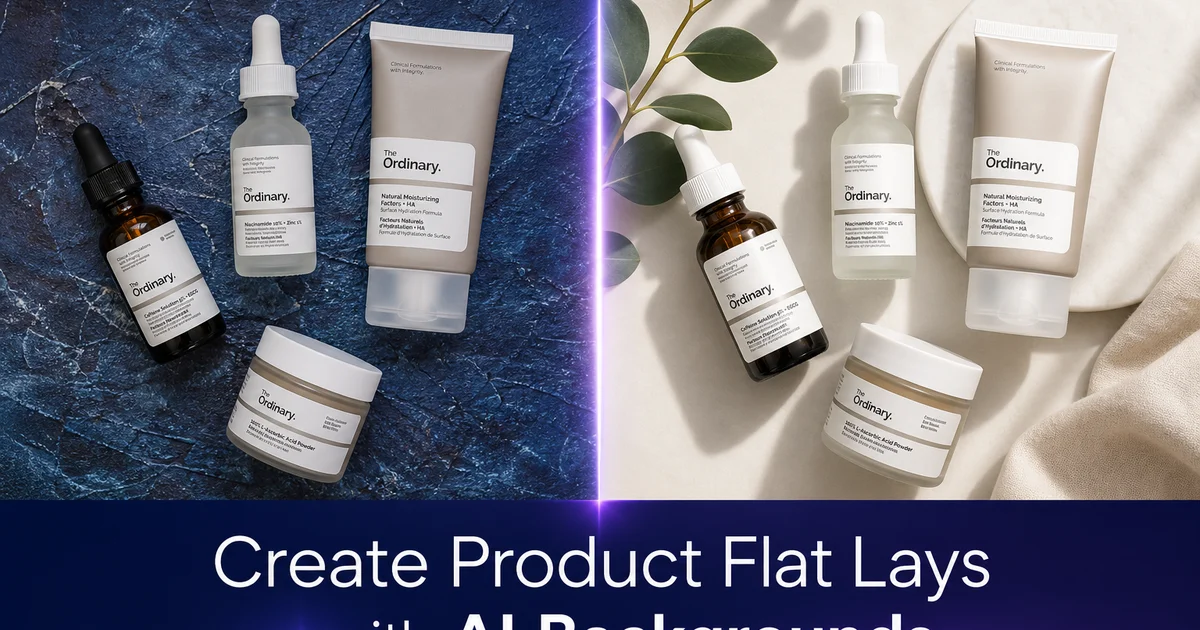
La photographie flat lay — des produits disposes sur une surface et photographies depuis le dessus — est le format visuel dominant pour le e-commerce, le marketing sur les reseaux sociaux et le storytelling de marque. Ce format fonctionne car il montre plusieurs produits en contexte, partage l'esthetique de la marque a travers les choix de surface et d'accessoires, et cree des compositions immediatement identifiables comme de la photographie produit professionnelle. Le flat lay genere de l'engagement sur Instagram, performe bien dans la recherche Pinterest et convertit a des taux plus eleves sur les pages de listing produits.
Le probleme est que la photographie flat lay traditionnelle necessite une installation studio physique : de grandes surfaces en plusieurs materiaux (dalles de marbre, planches de bois, rouleaux de tissu), un eclairage overhead constant, des competences en stylisme produit, et souvent un photographe professionnel. Pour les petites entreprises de e-commerce, les artisans et les vendeurs independants, cela represente un investissement majeur en temps et en argent pour chaque lancement de produit, campagne saisonniere ou publication sur les reseaux sociaux.
La generation d'arriere-plans par IA elimine completement la contrainte de surface physique. Vous photographiez les produits un par un sur n'importe quelle surface plane, supprimez l'arriere-plan, puis les placez sur une surface generee par IA de n'importe quel materiau, couleur ou texture. Marbre, beton, bois rustique, lin, terrazzo, acrylique colore — n'importe quelle surface que vous pouvez decrire, l'IA la cree avec une precision photorealiste. Cela signifie des options creatives illimitees, zero inventaire physique de surfaces, et la capacite de creer des flat lays saisonniers ou specifiques a une campagne en quelques minutes.
- Background Eraser isole les produits de toute surface de prise de vue, meme les articles aux bords complexes comme les chaines de bijoux, les textures tricotees et les formes irregulieres.
- AI Fill genere des surfaces flat lay photorealistes — marbre, bois, lin, beton, terrazzo — avec un eclairage, des ombres et une profondeur de texture precis.
- Les produits photographies a des moments differents sous des eclairages differents peuvent etre composes sur la meme surface IA avec un amelioration unifiee.
- Des flat lays saisonniers et specifiques a une campagne peuvent etre crees en quelques minutes en regenerant les arriere-plans sans rephotographier les produits.
- La technique elimine le besoin d'inventaire de surfaces physiques, d'espace studio et de sessions de stylisme produit repetees.
Pourquoi les flat lays surpassent les autres formats de photos produits pour le e-commerce
La photographie flat lay fonctionne car elle combine la clarte des photos produits isolees avec le contexte de l'imagerie lifestyle. Un produit sur fond blanc communique des specifications — taille, couleur, forme. Un produit dans une scene lifestyle partage une aspiration — comment le produit s'integre dans la vie du client. Un flat lay fait les deux a la fois : l'angle de prise de vue zenithale montre le produit clairement tandis que le materiau de surface, les accessoires assortis et la disposition partagent l'identite de la marque et le lifestyle cible.
Les donnees e-commerce montrent systematiquement que les listings de produits comportant des images flat lay aux cotes de photos produits standard ont des indicateurs d'engagement plus eleves. Sur Shopify, Amazon et Etsy, les listings avec des images de contexte lifestyle — y compris les flat lays — affichent des taux de clic plus eleves depuis les resultats de recherche et un temps passe sur la page plus long. Sur Instagram et Pinterest, les compositions flat lay recoivent beaucoup plus de sauvegardes et de partages que les images mono-produit car elles offrent une complexite visuelle que les spectateurs souhaitent etudier et utiliser comme reference.
Pour les entreprises multi-produits, les flat lays resolvent egalement le probleme de la vente croisee. Montrer une routine de soins de la peau disposee sur une surface en marbre, un ensemble de papeterie sur un fond en lin, ou une collection de bijoux sur du velours communique que ces articles vont ensemble. Le regroupement visuel encourage les achats par lot et augmente la valeur moyenne des commandes d'une maniere que les photos produits individuelles ne peuvent pas atteindre.
- Les flat lays combinent la clarte du produit avec le contexte lifestyle — montrant specifications et identite de marque en une seule composition.
- Les listings avec images flat lay affichent des taux de clic plus eleves, un temps passe sur la page plus long et plus d'engagement social que les photos de produits seuls.
- Le format genere nettement plus de sauvegardes et de partages sur les plateformes visuelles comme Instagram et Pinterest.
- Les flat lays multi-produits encouragent les achats par lot et augmentent la valeur moyenne des commandes grace au regroupement visuel des produits.
Isoler les produits et generer des surfaces photorealistes
Le fondement technique des flat lays assistes par IA est un isolement propre du produit. Background Eraser detecte la frontiere entre le produit et la surface avec precision, en gerant les cas limites qui font echouer les outils plus simples : un bracelet en argent sur une surface gris clair, une bougie blanche sur un fond blanc, des bouteilles en verre transparent. Les articles aux details fins comme la dentelle, les franges ou les chaines. Examinez le decoupage a 100 % de zoom autour de tout le perimetre du produit, en portant une attention particuliere aux zones ou la couleur du produit est similaire a celle du fond.
Une fois isole, le produit a besoin d'une nouvelle surface. AI Fill genere des arriere-plans flat lay a partir de descriptions : planches de chene chaud avec veinure visible, marbre blanc poli aux veines grises, lin naturel a la texture subtile, beton coule avec granulats visibles, bois peint rose poussiere, et des dizaines d'autres options. Les surfaces generees incluent une direction d'eclairage realiste, une profondeur d'ombre et des imperfections de surface qui les rendent impossibles a distinguer de photographies de materiaux reels.
Adaptez la surface a la categorie de produit et au positionnement de la marque. Les articles de luxe — bijoux, soins premium, accessoires haut de gamme — sont les plus beaux sur le marbre, la pierre foncee ou le velours. Les produits artisanaux et faits main fonctionnent sur le bois brut, le lin ou le papier kraft. Les accessoires tech modernes conviennent au beton, au metal brosse ou aux surfaces noires mates. Les produits lifestyle — bougies, papeterie, produits alimentaires — sont polyvalents mais tendent a mieux performer sur du bois chaud ou des surfaces textiles neutres qui semblent accessibles et domestiques.
- Background Eraser gere les cas limites difficiles — produits et surfaces de couleur similaire, transparence, details fins comme les chaines et la dentelle.
- AI Fill genere des surfaces photorealistes a partir de descriptions textuelles avec un eclairage precis, une profondeur d'ombre et des imperfections naturelles.
- Le materiau de surface doit correspondre au positionnement de la marque : marbre pour le luxe, bois pour l'artisanal, beton pour le moderne, lin pour le lifestyle.
- Les surfaces generees peuvent etre personnalisees pour les campagnes saisonnieres — tons chauds pour l'automne, blancs froids pour l'hiver, couleurs vives pour l'ete.
Composer des dispositions flat lay equilibrees
Un flat lay est une composition, et les principes de composition du design graphique et de la photographie s'appliquent. Les dispositions flat lay les plus puissantes suivent l'un de trois modeles : heros centre (un produit au centre, des accessoires rayonnant vers l'exterieur), flux diagonal (produits disposes en diagonale du haut-gauche vers bas-droit), ou grille structuree (produits alignes en rangees et colonnes pour un affichage catalogue). Chaque modele sert un objectif different : heros pour mettre en valeur un seul produit, diagonale pour creer de l'energie visuelle, grille pour presenter une collection.
L'espace blanc est crucial. Les debutants ont tendance a trop densifier leurs flat lays, remplissant chaque centimetre du cadre. Les flat lays professionnels utilisent 30 a 50 pour cent d'espace negatif, donnant a l'ceil de quoi se reposer et a chaque produit l'espace necessaire pour etre vu un par un. Lors de la composition de produits sur des arriere-plans IA, resister a l'envie de remplir toute la surface. Placez d'abord vos produits principaux, puis ajoutez les accessoires avec parcimonie. Une branche de fleurs sechees, un coin de tissu texture, un seul outil lie au produit — pour ajouter du contexte sans encombrement.
La coherence des ombres est ce qui separe les composites amateurs des flat lays d'aspect professionnel. Lorsque vous combinez des produits photographies sous des eclairages differents, les directions et intensites des ombres ne correspondront pas. AI Enhance resout ce probleme en analysant la composition globale et en normalisant les ombres vers une direction de source lumineuse unique et coherente. Passez le composite final dans boost avant publication pour garantir que chaque element projette son ombre dans la meme direction avec la meme intensite.
- Trois modeles de flat lays eprouves : heros centre pour l'accent sur un seul produit, flux diagonal pour l'energie, grille structuree pour les collections.
- Les flat lays professionnels utilisent 30 a 50 pour cent d'espace negatif — les compositions surchargees reduisent l'impact visuel de chaque produit.
- Les accessoires doivent ajouter du contexte avec parcimonie : un ou deux articles complementaires, pas une scene encombree qui concurrence les produits.
- AI Enhance normalise la direction et l'intensite des ombres entre les produits composites, creant l'illusion d'une source lumineuse unique.
Passer a l'echelle la production de flat lays pour les campagnes saisonnieres et les lancements de produits
L'avantage le plus puissant des arriere-plans flat lay generes par IA est l'evolutivite de la production. Les flat lays traditionnels necessitent une reprise de photos des que vous avez besoin d'une nouvelle surface, d'un theme saisonnier ou d'un contexte de marque different. Les arriere-plans IA vous permettent de recreer le meme arrangement de produits sur un nombre illimite de surfaces sans toucher aux produits physiques. Un ensemble de soins de la peau photographie en flat lay sur marbre blanc pour son lancement peut etre place sur de la terre cuite pour une campagne d'ete, du bois fonce pour l'automne, et de l'acrylique bleu glace pour une vente d'hiver — le tout a partir des memes decoupes de produits originales.
Cette evolutivite est particulierement precieuse pour les lancements de produits et les calendriers marketing saisonniers. Lorsqu'un nouveau produit sort, vous avez besoin d'images flat lay pour la page produit, l'annonce par email, les publications sur les reseaux sociaux multi-plateformes, les creatifs publicitaires payants et les kits partenaires. Chaque canal peut beneficier d'une surface ou d'un style de composition different. Avec les arriere-plans IA, une seule seance de photographie produit genere des actifs pour chaque canal et chaque campagne pour les douze mois suivants.
Pour les vendeurs sur plusieurs plateformes, la personnalisation de la surface par plateforme ameliore les performances. Les utilisateurs de Pinterest reagissent aux surfaces chaudes et texturees qui semblent aspirationales. Les images produits Amazon performent mieux avec des arriere-plans propres et minimalistes. Les audiences Instagram s'engagent le plus avec les surfaces tendance — terrazzo en 2024, textures platre en 2025, carreaux peints a la main en 2026. Les surfaces generees par IA vous permettent de correspondre au langage visuel de chaque plateforme sans maintenir un inventaire physique de materiaux tendance.
- Les memes decoupes de produits peuvent etre placees sur un nombre illimite de surfaces generees par IA pour les campagnes saisonnieres, les variantes de plateforme et les nouveaux lancements.
- Une seule seance de photographie produit genere des actifs pour les pages produits, les emails, les reseaux sociaux, les publicites et les kits partenaires sur tous les canaux.
- L'optimisation de surface par plateforme — textures chaudes pour Pinterest, fonds propres pour Amazon, materiaux tendance pour Instagram — ameliore les performances par canal.
- Les arriere-plans IA eliminent l'inventaire physique de materiaux de surface que les studios flat lay traditionnels doivent maintenir et mettre a jour saisonnierement.
How to do it
- 1
Photograph products from directly overhead on a plain surface
Place each product on a clean, matte surface. White poster board, gray seamless paper, or a plain countertop — and photograph from directly above using a phone or camera mounted perpendicular to the surface. Ensure even lighting with no harsh shadows by using diffused natural window light or two soft light panels placed at equal angles.
- 2
Remove the original background with Background Eraser
Open each product photo in Background Eraser to isolate the product from the shooting surface. The tool detects product edges accurately even on items with complex outlines — jewelry chains, fabric textures, irregular shapes. Review the cutout at the edges to ensure no background remnants remain around the product perimeter.
- 3
Generate an AI background that matches your brand aesthetic
Use AI Fill to create a flat lay background surface that complements your products. Generate marble for luxury goods, rustic wood for handmade items, linen texture for lifestyle products, or solid colors matching your brand palette. The AI creates photorealistic surfaces with accurate lighting, shadows. Texture that look like the product was actually photographed on them.
- 4
Arrange multiple products and props in the composition
Combine isolated product images on the generated background, positioning items in a balanced flat lay arrangement. Add contextual props — a coffee cup for stationery products, scattered flowers for beauty items, fabric swatches for fashion accessories — by photographing them separately and compositing them onto the same AI-generated surface.
- 5
Apply final enhancement for consistent lighting and color
Run the completed flat lay through AI Enhance to unify the lighting direction, shadow consistency, and color temperature across all elements. This ensures that products photographed under different lighting conditions look like they were arranged together on the same surface under the same light. The hallmark of a expert flat lay.