
Comment Creer un Effet de Bague Plique-a-Jour avec AI — Magic Eraser
Transformez des photographies de bagues en art emaille plique-a-jour grace a AI. Guide pas a pas pour creer l'effet de bijou vitrail sans fond avec des cellules d'email translucide, des armatures metalliques et un rendu de transmission lumineuse.

Product Marketing
Vérifié par Magic Eraser Editorial ·
Sommaire
- Comprendre l'optique de l'email plique-a-jour pour une recreation numerique convaincante
- Conception de motifs de bague : motifs historiques et styles contemporains pour les cellules plique-a-jour
- Rendu de la transmission lumineuse, des armatures metalliques et de la geometrie tridimensionnelle de la bague
- Applications creatives : visualisation de conception de bijoux, tirages d'art et pieces de galerie numerique
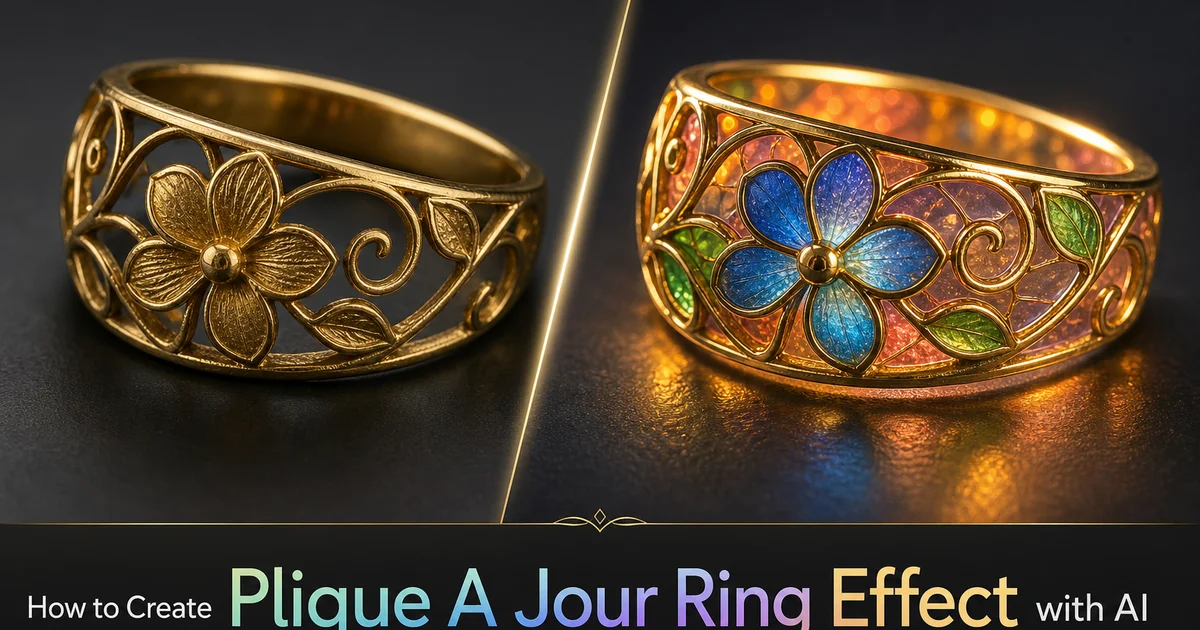
Le plique-a-jour — terme francais signifiant 'laisser entrer le jour' — est la plus exigeante techniquement et la plus spectaculaire visuellement de toutes les techniques d'emaillerie, creant des bijoux qui fonctionnent comme de miniatures vitraux montes dans du metal precieux. Contrairement a l'email conventionnel ou le verre colore est fusionne sur un support metallique, l'email plique-a-jour est applique dans des cellules formees par de fines parois metalliques sans aucun support. L'email est suspendu dans l'armature metallique comme le verre dans une cathedrale, permettant a la lumiere de traverser et d'illuminer les couleurs translucides de l'interieur. Lorsqu'une bague plique-a-jour capte la lumiere, chaque cellule d'email brille de la couleur riche et saturee de la lumiere transmise plutot que de la couleur reflechie plus terne des surfaces opaques. Cet effet captive les joailliers et les collectionneurs depuis que les artisans byzantins ont developpe la technique, a travers son age d'or Art Nouveau dans les ateliers de Rene Lalique et de la Maison Falize, jusqu'aux joailliers de studio modernes qui poursuivent aujourd'hui cette tradition.
L'effet visuel du plique-a-jour sur une bague est profondement different de toute autre technique decorative car il transforme un objet solide en quelque chose qui interagit dynamiquement avec la lumiere. Lorsque la porteuse bouge sa main, la bague capte la lumiere sous differents angles, et les cellules d'email alternent entre briller de lumiere transmise et s'assombrir lorsque l'angle change. La bague est constamment en mouvement, vivante de couleur d'une maniere que les pierres precieuses statiques et les emails opaques ne peuvent egaler. Les couleurs de l'email plique-a-jour sont uniquement belles car elles combinent la purete du verre colore avec l'intimite de l'echelle du bijou, concentrant l'effet de vitrail dans des cellules de seulement quelques millimetres. Chaque cellule agit comme une minuscule lentille de lumiere coloree. La combinaison de multiples couleurs au sein d'une seule bague cree un miniature kaleidoscopique que les spectateurs trouvent irresistible.
Creer un effet de bague plique-a-jour convaincant numeriquement necessite de imiter la physique de la transmission lumineuse a travers du verre colore translucide contenu dans une armature metallique. C'est un defi de rendu fondamentalement different de l'application d'effets de couleur de surface ou de texture. AI doit generer l'armature metallique avec des proprietes de materiau precises, remplir chaque cellule d'email avec les caracteristiques de transmission optique correctes pour sa couleur, simuler l'interaction entre une source lumineuse et les volumes d'email translucide, rendre les ombres projetees par les parois metalliques sur les surfaces d'email, et creer la lueur lumineuse globale qui rend le plique-a-jour visuellement distinctif. Ce guide parcourt le flux de travail complet pour transformer des photographies de bagues en compositions plique-a-jour qui capturent la magie de transmission lumineuse de cette technique d'email extraordinaire.
- La generation d'armature par AI cree des parois metalliques fines comme du fil en or, argent ou platine avec des proprietes de materiau precises, des joints de soudure et l'irregularite du travail artisanal de la construction reelle du plique-a-jour.
- Les remplissages de cellules d'email translucide simulent des volumes de transmission lumineuse plutot que de la couleur plate, avec une densite variant des zones centrales minces aux bords de menisque plus epais contre les parois des cellules.
- Le rendu de transmission de retroeclairage illumine chaque cellule selon sa couleur, son epaisseur et son angle par rapport a la source lumineuse, creant la lueur caracteristique de vitrail du plique-a-jour.
- L'ombrage de l'armature metallique cree de minuscules lignes d'ombre sur les surfaces d'email la ou les parois bloquent la lumiere transmise, ajoutant du realisme dimensionnel a l'effet translucide.
- La simulation d'angle lumineux dynamique montre comment la bague change d'apparence en captant la lumiere differemment, capturant la qualite vivante qui distingue le plique-a-jour de la decoration statique.
Comprendre l'optique de l'email plique-a-jour pour une recreation numerique convaincante
Le comportement optique de l'email plique-a-jour est fondamentalement different des surfaces decoratives opaques. Comprendre cette distinction est la cle pour creer un effet numerique convaincant. L'email opaque, les pierres precieuses sertes dans des chatons et les surfaces peintes fonctionnent tous en reflechissant la lumiere. Les photons frappent la surface, interagissent avec ses proprietes materielles et rebondissent vers l'oeil du spectateur en transportant des informations de couleur provenant de la couche superficielle. L'email plique-a-jour fonctionne par transmission — les photons entrent dans l'email par l'arriere, traversent le corps de verre colore et sortent par l'avant en portant le spectre d'absorption du colorant de l'email. C'est le meme mecanisme optique par lequel les vitraux, les bouteilles en verre colore et les films photographiques transparents produisent leurs couleurs distinctives, et il cree une qualite visuelle qui est immediatement perque comme differente de la couleur reflechie meme sans comprendre la physique impliquee.
Les couleurs specifiques disponibles dans l'email plique-a-jour sont determinees par les colorants d'oxyde metallique dissous dans la matrice de verre. Chaque couleur possede des proprietes de transmission que AI doit simuler avec precision. L'oxyde de cuivre produit une gamme allant du turquoise au bleu-vert. L'oxyde de cobalt cree un bleu profond. Le chlorure d'or produit le fameux rouge rubis du verre et de l'email anciens. L'oxyde de fer produit l'ambre et le brun. L'oxyde de chrome cree le vert. Et le manganese produit le pourpre et le violet. Chaque colorant absorbe des longueurs d'onde specifiques de la lumiere et transmet le reste. La couleur resultante est spectralement plus pure que les couleurs a base de pigments car il n'y a pas de diffusion de surface pour diluer les longueurs d'onde transmises. Cette purete spectrale donne au plique-a-jour son intensite visuelle distinctive. Les couleurs semblent presque incroyablement vives lorsqu'elles sont retroeclairees, creant l'effet qui a ete decrit par les joailliers comme 'lumiere piegee' ou 'couleur liquide'.
L'epaisseur de l'email dans chaque cellule affecte a la fois la densite de couleur et le niveau de transmission lumineuse, creant des variations au sein des cellules individuelles qui ajoutent de la complexite visuelle a l'effet. Dans le plique-a-jour reel, l'email forme naturellement un menisque dans chaque cellule. La tension superficielle attire l'email fondu legerement vers les parois des cellules, rendant l'email plus epais aux bords et plus mince au centre. Cette variation d'epaisseur signifie que chaque cellule passe d'une couleur plus profonde et plus saturee a la peripherie a une couleur plus claire et plus transparente au centre, creant un gradient subtil qui donne aux cellules un caractere dimensionnel. AI imite cet effet de menisque en variant a la fois la saturation de la couleur et la transmission lumineuse a travers chaque cellule, produisant l'aspect gradue caracteristique qui distingue le veritable plique-a-jour des remplissages de couleur plate dans une armature.
- La lumiere transmise a travers l'email translucide produit des couleurs spectralement plus pures que les surfaces reflechissantes, ce que AI simule avec un rendu volumetrique plutot qu'une application de couleur de surface.
- Les colorants d'oxyde metallique creent des spectres de transmission caracteristiques — cuivre pour le turquoise, cobalt pour le bleu, chlorure d'or pour le rubis, chrome pour le vert — chacun avec des proprietes optiques uniques.
- La variation d'epaisseur du menisque dans les cellules passe de bords satures profonds a des centres transparents plus clairs, ajoutant un caractere dimensionnel qui distingue le veritable plique-a-jour des remplissages plats.
- L'intensite visuelle de 'lumiere piegee' des couleurs d'email retroeclairees provient de la purete spectrale sans diffusion de surface, creant des couleurs vives que AI rend avec la physique de la transmission.
Conception de motifs de bague : motifs historiques et styles contemporains pour les cellules plique-a-jour
Le motif des cellules determine a la fois le caractere visuel et l'integrite structurelle d'une bague plique-a-jour. Differents styles de motifs produisent des effets tres differents. Les bagues plique-a-jour historiques de la periode Art Nouveau favorisaient les motifs organiques et naturalistes. Des petales de fleurs avec chaque petale comme cellule d'email separee, des ailes d'insectes avec des motifs de venation cellulaire, et des courbes abstraites fluides inspirees par les vrilles de plantes et les vagues oceaniques. Ces motifs organiques creent des cellules de tailles et de formes variees, produisant une variete visuelle car chaque cellule de taille differente transmet une nuance de couleur legerement differente en raison de la variation d'epaisseur du menisque. AI peut generer des armatures organiques de style Art Nouveau a partir de motifs de reference ou en analysant les structures de contour dans la photographie source pour deriver un motif de cellule naturaliste du contenu de l'image lui-meme.
Les motifs geometriques puisent dans differentes traditions historiques. L'entrelacs celtique, le carrelage geometrique islamique et les designs angulaires Art Deco se transposent tous bien en armatures de cellules plique-a-jour. Ces motifs produisent des cellules de taille plus uniforme, creant un aspect de couleur plus coherant sur l'ensemble de la bague car des cellules de taille similaire ont des profils d'epaisseur d'email analogues. Les motifs geometriques conferent egalement une resistance structurelle a la technique reelle car la disposition reguliere des parois repartit les contraintes uniformement, ce qui explique pourquoi de nombreuses pieces anciennes de plique-a-jour conservees utilisent des motifs geometriques plutot qu'organiques. Pour l'effet numerique, les motifs geometriques creent une esthetique plus graphique et precise qui contraste avec le caractere fluide des designs Art Nouveau, et la disposition reguliere des cellules fait un usage efficace de l'alternance des couleurs. Alterner des cellules de couleurs assorties comme le rouge et le bleu ou le vert et l'ambre cree un motif vibrant qui exploite la nature hautement saturee des couleurs d'email transmises.
Les designs modernes de bagues plique-a-jour fusionnent souvent les approches historiques avec les sensibilites contemporaines, creant des motifs hybrides qui combinent le flux organique de l'Art Nouveau avec la precision des armatures geometriques. Une bague pourrait presenter un motif central floral avec chaque petale comme cellule d'email naturaliste, entoure d'une bordure geometrique de cellules uniformes dans une couleur contrastante. Des designs abstraits qui referencent des phenomenes naturels — ondulations de l'eau, structures cristallines, motifs cellulaires vus au microscope — creent des motifs de cellules d'origine organique mais regularises en un cadre de conception adapte au travail d'email. AI prend en charge ces approches hybrides en permettant a differentes methodes de generation de motifs d'etre combinees au sein d'un seul design de bague, avec des cellules organiques dans une region transitionnant vers des cellules geometriques dans une autre, unifiees par le materiau d'armature metallique commun et la lueur translucide partagee des remplissages d'email.
- Les motifs organiques Art Nouveau creent des cellules de tailles variables avec une variete visuelle provenant de differents profils de menisque, generes a partir de motifs de reference ou derives des contours de la photographie source.
- Les motifs geometriques des traditions celtique, islamique et Art Deco produisent des cellules uniformes avec un aspect de couleur coherent et une regularite structurelle qui resiste a des siecles d'usure.
- L'alternance des couleurs dans les armatures geometriques cree des motifs complementaires vibrants qui exploitent la haute saturation de l'email transmis — associations rouge/bleu, vert/ambre ou pourpre/or.
- Les designs contemporains hybrides combinent des motifs centraux organiques avec des bordures geometriques, unifies par le materiau d'armature metallique et la lueur translucide partagee des remplissages d'email.
Rendu de la transmission lumineuse, des armatures metalliques et de la geometrie tridimensionnelle de la bague
Le rendu de la transmission lumineuse est le coeur technique de l'effet plique-a-jour. AI le simule en traitant chaque cellule d'email comme un volume translucide avec des proprietes optiques specifiques plutot qu'une surface avec une valeur de couleur. La simulation place une source lumineuse virtuelle derriere la bague et calcule comment la lumiere traverse chaque cellule d'email en fonction de la couleur de la cellule, de son profil d'epaisseur et de son orientation par rapport a la direction de la lumiere. Les cellules orientees directement vers la source lumineuse transmettent une intensite maximale et montrent leur couleur la plus pure. Les cellules sous des angles obliques transmettent moins de lumiere et paraissent plus sombres et plus saturees. Les cellules sous des angles extremes peuvent paraître presque opaques car le trajet de la lumiere a travers l'email est beaucoup plus long sous des angles prononces, absorbant davantage les longueurs d'onde transmises. Ce comportement dependant de l'angle est ce qui donne aux bagues plique-a-jour reelles leur qualite dynamique lorsqu'elles sont portees. La bague passe constamment entre des cellules brillamment lumineuses et des cellules sombres et saturees a mesure que la main bouge.
Le rendu de l'armature metallique necessite une simulation precise des surfaces en metal precieux a l'echelle tres fine de la construction plique-a-jour. Les parois des cellules dans le plique-a-jour sont caracteristiquement minces — souvent seulement 0,3 a 0,5 millimetre — et a cette echelle, les surfaces metalliques interagissent avec la lumiere de manieres specifiques. Les parois en or ont une reflectivite chaude qui influence la couleur des cellules d'email adjacentes, ajoutant de la chaleur aux bleus et intensifiant les rouges. Les parois en argent ont une surface froide et hautement reflective qui cree des reflets de bord lumineux la ou la paroi capte la lumiere. Les parois en platine ont une reflectivite blanc-gris plus subtile qui constitue le cadre le plus neutre pour les couleurs d'email. AI rend l'armature avec les proprietes metalliques correctes a la bonne echelle, y compris les joints de soudure la ou les parois se croisent et les irregularites subtiles du travail de fil fait main qui distinguent le plique-a-jour artisanal de la production industrielle.
La geometrie tridimensionnelle de la bague ajoute de la complexite au rendu car la surface incurvee d'une bague signifie que les cellules d'email a differentes positions autour de l'anneau font face a differentes directions, creant une progression d'angles lumineux qui fait varier l'intensite de la couleur transmise autour de la circonference. Les cellules sur la surface superieure de la bague, faisant face au spectateur, montrent la transmission de retroeclairage la plus directe et brillent le plus. Les cellules sur les cotes de l'anneau sont vues sous des angles plus prononces et montrent une couleur plus profonde et plus saturee. Cet effet de courbure est l'un des aspects les plus magnifiques des bagues plique-a-jour. L'anneau cree un spectre d'intensites lumineuses qui enveloppe le doigt, avec la lueur la plus brillante au sommet et une saturation graduellement plus profonde vers les cotes. AI calcule cette variation basee sur la courbure pour produire un rendu de bague qui montre toute la beaute tridimensionnelle de l'effet plique-a-jour sur une surface de bijou incurvee.
- La transmission lumineuse volumetrique calcule l'intensite et la couleur pour chaque cellule en fonction de son orientation — les cellules orientees directement brillent le plus tandis que les cellules obliques paraissent plus sombres et plus saturees.
- Le rendu de l'armature en metal precieux a l'echelle de 0,3-0,5 mm inclut la reflectivite de l'or chaud, de l'argent froid ou du platine neutre avec des joints de soudure et des irregularites de travail de fil artisanal.
- La courbure de la bague cree un spectre naturel d'intensites de transmission — la lueur la plus brillante au sommet progressant vers une saturation plus profonde sur les cotes a mesure que l'angle de vue devient plus prononce.
- Le changement d'apparence dependant de l'angle simule la qualite dynamique du veritable plique-a-jour, ou la bague passe entre des etats lumineux et satures a mesure que la main bouge.
Applications creatives : visualisation de conception de bijoux, tirages d'art et pieces de galerie numerique
Les createurs de bijoux utilisent l'effet de bague plique-a-jour comme outil de visualisation pour concevoir de veritables bijoux emaille, leur permettant de voir a quoi ressemblera un design propose avec des couleurs d'email et des motifs d'armature specifiques avant de s'engager dans le processus de fabrication couteux et techniquement exigeant. Un createur peut photographier un prototype de bague en metal brut et appliquer differents motifs plique-a-jour et combinaisons de couleurs, evaluant chaque option a l'ecran avant de selectionner la version a executer en email. Cette visualisation en phase de conception permet d'economiser du temps et des couts de materiaux considerables car la fabrication du plique-a-jour a un taux d'echec eleve. Les cellules d'email peuvent se fissurer pendant la cuisson, s'ecouler hors de leurs cellules ou developper des bulles qui ruinent la transparence — et etre confiant dans le design avant de commencer la fabrication reduit le risque d'echecs couteux. Les presentations aux clients deviennent plus efficaces lorsque le createur peut montrer un rendu realiste de la piece proposee plutot que de demander au client d'imaginer comment un croquis ou un dessin technique se traduira en bague finie.
Les tirages d'art des compositions de bagues plique-a-jour occupent un espace unique sur le marche des arts decoratifs car l'effet combine l'attrait de la photographie de bijoux avec la qualite de transmission lumineuse que les medias imprimes ne peuvent physiquement pas atteindre. Et pourtant, le rendu AI rend l'effet de lumiere transmise visible de maniere convaincante sur une surface d'impression reflective. Les tirages grand format montrant des bagues plique-a-jour retroeclairees sur des fonds sombres creent un art mural dramatique qui refere a la fois a la tradition historique des bijoux emaille et a la fascination moderne pour les installations artistiques basees sur la lumiere. Les couleurs riches et saturees de l'email transmis se traduisent particulierement bien sur le papier photo metallique et les impressions acryliques retroeclairees, ou les qualites lumineuses du support d'impression renforcent plutot qu'elles ne diminuent l'illusion de transmission lumineuse. Les expositions en galerie presentant des effets plique-a-jour peuvent juxtaposer les rendus numeriques avec de veritables pieces emaillees, creant un dialogue entre l'artisanat historique et l'interpretation numerique moderne.
Les applications de medias sociaux et de portfolio numerique exploitent la spectacularite visuelle de l'effet plique-a-jour pour un engagement maximal. La qualite lumineuse, semblable a celle d'une pierre precieuse, des cellules d'email retroeclairees attire immediatement l'attention dans un fil de medias sociaux. Le phenomene visuel inhabituel de la lumiere traversant apparemment un objet solide cree l'intrigue cognitive qui arrete les scrolls et incite a un examen plus approfondi. Les Reels Instagram et les videos TikTok peuvent montrer l'effet dynamique simule de la lumiere traversant la bague sous des angles changeants, creant un contenu hypnotique qui met en valeur a la fois la beaute artistique du plique-a-jour et les capacites des effets photo AI. Les artistes numeriques integrant des effets plique-a-jour dans des projets d'art fantastique et conceptuel utilisent la technique pour creer des objets de bijouterie magiques — des bagues qui brillent litteralement d'une lumiere interieure — pour la conception de personnages, l'art de jeux et la fiction illustree ou l'esthetique d'objet enchante du plique-a-jour sert parfaitement le but narratif.
- La visualisation de conception permet aux joailliers d'evaluer les motifs plique-a-jour et les combinaisons de couleurs sur des prototypes de bagues avant de s'engager dans le processus de fabrication techniquement exigeant et a taux d'echec eleve.
- Les tirages grand format sur papier metallique ou acrylique retroeclaire renforcent l'illusion de transmission lumineuse, creant un art mural dramatique qui fait le pont entre la photographie de bijoux et l'art d'installation base sur la lumiere.
- Le contenu des medias sociaux exploite la qualite lumineuse et gemme des cellules d'email retroeclairees pour un impact maximal d'arret du defilement et un engagement avec l'effet visuel inhabituel de la lumiere traversant un solide.
- Les applications d'art fantastique et conceptuel utilisent les effets plique-a-jour pour creer des objets de bijouterie magiquement lumineux pour la conception de personnages, l'art de jeux et la fiction illustree.
How to do it
- 1
Select or design a ring composition with translucent cell patterns suitable for plique-a-jour
Choose a source image of a ring or design a ring composition that features openwork patterns suitable for the plique-a-jour enamel effect. Traditional plique-a-jour rings use designs with clearly defined cells formed by thin metal walls. Floral petals, leaf veins, abstract geometric patterns, butterfly wings, or Art Nouveau flowing curves — where each cell will be filled with translucent enamel that light passes through. The AI needs distinct cell boundaries to work with, so images with strong linear frameworks produce the best results. If working from a plain band ring photograph, the AI can generate an appropriate cellular framework based on your selected pattern style.
- 2
Generate the metal framework with wire-thin cloison walls between enamel cells
Apply the AI framework generation to create the delicate metal walls that separate the enamel cells in plique-a-jour work. In real plique-a-jour, these walls are formed from thin strips of metal. Gold, silver, or platinum — soldered into a framework that holds the translucent enamel in place without any backing. The walls are characteristically thin, often less than half a millimeter, creating the illusion that the enamel windows are barely contained by the metal structure. The AI renders these walls with accurate metallic properties. Warm gold, cool silver, or white platinum — with the precise dimensions and construction details visible in real jewelry, including solder joints where walls meet and the slightly irregular character of hand-formed wirework.
- 3
Fill cells with translucent enamel colors that transmit light like stained glass
Apply translucent enamel fills to each cell in the framework, creating the stained-glass-like windows that define plique-a-jour. Unlike opaque enamel that reflects light from its surface, plique-a-jour enamel transmits light through its body, and each color has a characteristic transmission quality. Ruby red glows warmly like cathedral glass, sapphire blue creates deep cool pools of color, emerald green transmits with vivid intensity, and amber produces warm golden light. The AI mimics these transmission properties by rendering each cell as a light-transmitting volume rather than a flat color fill, with color density varying from lighter at the center where the enamel is thinnest to deeper at the edges where it meniscuses against the cell walls.
- 4
Add backlight transmission effects and the characteristic glow of light passing through enamel
Apply the backlighting simulation that creates the key visual trait of plique-a-jour. Light passing through the translucent enamel from behind, illuminating the colors from within. Real plique-a-jour jewelry is most beautiful when held up to a light source or worn in bright conditions where ambient light passes through the enamel cells. The AI mimics this by rendering a light source behind the ring that illuminates each enamel cell according to its color, thickness, and position relative to the light. Cells facing the light source glow more intensely than cells at angles. The metal framework casts tiny shadows on the enamel surfaces where it blocks the transmitted light. The overall effect is of a miniature stained-glass window set in a precious metal ring.
- 5
Export the plique-a-jour ring effect for jewelry portfolios, social media, and print materials
Save the completed plique-a-jour ring composition in formats optimized for different display contexts. Jewelry portfolio websites need high-resolution images on dark backgrounds that emphasize the translucent glow of the enamel cells. Social media posts benefit from dramatic backlit displays that show the light-transmitting quality at its most spectacular. These are the images that stop scrollers and generate engagement because the glowing color effect is immediately eye-catching. Print materials for jewelry catalogs and exhibition announcements need images that reproduce the translucent color quality on paper. This benefits from rich, saturated rendering that compensates for the inherent limitations of reflective print media in representing transmitted light effects.
Sources
- Plique-à-Jour Enamel: The Stained Glass of Jewelry — The Metropolitan Museum of Art
- Art Nouveau Jewelry: Enameling Techniques and Master Jewelers — Victoria and Albert Museum
- The Science of Vitreous Enamel: Optical Properties and Light Transmission — Illuminating Engineering Society