
Comment creer un effet Pietra Dura avec l'IA — Magic Eraser
Transformez vos photos en art de la marqueterie de pierre pietra dura grace au transfert de style par IA. Guide pas a pas couvrant les materiaux en pierre, les traditions florentine et moghole, les effets de polissage et le travail de la pierre expert.
SEO & Growth
Vérifié par Magic Eraser Editorial ·
Sommaire
- En quoi la conversion pietra dura par IA differe de la posterisation simple et des filtres mosaique
- Selection des materiaux en pierre et palette de couleurs geologique
- Finition de surface et impact visuel du niveau de polissage sur les materiaux en pierre
- Traditions historiques : Commesso florentin versus Parchin kari moghol
- Applications creatives : portraits, visualisation architecturale et panneaux decoratifs
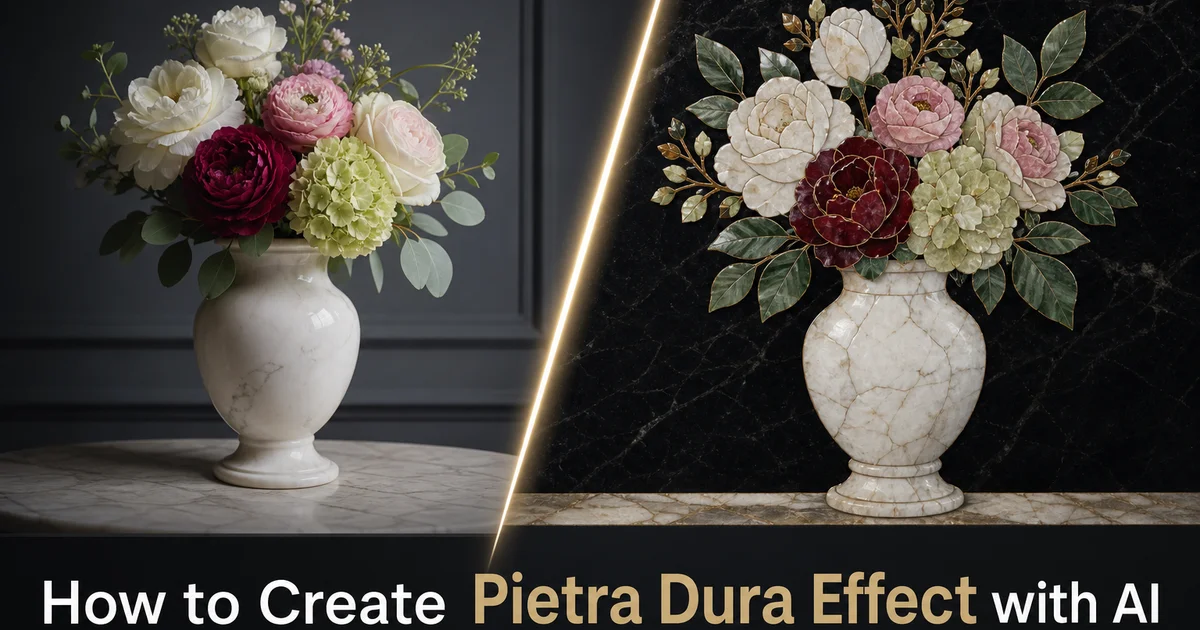
La pietra dura — litteralement 'pierre dure' en italien — est l'art de creer des images et des motifs decoratifs en decoupant de fines plaques de pierres semi-precieuses en formes precises et en les assemblant comme un puzzle sur un fond en pierre, souvent du marbre noir de Belgique ou du marbre blanc de Carrare. Developpee a son plus haut degre de raffinement a Florence pendant la Renaissance sous le mecenat de la famille Medicis, la pietra dura transforme les materiaux geologiques en art pictural d'un detail et d'une permanence etonnants. Des fleurs rendues en malachite, cornaline, lapis-lazuli. L'agate affiche une precision botanique qui rivalise avec la peinture a l'huile, mais le medium est la pierre qui durera des siecles sans se faner. La tradition parallele dans l'Inde moghole, connue sous le nom de parchin kari, orne le Taj Mahal et d'autres monuments imperiaux de rinceaux floraux incrustes dans le marbre blanc avec une delicatesse qui semble impossible compte tenu de la durete des materiaux.
La simulation numerique de la pietra dura a ete tente sous diverses formes. De la posterisation simple qui aplatit les couleurs en blocs discrets, aux filtres en mosaique qui tuilent les images avec des formes uniformes, en passant par le mappage de texture qui superpose des surfaces de pierre sur des zones de photographie. Ces approches ont echoue car elles fonctionnent mecaniquement plutot que de comprendre la logique artisanale de la veritable incrustation de pierre. La pietra dura authentique necessite de selectionner des materiaux en pierre specifiques pour chaque zone de couleur en fonction des couleurs et motifs naturels disponibles dans la palette geologique, de decouper des pieces qui suivent les contours du sujet plutot que des formes geometriques arbitraires, et de polir le panneau assemble jusqu'a une surface uniforme ou differents materiaux se rejoignent dans des jointures presque invisibles. Ces decisions propres a l'artisanat sont ce qui rend cette forme d'art puissante, et aucun filtre simple ne peut les reproduire.
La conversion pietra dura alimentee par l'IA apporte une veritable intelligence des materiaux au processus de transfert de style. L'IA segmente la photographie en regions de couleur discretes, attribue des materiaux en pierre geologiquement corrects a chaque region en fonction de la correspondance des couleurs par rapport a une bibliotheque de types de pierre reels, rend les motifs internes caracteristiques de chaque materiau — les bandes de la malachite, les inclusions du lapis-lazuli, les veines du marbre, les couches de l'agate — et joint les pieces adjacentes avec la precision serree de la marqueterie de maitre. Ce guide explique comment utiliser AI Filter et AI Enhance pour creer des œuvres d'art en pietra dura qui capturent la beaute materielle et la precision artisanale de la forme d'art originale, de la selection de la pierre et de la finition de surface aux details subtils qui distinguent une simulation convaincante de la taille de pierre d'un simple blocage de couleur plat.
- L'IA segmente les photographies en regions de couleur discretes et attribue des materiaux en pierre geologiquement corrects. Malachite pour les verts, lapis-lazuli pour les bleus, cornaline pour les rouges — basse sur une bibliotheque de veritables pierres semi-precieuses.
- De multiples traditions de pietra dura sont disponibles, notamment le commesso florentin sur marbre noir, le parchin kari moghol sur marbre blanc, la marqueterie de specimens du Derbyshire et les arrangements de pierre Art déco modernes.
- Chaque materiau en pierre affiche des motifs internes caracteristiques — bandes de malachite, veines de marbre, couches d'agate, points d'or du lapis — avec des variations realistes entre les pieces individuelles.
- La simulation de finition de surface va du poli miroir pour les panneaux finis au satin et au mat pour les differentes etapes du processus de taille de pierre, avec une visibilite des joints de mortier configurable.
- AI Enhance affine les textures du grain de pierre et les transitions de limite apres la conversion, garantissant que les motifs des materiaux sont clairement visibles et que les lignes de jointure sont lues comme des coupes precises.
En quoi la conversion pietra dura par IA differe de la posterisation simple et des filtres mosaique
La posterisation — reduction d'une image a un nombre limite de niveaux de couleur plats — produit des resultats qui ressemblent superficiellement a la pietra dura car les deux impliquent des blocs de couleur discrets plutot que des gradients continus. Mais la posterisation attribue des couleurs arbitraires basees sur des seuils de luminosite sans comprendre ce que ces couleurs representent materiellement. Une region verte posterisee est simplement un vert plat. Une region verte en pietra dura est de la malachite avec son motif caracteristique de bandes concentriques qui varie du sauge pale a l'emeraude profonde a mesure que les bandes ondulent sur la dalle de pierre. Cette specificite materielle est ce qui rend la veritable pietra dura visuellement riche. La pierre n'est pas simplement un porteur de couleur mais un sujet visuel a part entiere, avec des motifs internes qui recompensent un examen attentif.
Les filtres mosaique divisent l'image en tuiles geometriques uniformes — souvent des carres, des hexagones ou des cellules de Voronoi — et remplissent chaque tuile d'une couleur unique echantillonnee a partir de l'image sous-jacente. Bien que cela produise un aspect tesselle, la regularite geometrique n'a aucune relation avec le sujet. La veritable pietra dura decoupe chaque piece de pierre pour suivre les contours de l'element qu'elle represente : un petale est decoupe en forme de petale, une feuille suit le contour de la feuille, une zone de ciel est decoupee en grandes pieces fluides qui couvrent efficacement l'arriere-plan. Les formes sont dictees par le sujet, et non par une grille geometrique. La conversion par IA reproduit cette decoupe consciente du sujet en utilisant la segmentation semantique pour determiner les limites des pieces qui suivent les lignes de contour naturelles.
Les lignes de jointure entre les pieces dans la veritable pietra dura sont une caracteristique determinante que ni la posterisation ni les filtres mosaique ne reproduisent. Dans le commesso florentin de maitre, les pieces de pierre adjacentes sont coupees si precisement que la jointure est a peine visible — un espace capillaire rempli de cire teintee ou laisse comme une ligne sombre plus fine qu'un trait de crayon. Dans les travaux moins raffines, les jointures sont plus larges et remplies de mortier contrastant. L'IA rend les lignes de jointure avec la largeur et le caractere appropries pour la tradition simulee, ajoutant l'ombre subtile et la discontinuite materielle a chaque limite qui indique a l'œil du spectateur qu'il s'agit de pieces physiques separees assemblees plutot que de regions peintes sur une surface continue.
- La posterisation cree des blocs de couleur plats sans identite materielle, tandis que l'IA attribue des pierres geologiquement specifiques avec des bandes et motifs internes caracteristiques a chaque region.
- Les filtres mosaique utilisent des grilles geometriques sans rapport avec le sujet, tandis que l'IA decoupe des pieces de pierre virtuelles le long des contours naturels — petales en forme de petales, feuilles en forme de feuilles.
- Les lignes de jointure entre les pieces sont rendues avec une largeur et une ombre adaptees a la tradition, communiquant qu'il s'agit de dalles de pierre separees ajustees plutot que de regions peintes.
- La specificite materielle rend chaque piece de pierre visuellement riche en soi, avec des motifs internes qui recompensent un examen attentif au-dela de la composition picturale globale.
Selection des materiaux en pierre et palette de couleurs geologique
La palette de couleurs disponible pour un artisan de la pietra dura est determinee par la geologie plutot que par le melange de pigments. Contrairement a la peinture ou n'importe quelle couleur peut etre creee en melangeant des couleurs primaires, la marqueterie de pierre est limitee aux couleurs que la nature fournit dans des pierres semi-precieuses pouvant etre taillees et polies. Cette contrainte produit la palette distinctive de la pietra dura traditionnelle : les verts de la malachite avec leurs motifs de bandes tourbillonnantes, les bleus du lapis-lazuli parsemes d'inclusions de pyrite doree, les rouges de la cornaline et du jaspe allant de l'orange translucide a la brique opaque, la calcédoine et l'agate en bandes superposees de gris et de blanc, le marbre noir de Belgique et la serpentine sombre pour les tons d'ombre profonde, l'albâtre ou le marbre blanc de Carrare pour les reflets.
L'IA fait correspondre les couleurs de la photographie a cette palette geologique en analysant la teinte et la saturation dominantes de chaque region segmentee, puis en selectionnant le materiau en pierre dont la gamme de couleurs naturelles correspond le mieux. Ce n'est pas un simple remplacement de couleur — c'est une attribution de materiau. Une zone vert vif recoit de la malachite, qui a une gamme specifique de vert allant du pale au profond, avec des motifs de bandes qui courent en courbes concentriques. Une zone vert terne pourrait recevoir de la serpentine verte, plus foncee et plus uniforme. Une zone bleu-vert recoit de la chrysocolle ou de l'amazonite selon la teinte exacte. Chaque attribution apporte le caractere visuel authentique de la pierre — sa texture, ses motifs internes, sa translucidite et sa variation de couleur — plutot que d'appliquer simplement une couleur plate.
Pour les couleurs qui tombent en dehors de la palette de pierre naturelle, l'IA effectue des attributions interpretatives qui suivent les conventions de la pietra dura historique. Les tons de peau dans les portraits sont rendus dans diverses qualites d'albâtre, de quartz rose et de cornaline pale. Les cieux bleus recoivent du lapis-lazuli ou de la sodalite. Les jaunes vifs, rares dans la pierre taillee, peuvent recevoir de l'œil-de-tigre avec ses bandes dorees chatoyantes, ou de la citrine avec sa chaleur ambrée translucide. Les zones blanc pur recoivent du marbre de Carrare immacule avec ses veines grises subtiles. Ces attributions de materiaux garantissent que meme les sujets qui n'ont jamais ete rendus en marqueterie de pierre dans le passe recoivent des traitements en pierre geologiquement plausibles.
- La palette geologique limite les couleurs a ce que la nature fournit — verts de malachite, bleus de lapis, rouges de cornaline, gris d'agate — chacun avec des motifs internes caracteristiques.
- L'IA attribue les materiaux basee sur la correspondance de teinte et de saturation, distinguant entre des couleurs similaires pour selectionner la variete de pierre la plus appropriee pour chaque region.
- Les tons de peau recoivent de l'albâtre et du quartz rose, les cieux recoivent du lapis-lazuli, et les jaunes vifs recoivent de l'œil-de-tigre ou de la citrine — suivant les conventions de la pietra dura historique.
- Chaque attribution de materiau apporte un caractere visuel authentique incluant bandes, veines, translucidite et variation de couleur plutot qu'un simple remplacement de couleur plate.
Finition de surface et impact visuel du niveau de polissage sur les materiaux en pierre
Le niveau de polissage applique aux pieces de pierre simulees affecte grandement l'apparence des materiaux et la lecture de la composition globale. Le poli eleve — la surface miroir obtenue par des etages abrasifs progressivement plus fins aboutissant au polissage a la pate de diamant — fait ressortir la profondeur et la saturation maximales des couleurs de chaque materiau en pierre. La malachite polie passe d'un vert sourd a un emeraude intense avec des bandes clairement visibles. Le lapis-lazuli poli s'approfondit d'un bleu poudreux a un bleu royal sature avec des points de pyrite doree visibles. Le poli eleve cree egalement des reflets de surface qui ajoutent une qualite tridimensionnelle a l'image plane, car les reflets speculaires se deplacent sur la surface de pierre simulee en reponse a la direction de l'eclairage virtuel.
Le poli satin — une finition qui s'arrete avant la reflectivite miroir complete — produit un aspect plus doux et plus sophistique que de nombreux artisans de la pierre modernes preferent. Les couleurs restent riches mais la surface ne genere pas les reflets speculaires brillants du poli complet, creant un champ visuel plus uniforme que certains spectateurs trouvent plus facile a apprecier sur la duree. La finition satin revele egalement la texture de surface que le poli complet dissimule — les legeres piqures dans le marbre sofite, les marques directionnelles du processus de sciage dans les pierres plus dures, et la durete differentielle entre les materiaux qui provoque une ondulation de surface subtile aux limites de jointure la ou les pierres plus tendres et plus dures se rencontrent.
La finition mate imite la pierre qui a ete taillee et ajustee mais non polie, revelant les materiaux a leur etat le plus naturel et le moins transforme. Les couleurs sont plus claires et plus crayeuses que les equivalents polis car la lumiere se diffuse sur la surface rugueuse plutot que de se refleter directement. Les motifs internes de la pierre comme les bandes de malachite restent visibles mais apparaissent plus doux et moins definis. Cette finition est historiquement appropriee pour certains types de marqueterie de pierre, principalement les applications architecturales ou les panneaux etaient installes dans les murs et laisses non polis, et elle cree une esthetique distinctement differente de l'intensite joailliere du poli eleve — plus chaude, plus terreuse et plus proche du caractere geologique brut de la pierre.
- Le poli eleve maximise la saturation des couleurs et revele les motifs internes les plus profonds de la pierre, avec des reflets speculaires ajoutant une qualite tridimensionnelle a la composition.
- Le poli satin produit un aspect plus doux qui revele la texture de surface — piqures, marques de sciage et durete differentielle aux jointures — tout en maintenant des couleurs riches.
- La finition mate montre les materiaux a leur etat le plus naturel avec des couleurs plus claires et crayeuses et des motifs plus doux, historiquement appropriee pour la marqueterie de pierre architecturale.
- Le choix du niveau de polissage determine si le resultat se lit comme une œuvre d'art precieuse semblable a un bijou ou comme une taille de pierre decorative architecturale — les deux sont des traditions authentiques.
Traditions historiques : Commesso florentin versus Parchin kari moghol
Le commesso florentin, developpe sous le mécenat des Medicis a l'Opificio delle Pietre Dure etabli en 1588, represente le sommet pictural de la marqueterie de pierre europeenne. Les artisans florentins se specialisaient dans les representations naturalistes — fleurs, oiseaux, fruits, paysages et fantaisies architecturales — rendues avec une precision picturale en pierres semi-precieuses sur un fond de marbre noir de Belgique. Le fond sombre sert la meme fonction de composition qu'une toile sombre en peinture a l'huile, fournissant un contraste maximal qui fait vibrer les pieces de pierre colorees avec une intensite visuelle. L'IA imite le commesso florentin en placant les elements d'image convertis contre un fond de marbre noir poli avec de subtiles veines grises visibles dans les zones inoccupees.
Le parchin kari moghol, la tradition indienne de marqueterie de pierre perfectionnee sous le regne de Shah Jahan au XVIIe siecle, adopte l'approche opposee en utilisant le marbre blanc comme materiau de fond. Des rinceaux floraux, des bordures geometriques et des inscriptions calligraphiques sont incrustes dans la surface blanche lumineuse utilisant de la cornaline, du lapis-lazuli, de la turquoise, du jade et de l'œil-de-tigre. Le fond de marbre blanc brille a la lumiere du soleil, creant une luminosite ethere qui est la qualite visuelle determinante de la marqueterie de pierre moghole telle qu'on la voit sur le Taj Mahal. L'IA imite le parchin kari en rendant les elements d'image dans la palette de pierre aux tons chauds typique du travail moghol et en les placant contre du marbre blanc avec la lueur translucide douce caracteristique du marbre de Makrana de haute qualite.
Le choix entre les traditions florentine et moghole change fondamentalement l'ambiance de l'œuvre d'art resultante. Le commesso florentin sur marbre noir cree des compositions dramatiques semblables a des bijoux avec un contraste profond et des couleurs intenses sur le fond sombre — adapte aux sujets floraux riches, aux portraits dramatiques et aux images ou l'intensite visuelle est l'objectif. Le parchin kari moghol sur marbre blanc cree des compositions lumineuses et etherees avec un contraste doux et des tons terreux chauds sur la surface blanche lumineuse — adapte aux sujets botaniques delicats, a l'imagerie spirituelle et aux images ou la beaute sereine est la priorite. Les deux traditions sont des approches historiquement authentiques de la meme forme d'art fondamentale.
- Le commesso florentin utilise le marbre noir de Belgique comme fond, creant des compositions dramatiques a fort contraste ou les pieces de pierre colorees vibrent avec une intensite visuelle.
- Le parchin kari moghol utilise le marbre blanc de Makrana comme fond, creant des compositions lumineuses et etherees avec des tons de pierre terreux et chauds sur une surface blanche lumineuse.
- La tradition florentine excelle pour les sujets dramatiques aux couleurs intenses, tandis que la tradition moghole convient aux sujets botaniques delicats et aux compositions priorisant la beaute sereine.
- Les deux traditions sont historiquement authentiques — le choix entre fond sombre et clair change fondamentalement l'ambiance, de l'intensite dramatique a la luminosite etheree.
Applications creatives : portraits, visualisation architecturale et panneaux decoratifs
La conversion de portrait en pietra dura cree des œuvres d'art extraordinaires ou les visages humains sont reintegrés completement dans des pierres semi-precieuses soigneusement selectionnees. La peau rendue dans des nuances graduees d'albâtre et de quartz rose, les yeux en lapis-lazuli ou œil-de-tigre, les levres en cornaline et les cheveux en onyx rubane ou agate fluide. Chaque trait reçoit un materiau en pierre dont la couleur et le motif naturels completent la forme du visage. Ces portraits en pierre evoquent la permanence et la preciosite du medium, transformant une photographie en quelque chose de monumental et durable. Ils fonctionnent particulierement bien imprimes en grand sur des fonds sombres qui simulent le fond de marbre noir de la tradition florentine.
Les applications architecturales et de design d'interieur utilisent la conversion pietra dura pour visualiser comment les sujets photographiques apparaîtraient comme de veritables panneaux de marqueterie de pierre. Une photographie botanique convertie en pietra dura montre a un designer ou a un client a quoi ressemblerait cette composition si elle était executee comme un veritable plateau de table incruste, un panneau mural ou un medaillon de sol. Bien que la sortie de l'IA soit une visualisation artistique plutot qu'une specification technique, elle fournit une image conceptuelle immediate et puissante qui capture le caractere materiel du veritable travail de la pierre. Les ateliers de marqueterie de pierre artisanale rapportent utiliser les concepts de pietra dura generes par l'IA comme points de depart pour les consultations clients, remplacant le processus chronophage de dessin de croquis conceptuels a la main.
Les compositions de panneaux decoratifs appliquent la conversion pietra dura pour creer des œuvres d'art specialement concues pour l'affichage mural, le papier peint numerique, l'impression textile et l'emballage de luxe. Des compositions florales, des motifs geometriques et des bordures ornementales convertis en style pietra dura gagnent le poids visuel et la preciosite des materiaux en pierre tout en etant reproductibles a n'importe quelle echelle. Une serie d'estampes botaniques rendues dans le style pietra dura cree une collection coherente avec la gravite de l'art decoratif de qualite musee. La texture de la pierre et la specificite materielle ajoutent de la profondeur et un interes visuel qui distingue les estampes de style pietra dura des illustrations botaniques ou photographies ordinaires.
- Les portraits en pierre rendent les traits du visage dans des materiaux geologiquement specifiques — peau d'albâtre, yeux de lapis, levres de cornaline — creant des œuvres d'art qui semblent monumentales et durables.
- La visualisation architecturale montre aux designers et aux clients comment les sujets photographiques apparaîtraient comme de veritables plateaux de table incrustes, panneaux muraux et medaillons de sol.
- Les compositions de panneaux decoratifs gagnent le poids visuel de materiaux en pierre precieuse pour l'art mural, le papier peint numerique, l'impression textile et les applications d'emballage de luxe.
- La specificite materielle de la conversion pietra dura distingue les resultats de l'illustration ordinaire, ajoutant une profondeur geologique et une preciosite a tout sujet.
How to do it
- 1
Upload your photo and assess its suitability for pietra dura conversion
Open your image in AI Filter and examine it for well-defined shapes with clear boundaries between color regions. Pietra dura effects work by replacing photographic areas with simulated inlaid stone slabs, so photos with distinct color blocks, strong subject silhouettes. Clearly separated foreground and background elements convert most convincingly. Floral compositions, architectural details, portraits with clean backgrounds. Still life arrangements with well-separated objects produce the most authentic pietra dura results. Images with smooth gradients and subtle tonal transitions are more challenging because real stone inlay uses discrete pieces rather than steady blending.
- 2
Select the pietra dura style and configure stone material assignments
Choose from pietra dura presets that simulate different historical traditions. Florentine commesso with polished semi-precious stones on a black marble ground, Mughal parchin kari with white marble inlaid with carnelian and lapis lazuli, Derbyshire inlay with local specimen stones in geometric patterns, or modern art deco interpretations with bold geometric stone arrangements. AI Filter analyzes the image's color regions and assigns right stone materials to each. Green areas receive malachite, blue areas receive lapis lazuli, red areas receive carnelian, white areas receive alabaster, and dark areas receive black Belgian marble or dark serpentine.
- 3
Adjust stone texture, polish level, and grout line visibility for authentic inlay appearance
Configure the surface finish to determine how the simulated stone pieces appear. High polish for the mirror-like surface of finished pietra dura panels, satin polish for a softer sheen, or matte finish for the look of unpolished stone slabs. Then adjust the grout line visibility that defines the boundaries between adjacent stone pieces: fine hairline joins simulate the nearly invisible seams of masterwork Florentine inlay. Visible grout lines create a more mosaic-like look. Each stone material displays its trait internal patterns. The banding of malachite, the veining of marble, the gold flecks of lapis lazuli — with realistic variation across each piece.
- 4
Use AI Enhance to sharpen stone grain detail and refine material boundaries
After the initial pietra dura conversion, apply AI Enhance to tighten the definition of stone material textures and ensure that the trait internal patterns of each stone type are clearly visible. The boost step improves the clarity of malachite banding, marble veining, agate layering. The metallic inclusions in lapis lazuli and goldstone. It also sharpens the boundary transitions between adjacent stone pieces so the join lines read as precise cuts rather than soft blends.
- 5
Export the final pietra dura artwork and evaluate against museum collection references
Save the finished piece at full resolution and compare it with photographs of real pietra dura panels from the Opificio delle Pietre Dure in Florence, the Taj Mahal, and museum collections worldwide. Verify that stone materials display authentic internal patterns, that the color palette falls within the natural range of actual semi-precious stones, that join lines between pieces are properly tight for the tradition being simulated. That the overall composition reads as a planned decorative design rather than a random patchwork. Adjust material assignments or polish level if any element falls outside the authentic range of historical pietra dura craftsmanship.
Sources
- Pietra Dura: The Art of Inlaid Stone in Florentine Tradition — Gallerie degli Uffizi
- Image Segmentation and Material-Aware Style Transfer for Decorative Art Simulation — arXiv — Computer Vision and Pattern Recognition
- The Tradition of Pietra Dura at the Taj Mahal and Mughal Architecture — Smithsonian Magazine