
Comment Créer un Effet Opus Vermiculatum avec la Retouche Photo AI — Magic Eraser
Tutoriel étape par étape pour créer l'effet de mosaïque romaine opus vermiculatum grâce à la retouche photo AI. Transformez vos photographies avec les rangées de tesserae en contours sinueux vermiculés et les détails figuratifs fins caractéristiques des mosaïques antiques romaines magistrales.
SEO & Growth
Vérifié par Magic Eraser Editorial ·
Sommaire
- Comprendre l'opus vermiculatum : la technique la plus fine de l'art de la mosaïque romaine
- Cartographier les contours et générer les rangées ondulantes de tesserae
- Textures matérielles : tesserae de pierre, de verre et d'or
- Techniques avancées : composition en emblemata, modelé chromatique et effets dimensionnels
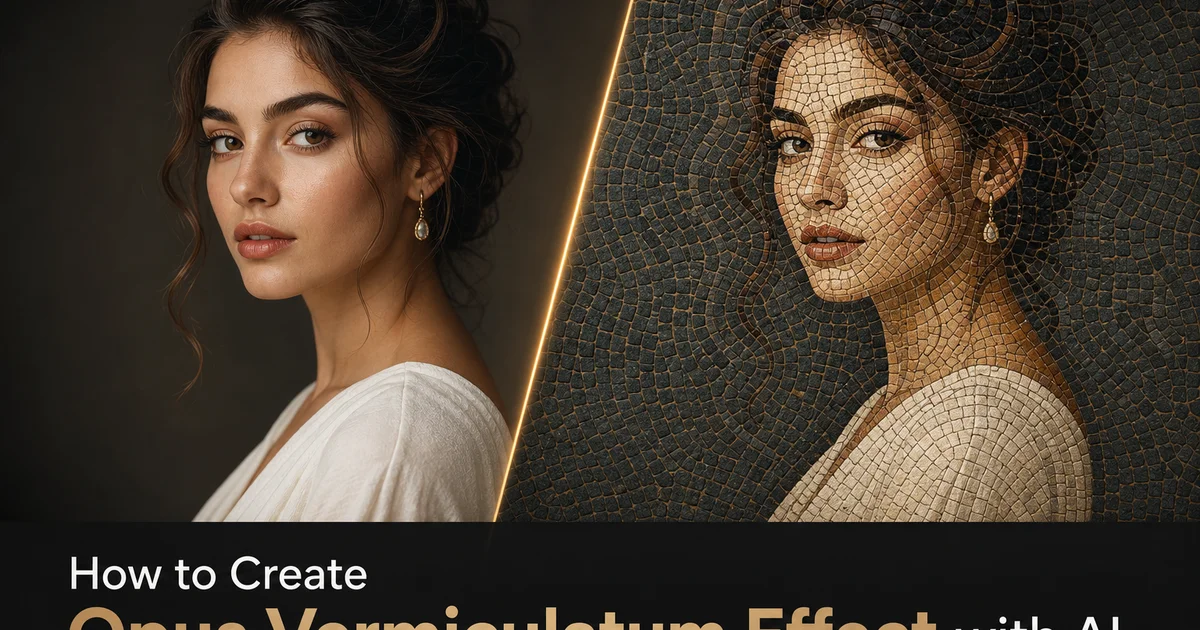
L'opus vermiculatum représente le summum de l'art de la mosaïque romaine antique. Une technique où de minuscules tesserae sont disposées en rangées sinueuses et vermiculées qui suivent les contours d'une figure centrale, créant un effet donnant au sujet une présence visuelle rayonnante comme aucun autre support décoratif. Le terme vient du latin vermiculus, signifiant petit ver, décrivant la façon dont les rangées de tesserae serpentent et coulent autour de la figure comme les traces laissées par les vers dans la terre meuble. Présent dans les plus belles mosaïques romaines de Pompéi à Antioche, l'opus vermiculatum était réservé aux compositions figuratives les plus importantes. Portraits détaillés, scènes mythologiques et natures mortes naturalistes — où les lignes de contour ondulantes autour du sujet amplifiaient son importance visuelle et démontraient la suprême habileté technique du mosaïste.
La puissance visuelle de l'opus vermiculatum provient du contraste entre deux échelles de traitement au sein d'une même mosaïque. La figure centrale est rendue avec des tesserae très fines. Parfois aussi petites que 1 mm de côté — disposées en rangées qui suivent le contour et les formes internes du sujet, créant une sensation de modelé tridimensionnel par le flux directionnel de la tessellation. Le fond environnant utilise souvent des tesserae beaucoup plus grandes dans un motif plus simple, créant un cadre visuel qui pousse l'attention du spectateur vers le centre finement travaillé. Ce contraste d'échelle délibéré, combiné aux lignes de contour ondulantes qui semblent rayonner vers l'extérieur depuis la figure, confère aux mosaïques d'opus vermiculatum une présence qui en fait le point focal de toute pièce qu'elles habitent, même deux mille ans après leur pose.
Les outils de retouche photo AI peuvent reproduire l'effet opus vermiculatum en combinant des algorithmes de tessellation suivant les contours avec l'application de textures matérielles, créant des mosaïques numériques qui capturent les qualités visuelles spécifiques de cette technique antique. Le processus comprend le cartographie des lignes de contour d'une figure centrale, la génération de rangées ondulantes de fines tesserae le long de ces contours, le remplissage du fond avec des tesserae plus grandes dans un motif contrastant, et l'application de textures de pierre et de verre qui donnent à chaque tessera la qualité matérielle du support d'origine. Ce guide couvre la technique complète, de la compréhension de l'artisanat historique qui éclaire chaque décision de conception aux instructions pratiques étape par étape pour obtenir un aspect opus vermiculatum authentique.
- La tessellation suivant les contours génère les rangées de contour caractéristiques de fines tesserae qui coulent autour de la figure centrale en trajectoires sinueuses vermiculées, la signature visuelle déterminante de l'opus vermiculatum.
- La structure de mosaïque à deux échelles utilise de très fines tesserae (1-4 mm) pour le travail figuratif détaillé et des tesserae plus grandes (10-15 mm) pour le remplissage du fond, créant le contraste d'échelle délibéré des mosaïques romaines authentiques.
- AI Enhance applique des textures spécifiques aux matériaux — grain de calcaire pour les tesserae blanches, veinure de marbre pour la pierre colorée, translucidité du verre pour le smalti, et reflet doré pour les pièces dorées.
- Background Eraser isole le sujet de l'image source avant la conversion, assurant des bords sujet-fond propres qui guident une tessellation précise suivant les contours.
- Magic Eraser supprime les éléments indésirables de l'image source avant la conversion en mosaïque, car chaque détail présent sera traduit en tesserae et deviendra permanent dans la mosaïque.
Comprendre l'opus vermiculatum : la technique la plus fine de l'art de la mosaïque romaine
L'artisanat de la mosaïque romaine englobait plusieurs techniques distinctes, chacune adaptée à différentes échelles et applications. Comprendre cette hiérarchie est essentiel pour créer un effet opus vermiculatum authentique. L'opus tessellatum était la technique standard pour la plupart des mosaïques de sol et de mur, utilisant des tesserae régulièrement taillées de taille moyenne (environ 10-15 mm) disposées en rangées droites pour remplir efficacement de grandes surfaces. L'opus musivum appliquait des principes similaires à la décoration murale et de voûte, utilisant souvent des tesserae de verre et d'or pour leurs qualités réfléchissantes. L'opus sectile utilisait de plus grandes pièces de pierre précisément formées assemblées comme un puzzle. Mais l'opus vermiculatum se tenait au sommet de la hiérarchie. Une technique réservée aux petits panneaux précieux appelés emblemata, où les plus fines tesserae disponibles étaient disposées avec une précision extraordinaire pour créer des images d'une qualité quasi picturale.
La marque technique de l'opus vermiculatum est la disposition des tesserae suivant les contours autour des éléments figuratifs. Plutôt que de placer les tesserae en rangées droites sur toute la composition, le mosaïste les disposait en lignes concentriques suivant le contour de la figure centrale, chaque rangée épousant la forme de la rangée intérieure comme des courbes de niveau sur une carte topographique. Cette disposition remplit à la fois des fonctions esthétiques et perceptuelles : esthétiquement, les lignes ondulantes créent une énergie visuelle qui rayonne vers l'extérieur du sujet, attirant l'œil vers le centre de la figure. Perceptuellement, les rangées courbes accentuent le contour du sujet et créent une subtile sensation de forme tridimensionnelle. Le flux directionnel des tesserae imite la façon dont les artistes utilisent les hachures parallèles pour décrire la courbure des surfaces.
Les plus beaux exemples survivants d'opus vermiculatum montrent des capacités techniques qui défient encore les mosaïstes modernes. La mosaïque d'Alexandre de la Maison du Faune à Pompéi, représentant Alexandre le Grand en bataille contre Darius III de Perse, contient environ 1,5 million de tesserae dont certaines aussi petites que 1,5 mm de côté, créant une composition qui rivalise avec la peinture moderne par son détail et son intensité émotionnelle. La mosaïque des Colombes de Pline, trouvée à la Villa d'Hadrien à Tivoli et considérée comme une copie d'une célèbre œuvre du mosaïste Sosus de Pergame, utilise l'opus vermiculatum pour représenter des oiseaux buvant dans un vase en bronze avec une telle précision naturaliste que le reflet des oiseaux dans l'eau est visible dans les tesserae. Ces chefs-d'œuvre ont établi l'opus vermiculatum comme la plus haute expression du medium mosaïque.
- Les techniques de mosaïque romaine formaient une hiérarchie allant de l'opus tessellatum standard à l'opus musivum pour murs et l'opus sectile en pièces façonnées jusqu'au sommet de l'opus vermiculatum pour les panneaux figuratifs fins.
- Les rangées de tesserae suivant les contours créent une énergie visuelle rayonnant du sujet, accentuent le contour de la figure. Suggèrent une forme tridimensionnelle par un flux directionnel similaire au hachurage artistique.
- La mosaïque d'Alexandre de Pompéi contient environ 1,5 million de tesserae, certaines aussi petites que 1,5 mm, démontrant l'opus vermiculatum à des niveaux de détail et d'intensité émotionnelle dignes de la peinture.
- Les emblemata — petits panneaux de mosaïque portables réalisés en opus vermiculatum — étaient fabriqués en atelier et installés comme pièce maîtresse de grandes mosaïques de sol exécutées avec des techniques plus grossières.
Cartographier les contours et générer les rangées ondulantes de tesserae
L'étape de cartographie des contours est le cœur technique de l'effet opus vermiculatum. La qualité et le flux des rangées de tesserae suivant les contours déterminent si le résultat est perçu comme un vermiculatum authentique ou comme un simple filtre de mosaïque générique. Commencez par extraire le contour du sujet de l'image source à l'aide de Background Eraser pour créer une limite sujet-fond propre. Ce contour sert de première ligne de contour. Dans le vermiculatum authentique, la rangée la plus intérieure de tesserae de fond se place directement contre le bord de la figure, suivant chaque courbe et chaque angle de la forme du sujet. Chaque rangée suivante suit le chemin de la rangée intérieure mais à une distance légèrement plus grande, comme des ondulations se propageant depuis une pierre jetée dans l'eau. Les rangées doivent couler en douceur, se redressant progressivement des courbes serrées près de la figure en arcs plus doux à mesure qu'elles s'éloignent.
Le nombre de rangées suivant les contours détermine l'intensité visuelle de l'effet vermiculatum. Les exemples historiques varient d'aussi peu que trois rangées à huit ou plus, le nombre variant souvent autour d'une même figure en fonction de la complexité du contour. Plus de rangées dans les zones de courbure douce où il y a de l'espace pour qu'elles se déploient, moins de rangées dans les concavités serrées où des rangées supplémentaires entreraient en collision. Quatre à six rangées est la plage la plus courante dans les mosaïques survivantes et produit un résultat visuellement équilibré qui se distingue clairement comme vermiculatum sans submerger la composition. Les rangées de contour doivent être rendues dans des tons alternés clairs et foncés. Souvent crème chaud et gris froid — pour rendre le motif ondulant visible sur le fond.
La transition des rangées suivant les contours vers le motif de remplissage du fond est un moment de conception critique. Dans les mosaïques authentiques, la rangée de contour vermiculatum la plus externe ne se termine pas brusquement mais fusionne progressivement dans la tessellation du fond, certaines tesserae commençant à s'aligner sur la grille du fond tandis que d'autres suivent encore la direction du contour. Cette zone de transition — généralement large d'une à deux rangées — empêche les rangées de contour d'apparaître comme une bordure dure autour de la figure et crée plutôt l'impression que l'énergie visuelle de la figure se dissipe naturellement dans le champ environnant. Le fond lui-même doit utiliser une simple disposition d'opus tessellatum. Des rangées droites horizontales ou légèrement inclinées de plus grandes tesserae — qui fournissent un fond visuel calme contre lequel les rangées de contour dynamiques de la zone figurative vermiculatum se détachent en contraste net.
- Background Eraser extrait le contour du sujet qui sert de premier guide de contour, chaque rangée de tesserae suivante suivant le chemin de la rangée intérieure comme des ondulations se propageant vers l'extérieur.
- Quatre à six rangées suivant les contours produisent l'effet opus vermiculatum le plus historiquement équilibré, le nombre variant autour de la figure selon la complexité du contour et l'espace disponible.
- Les tons alternés clairs et foncés dans les rangées de contour — crème chaud et gris froid — rendent le motif vermiculatum ondulant visible sur le fond.
- La zone de transition d'une à deux rangées où le suivi de contour fusionne dans la grille du fond empêche une bordure dure et crée une dissipation naturelle de l'énergie visuelle de la figure.
Textures matérielles : tesserae de pierre, de verre et d'or
La qualité matérielle des tesserae individuelles est ce qui distingue un effet opus vermiculatum convaincant d'un simple filtre de mosaïque géométrique. Les mosaïstes romains sélectionnaient les matériaux à la fois pour leur couleur et leurs propriétés optiques. Différents matériaux au sein d'une même mosaïque créent une richesse que les couleurs numériques plates ne peuvent égaler. Les tesserae de pierre — le matériau le plus courant — étaient taillées dans du calcaire et du marbre disponibles localement, chacune portant la structure du grain, le veinage et la variation chromatique subtile du matériau géologique naturel. Une tessera de calcaire blanc n'est pas un blanc uniforme mais un blanc cassé chaud avec de fines inclusions fossiles et des faces cristallines de calcite qui captent la lumière à des angles microscopiques. AI Enhance peut superposer ces textures de pierre à la bonne échelle, faisant lire chaque tessera comme un minuscule morceau de roche sculptée plutôt qu'un carré coloré plat.
Le smalti de verre — verre coloré opaque fabriqué spécifiquement pour le travail de la mosaïque — fournissait les couleurs intenses et saturées que la pierre naturelle ne pouvait atteindre. Le smalti romain était produit en mélangeant des oxydes métalliques dans une base de verre : cobalt pour le bleu profond, cuivre pour le turquoise et le vert, manganèse pour le violet, fer pour le brun et le noir, et antimoine pour le blanc-jaune. Les tesserae d'or étaient fabriquées en prenant en sandwich une feuille d'or entre deux couches de verre transparent, créant une surface qui réfléchissait une chaude lumière dorée tout en étant suffisamment durable pour une installation au sol et au mur. En reproduction numérique, les tesserae de verre doivent avoir une légère translucidité et une réflexion de surface qui les distinguent de la pierre, et les tesserae d'or nécessitent la qualité spéculaire chaude du métal derrière le verre. Plus brillantes et plus réfléchissantes que les surfaces de pierre et de verre environnantes.
Le jointoiement entre les tesserae est le dernier élément matériel qui complète l'aspect opus vermiculatum. Dans les mosaïques romaines, le mortier — un mortier à base de chaux — remplissait les espaces entre les tesserae et créait un fin réseau de lignes qui définissait chaque pièce une par une tout en unifiant visuellement la surface. La couleur du mortier était souvent un gris grès chaud qui s'harmonisait avec les tesserae de pierre et de verre. Dans l'effet numérique, les lignes de jointoiement doivent toujours être visibles entre chaque paire de tesserae adjacentes, avec une largeur proportionnelle à la taille des tesserae. Des lignes de jointoiement plus fines entre les petites tesserae vermiculatum près de la figure et des lignes légèrement plus larges entre les plus grandes tesserae du fond. La couleur du jointoiement doit être chaude et neutre, évitant à la fois le blanc pur (qui semble trop lumineux et moderne) et le gris foncé (qui crée trop de contraste et fragmente la surface visuelle).
- Les tesserae de pierre portent un caractère géologique naturel — structure du grain, veinage, inclusions fossiles et faces cristallines de calcite qui donnent à chaque pièce la chaleur et la variation de la roche sculptée.
- Les tesserae de smalti de verre nécessitent une légère translucidité et une réflexion de surface les distinguant de la pierre, avec des couleurs issues de la chimie des oxydes métalliques : bleu cobalt, vert cuivre, violet manganèse.
- Les tesserae d'or nécessitent la qualité spéculaire chaude du métal pris en sandwich sous le verre — plus brillantes et plus réfléchissantes que les matériaux environnants, captant la lumière différemment à chaque angle.
- Les lignes de jointoiement en gris grès chaud (#B8A88A) doivent être proportionnellement fines entre les petites tesserae vermiculatum et légèrement plus larges entre les plus grandes pièces du fond.
Techniques avancées : composition en emblemata, modelé chromatique et effets dimensionnels
L'opus vermiculatum traditionnel était le plus souvent créé sous forme d'emblemata. Des panneaux figuratifs autonomes souvent de 30 à 60 cm de large, fabriqués en atelier sur un plateau portable, puis insérés dans une plus grande mosaïque de sol exécutée sur place avec une technique plus grossière. Reproduire ce format de composition numériquement renforce la référence historique : placez votre composition figurative d'opus vermiculatum à l'intérieur d'une bordure décorative. Entourez la bordure d'un champ d'opus tessellatum plus simple qui remplit la composition plus large. Ce format fait référence au contexte archéologique réel dans lequel les mosaïques vermiculatum sont trouvées. Le contraste entre le fin emblemata central et le champ environnant plus grossier amplifie l'impact visuel de la technique vermiculatum en fournissant une comparaison directe d'échelle et de précision au sein d'une même image.
Le modelé chromatique dans l'opus vermiculatum atteint une forme tridimensionnelle par la gradation de couleur des tesserae plutôt que par les rangées ondulantes suivant les contours. À l'intérieur de la figure elle-même, le mosaïste utilisait des tesserae progressivement plus claires ou plus foncées pour modeler le volume. Des valeurs plus claires sur les surfaces faisant face à la source lumineuse, des valeurs plus foncées sur les surfaces s'en éloignant, avec des transitions chromatiques précises imitant le clair-obscur de la peinture. Ce modelé nécessite une palette substantielle de valeurs chromatiques étroitement liées : un portrait romain pourrait utiliser vingt couleurs de pierre distinctes ou plus rien que pour les tons de peau, passant du crème clair pour les rehauts à travers des demi-teintes rose chaud jusqu'à une ombre brun-rouge foncé. Dans l'effet numérique, ce modelé chromatique à l'intérieur de la figure doit utiliser des gradations douces entre des couleurs de pierre naturelles contraintes par la palette, distinctes du motif de suivi de contour net des rangées vermiculatum environnantes.
L'ajout d'effets dimensionnels suggérant la surface physique d'une mosaïque antique renforce l'illusion matérielle de l'effet opus vermiculatum. Les véritables mosaïques ont un relief de surface subtil car les tesserae individuelles ne sont ni parfaitement plates ni parfaitement de niveau. Certaines sont légèrement plus hautes, d'autres légèrement inclinées, et le mortier entre elles est en retrait. Cette micro-topographie capte la lumière de manière inégale, créant de minuscules rehauts sur les bords surélevés et de minuscules ombres dans les lignes de mortier. Ajoutez un effet de lumière directionnelle subtil qui imite ce relief de surface. Des bords plus brillants du côté faisant face à la source lumineuse implicite, des bords légèrement plus sombres du côté opposé, et des lignes de mortier ombrées — transforme la mosaïque numérique plate en quelque chose qui se lit comme une surface physique. Pour un aspect archéologique patiné, ajoutez une légère variation chromatique suggérant des siècles d'exposition, certaines tesserae décolorées et d'autres assombries par des taches minérales.
- Le format emblemata place le fin panneau vermiculatum dans une bordure décorative et un champ d'opus tessellatum plus grossier, reproduisant le contexte archéologique et amplifiant le contraste technique.
- Le modelé chromatique à l'intérieur de la figure utilise vingt valeurs de pierre naturelle ou plus étroitement liées pour passer du rehaut à la demi-teinte puis à l'ombre, réalisant un clair-obscur en tesserae.
- La simulation de relief de surface avec éclairage directionnel sur les bords des tesserae et lignes de mortier ombrées transforme la mosaïque numérique plate en une surface physique dimensionnelle.
- Les effets de patine archéologique avec décoloration sélective et taches minérales ajoutent une profondeur temporelle suggérant des siècles d'existence en tant qu'artefact physique.
How to do it
- 1
Select a source image with a strong central figure for the opus vermiculatum contour treatment
Choose a photograph with a clearly defined central subject. A portrait, animal, object, or figure — that will serve as the focal point for the opus vermiculatum contour lines. In authentic Roman opus vermiculatum, the defining technique is the use of tiny tesserae arranged in concentric rows that follow the contour of a central figure, creating a visual halo or outlining effect that draws the eye and gives the subject dimensional presence. The source image needs strong, unambiguous edges between subject and background. These edges will determine where the distinctive worm-like flowing lines of tesserae are generated. Portraits, still life subjects, animals, and architectural details all work well.
- 2
Apply edge detection to define the contour lines where tesserae rows will flow
Use AI tools to identify and map the contour edges of the central figure that will guide the flowing rows of tesserae. In opus vermiculatum, artisans set tiny tesserae in rows that follow the subject's outline. The first row directly adjacent to the figure edge, the second row following the first, and subsequent rows flowing outward in concentric paths that gradually smooth into the background pattern. These contour-following rows are the defining visual signature of the technique, creating a ripple-like effect around the figure that ancient Roman viewers and modern art historians alike recognize as the hallmark of the finest mosaic craftsmanship. Map at least four to six contour rows before transitioning to the background treatment.
- 3
Generate the tesserae grid with size variation between the fine vermiculatum contour and the coarser background
Create the mosaic tessellation with two distinct tesserae scales. Very fine tesserae along the figure contours where the opus vermiculatum technique applies, and larger tesserae in the background fill where a simpler opus tessellatum pattern suffices. In authentic Roman mosaics, the vermiculatum tesserae used for detailed figural work were often as small as 1-4mm square. The background tesserae might be 10-15mm or larger. This size differential is technically and visually important: the fine tesserae allow the curving contour rows to follow the figure's outline smoothly. The larger background tesserae fill space efficiently without competing for visual attention with the central subject.
- 4
Apply stone and glass material textures using AI Enhance for authentic tesserae appearance
Use AI Enhance to overlay natural stone and glass textures onto the mosaic tesserae, transforming flat colored squares into surfaces that read as physical materials. Roman mosaic tesserae were cut from a variety of materials — limestone and marble for whites, creams, and grays. Colored marbles for reds, greens, and earth tones. Egyptian blue frit for blues. And glass smalti for intense colors like cobalt blue, emerald green, and gold leaf under glass. Each material has a distinctive surface quality: stone tesserae show grain and veining, glass tesserae have a slight translucency and reflective quality. Gold tesserae have the warm specular reflection of metal under glass. Adding these material-specific textures at the tesserae scale gives the mosaic its authentic materiality.
- 5
Export the opus vermiculatum effect with settings that preserve tesserae detail and grout line definition
Save the finished mosaic image at high resolution to preserve the fine tesserae detail in the vermiculatum contour area. The smallest tesserae carry the technique's distinctive visual signature. Export in PNG format for digital use to maintain the crisp grout lines between individual tesserae without JPEG compression artifacts that blur these critical boundaries. For print applications, export at 300 DPI or higher. Consider that the fine vermiculatum tesserae near the figure contour need to remain legible at the final print size. The grout lines, often rendered in a warm sandstone gray, should always be visible across the entire mosaic at the intended display size.
Sources
- Roman Mosaic Techniques: Opus Vermiculatum and Fine Tesserae Work — The Metropolitan Museum of Art
- Ancient Mosaic Conservation and Documentation Standards — Getty Conservation Institute
- Digital Mosaic Generation Techniques for Artists and Designers — Adobe Creative Cloud Design Guide