
Comment créer un effet Ferronnerie Nambu avec le montage photo IA
Transformez vos photos en effets de ferronnerie Nambu tekki japonaise grâce au transfert de style IA. Guide étape par étape couvrant le motif grêle arare, la texture fil itome, le moulage en relief et la surface moulée au sable avec une profondeur de patine d'oxyde authentique.

SEO & Growth
Vérifié par Magic Eraser Editorial ·
Sommaire
- En quoi le rendu IA de la fonte diffère des approches standard d'assombrissement et de texture
- Les traditions de surface Nambu : arare, itome, moulage en relief et tetsubin uni
- Patine d'oxyde de fer : chimie, progression des couleurs et simulation d'assaisonnement
- Applications créatives : photographie de produit, branding hôtelier et design wabi-sabi
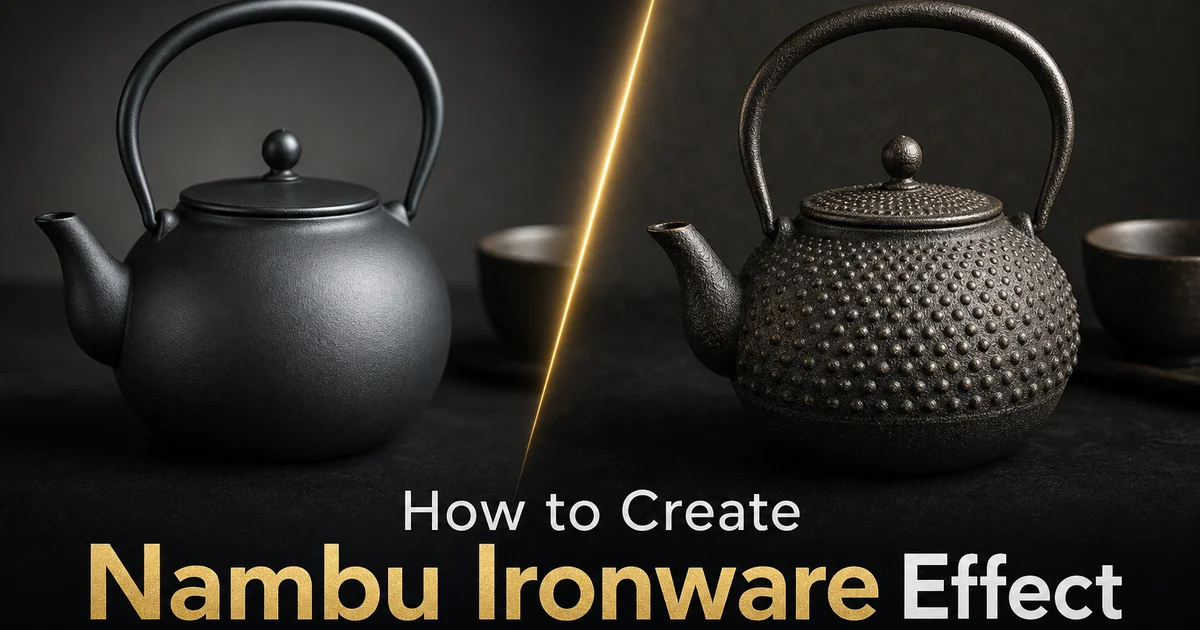
Le Nambu tekki — la tradition de la ferronnerie de la préfecture d'Iwate dans le nord du Japon — occupe une position distinctive dans la culture artisanale japonaise en tant que forme d'art définie à la fois par son poids matériel et sa retenue visuelle. Là où les laques brillent et où les céramiques montrent le mouvement de l'émail, la ferronnerie Nambu communique par la gravité et l'immobilité : les surfaces denses, mates et sombres de la fonte qui absorbent la lumière plutôt que de la réfléchir, créant des objets qui semblent ancrés dans leur environnement. La tradition remonte au début du dix-septième siècle, lorsque les seigneurs du clan Nambu de Morioka ont réuni des maîtres de cérémonie du thé et des maîtres fondeurs, établissant un centre de production qui allait définir l'esthétique de la ferronnerie japonaise pendant quatre cents ans. Aujourd'hui, le Nambu tekki — centré à la fois sur Morioka et Mizusawa — est officiellement désigné comme un Artisanat Traditionnel du Japon.
La reproduction numérique de la ferronnerie Nambu présente un défi particulier car l'identité visuelle de la fonte est largement définie par ce qu'elle ne fait pas avec la lumière. La plupart des effets de matériaux numériques fonctionnent en ajoutant de la complexité visuelle — réflexions, réfractions, variations de couleur, brillance de surface. Le caractère visuel de la fonte vient de son absorption de la lumière, de sa réflectance diffuse mate. La micro-texture subtile des surfaces moulées au sable disperse toute lumière réfléchie en une lueur douce et non directionnelle plutôt que les reflets focalisés qui caractérisent les surfaces polies ou émaillées. Créer un effet de fer convaincant nécessite de supprimer les qualités photographiques de surface de l'image source et de les remplacer par le comportement visuel calme et absorbant du métal coulé oxydé.
Le transfert de style alimenté par l'IA relève ce défi en apprenant à partir de milliers de photographies de véritables Nambu tekki comment les surfaces de fonte apparaissent réellement dans différentes conditions d'éclairage et états de patine. Comment la surface mate diffuse la lumière uniformément plutôt que de créer des reflets directionnels, comment la texture moulée au sable fournit une irrégularité de surface à grain fin distincte du métal usiné ou martelé, comment les points arare et les motifs en relief projettent des ombres subtiles qui donnent de la profondeur à la surface sans briser son caractère absorbant global, et comment la patine d'oxyde de fer se développe du gris de coulée brute à travers le gris foncé assaisonné jusqu'au noir profond d'un tetsubin utilisé quotidiennement pendant des décennies. Ce guide couvre le flux de travail complet pour créer des effets de ferronnerie Nambu à l'aide d'AI Filter et d'AI Enhance.
- L'IA reproduit la qualité mate absorbante distinctive de la fonte — diffusion de la lumière, réflexion spéculaire minimale et le poids visuel silencieux qui définit l'esthétique Nambu tekki.
- Plusieurs préréglages de surface couvrent les points grêle arare, le motif fil itome, le moulage en relief à motifs naturels et la texture tetsubin moulée au sable unie avec une profondeur dimensionnelle authentique.
- La simulation de texture moulée au sable capture l'irrégularité de surface à grain fin transférée des moules en argile et sable pendant le processus de coulée du fer, distincte du métal usiné ou martelé.
- La progression de la patine d'oxyde de fer, du gris argenté brut à travers le gris foncé assaisonné jusqu'au noir profondément patiné, est physiquement calibrée sur la chimie d'oxydation réelle de la fonte.
- AI Enhance affine la profondeur des motifs en relief et la solidité visuelle communiquant le poids qui distingue la ferronnerie Nambu des matériaux plus légers et des approximations numériques en couleur plate.
En quoi le rendu IA de la fonte diffère des approches standard d'assombrissement et de texture
L'effet fer numérique le plus courant assombrit une image, désature les couleurs et applique une superposition de texture rugueuse pour approximer l'apparence du métal sombre. Cette approche capture l'obscurité superficielle du fer mais rate son comportement optique distinctif. La vraie fonte n'est pas simplement sombre et rugueuse. C'est un matériau avec des propriétés de réflectance spécifiques : une réflexion spéculaire très faible, une diffusion diffuse élevée depuis la surface micro-texturée et une gamme de couleurs étroite (du gris argenté au noir chaud) déterminée par la composition chimique de la couche d'oxyde de surface. Une photographie assombrie et texturée se lit encore comme une photographie avec un filtre sombre plutôt que comme une surface de fer, car le comportement de réflectance photographique sous-jacent — reflets lumineux, variation de couleur, brillance de surface — transparaît à travers la superposition.
Le rendu IA du fer Nambu commence par le changement fondamental du remplacement de la réflectance photographique par la réflectance du fer. Cela signifie supprimer les reflets spéculaires et les remplacer par la lueur diffuse uniforme du métal coulé mat, réduire la gamme de couleurs à la plage d'oxyde de fer tout en préservant la variation tonale dans cette plage. Remplacer les surfaces photographiques lisses par la micro-texture spécifique de la fonte moulée au sable. La texture moulée au sable est extrêmement importante car c'est le mécanisme physique par lequel la fonte obtient son aspect mat. Les milliers de minuscules irrégularités de surface laissées par le moule en sable dispersent la lumière dans toutes les directions, empêchant la formation de reflets focalisés.
La qualité dimensionnelle des motifs de surface Nambu est rendue sous forme de relief — des formes tridimensionnelles s'élevant ou s'enfonçant dans la surface du fer — plutôt que comme une décoration imprimée ou peinte. Chaque point arare est un hémisphère s'élevant de la surface, projetant une petite ombre d'un côté et captant la lumière du côté opposé. Ce motif d'ombre-et-lumière donne à la surface sa qualité tactile, la sensation que vous pourriez passer vos doigts dessus et sentir les bosses. L'IA modélise ces motifs comme des éléments de relief tridimensionnels avec un placement d'ombre et de lumière physiquement correct basé sur la direction de la lumière configurée, créant un réalisme dimensionnel que les superpositions de motifs plats ne peuvent pas atteindre.
- Les approches d'assombrissement standard ratent le comportement optique spécifique de la fonte — réflexion spéculaire extrêmement faible et diffusion diffuse élevée depuis les surfaces micro-texturées.
- L'IA remplace la réflectance photographique par la réflectance du fer, supprimant les reflets spéculaires et réduisant la gamme de couleurs à la plage d'oxyde de fer tout en préservant la variation tonale.
- La texture de surface moulée au sable est modélisée comme le mécanisme physique de l'aspect mat — des milliers de micro-irrégularités transférées par le moule qui dispersent la lumière dans toutes les directions.
- Les motifs de surface comme les points arare sont rendus sous forme de relief tridimensionnel avec un placement d'ombre et de lumière physiquement correct plutôt que des superpositions décoratives plates.
Les traditions de surface Nambu : arare, itome, moulage en relief et tetsubin uni
L'arare — le motif grêle — est le traitement de surface Nambu tekki le plus distinctif, recouvrant l'extérieur des bouilloires tetsubin et des théières de rangées de petits points hémisphériques surélevés de la surface du fer. Le motif est né comme une caractéristique fonctionnelle : les points surélevés augmentent la surface extérieure d'une bouilloire, améliorant la distribution de la chaleur et offrant une prise tactile. Mais l'arare a transcendé son origine fonctionnelle pour devenir la signature visuelle déterminante de la ferronnerie Nambu, avec des variations de taille, d'espacement et d'agencement des points créant des sous-styles distincts. L'arare standard utilise des points moyens uniformes en rangées droites, tandis que l'ama-arare (grêle de pluie) varie les tailles de points pour un aspect plus organique. L'espacement entre les points varie de presque jointifs à largement espacés selon le jugement esthétique de l'artisan.
L'itome — motif fil — crée une surface couverte de fines crêtes linéaires qui coulent sur la surface du fer comme la texture du tissu tissé. Le motif est créé dans le moule de coulée en pressant du fil ou de la corde dans la surface du sable avant la coulée, transférant sa texture linéaire à la fonte. Le résultat est une surface avec une directionnalité subtile — la lumière accrochant les crêtes différemment selon l'angle de vue — qui adoucit le poids visuel du fer sans la dimensionnalité prononcée de l'arare. L'itome est souvent utilisé sur des objets plus petits comme les boîtes à thé et les brûle-parfum où la texture plus fine est proportionnellement appropriée. Son association textile relie la ferronnerie à la tradition plus large de l'artisanat japonais à travers les matériaux.
Le moulage en relief dans le Nambu tekki comprend des motifs de la nature — fleurs de cerisier, branches de pin, feuilles de bambou, eau courante et scènes saisonnières — comme éléments décoratifs en relief ou en creux sur la surface du fer. Contrairement à la régularité répétée de l'arare, les motifs en relief sont picturaux, racontant une histoire visuelle qui relie l'objet fonctionnel au monde naturel. Les motifs sont sculptés dans le moule de coulée et transférés au fer avec toute la profondeur tridimensionnelle que permet le processus de coulée. Les tetsubin unis — bouilloires sans motif décoratif — mettent en valeur la texture moulée au sable elle-même comme surface esthétique, comptant sur le grain subtil, la qualité du fer et le développement de la patine d'oxyde au fil des années d'utilisation pour créer un intérêt visuel uniquement par le réalisme matériel.
- Les points grêle arare étaient à l'origine fonctionnels pour la distribution de chaleur et la préhension, mais sont devenus la signature visuelle déterminante du Nambu tekki, avec des variations de taille, d'espacement et d'agencement.
- Le motif fil itome transfère des crêtes linéaires semblables à du tissu depuis la corde pressée dans les moules de coulée, créant une texture directionnelle qui adoucit le poids visuel du fer.
- Le moulage en relief incorpore des motifs de la nature — fleurs de cerisier, pin, bambou, eau — comme éléments picturaux tridimensionnels reliant la ferronnerie fonctionnelle au monde naturel.
- Le tetsubin uni met en valeur la texture moulée au sable et le développement de la patine d'oxyde comme seule esthétique, comptant sur l'authenticité matérielle plutôt que sur un motif décoratif.
Patine d'oxyde de fer : chimie, progression des couleurs et simulation d'assaisonnement
La surface du Nambu tekki n'est pas du fer nu mais une couche d'oxyde de fer qui se développe par des processus contrôlés pendant et après la fabrication. Le fer fraîchement coulé est gris argenté avec une texture de surface légèrement rugueuse. Pendant le processus de finition traditionnel appelé kamasabi, l'intérieur d'un tetsubin est traité en y faisant bouillir du thé, déposant une couche de composés tanin-fer qui empêche la rouille tout en assombrissant progressivement la surface. L'extérieur s'oxyde par exposition à la chaleur pendant l'utilisation, passant du gris au charbon chaud puis au noir profond d'une pièce bien assaisonnée. Cette progression de patine prend des années d'utilisation régulière, et la couleur spécifique à tout moment du processus reflète la chimie des états d'oxydation — de la magnétite (Fe3O4, noire) à l'hématite (Fe2O3, brun-rouge) en passant par divers oxydes hydratés selon l'exposition à l'humidité.
L'IA imite cette progression de patine comme un processus physique avec un état d'assaisonnement configurable. À l'extrémité fraîchement coulée du spectre, la surface montre la couleur gris argenté du fer brut avec toute la texture du moule en sable clairement visible. Au stade légèrement assaisonné, une fine couche d'oxyde ajoute de la chaleur et commence à assombrir la surface, avec une saturation légèrement plus élevée dans les zones en creux où la chaleur et l'humidité se concentrent. Au stade complètement assaisonné, la surface atteint le noir profond que les collectionneurs de Nambu tekki prisent. La couche d'oxyde est suffisamment épaisse pour masquer complètement le fer gris sous-jacent et produire une surface sombre, chaude, presque veloutée qui absorbe la lumière avec une douceur particulière.
La distribution de la patine n'est pas uniforme — elle varie selon la façon dont l'objet est utilisé. Sur un tetsubin, les zones exposées à la flamme (le fond et les côtés inférieurs) développent la patine le plus rapidement, tandis que le corps supérieur s'assaisonne plus lentement. La poignée, rarement exposée à la chaleur directe, peut rester à un stade de patine plus précoce. Les zones touchées par les mains développent une qualité polie car les huiles de la peau interagissent avec la surface d'oxyde. L'IA modélise ce développement non uniforme de la patine en fonction du motif d'utilisation configurable du type de récipient, plaçant une patine plus sombre et plus développée là où l'exposition à la chaleur et la manipulation accéléreraient naturellement l'oxydation, créant l'apparence authentique d'un objet qui a été utilisé plutôt que simplement vieilli.
- La patine d'oxyde de fer progresse du gris argenté de coulée brute à travers le charbon chaud jusqu'au noir profond, avec une chimie couvrant les états de magnétite, d'hématite et d'oxyde hydraté.
- La finition traditionnelle kamasabi avec du thé bouilli dépose des composés tanin-fer qui empêchent la rouille tout en initiant le processus de patine noircissante sur les surfaces intérieures.
- L'IA configure l'état de patine du fraîchement coulé au complètement assaisonné, l'épaisseur de l'oxyde affectant la profondeur de couleur, la chaleur de surface et le degré auquel la texture moulée au sable reste visible.
- La distribution non uniforme de la patine basée sur les motifs d'utilisation — développement plus rapide près de l'exposition à la flamme, qualité polie due au contact des mains — crée l'apparence authentique d'un objet utilisé.
Applications créatives : photographie de produit, branding hôtelier et design wabi-sabi
Les photographes de produit et les vendeurs de commerce électronique spécialisés dans les ustensiles de cuisine et les services à thé japonais utilisent les effets de ferronnerie Nambu pour créer des images qui communiquent le réalisme matériel, l'héritage artisanal et le poids visuel qui distingue la fonte de qualité des options légères. Un service à thé photographié avec des effets de fer texturé arare signale immédiatement la qualité artisanale japonaise aux publics familiers avec la tradition Nambu. L'obscurité mate silencieuse de l'esthétique du fer fournit une ancre visuelle d'enracinement pour la photographie de style de vie mettant en scène de la nourriture, du thé ou des scènes domestiques. Ces images transformées fonctionnent particulièrement bien auprès des consommateurs soucieux du design qui valorisent l'esthétique wabi-sabi — la beauté de l'imperfection, de l'âge et du matériau naturel.
Le branding hôtelier et de restauration s'appuie de plus en plus sur le langage visuel de la ferronnerie Nambu pour communiquer le réalisme, l'ancrage et le lien avec la culture matérielle traditionnelle. Les surfaces mates sombres et les textures tactiles de la fonte évoquent un monde sensoriel spécifique — le poids d'un tetsubin dans la main, le son de l'eau chauffant dans le fer, le goût minéral que le fer confère à l'eau bouillie. Les designers de marque traduisent cette association sensorielle en identité visuelle à travers des fonds texturés de fer, des éléments décoratifs en relief et la palette de couleurs sombres retenues que définit la ferronnerie Nambu. Les restaurants izakaya, les maisons de thé spécialisées, le branding des ryokan (auberges japonaises) et l'emballage alimentaire artisanal bénéficient tous de ces associations.
Les designers modernes travaillant avec le wabi-sabi et l'esthétique minimaliste japonaise utilisent l'effet fer Nambu pour créer des compositions visuelles qui incarnent le principe de trouver la beauté dans les choses calmes, simples et imparfaites. La surface mate absorbante du fer — qui capte la lumière plutôt que de la renvoyer — fournit un contrepoint visuel aux surfaces brillantes, réfléchissantes et avides d'attention qui dominent le design moderne. L'utilisation d'effets de fer Nambu sur les fonds, la photographie de produit et les supports de marque crée un cadre visuel de retenue et de profondeur qui permet aux autres éléments d'être vus plus clairement. La surface du fer devient non pas un point focal mais une présence d'ancrage qui établit l'ambiance et le contexte matériel pour la composition globale.
- Les photographes de produit communiquent l'authenticité matérielle et l'héritage artisanal à travers des images texturées de fer qui signalent la qualité aux publics valorisant l'esthétique wabi-sabi.
- Le branding hôtelier traduit les associations sensorielles de la ferronnerie Nambu — poids, chaleur, qualité minérale — en identité visuelle pour les restaurants, les maisons de thé et les ryokan.
- Les applications de design wabi-sabi utilisent la surface mate photo-absorbante du fer comme contrepoint visuel aux surfaces réfléchissantes brillantes qui dominent le design contemporain.
- La présence d'ancrage silencieuse des textures de fer Nambu dans les fonds et les supports de marque établit l'ambiance et le contexte matériel sans exiger d'attention visuelle.
How to do it
- 1
Upload your photo and evaluate its suitability for cast iron aesthetics
Open your image in AI Filter and assess how the composition translates to the visual language of Nambu tekki ironware. Nambu ironware — produced in the Morioka and Mizusawa areas of Iwate Prefecture since the seventeenth century — is characterized by its heavy, grounded presence, matte dark surfaces with subtle texture. Its distinctive arare (hailstone) dot pattern has become iconic in Japanese ironware design. Images with strong tonal contrast, weighty subjects, and compositions that evoke the quiet domesticity of Japanese tea culture translate best into the Nambu iron vocabulary.
- 2
Select a Nambu ironware surface style and configure texture parameters
Choose from presets that simulate the major Nambu surface traditions. Arare (hailstone) featuring rows of raised hemispherical dots that cover the exterior surface in a pattern both decorative and functional (increasing surface area for heat distribution), itome (thread pattern) with fine linear ridges flowing across the surface like fabric texture, sakura (cherry blossom) and other nature-motif relief casting, and plain tetsubin with smooth sand-cast texture showing only the grain of the casting mold. Each preset configures relief depth, pattern density, surface roughness, and the matte-to-satin reflectance range characteristic of seasoned iron.
- 3
Adjust surface roughness, oxide layer appearance, and casting texture details
Fine-tune the simulation of how cast iron interacts with light. Nambu tekki has a distinctive matte quality that results from the combination of sand-casting surface texture and the iron oxide layer that develops through use. Unlike polished metal, the surface absorbs most incident light and reflects it diffusely, creating a soft, non-directional look with minimal specular highlights. The AI replicates this with sliders for surface roughness (controlling the ratio of diffuse to specular reflection), oxide layer thickness (affecting whether the iron appears raw silver-gray, seasoned dark gray, or deeply patinated near-black). The controls also preserve the fine sand-grain texture transferred from the clay and sand casting mold during the pouring process.
- 4
Use AI Enhance to refine casting texture, relief pattern depth, and oxide patina transitions
Run AI Enhance to sharpen the three-dimensional quality of the cast iron surface, emphasizing the depth of arare dots or relief patterns, the fine grain of the sand-cast texture between the pattern elements, and the subtle color variations within the oxide layer that reveal the casting history and use patterns of the piece. Enhancement also accentuates the weight and solidity that are key to Nambu iron's visual identity: the sense that the object is heavy, grounded, and substantial in a way that lighter materials cannot convey.
- 5
Export and compare against documented examples of traditional Nambu tekki
Save the completed image at full resolution and compare it with photographs of recognized Nambu tekki from the Iwate Prefectural Museum, the Morioka History and Culture Museum, and documented works by certified Nambu tekki artisans. Verify that the surface texture matches the traits of sand-cast iron rather than machined or forged metal, that the arare or relief patterns have the dimensional quality of cast ornament rather than applied decoration, and that the oxide patina falls within the color range of traditionally seasoned iron, from the blue-gray of newly cast pieces through the warm dark gray of lightly seasoned ware to the deep black of extensively used tetsubin.
Sources
- Nambu Tekki: The Living Tradition of Morioka and Mizusawa Ironware — Nambu Tekki Cooperative Association
- Traditional Japanese Iron Casting: Materials, Molds, and Cultural Significance — Agency for Cultural Affairs, Government of Japan
- Physically-Based Rendering of Cast Iron Surfaces with Oxidation Patina — Computer Graphics Forum — Eurographics