
Comment creer un effet Iga ware avec l'IA : tutoriel sur la poterie japonaise marquee par le feu — Magic Eraser
Apprenez a creer des effets de poterie Iga spectaculaires dans vos photos avec l'IA. Tutoriel etape par etape couvrant les textures d'argile craquele, les formations de verre bidoro et l'esthetique intense de la ceramique de la prefecture de Mie.
SEO & Growth
Vérifié par Magic Eraser Editorial ·
Sommaire
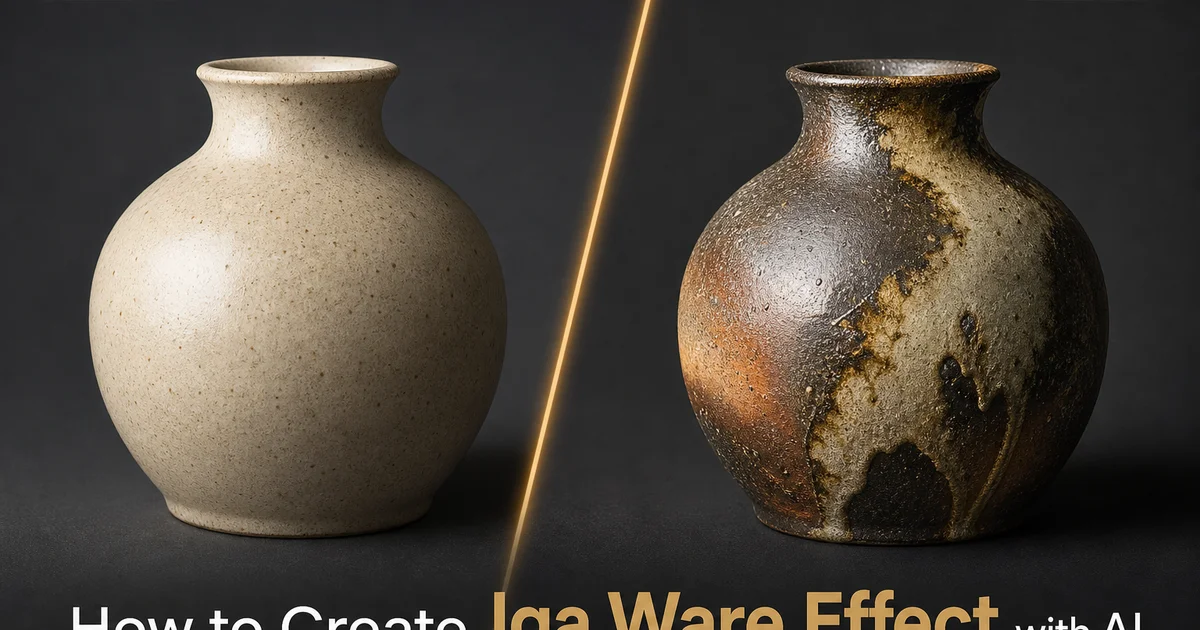
L'Iga ware compte parmi les plus puissamment belles des traditions céramiques du Japon. Une poterie qui semble avoir survécu à une éruption volcanique et en être ressortie plus forte. Produite dans la région d'Iga, dans la préfecture de Mie, depuis au moins le huitième siècle, l'Iga ware est cuite dans des fours anagama alimentés au bois à des températures extrêmes pendant plusieurs jours, durant lesquels le corps d'argile subit une transformation violente. La surface se fissure, cloque et se déforme. Les cendres de bois s'accumulent en dépôts épais qui fondent en un verre vert éclatant. Les flammes brûlent les surfaces exposées en un charbon profond et un ambre chaud. Le résultat est un objet céramique qui porte la preuve visible du feu qui l'a créé — brut, puissant et intensément vivant.
Contrairement au contrôle raffiné de traditions comme l'Agano ou à la simplicité délibérée du Raku, l'Iga ware embrasse les effets de four les plus extrêmes comme esthétique première. Les fissures qui seraient considérées comme des défauts dans la plupart des traditions céramiques sont célébrées à Iga sous le nom de kairagi. Un terme emprunté à la peau rugueuse du requin, décrivant les motifs irréguliers et en relief qui se forment lorsque le corps d'argile fond partiellement et se resolidifie sous la contrainte du four. L'épais verre vert bidoro qui s'accumule et coule sur la surface n'est pas une glaçure appliquée mais un dépôt naturel de cendres de bois fondues. Son emplacement est entièrement déterminé par les schémas de feu et de circulation d'air du four. Chaque pièce d'Iga est un témoignage unique de la cuisson particulière qu'elle a traversée.
Les outils d'édition photo par IA peuvent désormais appliquer les qualités visuelles de l'Iga ware. Les textures fissurées et cloquées, les formations spectaculaires de verre bidoro et la palette de couleurs intense marquée par le feu — comme effets sur des photographies ordinaires. L'IA analyse la géométrie de l'image et applique des effets de rupture de surface et de verre de cendre qui répondent à la structure tridimensionnelle de votre composition, créant des traitements inspirés d'Iga qui épousent naturellement les formes plutôt que de se poser comme des calques plats. Le résultat capture l'énergie brute et viscérale qui fait de l'Iga ware l'une des traditions céramiques les plus visuellement saisissantes du Japon.
- Appliquez des textures d'argile fissurées et cloquées (kairagi) qui simulent la rupture de surface d'une cuisson au bois extrême de plusieurs jours.
- Ajoutez des effets de verre naturel bidoro — des flaques et coulures de cendres de bois fondues, du vert éclatant à l'ambre foncé, sur les surfaces faisant face au feu.
- L'IA analyse la géométrie de l'image pour appliquer le marquage par le feu et l'accumulation de cendres avec une conscience directionnelle conforme à la physique réelle du four.
- Décalez les palettes vers la gamme spectaculaire d'Iga — charbon profond, ambre chaud, vert cendre éclatant, rouge-orange oxydé et argile brute pâle.
- Exportez en PNG pour une préservation complète de la texture ou augmentez le contraste pour les réseaux sociaux où le contraste tonal spectaculaire porte l'effet.
L'esthetique extreme du four de l'Iga ware
Le caractère visuel de l'Iga ware commence par l'argile elle-même. L'argile locale d'Iga, extraite d'anciens dépôts de lits de lac, contient une forte proportion de matière organique. Des fossiles végétaux et de l'humus accumulés sur des millions d'années. Pendant la cuisson de plusieurs jours, cette matière organique brûle, créant de minuscules vides dans tout le corps d'argile qui le rendent poreux et léger. Sujet aux fissures de surface qui définissent la texture d'Iga. Aux températures maximales du four approchant les 1300 degrés Celsius, le feldspath et la silice contenus dans l'argile commencent à se vitrifier (se transformer en verre), et la surface du vase développe la texture kairagi. Un réseau de fissures irrégulières et de crêtes en relief où l'argile partiellement fondue s'est contractée et gondolée en refroidissant.
La cuisson au bois apporte le deuxième élément esthétique essentiel. Une cuisson d'Iga consume souvent plusieurs tonnes de pin rouge sur trois à cinq jours, générant d'énormes quantités de cendres transportées à travers la chambre du four par des courants d'air surchauffés. Là où ces cendres se déposent sur la surface céramique, elles s'accumulent en dépôts épais qui fondent à température maximale en un verre naturel appelé bidoro. Le bidoro va de revêtements pâles et fins qui couvrent à peine l'argile à des flaques épaisses et visqueuses qui coulent le long des surfaces verticales sous l'effet de la gravité, se figeant sur place à mesure que le four refroidit. La couleur va du vert émeraude éclatant à l'ambre foncé en passant par l'olive, selon la chimie des cendres et l'atmosphère du four à cet emplacement précis de la chambre.
Le feu lui-même laisse ses marques les plus spectaculaires sur les surfaces faisant directement face au trajet des flammes. Ces zones reçoivent la chaleur la plus intense et les dépôts de cendres les plus lourds, développant un noircissement profond du charbon au noir, en couches sous une épaisse accumulation de bidoro. Le côté opposé du vase. Abrité de la flamme directe — conserve davantage de la couleur naturelle de l'argile, montrant le brun chaud au gris du corps d'argile d'Iga avec un marquage par le feu plus léger. Cette asymétrie spectaculaire entre les côtés faisant face au feu et abrités donne à chaque pièce d'Iga une énergie visuelle dynamique, presque violente, qu'aucune autre tradition céramique japonaise n'égale en intensité.
- L'argile ancienne des lits de lac, à forte teneur organique, brûle pendant la cuisson, créant la structure poreuse sujette aux fissures de surface kairagi.
- Les cuissons de plusieurs jours consomment des tonnes de pin rouge, générant de lourds dépôts de cendres qui fondent en un épais verre bidoro aux températures maximales.
- La couleur du bidoro va du vert émeraude éclatant à l'ambre foncé en passant par l'olive, avec une épaisseur allant de fins revêtements à de lourdes coulures et flaques.
- L'asymétrie spectaculaire entre les surfaces faisant face au feu et marquées et les zones abritées donne à Iga son intensité visuelle et son énergie caractéristiques.
Application de textures craquelees et d'effets de disruption de surface
Créer un effet Iga numérique convaincant nécessite de superposer plusieurs éléments de texture plutôt que d'appliquer un seul calque de surface fissurée. La couche de base est le motif de fissuration kairagi. Un réseau de fissures irrégulières qui suit les schémas de contrainte de la surface sous-jacente. L'IA analyse les lignes structurelles de votre image (bords, contours, limites tonales) et génère un réseau de fissures qui suit ces lignes de contrainte naturelles plutôt qu'un motif aléatoire. Les fissures se concentrent dans les coins, les bords et les zones de forte courbure où la contrainte physique serait la plus grande sur une surface céramique réelle, et elles s'amincissent dans les zones plates et peu contraintes.
Par-dessus le motif de fissures, l'effet de cloquage ajoute des formations en relief, en forme de dôme, là où l'argile s'est dilatée sous la pression interne des gaz pendant la cuisson. Ces cloques vont de minuscules formations rapprochées couvrant de larges zones à de plus grandes cloques individuelles de plusieurs millimètres de large. L'IA place les cloques de préférence dans les zones de l'image qui reçoivent un fort traitement de marquage par le feu. Dans l'Iga ware réel, le cloquage est le plus intense sur les surfaces faisant face au feu où la température était la plus élevée. La combinaison de fissuration et de cloquage crée une texture complexe à plusieurs échelles qui se lit comme une surface façonnée par une chaleur extrême plutôt que par un simple dommage mécanique.
Le troisième élément de texture est la qualité de surface rugueuse et partiellement fondue de l'argile d'Iga fortement cuite. Dans les zones d'exposition à une chaleur intense, la surface de l'argile devient semi-vitreuse. Partiellement fondue en un état rugueux et vitreux qui capte et reflète la lumière différemment du corps d'argile mat et non cuit. L'IA applique un changement de brillance localisé dans les zones les plus marquées par le feu, les faisant paraître légèrement réfléchissantes et vitreuses par rapport aux surfaces mates des zones abritées. Ce subtil changement de brillance ajoute de la profondeur et du réalisme à la texture, transmettant le changement physique que la chaleur extrême produit dans un corps céramique.
- Les motifs de fissures kairagi suivent les lignes structurelles de l'image — se concentrant aux bords et aux courbes, s'amincissant dans les zones plates — et non un bruit aléatoire.
- Les effets de cloquage sont placés de préférence sur les surfaces faisant face au feu où les températures étaient les plus élevées dans les conditions réelles du four.
- La texture à plusieurs échelles combine de fins réseaux de fissures, des cloques moyennes et de grandes déformations de surface pour une apparence réaliste de dommage par le four.
- La brillance localisée sur les zones fortement cuites simule une vitrification partielle, ajoutant une profondeur réfléchissante à des surfaces d'argile autrement mates.
Effets de verre bidoro et simulation de depot de cendre
Le bidoro est la pièce maîtresse visuelle de l'Iga ware. Un verre naturel épais et éclatant qui offre un contraste spectaculaire avec le corps d'argile rugueux et sombre. Numériquement, créer un bidoro convaincant exige d'imiter un matériau fondamentalement différent de la surface environnante : semi-transparent, brillant, lisse. Brillamment coloré sur un fond mat, rugueux et sombre. L'IA applique le bidoro comme une couche distincte avec ses propres propriétés optiques. Une réflectivité, une saturation des couleurs et une douceur accrues — qui se pose au-dessus de la texture de l'argile plutôt que de la remplacer. Là où le bidoro est fin, la texture de l'argile transparaît dessous. Là où il est épais, il forme des flaques lisses et vitreuses qui couvrent entièrement la surface sous-jacente.
L'emplacement du bidoro suit la physique du four. L'air chargé de cendres se déplace dans la chambre du four du foyer vers la cheminée. Les cendres se déposent le plus fortement sur les surfaces faisant face au flux d'air et sur les zones horizontales où la gravité maintient les dépôts en place. L'IA applique une accumulation de bidoro plus importante sur les surfaces faisant face à la direction implicite du feu (que vous pouvez définir ou que l'IA déduit de la direction de lumière existante) et sur toutes les surfaces horizontales de la composition. Les surfaces verticales reçoivent des coulures de bidoro — des stries allongées de matière vitreuse s'écoulant vers le bas sous l'effet de la gravité — plutôt que les flaques épaisses qui se forment sur les zones horizontales.
La couleur du bidoro est cruciale pour l'esthétique d'Iga. La couleur la plus prisée est un vert éclatant et saturé produit par le fer des cendres de bois réduit dans l'atmosphère pauvre en oxygène du four. Ce vert peut aller d'un jade vif à un olive profond selon la chimie des cendres et les conditions de cuisson. Là où le bidoro est plus fin ou là où l'atmosphère du four était plus oxydante, le verre apparaît ambre, brun ou doré plutôt que vert. L'IA devrait appliquer du bidoro vert dans les zones d'accumulation les plus épaisses et passer à l'ambre et au brun dans les dépôts plus fins et aux bords des formations de verre, imitant la variation de couleur naturelle produite par les variations d'épaisseur du verre et les conditions d'atmosphère sur un même vase.
- Le bidoro forme une couche optique distincte — brillante, semi-transparente et saturée — contrastant avec le corps d'argile rugueux et mat en dessous.
- L'emplacement suit la physique du four : flaques épaisses sur les surfaces horizontales et faisant face au feu, stries de coulure allongées sur les zones verticales.
- Le vert jade à olive éclatant dans les dépôts épais passe à l'ambre et au brun là où la couche de verre s'amincit sur les bords.
- Les zones de bidoro fin laissent transparaître la texture de l'argile sous le verre, tandis que les flaques épaisses créent une couverture lisse et opaque.
Applications creatives pour l'esthetique Iga ware
L'effet Iga ware occupe une niche créative unique — il transmet la puissance brute, la force élémentaire et la survie à travers le changement. Cela le rend idéal pour les marques et projets qui veulent transmettre l'intensité, la résilience et un réalisme sans compromis. Distilleries artisanales, marques alimentaires artisanales, entreprises de plein air et d'aventure. Les studios créatifs travaillant dans la musique heavy, les arts martiaux ou les sports extrêmes trouvent que l'esthétique d'Iga s'aligne sur leurs valeurs de marque d'une robustesse forgée par le feu. L'effet fonctionne surtout bien pour les images héros et la photographie de mise en avant où l'impact visuel prime sur le raffinement délicat.
Contrairement à l'élégance fluide de l'Agano ou à la sobriété subtile du Shigaraki, le langage visuel d'Iga est confrontant et plein d'énergie. Les fissures spectaculaires, les formations de verre vert vif et les surfaces intensément marquées par le feu exigent l'attention et créent une réponse émotionnelle immédiate. Cela rend l'effet surtout efficace pour le contenu des réseaux sociaux où le pouvoir d'arrêt dans un fil défilant rapidement est essentiel. Les forts contrastes tonals entre les zones sombres brûlées par le feu et le bidoro vert éclatant restent visuellement frappants même aux petites tailles d'affichage et à la forte compression des plateformes sociales. Des effets céramiques plus subtils pourraient perdre leur caractère.
Pour les designers intégrant des effets Iga dans des systèmes visuels plus larges, la texture extrême et le contraste élevé offrent des points focaux naturels. Utilisez le traitement Iga complet sur les images héros clés et le contenu mis en avant, avec la palette de couleurs d'Iga (charbon, ambre, vert cendre) reportée dans les éléments de design de soutien à une intensité de texture plus faible. La typographie placée sur des fonds traités à l'Iga doit être grasse et très contrastée. Les caractères délicats ou légers sont submergés par l'intensité texturale. Le langage de design global doit correspondre aux valeurs esthétiques d'Iga : audacieux, direct, résolument intense, avec la confiance de laisser les éléments visuels spectaculaires parler d'eux-mêmes.
- La puissance brute d'Iga convient aux marques transmettant l'intensité et la résilience — distilleries artisanales, entreprises de plein air, arts martiaux et studios créatifs extrêmes.
- Le fort contraste tonal entre les zones sombres brûlées et le bidoro vert éclatant maintient l'impact visuel même aux petites tailles d'affichage des réseaux sociaux.
- Utilisez le traitement Iga complet pour les images héros et reportez la palette charbon-ambre-vert dans les éléments de soutien à une intensité de texture réduite.
- Une typographie grasse et très contrastée complète l'intensité texturale d'Iga — les caractères délicats sont submergés par les effets de surface spectaculaires.
How to do it
- 1
Select a photo with strong texture and organic forms
Iga ware is defined by dramatic, rugged surfaces shaped by extreme kiln conditions. Choose source images with strong existing texture — rough stone, weathered bark, craggy landscapes, or macro photography of organic materials. Images with angular, irregular forms respond best to the Iga treatment because the effect emphasizes surface disruption and dramatic tension rather than smooth elegance. Portraits with strong character features and visible skin texture also work well for conveying Iga's raw power.
- 2
Apply the cracked and blistered surface texture using AI Filter
Open the image in AI Filter and select a volcanic or cracked-earth texture preset as the starting point. Iga ware is famous for its violently textured surfaces. The clay body cracks, blisters, and deforms during firing at extreme temperatures up to 1300 degrees Celsius over multiple days. The AI applies a texture overlay that mimics these kiln-induced surface disruptions: deep cracks (kairagi), raised blisters. Areas where the clay has melted and re-solidified into rough, glassy formations.
- 3
Add bidoro (natural glass) and ash-deposit effects
Iga ware features dramatic bidoro — areas where wood ash has accumulated heavily and melted into thick, glassy pools and drips of natural glass ranging from brilliant green to dark amber. Apply glassy texture overlays concentrated on horizontal and fire-facing surfaces, with drips and runs flowing down vertical areas. These bidoro deposits should appear as semi-transparent, glossy interruptions in the otherwise rough matte surface of the clay body, creating the contrast between raw earth and molten glass that defines Iga's dramatic aesthetic.
- 4
Adjust the color palette to Iga's kiln-fired earth tones
Use AI Enhance to shift the palette toward Iga's trait colors. The deep charcoal and warm brown of heavily fire-marked clay, the brilliant green of thick bidoro glass, the reddish-orange of areas where iron in the clay has oxidized, and the pale gray-tan of the raw clay body visible in sheltered areas. Iga's palette is more dramatic than Shigaraki or Bizen, with stronger contrast between the deep darks of fire-scorched areas and the vivid green of heavy ash accumulation.
- 5
Export the finished Iga ware effect image
Save in PNG format to preserve the full range of texture detail. The fine cracks, glassy bidoro surfaces, and tonal contrasts between fire-marked and sheltered areas. For social media, increase contrast slightly before export to ensure the dramatic texture reads clearly at smaller display sizes. For print, export at 300 DPI minimum. The Iga aesthetic is inherently high-impact, so the effect works at both large display sizes where texture detail is visible and at thumbnail sizes where the dramatic tonal contrast carries the visual weight.
Sources
- Iga Ware: The Resilient Beauty of Fire and Earth — Iga Pottery Traditional Industry Association
- Japanese Kiln Traditions: Six Ancient Kilns of Japan — The Metropolitan Museum of Art
- Wood-Fired Ceramics: Natural Ash Glazing and Kiln Effects — Journal of the American Ceramic Society