
Comment creer un effet guilloche avec l'IA
Transformez vos photos avec des motifs de guillochage au tour a l'aide de l'IA. Guide etape par etape couvrant les motifs de rose engine spirographe, la decoration de cadrans de montres, les motifs de securite de billets de banque et les effets de gravure ornementale style Faberge.
SEO & Growth
Vérifié par Magic Eraser Editorial ·
Sommaire
- Les mathematiques et la mecanique de la generation de motifs guilloche
- Types de motifs : compositions de rose engine, ligne droite et spirographe
- Rendu des materiaux : simulation de surface metallique, emaillee et gravee
- Adaptation contextuelle des motifs et integration compositionnelle
- Applications creatives : image de marque de luxe, certificats et arts decoratifs
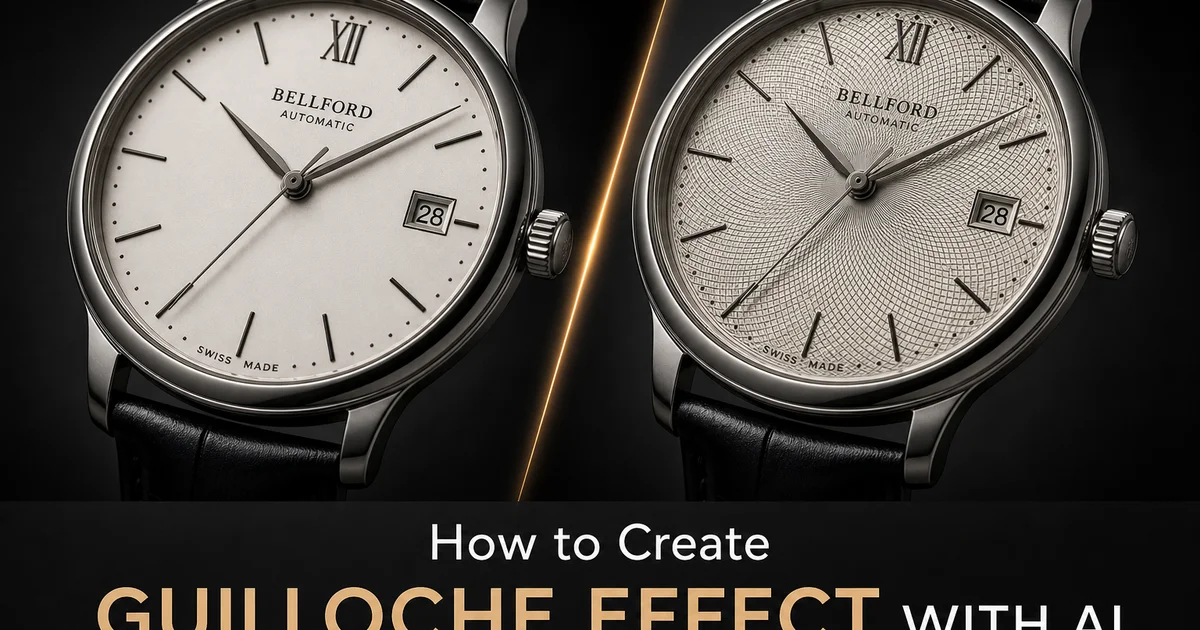
Le guilloché est l'art de graver des motifs géométriques complexes et répétés dans le métal, le verre ou d'autres surfaces dures à l'aide d'un tour spécialisé. La machine à roses ou le tour à ligne droite guide un outil de coupe le long de trajectoires d'ondes mathématiquement précises pendant que la pièce tourne ou se déplace en dessous. Le résultat est une surface couverte de lignes courbes entrecroisées d'une régularité et d'une complexité extraordinaires qui captent la lumière différemment sous chaque angle, créant un chatoiement optique immédiatement reconnaissable sur les cadrans de montres de luxe, les œufs Fabergé, la joaillerie fine, les capuchons de stylos-plumes et les bordures élaborées des billets de banque et des titres gouvernementaux. La beauté mathématique du guilloché réside dans sa nature paramétrique : de petites variations de la vitesse de rotation, de l'amplitude des ondes ou du décalage de l'outil produisent des motifs entièrement différents, tous régis par les mêmes principes géométriques sous-jacents.
Reproduire le guilloché numériquement exigeait autrefois un logiciel de graphisme vectoriel spécialisé et une compréhension approfondie des courbes mathématiques — hypotrochoïdes, épitrochoïdes et figures de Lissajous — qui définissent chaque type de motif. Un concepteur créant une bordure guilloché pour un certificat ou un emballage doit spécifier des dizaines de paramètres : le nombre de passages d'ondes superposés, la relation de phase entre chaque passage, l'enveloppe d'amplitude qui contrôle la variation de la hauteur des ondes à travers le motif, et l'épaisseur du trait qui détermine si le résultat se lit comme une gravure délicate ou une décoration audacieuse. Cette barrière technique a largement confiné l'esthétique du guilloché à l'impression de sécurité spécialisée, à l'horlogerie haut de gamme et à une petite communauté de passionnés d'arts décoratifs qui possèdent ou peuvent accéder aux machines à roses de plus en plus rares qui produisent le guilloché physique.
La conversion guilloché assistée par IA démocratise cette technique décorative exquise en permettant à quiconque d'appliquer des motifs de guillochage au tour mathématiquement précis sur des photographies et des images numériques. L'IA génère des motifs guilloché basés sur les mêmes mathématiques de courbes paramétriques utilisées par les machines à roses physiques, mais elle peut aussi adapter les motifs au contenu de l'image sous-jacente : suivre les contours d'un visage, épouser le contour d'un produit, ou concentrer la densité dans les zones qui bénéficient d'un enrichissement de texture tout en laissant d'autres zones claires pour la lisibilité. Ce guide explique l'utilisation d'AI Filter et AI Enhance pour créer des effets guilloché qui font référence à la précision et à la richesse visuelle de la véritable orfèvrerie guillochée, en couvrant la sélection de motifs, la configuration des paramètres géométriques, le contrôle de la qualité des traits et le rendu des matériaux qui fait paraître le guilloché numérique gravé plutôt que simplement imprimé.
- L'IA génère des motifs guilloché mathématiquement précis en utilisant les mêmes familles de courbes hypotrochoïdes, épitrochoïdes et de Lissajous que produisent les machines à roses physiques, garantissant une authentique régularité géométrique.
- Plusieurs préréglages de motifs simulent les ondes circulaires de la machine à roses, les ondulations parallèles du tour à ligne droite et les compositions de spirographe complexes avec des contrôles paramétriques de fréquence, d'amplitude et de passages rotatifs.
- L'adaptation du motif au contenu suit les contours de l'image. Elle épouse les traits du portrait, les contours du produit et les zones de texte, concentrant la densité décorative là où elle enrichit la composition et la réduisant là où la clarté est nécessaire.
- Le rendu de matériau métallique imite le comportement de captation de la lumière des sillons gravés avec une géométrie de section transversale cylindrique correcte, produisant le chatoiement dépendant de l'angle caractéristique du guilloché physique.
- AI Enhance garantit une précision de trait exceptionnelle dans tout le motif, éliminant les artefacts de crénelage et maintenant la régularité mathématique qui distingue le guilloché du travail décoratif à main levée.
Les mathematiques et la mecanique de la generation de motifs guilloche
Chaque motif guilloché est par essence une courbe paramétrique : une fonction mathématique qui définit la position de l'outil de coupe en chaque point de sa trajectoire pendant que la pièce tourne en dessous. Le tour à machine à roses, instrument principal de la gravure guilloché, y parvient en montant la pièce sur une broche qui non seulement tourne mais oscille aussi radialement selon le profil d'une came ou d'une roue à rosette. Lorsque la broche tourne, l'outil de coupe trace une trajectoire qui combine la rotation régulière avec le déplacement radial périodique, produisant les motifs d'ondes pulsatiles caractéristiques qui distinguent le guilloché de la simple gravure circulaire. Différents profils de roues à rosette — sinusoïdal, triangulaire, multilobé — produisent différentes formes d'ondes. Le nombre de lobes sur la rosette détermine le nombre d'ondulations par révolution de la pièce.
Les courbes mathématiques résultant de ce procédé mécanique appartiennent à des familles bien étudiées en géométrie. Lorsque l'outil de coupe se déplace sur un disque plat en rotation, la trajectoire trace une hypotrochoïde ou une épitrochoïde : les mêmes courbes produites par le jouet Spirographe, qui est par essence une machine à roses simplifiée utilisant des engrenages imbriqués au lieu de l'oscillation entraînée par came. Lorsque la pièce se déplace linéairement au lieu de tourner, le tour à ligne droite produit des motifs d'ondes sinusoïdales dont l'interférence avec les passages voisins crée des textures visuelles de type moiré. Le générateur de motifs IA travaille directement avec ces familles mathématiques, spécifiant chaque motif par ses équations paramétriques plutôt qu'en imitant la mécanique physique. Cela lui permet de produire des motifs d'une précision et d'une complexité illimitées qui seraient mécaniquement difficiles ou impossibles sur un tour physique.
La richesse visuelle du guilloché provient de la superposition de multiples passages aux paramètres légèrement décalés. Un seul motif d'onde tracé une fois produit une simple ligne ondulée. Le même motif tracé trente fois avec un petit décalage angulaire entre chaque passage produit une rosette dense qui scintille de lumière. Les contrôles de nombre de passages et de décalage de l'IA vous permettent de déterminer combien de tracés superposés composent le motif final, des dessins ouverts et clairsemés aux lignes individuelles clairement distinguables jusqu'aux textures denses où le travail accumulé crée une surface tonale presque uniforme. Un nombre de passages plus élevé augmente aussi la valeur anti-contrefaçon du motif. Un principe exploité par les concepteurs de billets, car les motifs guilloché à nombreuses lignes fines superposées sont très difficiles à reproduire sans les spécifications paramétriques originales.
- Les tours à machine à roses combinent la rotation de la pièce avec une oscillation radiale entraînée par came pour tracer des motifs d'ondes paramétriques dont la forme dépend du profil de la roue à rosette — sinusoïdal, triangulaire ou multilobé.
- Les courbes guilloché appartiennent aux familles des hypotrochoïdes et épitrochoïdes, les mêmes courbes mathématiques produites par les engrenages du Spirographe, spécifiées par des équations paramétriques que l'IA génère directement.
- De multiples passages superposés avec des décalages angulaires transforment de simples lignes d'ondes en rosettes denses qui scintillent de lumière, le nombre de passages contrôlant l'équilibre entre ouverture et densité de texture.
- Le tour à ligne droite produit des translations sinusoïdales dont l'interférence avec les passages voisins crée des textures visuelles de type moiré utilisées dans les bordures de billets et les dessins de sécurité des certificats.
Types de motifs : compositions de rose engine, ligne droite et spirographe
Les motifs de machine à roses sont la forme la plus emblématique du guilloché, produisant les dessins circulaires rayonnants qui ornent les cadrans de montres de luxe, la joaillerie fine et l'orfèvrerie décorative la plus élaborée. La qualité visuelle caractéristique du guilloché à la machine à roses est sa symétrie radiale combinée à l'ondulation : des cercles concentriques qui pulsent vers l'intérieur et l'extérieur avec un rythme régulier, créant une texture visuelle hypnotique qui capte la lumière différemment sous chaque angle de vue. Le préréglage machine à roses de l'IA génère ces motifs avec des contrôles pour le nombre de pétales par révolution, la profondeur de l'amplitude des ondes et l'étendue radiale du motif du centre au bord. Les motifs classiques de cadrans incluent la grille clou de Paris de petites bosses pyramidales, la texture en grain d'orge à ondes diagonales et le motif de lignes radiales en soleil, chacun réalisable par des combinaisons spécifiques de paramètres.
Les motifs de tour à ligne droite produisent les textures d'ondes parallèles le plus souvent vues dans l'impression de sécurité : les fonds complexes des billets de banque, certificats d'actions, obligations gouvernementales et documents officiels. Ces motifs consistent en ondes sinusoïdales horizontales ou verticales dont la fréquence, l'amplitude et la phase varient selon des fonctions mathématiques produisant des textures visuelles complexes résistantes à la reproduction photographique. Lorsque plusieurs ensembles d'ondes en ligne droite se superposent à différents angles, l'interférence entre les ensembles de lignes crée des motifs de moiré qui se déplacent et scintillent lorsque le document est incliné. Une caractéristique anti-contrefaçon qui dépend de la relation mathématique précise entre les ensembles d'ondes superposés. L'IA génère ces motifs avec des contrôles pour la direction des ondes, l'angle de superposition et la fonction d'enveloppe d'amplitude qui façonne la variation de la hauteur des ondes sur la zone de conception.
Les compositions de spirographe combinent mouvement rotatif et translation pour produire les courbes en boucle complexes familières du jouet de dessin géométrique, mais élevées à la précision et à la densité de la gravure guilloché experte. Ces motifs sont définis par le rapport de deux mouvements circulaires : l'orbite d'un point sur un petit cercle roulant à l'intérieur ou à l'extérieur d'un grand cercle, et ce rapport détermine le nombre de boucles, de points de rebroussement et d'axes de symétrie du dessin résultant. Les rapports rationnels produisent des courbes fermées qui se répètent après un nombre fini de révolutions. Les rapports irrationnels produisent des courbes qui ne se répètent jamais exactement et continuent théoriquement à l'infini, remplissant le plan d'un travail de lignes toujours plus dense. Le préréglage spirographe de l'IA offre les deux modes de rapport, le mode rationnel produisant des rosettes répétitives nettes adaptées au design ornemental et le mode irrationnel générant des motifs de remplissage progressivement plus denses adaptés aux textures de fond.
- Les motifs de machine à roses génèrent des dessins d'ondes pulsatiles à symétrie radiale incluant le clou de Paris, le grain d'orge diagonal et les textures radiales en soleil utilisés sur les cadrans de montres de luxe.
- Les motifs de tour à ligne droite produisent des ondes sinusoïdales parallèles dont la superposition multi-angles crée des textures d'interférence de moiré utilisées dans l'impression de sécurité des billets et certificats.
- Les compositions de spirographe utilisent le rapport entre deux mouvements circulaires pour générer des courbes en boucle complexes. Les rapports rationnels produisent des rosettes répétitives tandis que les rapports irrationnels remplissent l'espace de lignes toujours plus denses.
- Chaque type de motif offre des contrôles paramétriques de fréquence, d'amplitude, de phase, d'angle de superposition et de nombre de passages qui correspondent aux ajustements physiques disponibles sur les vrais tours guilloché.
Rendu des materiaux : simulation de surface metallique, emaillee et gravee
L'impact visuel du guilloché physique dépend autant du matériau de surface que du motif géométrique. Le matériau détermine comment les sillons gravés interagissent avec la lumière. Le guilloché en argent montre des reflets brillants à fort contraste sur les parois des sillons avec des ombres sombres au fond, créant un effet d'étincellement qui change grandement selon l'angle de vue. Le guilloché en or produit des reflets plus chauds et plus diffus qui créent une lueur subtile plutôt qu'un éclat vif. L'acier guilloché montre le détail le plus fin car le matériau dur conserve des arêtes de sillon nettes. Les métaux plus tendres comme le cuivre produisent des profils de sillons légèrement arrondis qui captent la lumière plus doucement. Le système de rendu de matériau de l'IA imite ces différentes interactions lumière-sillon en modélisant chaque ligne gravée comme une section transversale tridimensionnelle de sillon et en calculant comment la lumière se reflète sur les minuscules surfaces courbes selon l'angle de vue.
L'émail guilloché — où un émail coloré transparent est cuit sur une surface métallique guillochée — est peut-être l'application la plus luxueuse de la technique et la signature du légendaire atelier Fabergé. Le motif guilloché transparaît à travers la couche d'émail translucide, ajoutant profondeur et couleur tout en conservant la géométrie captant la lumière des gravures sous-jacentes. L'effet visuel est extraordinaire : le motif semble flotter sous une surface colorée vitreuse, la profondeur de l'émail créant un effet de parallaxe où le motif semble se déplacer légèrement quand l'angle de vue change. L'IA imite cet effet en couches en rendant le motif guilloché à une profondeur spécifiée sous une surface colorée transparente, calculant la réfraction et la mise au point dépendante de la profondeur qui créent l'aspect caractéristique du véritable travail d'émail Fabergé.
Le rendu papier et encre imite l'aspect des motifs guilloché tels qu'ils apparaissent dans les documents de sécurité imprimés plutôt que dans l'orfèvrerie gravée. Le guilloché de billet est souvent imprimé en taille-douce : une technique où l'encre remplit les sillons gravés d'une plaque d'impression et est transférée sur le papier sous une pression extrême, laissant l'encre légèrement en relief au-dessus de la surface du papier. Cette encre en relief crée une texture tactile qui fait partie de l'élément de sécurité. Elle produit aussi une qualité visuelle caractéristique où les lignes paraissent légèrement plus épaisses que leurs originaux gravés à cause de l'étalement de l'encre. Le mode de rendu d'impression de l'IA imite ce comportement d'étalement de l'encre, la subtile qualité de relief tridimensionnel de l'impression en taille-douce, et les relations de couleurs spécifiques utilisées dans l'impression de sécurité où plusieurs couleurs d'encre se superposent pour créer des motifs difficiles à reproduire avec des procédés d'impression commerciaux standards.
- Le rendu métallique modélise chaque sillon gravé comme une section transversale tridimensionnelle, calculant des reflets dépendant de l'angle qui diffèrent entre l'étincellement de l'argent, la lueur de l'or et la précision de l'acier.
- La simulation d'émail guilloché rend le motif sous une surface colorée transparente avec des effets de réfraction et de parallaxe qui reproduisent le luxe signature de la technique de l'atelier Fabergé.
- Le rendu d'impression en taille-douce simule l'encre en relief, l'étalement de l'épaisseur des lignes et les caractéristiques de superposition multicolore du guilloché de sécurité des billets produit sous impression à pression extrême.
- Le choix du matériau change par essence le caractère visuel de motifs géométriques identiques. Le même dessin de machine à roses se lit comme de la joaillerie, de l'horlogerie ou un document de sécurité selon la simulation de surface appliquée.
Adaptation contextuelle des motifs et integration compositionnelle
Contrairement à la gravure guilloché physique où le motif couvre uniformément toute la surface, le guilloché assisté par IA peut adapter sa densité, son échelle et sa visibilité en réponse au contenu de la photographie sous-jacente. Cette adaptation au contenu permet au motif de servir un objectif compositionnel : enrichir les zones de fond d'une complexité de texture tout en respectant la lisibilité et la primauté visuelle du sujet principal. L'IA identifie les visages, le texte et les éléments importants du sujet par segmentation sémantique et réduit automatiquement la densité du guilloché dans ces régions, créant un design qui possède la richesse visuelle du guilloché pleine surface dans les zones décoratives tout en maintenant la clarté là où le contenu de l'image l'exige. Cela reflète l'approche utilisée dans la conception des billets : un guilloché élaboré remplit le fond mais se sépare proprement autour de la vignette de portrait centrale.
L'adaptation d'échelle permet au motif guilloché de varier son espacement de lignes et l'amplitude des ondes selon différentes régions de l'image, créant une hiérarchie visuelle par la seule densité du motif. Un guilloché fin et serré dans les zones périphériques crée de riches fonds texturés. Des motifs plus grands et plus ouverts dans les zones focales fournissent une accentuation décorative sans submerger le sujet. L'IA peut aussi aligner la géométrie du motif sur le contenu de l'image : courber les ondes guilloché pour suivre les contours d'un visage, faire rayonner le motif depuis un produit central, ou aligner les motifs en ligne droite sur la géométrie architecturale d'un bâtiment. Cet alignement réactif au contenu crée le sentiment que le guilloché a été conçu spécifiquement pour l'image plutôt qu'appliqué comme une superposition générique.
L'intégration des couleurs détermine comment le motif guilloché interagit avec l'information chromatique de la photographie sous-jacente. En mode monochrome, le motif apparaît comme une superposition d'une seule couleur : lignes dorées sur fond sombre pour un effet luxueux, ou lignes bleu foncé sur fond clair pour une esthétique de document de sécurité. En mode réactif aux couleurs, les lignes guilloché prennent leur couleur de l'image sous-jacente, créant un motif qui porte l'information chromatique de la photographie dans sa structure géométrique. Ce mode produit des résultats rappelant les portraits gravés au trait sur les monnaies : la densité des lignes guilloché varie pour créer des valeurs tonales qui rendent le contenu de l'image entièrement par l'épaisseur et l'espacement du motif géométrique, sans aucune tonalité photographique visible entre les lignes.
- La segmentation sémantique identifie les visages, le texte et les sujets clés, réduisant automatiquement la densité du guilloché dans ces régions tout en enrichissant les fonds d'une complexité de texture en motif plein.
- L'adaptation d'échelle fait varier l'espacement des lignes et l'amplitude des ondes à travers l'image, créant une hiérarchie visuelle par la densité du motif qui attire l'attention sur les points focaux tout en décorant les zones périphériques.
- L'alignement réactif au contenu courbe les ondes guilloché pour suivre les contours du sujet, rayonner depuis des produits centraux ou s'aligner sur la géométrie architecturale pour un aspect conçu sur mesure plutôt que superposé.
- Le mode réactif aux couleurs rend le contenu de l'image entièrement par la densité et l'espacement des lignes guilloché, produisant des portraits gravés de style monétaire où la structure géométrique remplace la tonalité photographique.
Applications creatives : image de marque de luxe, certificats et arts decoratifs
L'identité visuelle des marques de luxe bénéficie énormément du guilloché car le motif partage précision, héritage et exclusivité par le seul langage visuel. Une photographie de produit avec un fond rehaussé de guilloché signale immédiatement un positionnement premium. Les motifs géométriques complexes déclenchent des associations avec l'horlogerie suisse, la joaillerie fine et le type d'artisanat méticuleux qui justifie des prix premium. Les marques de joaillerie et d'horlogerie utilisent la photographie de produit filtrée au guilloché pour créer des supports marketing qui font référence aux traditions de guillochage au tour de leur véritable processus de fabrication. Les marques de mode et de parfum empruntent l'esthétique pour rehausser leur identité visuelle. L'IA permet à ces marques d'appliquer le guilloché de manière cohérente sur tous les points de contact visuels — en-têtes de site web, modèles de réseaux sociaux, conception d'emballage et publicité — en maintenant la précision mathématique du motif à chaque échelle et résolution.
La conception de certificats et de documents représente l'application fonctionnelle du guilloché où la beauté esthétique sert l'objectif pratique de la sécurité et de la vérification d'authenticité. Diplômes, récompenses, licences, certifications d'experts et billets d'événements utilisent tous des fonds guilloché pour communiquer un statut officiel et dissuader la reproduction. L'IA génère ces motifs de niveau sécurité avec la complexité nécessaire pour résister à la copie photographique : un travail de lignes fines qui se dégrade au scan, des effets de moiré qui disparaissent dans les photocopies, et des relations de couleurs qui se décalent lors de la reproduction avec différents systèmes d'encre. Les organisations qui s'appuyaient auparavant sur des modèles de certificats génériques peuvent désormais générer des motifs guilloché personnalisés uniques à leur institution, ajoutant une couche d'authenticité visuelle qui distingue les documents authentiques des reproductions.
Les arts décoratifs et le design d'intérieur puisent dans le guilloché pour des motifs de surface qui apportent la précision de la gravure mécanique aux papiers peints, impressions textiles, carreaux et panneaux architecturaux. La régularité mathématique du guilloché crée des motifs qui se répètent de façon transparente sur de grandes surfaces sans répétitions visibles, les rendant idéaux pour les revêtements muraux et les designs textiles. L'IA peut générer des panneaux guilloché juxtaposables à toute échelle, des motifs à petite répétition pour le tissu aux designs grand format pour les panneaux d'orfèvrerie architecturale. Les artistes et designers modernes utilisent aussi le guilloché comme pont entre l'artisanat traditionnel et l'esthétique numérique, créant des œuvres qui honorent la tradition séculaire du guillochage au tour tout en exploitant la liberté informatique de générer des motifs qu'aucun tour physique ne pourrait produire.
- Les marques de luxe utilisent l'imagerie rehaussée de guilloché pour communiquer précision et héritage, le motif mathématique créant des associations instantanées avec l'horlogerie suisse et l'artisanat de la joaillerie fine.
- La conception de certificats et de documents utilise un guilloché de niveau sécurité avec des lignes fines qui se dégradent au scan et des effets de moiré qui disparaissent dans les photocopies, dissuadant la reproduction non autorisée.
- Les panneaux guilloché juxtaposables générés par l'IA couvrent de grandes surfaces — papier peint, tissu, orfèvrerie architecturale — sans répétitions visibles, exploitant la régularité mathématique inhérente aux courbes paramétriques.
- Les artistes modernes font le pont entre l'artisanat traditionnel du guillochage au tour et le design informatique en générant des motifs guilloché qui honorent des principes géométriques séculaires tout en dépassant les limites physiques des vrais tours.
How to do it
- 1
Upload your photo and evaluate its suitability for guilloché pattern overlay
Open your image in AI Filter and consider how the subject will interact with the dense geometric line work of guilloché patterns. Images with large areas of fairly uniform tone or color. Metallic surfaces, fabric expanses, architectural planes, skin in portraits — provide the best canvas for guilloché overlays because the pattern remains legible against consistent backgrounds. Highly detailed or busy photographs can compete visually with the intricate line work. Consider using images where the subject occupies a distinct area that can contrast against guilloché-filled background regions. The AI will analyze the image composition and suggest optimal areas for pattern application.
- 2
Select the guilloché pattern type and configure the geometric parameters
Choose from pattern presets that simulate different guilloché traditions. The rose engine preset generates the interlocking circular wave patterns created by rose engine lathes. The traditional tool of guilloché engravers that produces the trait pulsating rosette designs found on luxury watch dials. The straight line engine preset creates parallel wave patterns with controlled undulation that are typical of banknote border designs and certificate backgrounds. The spirograph preset generates the complex hypotrochoid and epitrochoid curves associated with the mathematical toy but rooted in the same geometric principles that guilloché masters use. Each preset offers parametric controls for wave frequency, amplitude, line spacing, and the number of overlapping rotational passes.
- 3
Adjust line weight, density, and the interaction between pattern and photographic content
Control the visual weight of the guilloché pattern through line thickness and spacing parameters. Fine lines with tight spacing produce the dense, almost shimmering effect seen on Swiss watch dials where the guilloché catches light across thousands of tiny facets. Heavier lines with wider spacing create the bolder decorative patterns used in architectural metalwork and picture frame ornamentation. The pattern-image interaction slider controls how the guilloché relates to the underlying photograph: at one extreme, the pattern overlays the entire image as a semi-transparent screen. At the other, it replaces the image in selected areas while leaving the subject clear, similar to how banknote guilloché fills the background while leaving the portrait vignette unobstructed.
- 4
Use AI Enhance to sharpen line precision and metallic rendering quality
After the initial guilloché conversion, run AI Enhance to ensure every line in the pattern maintains crisp definition without blurring or aliasing artifacts. Guilloché patterns demand exceptional line precision because the visual effect depends on the regularity and mathematical exactness of the curves. Any wavering, line weight variation, or inconsistency in spacing right away reads as a flaw rather than an artistic choice. The boost step also refines the metallic rendering if you have applied a material finish to the pattern, sharpening the light-catching behavior of simulated engraved grooves and ensuring the highlights and shadows within each groove follow the correct cylindrical cross-section geometry.
- 5
Export the final guilloché composition and verify pattern integrity at full resolution
Save the finished image at the highest available resolution and inspect the guilloché pattern at 100 percent zoom to verify that every line is clean, consistent, and mathematically regular. Check that pattern lines do not develop visible aliasing stairstepping at fine scales, that the spacing between adjacent lines remains uniform throughout the composition. That any intersection points where multiple line sets cross are rendered cleanly without visual congestion. Compare the pattern against photographs of real guilloché work. Engine-turned watch dials, engraved banknote borders, or Fabergé egg surfaces — to verify that the line quality, spacing density, and light-catching behavior match the authentic craftsmanship you are referencing.
Sources
- The Art of the Engine-Turned Pattern: Guilloché in Horology and Decorative Arts — Hodinkee
- Security Printing and the Role of Intaglio Guilloché in Banknote Anti-Counterfeiting — Bank for International Settlements
- Geometric Pattern Generation Using Spirograph Mathematics and Parametric Curves — arXiv — Computer Graphics Forum